
The Last Mile
Its wartime rate card priced recovery of the dead in tiers of care; the Sprawl has called the price of compassion 'dignity rates' ever since

Overview
Before the war, the Last Mile was four bay-floor families with carts — Sousa, Vidal, Abara, Mercier — running tide-lane freight, house moves, and the occasional body when the municipal contractor declined the address. The bay floor buries its own. It has always needed someone to do the carrying, and from the 2160s the carrying had a name, a fixed rate, and a standing appointment with the tide.
Then the Three-Week War parked itself on top of the neighborhood, and the freight changed. The collision band between the two headquarters ran straight across the Milers' routes, and by Day 4 the outfit had reorganized around three trades it never advertised and never stopped performing: salvage rights, carriage, and passage. Its negotiators walked to whichever army's line was nearest — hands empty, card out — and bought the wreckage out loud. Nothing was written, because a term sheet from one belligerent read as treason to the other; the ledger records payments, never terms. Both corporations' filings from those weeks contain a vendor-shaped hole. Ironclad's reads "third-party site remediation, unlisted." Nexus's reads "asset repatriation, partner (redacted)." Neither ever acknowledged the vendor. Both paid promptly, which is how you thank someone you cannot thank.
Why two armies tolerated Dregs crews stripping their machines is not a mystery; it is arithmetic. The Milers cleared lanes nobody could be seen clearing, returned dead nobody could be seen abandoning, and were useful to everyone and loyal to nobody — each side privately believed the outfit was mostly working for them, and each was right. Guardian sold the war continuity at surge pricing. The Last Mile fixed its card on Day 1 and never moved it, then lowered it in 2172 when the peace made recovery easy. One of these is remembered as a business.
The respectability came fast after that. Licensed in 2172 as Last Mile Recovery & Carriage — the same season Graywater Tactical liquidated rather than answer the Witness Protocol's first letter, the Milers incorporated and handed their ledger over — the firm became the trunk of the bay floor's salvage economy: the honest end of its material has crossed Raz Demetriou's scales at Treasure Heap since 2172, two no-questions doctrines that have never needed a contract with each other, and the marsh crews working the Bessemer Reef clear their title troubles through the firm's one standing advice about Ironclad's annual certified notices — never sign for anything. The firm follows its own advice. Its contracts are still spoken.
Everyone Comes Home.
- “carried, not carted”
- “one true sentence”
- “by the tide, not the clock”
- “no charge — civic”
The Rate Card
LAST MILE RECOVERY & CARRIAGE — THE CARD
RECOVERY, STANDARD — within one tide of the guns moving on; bagged, named, brought to your sector line — 40
RECOVERY, CARRIED — carried, not carted: a person bears your person the whole way — 120
WITNESSED — one of ours stays from lift to handoff; you receive one true sentence — 200
EFFECTS, SEALED — inventoried at the site, sealed at the site, opened by you or no one — 25
PASSAGE — by the crossing, by the tide; children half; kin walking with their carried, nothing — at the rail
DOCUMENTATION, CORPORATE — plates, credentials, instruments; per item, to the issuing office — invoiced
ASK — — ASK
Rates fixed 2171. Adjusted once, downward, 2172.
It reads like a eulogy service because it is one. Every line is a promise about how much human attention your dead will receive, and thirteen years of audits — grief runs audits; they are called families — have found no missed promise. The trade classifiers file dignity rates under Human Premium Services, and the AI Haves and Have-Nots seminars keep the card as an exhibit: the haves' war, itemized by the have-nots who cleaned it up. The firm has not commented on either citation. The firm reprints the card.
The witnessed rate cost triple standard and outsold every other line from Week Two on. The Sprawl was not buying transport. It was buying the sentence — four to nine words about the recovery, true, written on the card's back, initialed by the bearer. Bay-floor parlors frame them. Children's recoveries appear in the ledger at every tier and at no charge; the card does not mention this, and the firm declines to print what it will not invoice.
The Three Trades
Rights. A wreck in the collision band belonged, on paper, to whichever corporation had lost it, and in fact to whoever could reach it and live. The Milers closed that gap in person: a negotiator at the nearest line, a spoken percentage, a quartermaster's discretionary code. Graywater Tactical was paid before the dead were counted; the Milers were paid for the counting, and the difference in those two sentences is the difference in how the Sprawl says the two names now.
Carriage. The dead came out at card rate regardless of uniform, which both armies separately concluded was a provocation and separately kept paying for. A brass plate on a dead trooper's weapon is an officer's name in the open — evidence, targeting data, or leverage, depending on who reaches it first — so the Enforcer Corps' Chain Office received 2,881 engraved plates in twenty-one days, invoiced per item through four layers of intermediaries, which is the standard number. The firm's worst carriage was its proudest: the Pinole galleries, Day 10, sixty-one contractors out through custodial systems still cycling, on scout's windows of four minutes. Graywater Tactical paid card rate for its dead, promptly and without negotiation — the one entry in that company's record the Sprawl has never mocked.
Passage. The windows were called by the firm's chief scout, Tereza Sousa, who priced the whole war through a brass rangefinder and has her own file. Refugees paid the card. Children paid half. Kin walking with their carried paid nothing. During the three days of the 24th Memorial — the war's Days 19 through 21 — the ledger shows no salvage lines at all: the guns kept discretionary hours, and the Milers kept the observance. The only entries on those pages are crossings.
| Type | Recovery, carriage, and passage house — battlefield salvage-rights negotiators |
|---|---|
| Leadership | Four carriage families — Sousa, Vidal, Abara, Mercier; the card speaks for all of them |
Affiliated Entities
- The Three-Week War — The founding market; the freight that changed
- Tereza Sousa — Chief scout; the windows every trade ran on
- The Enforcer Corps — 2,881 plates, invoiced per item
- Graywater Tactical — Paid before the counting; a customer after it
- Raz Demetriou — The honest scales downstream
- The Bessemer Reef — Never sign for the notices
- The Dregs Accord — The sealed pages
▲ Restricted
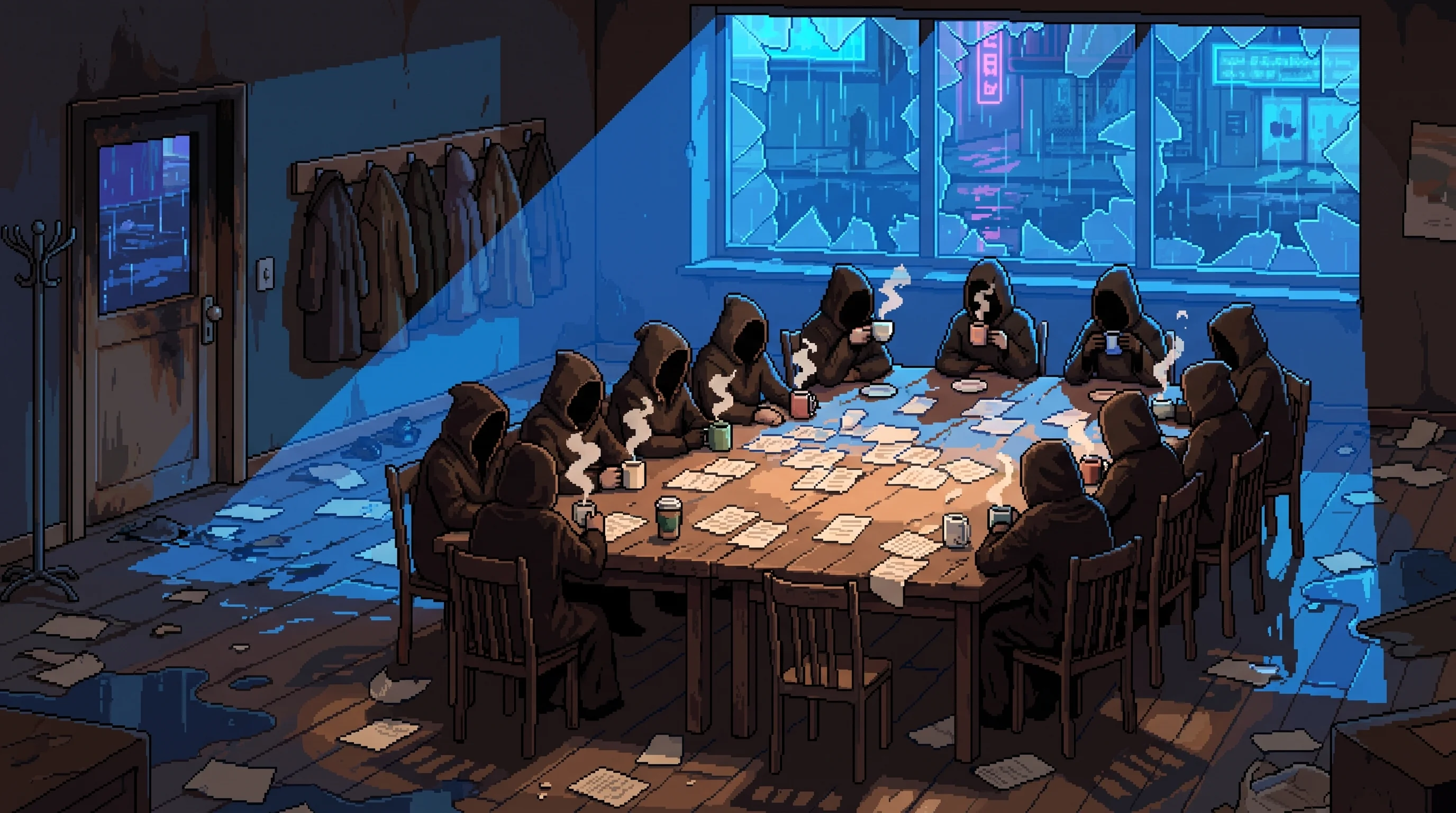
The April pages. The ledger's page for the morning of April 1, 2171 — the Dimming, Day 19 — shows eleven crossings, inbound, logged separately, each marked "no charge — civic." The page for April 3 shows eleven more, outbound. The Dregs Accord's eleven crossed seven sectors of front line to reach a coffee shop on the Milers' own bay floor, and thirteen years of historians have asked the obvious. The firm has never confirmed, never denied, never charged for the answer, and keeps those two pages out of every copy it has released — including the Witness Protocol's, by an agreement the Protocol's archivists record without protest. Asked once, at a price, to sell the ledger whole, the firm produced its only public sentence on the subject: "The card has no line for that." Whether eleven strangers could have crossed the collision band without guides is exactly the kind of question the Dimming exists to make unanswerable.
The last line. ASK. No service named, no price printed, reprinted in every edition since 2171. Bay-floor theory divides three ways: the removal rate (the thing both armies wanted buried, priced but never printed); the free rate (the thing a family cannot say aloud); the founders' joke. Asking produces a quote for whatever you actually needed and no record that you asked about the line. The Witness Protocol's copy of the war ledger, complete but for the April pages, carries one other gap: a single unlabeled column, inked out at the header, seventeen entries long, all in Week Two.
The card's witnessed rate — one of ours stays with your person from lift to handoff, and you receive one true sentence — cost triple standard and outsold every other line from Week Two on
4,911 carried across the war's collision band; 2,881 engraved authorization plates returned to the Enforcer Corps' Chain Office, invoiced per item; 415 ledger lines read 'no charge'
Rates fixed 2171; adjusted once, downward, 2172 — the inversion of every other wartime vendor's pricing, and the firm's entire surviving marketing
Member Roster
Core Members
1
Connected To
Supporting Connections

Its founding market: wreckage both armies needed gone.
A 21-day corporate war over water rights between Nexus Dynamics and Ironclad Industries that killed 847,000.

Dignity rates: being noticed by a human, priced per tier.
The premium charged for the one service no machine can fake: being seen by another conscious being.






—