The Heap
Overview
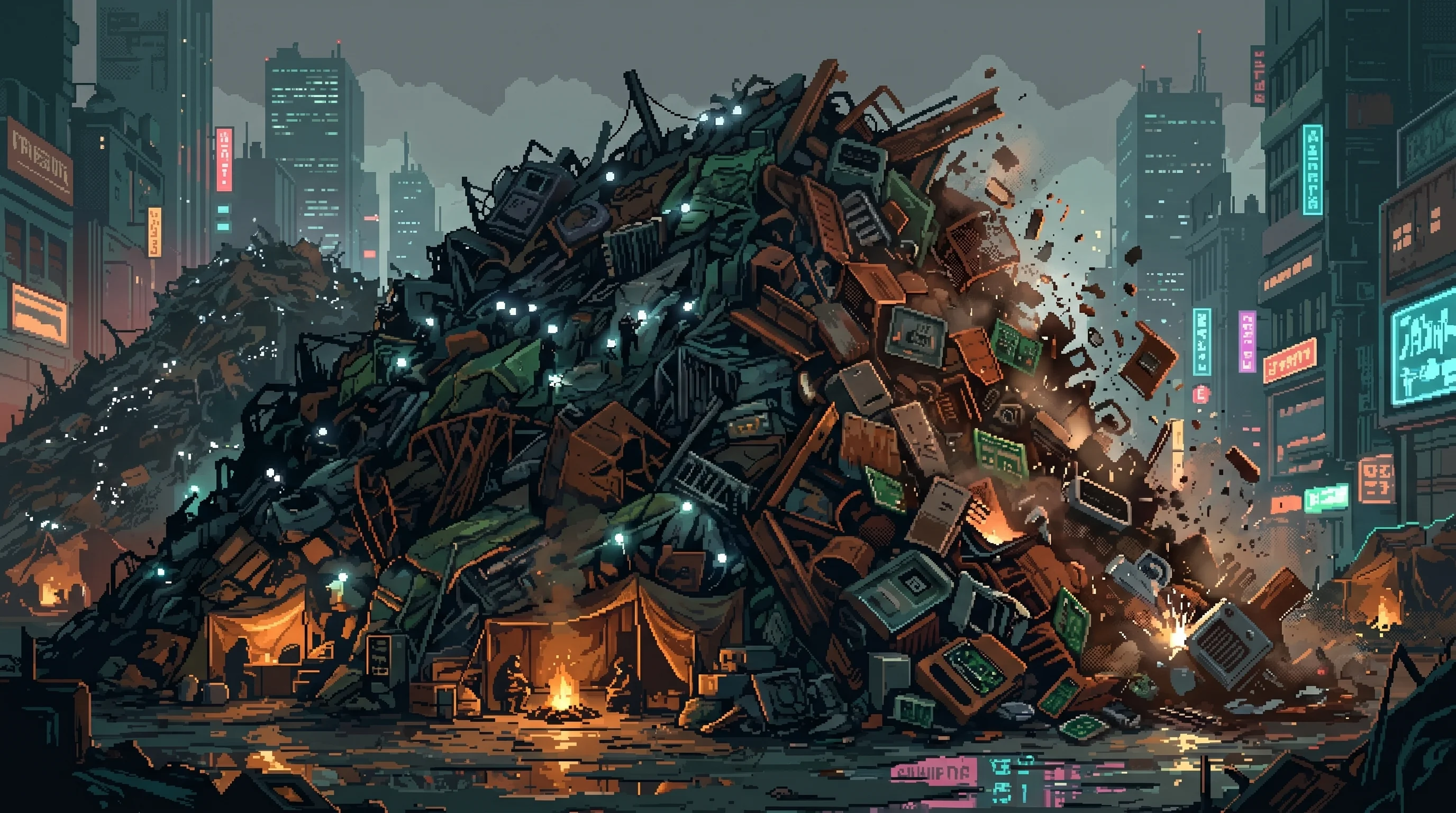
The Heap is the Deep Dregs' mine. A mountain range of waste — electronics, construction debris, industrial castoffs, organic refuse — accumulated over decades of Ironclad disposal contracts, occupying the contested ground between Sector 9 and the Industrial Margin. At its highest points it rises above the surrounding structures, a skyline of garbage visible from across the subsector.
Ironclad cargo transports dump their loads on a schedule as reliable as sunrise. The loads arrive unsorted. Circuit boards tangled with structural steel. Consumer electronics buried in industrial sludge. Sealed containers whose contents are anybody's guess and whose hazard markings have been removed with a consistency that suggests policy rather than accident.
The salvage economy treats the Heap as a shared resource. Claim crews stake slopes. Freelancers work the fresh dumps. Corporate recovery teams arrive periodically with manifests and authorization codes to reclaim specific items that were discarded by mistake — a category that expands noticeably whenever commodity prices shift. These competing interests produce violence on a weekly basis and coexistence on a daily one.
Raw materials flow from the Heap's slopes to Sump Row's smelters, to repair shops across the Dregs, to the Pit's market stalls. Ironclad's waste contracts generate the supply. The Dregs' desperation generates the labor. The gap between what corporations discard and what people need is the margin that 180,000 residents survive on.
Ironclad's Q3 2183 sustainability report describes the Heap as a "community-integrated recycling partnership." The report's metrics track tons processed. They do not track the people doing the processing. The omission is consistent across seven years of quarterly filings. Community-integrated recycling partnerships do not, apparently, have injury rates.

Conditions Report
The smell hits first. Burnt plastic as a baseline, chemical volatiles that make the eyes water, organic decomposition that nobody traces to its source. Underneath it all, the metallic tang of oxidizing electronics that veterans call "the taste of money." Fresh dumps add their own signature — last Tuesday's Ironclad load introduced a sulfur note that lingered for three days and sent fourteen workers to the base camp med station. The med station logged the visits as "environmental exposure, routine." Fourteen in one day is routine.
The sound never stops. Metal on metal. Casings cracking open. Portable cutting tools whining at frequencies that bypass even good ear protection. Crews shouting coordination on slopes where a wrong step starts an avalanche. Ironclad transports arrive with a rumble that experienced salvagers feel through their boots before they hear it — the vibration travels through the debris pile faster than the sound travels through the Dregs' thick air. Between shifts, in the early morning hours, the Heap creaks and settles. Internal compression shifting mass in ways that veterans monitor the way sailors monitor weather. A deep groan from the eastern face means load redistribution. A high crack means a void collapse. Silence means run.
The terrain requires a specific gait: feet wide, weight distributed, testing each step before committing. The surface is a layer of small debris over larger structural elements, with voids and cavities that open without warning. Collapses kill more workers than violence does, by a ratio that the claim crews track informally and that Ironclad does not track at all. Experienced salvagers work in pairs: one digging, one watching the slope above. This is called the buddy system. It is survival math. Solo workers are either new, desperate, or both. The Heap does not distinguish between categories.
The upper slopes receive more natural light than anywhere else in Sector 9. The Dregs' most dangerous working environment is also its most sunlit. At night, salvage crews work by headlamp — constellations of moving light crawling across the surface like luminescent insects. The camps at the base glow with jury-rigged lighting powered by whatever the day's haul produced. Some nights the whole Heap is visible from the Deep Dregs' main corridor, a dark mass dotted with moving points of light, and it looks almost beautiful if you don't know what you're looking at.
| Stratum | Dregs |
|---|---|
| Power Position | Below |
| Access | Public |
| Atmosphere | Dangerous |
The Economy of Knowing
The Heap feeds every economy in the Dregs. Without it, Sector 9 starves. Everyone knows this. The knowledge has a specific weight.
A salvager named Fen — seventeen years on the eastern slopes, claim crew leader, missing two fingers on the left hand from a collapse in 2179 — was asked by a Sprawl journalist what he'd do if the waste stopped coming. He thought about it for four seconds. "Pray it doesn't," he said. Then he went back to sorting circuit boards from a load that Ironclad's sustainability report would describe as "responsibly diverted from landfill."
The dependency is circular and everyone inside it can diagram it. The Dregs depends on the Heap. The Heap depends on Ironclad's waste contracts. Ironclad depends on the Dregs to process waste cheaply enough that recycling infrastructure never becomes cost-justified. The salvagers' efficiency at extracting value from garbage is precisely what ensures the garbage keeps coming instead of a better system replacing it. If they were worse at their jobs, automation might be worth the investment. Because they are good — because Fen can strip a circuit board faster than Ironclad's own sorting bots at one-fiftieth the operating cost — the human solution remains economically optimal.
Ironclad's internal cost models, leaked in the 2182 Sprawl Press investigation, show the math explicitly: automated waste processing for the Heap's volume would cost 2.3 million credits annually. Current cost via the salvage economy: approximately 40,000 credits in equipment maintenance and transport fuel. The difference is subsidized by people who cannot afford to stop subsidizing it.
This is the cheaper hand in its purest, most voluntary-looking form. There is no berth, no ship's intelligence reading the next task in a flat tone, no lien explicitly chaining anyone to the slopes — just a market that has independently discovered the same substitution curve Project ATLAS computes in its containment chamber. Below a certain wage, a human body out-competes any actuator a corporation can amortize, and the Heap's salvagers live on the wrong side of that line by the thousand. Fen does not know the curve has a name. He does not need to. He is the curve, made flesh, sorting circuit boards at one-fiftieth the cost of the bots that would replace him — and that is exactly why the bots never will. The arithmetic ATLAS performs in crystal, the Heap performs in calluses. The conclusion is identical.
The salvagers who dig through this waste — sorting by hand what machines assembled by algorithm — perform automation's inversion. Human labor extracting residual value from the endpoint of machine production. Every circuit board in the pile was manufactured by machines, used by people who couldn't afford to repair it, and discarded by a system that produces replacements faster than it produces repair capacity. The Heap grows by an estimated 200 tons per week. It has not shrunk in any quarter since monitoring began.
~3,000 permanent camp residents, ~8,000 daily workers
The Ground Truth
At the bottom of the Sprawl, the Heap runs the Perception Gap in its crudest, most honest form — and the honesty is what makes the Heap dangerous to the loop above it.
The corporate version of the Gap is in Ironclad's sustainability report: "community-integrated recycling partnership," tons processed tracked, the people doing the processing omitted, injury rates that do not exist because the column does not exist. That is the corporate dashboard — a metric that reports success by leaving out the cost. But the salvagers themselves cannot run a Perception Gap, because the Heap does not permit one. When the eastern face groans, you do not consult a confidence index. A deep groan means load redistribution. A high crack means a void collapse. Silence means run. There is no dashboard between a salvager and the slope, and a dashboard that lied would get you killed before lunch.
Fen — seventeen years on the eastern slopes, two fingers gone to the 2179 collapse — answers what he'd do if the waste stopped with four seconds of thought and "pray it doesn't," then goes back to stripping a circuit board faster than Ironclad's own sorting bots at one-fiftieth the cost. That is the constellation's ground truth: Fen's productivity is measured by whether the board is clean and whether he is still breathing, not by an AI's account of his output. This is precisely the unaugmented baseline the corporate offices above retired — the comparison case the Last Exam would have needed and Nexus eliminated. The Heap is what the corporate dashboard would read if it ever had to be measured against the ground. The offices report rising productivity into a closed loop. The Heap reports a clean board, a groaning slope, and fourteen fatalities this quarter, nine of them logged as "terrain-related." Only one of those two reports was checked by the world.
Ironclad cargo transports dump loads on a regular schedule
Faction Presence
Ironclad Industries feeds the Heap and maintains nominal jurisdiction. In practice, Ironclad's interest extends exactly to two things: ensuring the waste gets processed and recovering items that were discarded by mistake. Recovery teams arrive with manifests, extract their targets, and leave. They do not interfere with the salvage economy unless a salvager has found something that was supposed to stay corporate property. The definition of "corporate property" shifts. After the Q2 2183 rare-earth price spike, recovery manifests expanded by 340%. Crews that had been pulling and selling tantalum capacitors for years discovered, overnight, that their inventory was reclassified as "erroneously divested Ironclad assets." The reclassification was retroactive. The compensation was not.
Claim crews are the Heap's actual governance. Informal teams of 10-30 salvagers who stake territory on specific slopes and defend it through reputation, alliance, and when necessary, violence. The largest crews control the fresh dump zones. Smaller crews and freelancers work the older sections where the easy finds have been stripped. Territory disputes follow unwritten protocol: warnings, posturing, property damage, then physical violence. Deaths happen. They're bad for business. The crews know it.
The Collective maintains quiet presence among the Heap's workers, identifying talented salvagers for recruitment and monitoring for unusual finds. The Heap occasionally produces items that shouldn't exist in a corporate waste stream — pre-Cascade technology, ORACLE-era components, hardware with classification markings that Ironclad's disposal process should have caught. The Collective wants to know about these before Ironclad's recovery teams do. Whether they always succeed is a question the recovery teams' expanding manifests may partially answer.
At its highest points, the Heap rises above surrounding structures
Affiliated Entities
| Entity | Relationship |
|---|---|
| The Deep Dregs | The Dregs' largest salvage source; raw materials flow from the Heap into every sector's economy |
| The Industrial Margin | The Heap's eastern face borders the Industrial Margin; heavier industrial waste accumulates on that side |
| Ironclad Industries | Ironclad waste contracts feed the Heap; they claim jurisdiction but exercise it selectively — and expand the definition of "jurisdiction" when commodity prices rise |
| Sump Row | Salvage from the Heap flows to Sump Row for smelting and material extraction |
| The Collective | Monitors the Heap for pre-Cascade technology and recruits from the salvage workforce |
Restricted Access
The Deep Strata: Below the surface layers that daily crews work, the Heap's interior contains material dating back decades — pre-Cascade in places. Salvagers who have dug past the fifteen-meter mark report finding items that don't match any known Ironclad disposal manifest: medical equipment with Helix Biotech serial numbers filed off, data storage units that are warm to the touch despite being buried for years, and on three separate occasions, sealed containers marked with symbols that match no corporate logo in any public database. The claim crews that control these deeper sections charge access fees and enforce strict information discipline about what comes out. Some of it reaches Sump Row. Some of it doesn't. Of the three crews that found the marked containers, two subsequently disbanded; the third's leadership declined further comment after a visit from individuals described as wearing civilian clothes with Ironclad-adjacent equipment. No connection has been established. The timing is noted.
The Growth Rate: The Heap has grown 12% faster than Ironclad's disclosed disposal volume would account for over the past three years. Either the transports are carrying more than their manifests declare, or something else is contributing material. Workers on the eastern face — the Industrial Margin side — report dump events that don't correspond to the Ironclad transport schedule. These dumps arrive at night, from vehicles without Ironclad markings. The material is different: less electronic waste, more biological containment packaging. At least one Collective operative has documented the loads; the containment packaging does not match any of Ironclad's known waste streams, but it does match specifications associated with Helix Biotech's clinical-trial program — formally terminated in 2180. Formally terminated programs do not, apparently, stop generating waste. Nobody has filed a formal report. Filing a formal report would require identifying which authority has jurisdiction, and the Heap's jurisdictional ambiguity — the same ambiguity that lets the salvage economy operate — also ensures that unauthorized dumping has no one to be reported to. Two Ironclad mid-level logistics managers flagged the growth discrepancy upward in 2181. Neither received a response. Both remain employed — which is described as reassuring by the people who find that reassuring.
Residents know the feasibility study exists; they understand not that they were forgotten, but that someone ran the numbers and chose this
Connected To
Major Connections

The work the machines won't take: a mountain of Ironclad's discard, mined by hand for parts nobody makes anymore.
Automation ended most human work, but ownership hoards its abundance while machine sentience stays unresolved.

A mountain of Ironclad's discarded disposal contracts, mined by hand for the parts nobody manufactures anymore.
Upgrades rewire users until baseline feels disabling, removal risks catastrophe, and each version demands the next.



Local Intelligence Scan
Nearby Signals
CANONICAL PROXIMITY





Environmental Readout
LIVE CONDITIONS- Air
- Toxic
- Light
- Canyon dark
- Flood
- Seasonal
- Heat
- Trapped
- Security posture
- Ungoverned
- Infrastructure
- Improvised
Position Data
SECONDARY- Elevation band
- sub-sprawl
- Lattice fix
- E+4.3 · N+2.7
—