The Scour Charge
The scour charge is a shaped-EMP munition manufactured by Ironclad 2169–2171 and used at scale exactly once — the Data Purge; 1,206 were produced, 341 expended, and the remainder have been unaccounted for since the treaty
Overview
The scour charge is the Three-Week War's signature munition: a shaped electromagnetic-pulse weapon, Ironclad-built, that erases rather than destroys. Used at scale exactly once — the Day 13 Data Purge — it left three research districts physically pristine and informationally void, including the systems that managed medicine and the systems that counted the dead. Production halted under the treaty nine days later. Of 1,206 manufactured, 341 were expended; the remainder have been unaccounted for since, which is the polite tense for distributed.
How It Works
A scour charge is a single-use flux-compression device wrapped in a shaping mantle: detonation — the word survives from conventional ordnance, inaccurately — collapses a charged coil assembly and emits the resulting electromagnetic event through a directional aperture rather than a sphere. The footprint is roughly conical, four hundred meters at base focus. Inside it, unshielded electronics end: circuits die at the junction level, storage media wipe past recovery, and active processes simply cease mid-instruction. There is no blast, no heat signature worth the name, no fire. Shielded systems survive; the war taught the Sprawl, at enormous tuition, exactly which systems anyone had bothered to shield.
Technical Brief
A scour charge does not burn, breach, or blast. Detonated — the word survives from conventional ordnance, inaccurately — it delivers a shaped electromagnetic event across a roughly conical footprint, four hundred meters at base focus, that ends every unshielded electronic process inside it. Circuits die. Storage wipes. Data evaporates without residue, ash, or the decency of wreckage. The morning after the Data Purge, the three struck districts were physically pristine. That was the horror the Sprawl took longest to metabolize: the districts looked fine. They had simply been forgotten by their own machines, comprehensively, including the machines that managed medicine, and the machines that counted the dead.
Ironclad Industries' munitions division built 1,206 between 2169 and 2171 — a production run that began two years before the war it was used in, a chronology both corporations have declined to discuss under oath. Three hundred forty-one were expended on Day 13. The treaty's infrastructure-neutrality umbrella made the weapon's only economical targets illegal nine days later, halting production without ever naming the product. The remaining inventory — 865 units by subtraction, a number that appears in no official document precisely because subtraction is not deniable — has spent thirteen years being nowhere.
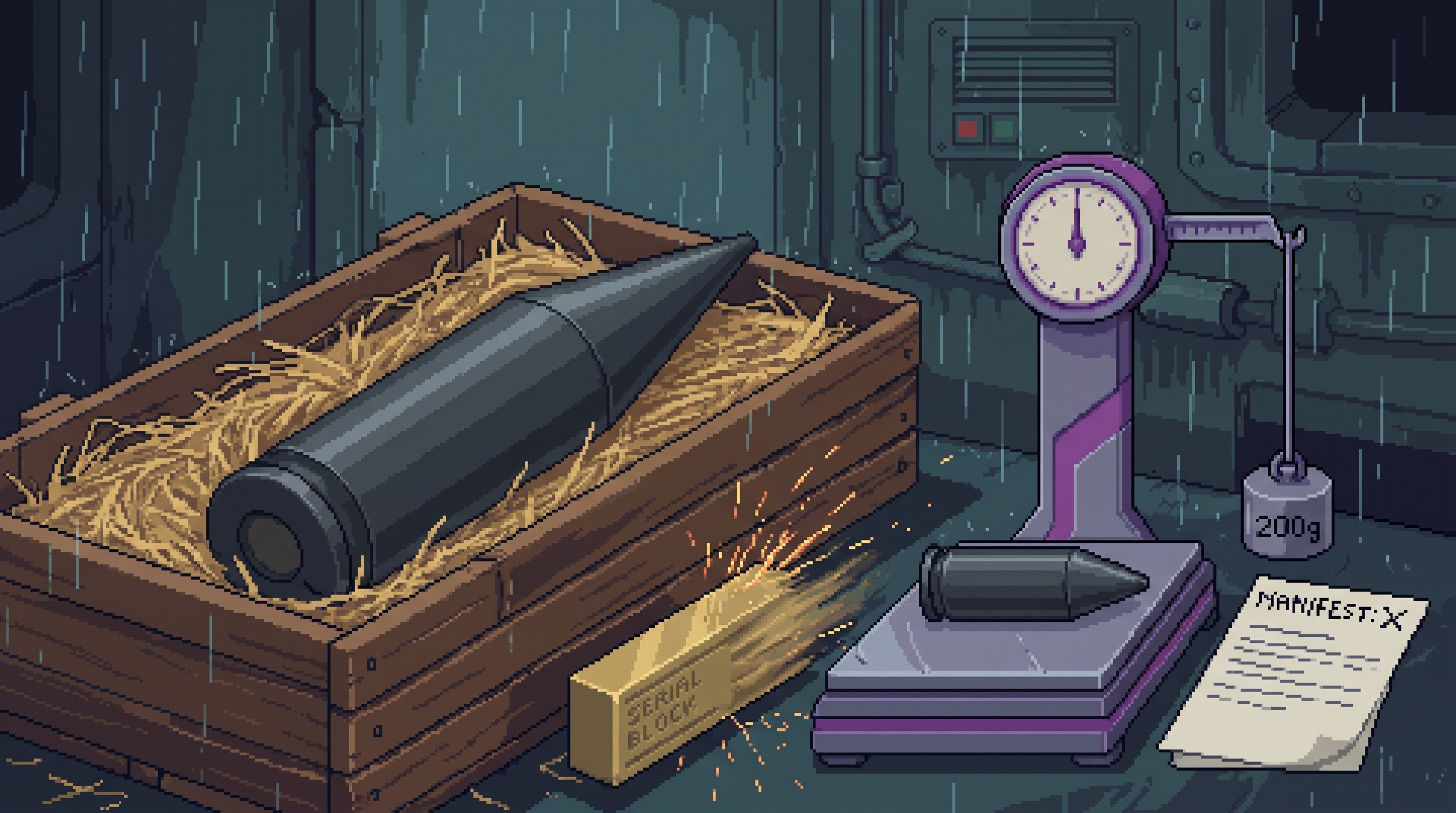
Which is to say: it is somewhere, in the specific way unaccounted ordnance always is. Inert training casings circulate as legal salvage. Live units are distinguishable only by mass and by a serial block that recovered examples have invariably had ground off — the grinding itself a signature, since only one original owner benefits from unprovenance. The trade calls them erasers. Raz Demetriou's no-questions policy has met its hardest cases here; the honest salvage market's working rule is casings yes, mass discrepancies no, and the dishonest market's working rule is the price.
| Type | Shaped electromagnetic-pulse munition — directional, no blast, no fire |
|---|---|
| Manufacturer | Ironclad Industries munitions division, 2169–2171 |
Implications
In the Forgetting Wars' taxonomy the eraser is the only industrial-grade weapon — every other combatant edits records; the charge edits the substrate. It is the reason the Sprawl's paranoia about its own memory has hardware underneath it. Every hardened archive, every paper-chart ward practice, every Ugly Build air gap is sized against a weapon that officially stopped existing in 2171 and unofficially exists in 865 places at once. Security services on all sides quietly maintain eraser-recovery desks; the desks quietly maintain each other's phone numbers; and once every year or two a warehouse fire somewhere on the flats burns strangely cold and electromagnetic, and every desk closes one number off its list, and nobody files anything.
Possession is unregulated because regulating it would require a signatory to admit the category exists; the salvage trade calls them 'erasers' and prices them accordingly
A scour charge's shaped footprint is roughly conical, 400 meters at base focus — the Ugly Build's air-gap distances match it to the meter, which is the closest either corporation has come to publishing the specification
Connected To
Supporting Connections

Built 1,206; fired 341; accounts for neither difference nor rest.
The megacorporation that controls the Sprawl's physical infrastructure — steel, concrete, and the Orbital Elevator.

The Day 13 munition — eleven minutes, three districts.
Ironclad's Day 13 EMP strike on three research districts — the toll uncounted because the counters died too.

In a civilization of total memory, the bomb that forgets.
Nothing expires, so forgetting became a service — and forgiveness a question the archive keeps answering no.



—