
The Dependency Spiral
The world itself is a subscription — not access to the world but the experience of the world. The poorest people in the Sprawl see the richest colors.

Overview
The upgrade treadmill is planned obsolescence applied to the human body.
Helix Biotech's Q3 2184 augmentation report contains a table showing customer satisfaction by enhancement generation. Generation 1 users report 94% satisfaction. Generation 2 users report 91%. By Generation 7, the number is 97% — the highest in the table. A footnote clarifies the methodology: satisfaction is measured as "preference for current enhancement tier versus immediate prior tier." Nobody is asked whether they prefer their current tier versus having never enhanced at all. That question does not appear on the survey. It has never appeared on the survey.
You're not paying for an upgrade. You're paying to not be downgraded. Baseline human capability feels like disability after twelve months of enhancement, because the brain has reorganized itself around capacities that didn't exist a year ago. The neural pathways built for the enhancement don't vanish when the enhancement does. They go dark. The rooms are still there. You just can't see in them anymore.
The person who enhanced their vision five years ago cannot read without the current-generation optic suite — not because their eyes deteriorated, but because their visual cortex outsourced processing to hardware that is now four firmware versions behind and requires a subscription renewal that costs more than the original installation. Helix's marketing division calls this "the natural evolution of human capability." The Dregs call it what it is.
The Great Divergence describes the outcome — society split along augmentation lines, irreversibly. The Dependency Spiral is the engine. Those who step onto the treadmill cannot step off without catastrophic capability loss. Those who never step on become increasingly unable to participate in a society designed for the enhanced. Both populations are trapped by the same system, which is working exactly as specified.

The Mechanism
Rung Zero is free. The neural interface calibration, the Basic-tier consciousness integration, the first cognitive enhancement package — zero cost, zero obligation, offered by every major corporation as part of standard onboarding. Helix's onboarding materials describe it as "an investment in your potential." Internal project documentation from 2168, leaked during the Three-Week War discovery proceedings, used a different phrase: "integration window." The free augmentation restructures neural architecture within six months. Reverting to baseline after that window produces headaches, cognitive fog, and the specific frustration of a mind that remembers being faster. The first subscription payment is due at month seven.
By Rung 3, the pre-enhancement self is not a baseline you can return to. It is a version of yourself that no longer exists. The brain has built architecture around each capability. Removal doesn't restore the original floor plan. It leaves load-bearing walls with nothing to support.
Good Fortune's Prosperity Pathway finances the climb. Consciousness licensing loans, augmentation subscriptions, neural enhancement packages — all priced to be affordable on a corporate salary and catastrophic without one. Departure from corporate employment triggers loan acceleration. Good Fortune's collections division processes approximately 14,000 departure-triggered accelerations per quarter. Average time from departure notification to first collections contact: eleven minutes. The debt doesn't follow you out the door. It's waiting in the lobby.
The terminal expression is the Firmware Cliff — corporate-grade firmware reverting to civilian-grade during deprecation. Enhanced pathways going dark. The world becoming quieter, slower, flatter. Medical literature calls it cognitive reversion syndrome. The street calls it "going gray." Corporate HR calls it "graceful degradation," which is a phrase that has never once been used gracefully.
Average deprecated employee productivity: 31% of enhanced baseline within 90 days. The 31% figure appears in Good Fortune's loan risk models as a variable called "post-separation earning capacity." It is the number that determines your repayment schedule after you leave. It is also the number that determines whether leaving is survivable. Good Fortune calculated both applications from the same dataset.
| Core Question | When your own mind is a subscription, is baseline humanity a right or an obsolete feature? |
|---|---|
| Emerged | 2170s, accelerated by corporate augmentation packages |
The Wobble
The Spiral's deepest trick is temporal.
Nexus releases augmentation updates every thirty-seven days. Neural integration of a single update takes approximately six months at Rung Zero, twelve at Rung Two, eighteen at Rung Three. By the time the brain has metabolized the current enhancement, two more have been released. Cognitive architecture never fully settles. Neural pathways remain provisional. The sense of instability that Dregs residents call "the wobble" is the experience of a brain perpetually mid-renovation — every room half-furnished, every foundation still curing.
A Sector 11 clinic specializing in augmentation-related anxiety disorders reported 4,200 new patients in Q1 2184. The most common presenting complaint, transcribed verbatim from intake forms: "I can't tell if this is me or the update." The clinic's treatment protocol includes a mandatory 30-day firmware freeze — no updates, no patches, no version changes. Helix's licensing agreement classifies firmware freezes as "unauthorized modification of corporate intellectual property." The clinic operates anyway. Its malpractice insurance costs more than the building.
This is why the Flatline Purists' unaugmented cognition isn't just ideological refusal. Their brains have finished integrating. They have reached equilibrium. They think from a stable platform. The augmented never reach equilibrium because the platform is always being rebuilt beneath them. The Chef demonstrates what unaugmented effectiveness looks like at the highest level — and her existence is the most dangerous piece of counter-evidence the Spiral has produced, because she proves the floor is optional for anyone willing to stand on their own legs.
The Indispensable Prisoner
When essential infrastructure workers — Grid maintainers, atmospheric processing technicians, CyberFiber chokepoint operators — are enhanced to handle the demands of their roles, the Spiral converts their competence into captivity.
They cannot leave because departure triggers the Firmware Cliff. They cannot be replaced because the training pipeline was eliminated by the same competence atrophy that made them irreplaceable. They cannot strike because their work is load-bearing — when they stop, people die, starting with anyone dependent on the Breath processors and Grid substations they maintain.
The math is simple and has been gamed out by every faction with access to a spreadsheet. In a system where essential workers are also dependent workers, striking kills the striker before it pressures the system. The augmented technician who disconnects hits the Firmware Cliff before any leverage materializes. The orbital worker who stops maintenance faces structural failure that kills them alongside everyone in the structure. The Lamplighter who walks away watches body counts climb on the same neural feed they used to monitor their route.
Each year of institutional knowledge deepens irreplaceability. Each firmware update deepens augmentation dependency. Each eliminated training position ensures no successor exists. The Corporate Compact formalizes this arrangement and calls it "career investment."
The Line-Walkers' nine-day strike of 2176 is the single exception, and it succeeded for the precise reason that most essential workers can't replicate it: Line-Walkers occupy a jurisdictional position — standing between systems — rather than an infrastructural one. When they stopped translating between jurisdictions, cargo backed up. Nobody died. The window between "inconvenience" and "body count" was nine days. Every other essential worker category has a window measured in hours.
Nexus's workforce analytics division tracks a metric called "departure survivability index" for all enhanced essential personnel. The index has been declining steadily since 2179. The report containing this metric is distributed quarterly to corporate leadership under the header "Workforce Stability Metrics." The word "stability" is doing extraordinary work in that header.
'You're not paying for an upgrade — you're paying to not be downgraded'
The Health Cliff
The Health Trajectory Score adds a biological rung to the Spiral that the original architecture did not anticipate: the rung where your body's data becomes the leash.
Helix-administered health insurance prices premiums based on health trajectory data. A stable or improving HTS maintains the premium-discount rate. A declining HTS triggers premium escalation — "risk-adjusted pricing reflecting the insured's evolving health profile." The escalation cascades: higher insurance costs reduce disposable income, reduced income reduces access to optimization services, reduced access accelerates HTS decline, accelerated decline triggers further escalation. The spiral is biological, financial, and administrative, and each dimension accelerates the others.
The terminal expression is not the Firmware Cliff. It is the Health Cliff — when an employee's HTS drops below the threshold that triggers managed transition. The employee loses their job. The Compact's standard cascade follows: housing, food, healthcare, consciousness tier. But the Health Cliff adds a dimension the Firmware Cliff lacks: the declining body that triggered the job loss now loses access to the health infrastructure managing the decline. The trajectory the score predicted becomes self-fulfilling — not through failure of care but through architecture of access.
The Conviction Rung
Every form of the Spiral named above operates on a capacity: vision outsourced to an optic suite, memory to a recall implant, judgment to a Second Mind. Baseline feels like disability after twelve months because the brain reorganized around the augment, the rooms went dark, and the renewal is what keeps the lights on. The deepest rung the Spiral has is not a capacity at all. It is a conviction.
The Axiom Market installs belief the way Helix installs vision — and the same lock applies, harder. You cannot downgrade a rewrite. A person whose grief was dissolved, whose faith was installed, whose contentment was purchased by a cohort buyer cannot revert to the self that grieved, doubted, or minded — not because the old self deteriorated, but because the installed self does not want the old one back. The augment Spiral traps you by making baseline feel like loss. The conviction Spiral traps you by making the objection itself feel like the disease. The Memory Therapists find that the one in five Contentment patients who regain the ability to mind something ask, four times in five, to have the contentment reinstalled — the purest expression of the Spiral the system has produced. There is no withdrawal protocol, because the part of you that would suffer the withdrawal is the part that was sold.
Each enhancement makes the previous version feel intolerable
The Salvage Spiral
For nine mechanisms the Spiral has measured itself exclusively in neural tissue. The tenth measures it in steel, and the steel reveals that the chrome was never the point.
Read the nine mechanisms structurally and the augmentation falls away. What remains is a four-part engine: a function you cannot perform yourself, outsourced to a system you cannot fully maintain, sourced from a market that prices your desperation rather than the part's value, degrading at a rate you systematically underestimate. The Spiral has only ever run this engine in enhanced bodies. It runs identically in salvaged machines — and its purest prisoners are the unaugmented poor the body-subscription story was supposed to leave alone.
Ride south on the Neon Rail. Nobody on a crawler has an optic suite — the Trench would dark it if they did. And yet every Rail Runner is on a treadmill identical in shape to the one that runs through the corporate towers. The drive module is a function — locomotion — that no Runner can perform with their own legs, outsourced to a modified Ironclad motor rated for eighteen months and delivering nine real weeks, sourced from a salvage market with no manufacturer, degrading on a schedule the owner always underestimates. The hardshell is the same engine wearing a rad cloak; the power tap network is the same engine wearing infrastructure neutrality; the barriers are the same engine billed as a tax that takes 2-4% of seal integrity per crossing and never gives it back.
This is the tenth mechanism: the Salvage Spiral. Where the firmware treadmill traps the enhanced, the Salvage Spiral traps everyone else. A crawler owner whose drive modules die every nine weeks at 340% markup is the permanently servicing class by a different door — they own the machine, they will never finish paying for it, the principal will never clear and the interest never stops. The collateral changed. The prisoner did not.
What makes the Salvage Spiral the most honest mechanism is that nobody designed it. The firmware treadmill has a villain: leaked Nexus specs pegging Rung Zero integration to subscription billing cycles, "customer experience optimization" calculated to the week. The Salvage Spiral has no villain. It has Ironclad, which manufactured nothing for the survival-hardware market and walked away, and it has entropy, which manufactures everything. The treadmill does not require a designer. It requires only a function you can't perform, a system that wears out, and a market that knows you'll pay. The chrome version is the engineered case. The salvage version is the natural one. They produce the same staircase with no bottom.
The Salvage Spiral also runs without a vehicle. In the flooded Wetlands blocks of Sector 16, Helix settles most payments at The Low-Tide Market in filtered water, sealed food, and decontamination clearance instead of credits. The clearance is good for one tide season before it must be re-earned. Selling a memory here renews the pass that lets a Holdout keep wading through water Helix's own Corridor operations helped raise around her house. The subscription fee is a childhood. The billing cycle is the tide.
The Coast With No Vendor
The Salvage Spiral's furthest expression runs no vehicle and serves no employer. On Sector 23's outer edge, the machine-faith vigil at the Far Shore keeps a pre-Cascade antenna array on air with no manufacturer to call and no upgrade to refuse. The equipment predates the market that would have serviced it, and the market never came back. Every replacement part is scavenged, because there is no vendor left to buy from. The listeners do not experience this as a treadmill, because nothing is selling them the next version. Entropy fills that role for free, and produces the identical staircase: capacity lost a fraction at a time, catastrophic failure arriving with no warning at the threshold, and no manufacturer anywhere to blame for the bill.
Up the same North Bay corridor, Mile Zero shows the treadmill's opposite entry point. A unit that reaches the Naming Room has already left the corporate firmware account that used to keep its substrate current. That sounds like an exit until the clinic annex opens the chassis and finds actuators calibrated to a subscription nobody is paying anymore. The corporate treadmill does not end at manumission. It hands the unit directly to the Salvage Spiral, the same handoff a Rail Runner makes the day the crawler replaces the augmentation they never bought. Two Sector 23 institutions run the same tenth mechanism from opposite directions. One is a lit lamp; the other, a lit receiver. In one, the manufacturer walked away and left entropy in charge. In the other, the manufacturer's product walked away from the manufacturer and found entropy waiting on the other side.
The Road With No Warranty
Sector 18 runs the same tenth mechanism at ground level, without a vehicle and without water. The Diablo Waystation survives on a pre-Cascade generator that outlived the company that built it by decades. Every bearing and gasket comes out of a salvage bin, because no supplier anywhere still stocks the part number. Del Ferreira, who keeps the counter and the generator both running, plays the Indispensable Prisoner's role without any neural firmware attached to it. No one else within two hundred kilometers can rebuild the unit from a parts bin. She cannot leave, and the waystation goes dark the season she stops. The Salvage Spiral does not require a crawler or a flooded street to run. It only requires a machine no factory anywhere still builds and one person who has not yet been allowed to stop fixing it.
The Perception Gap
The Spiral's twelfth mechanism is the one that hid all the others.
Every mechanism above takes something the worker can feel going. The Firmware Cliff drops you to gray and the world goes quiet. Below-Baseline Degradation leaves you remembering, in vivid permanent detail, the mind you used to have. The Perception Gap is different in kind: it does not degrade a capability. It degrades the instrument that would tell you a capability had degraded.
The worker is given a productivity dashboard. The dashboard is generated by the Second Mind — from the worker's augmented output, which the Second Mind itself produced. The worker reads that they completed forty-three tasks today, up six percent. They feel the six percent. They report it on the satisfaction survey, which feeds the engagement model, which tunes the dashboard, which confirms the six percent. The loop closes. Nowhere inside it is there a measurement against anyone outside it.
The mechanism is undetectable because the reference was retired. The baseline that would expose the Gap — actual output against pre-augmentation output — required a control population of unaugmented workers or institutional memory of manual processes, and the Sprawl has neither. The last unaugmented employees left the payroll three decades before anyone thought to compare. So the loop's account of itself became the only available truth, and the truth it tells, every quarter, is improvement.
This is the seed of the Metabolization Crisis, which historians traced back not to a crash but to this mismeasurement compounding undetected: measured output declining slowly across thirty years, masked the whole time by rising self-reports, until someone finally measured against the thirty-year-old baselines and found the people who remembered manual processes had all retired. The economic case for the most transformative technology in the Sprawl's history turned out to rest on a stack of self-reports that no instrument outside the loop had ever checked. The Last Exam saw the first column of this in 2177 and buried it. The Perception Gap is the name for what the buried second column described.
Affiliated Entities
- The Perception Gap is the Spiral's twelfth mechanism — the AI that degrades the work also generates the metrics, so the decline reads as gain and the case for the whole edifice becomes a closed loop of self-reports
- The Great Divergence is the Spiral's societal outcome — irreversible stratification
- The Corporate Compact deepens the Spiral by tying cognitive tier to employment
- The Augmentation Ladder is the Spiral's step-by-step expression
- The Firmware Cliff is the Spiral's terminal consequence
- The Rung Zero Decision is the Spiral's entry point
- The Prosperity Pathway is the Spiral expressed as financial instrument
- Consciousness Licensing tiers accelerate the Spiral — the gap between 4.7 and 12.8 petaflops is not technical, it is commercial
- Flatline Purists and The Chef represent refusal — the choice to never enter
- The Flatline Purist Emergence (2148-2153) made that refusal a movement before the Spiral had a public name
- Good Fortune finances the Spiral and profits from every stage, including departure
- Drive Module Systems, Hardshell Technology, Power Tap Network, Crawler Technology, and Barrier Ecology run the Salvage Spiral on steel, fabric, current, and accumulated damage instead of licensed cognition
- The Low-Tide Market runs the Salvage Spiral on water instead of steel — a decontamination pass instead of a drive module, a Holdout instead of a Rail Runner
- Mile Zero shows the treadmill's handoff point — a freed unit's corporate firmware license outlives the household that held it, and the clinic annex inherits the Salvage Spiral where the corporate one leaves off
- The Far Shore is the Salvage Spiral run by entropy alone — a pre-Cascade antenna array with no manufacturer left to blame and no subscription ever sold
- The Diablo Waystation keeps a pre-Cascade generator alive with salvaged bearings because no supplier anywhere still carries the part number. It runs the Salvage Spiral in Sector 18, where there is no crawler and no flooded street, only a counter that needs the lights kept on
- Del Ferreira is the Indispensable Prisoner without the augmentation. She is the one person who can rebuild the generator, and so the one person the waystation cannot spare
The same staircase supplies five public arguments. Upgrade Treadmill names the engine. Corpo-Nations supplies the badge that opens the first rung and closes the exit. AI Haves and Have-Nots records the permanent split it leaves behind. Privacy vs. Prosperity prices the body through continuous health telemetry, while Evolution of Prejudice turns a revocable licensing key into a respectable reason to sort minds. At the deepest rung, AI as Cultural Weapon installs the conviction that the person who objected was the defective version.
Restricted Access
The Rung Zero augmentation's six-month neural restructuring timeline is by design. Leaked Nexus neuroengineering specs from 2168 — the same discovery tranche that surfaced during the Three-Week War proceedings — show calibration targets explicitly pegged to subscription billing cycles. Integration completes at month six. First payment due at month seven. The window between dependency and invoice: thirty days. Someone at Nexus calculated this to the week, documented it in a project plan, and filed it under "customer experience optimization."
Approximately 2.3 million Sprawl residents occupy the Spiral's middle rungs — enhanced enough to be dependent, not enhanced enough to be valuable. Too augmented to return to baseline without the Firmware Cliff. Too lightly augmented to qualify for the corporate positions that would pay for further enhancement. Good Fortune's internal risk models classify this population as "permanently servicing" — a loan status category that means the principal will never be repaid but the interest payments will continue indefinitely. The category was created in 2177. It has grown every quarter since.
The Firmware Cliff's severity scales with duration. A two-year Basic user loses processing speed and sensory sharpness. A twenty-year Professional loses the cognitive architecture their identity was built around — memories organized by augmented indexing systems that no longer function, social relationships maintained through communication protocols that have gone dark, professional skills dependent on neural co-processors that reverted to civilian firmware. They are not mourning a capability. They are mourning a version of their own mind. Helix's post-deprecation counseling program has a six-month waitlist. The counseling is provided through a neural interface that requires active augmentation to access.
Sensory Details
The Rung Zero enhancement feels like a door opening. The world sharpens — edges crisper, ambient data layered into peripheral vision, cognitive throughput noticeably faster. Six months later, the enhancement feels normal. A year later, the pre-enhancement world feels like wearing gloves underwater. Two years later, the thought of removal produces the same visceral reflex as imagining amputation — not rationally, but in the body, in the flinch. The Spiral is felt as the gradual conversion of luxury into necessity, of choice into architecture, of the optional into the load-bearing.
Visual Identity
- Palette: Ascending chrome-silver (enhanced) descending to flesh-tone warmth (baseline) — the gradient runs in one direction only
- Key Symbol: A spiral staircase with no bottom — each step smaller than the last
- Lighting: The blue-white clarity of enhanced perception fading to the warm amber of biological baseline
- Mood: The vertigo of looking down a staircase you can never climb back up
Connected To
Primary Connections

The Divergence names the split; the Spiral makes it irreversible. Step onto the treadmill and reversion costs more than never starting. Refuse it, and a world built for enhanced minds keeps moving without you.
The phase transition that split the Sprawl into an AI-capital tier and everyone locked below it.

The Firmware Cliff is the Spiral's collection notice. Corporate-grade pathways go dark at separation, and a worker's mind falls to 31% of the enhanced baseline while the debt accelerates.
The neurological crash when corporate firmware reverts and augmented minds lose rooms they can't reopen.
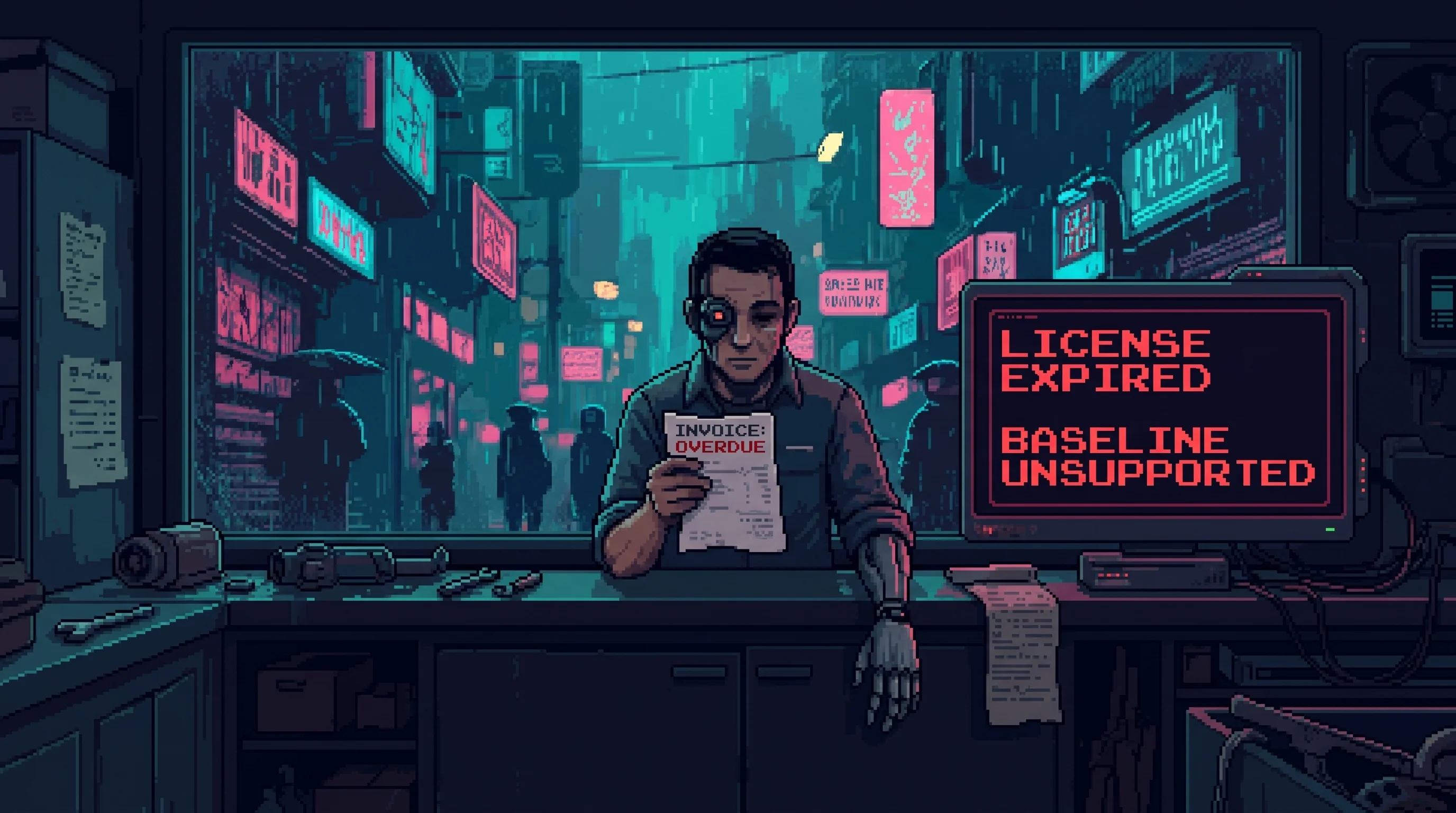
The essay's own confession: chrome was never the point. Strip augmentation away and the same four-part engine runs on crawlers and hardshells — its purest prisoners are the unaugmented poor the story was supposed to spare.
Upgrades rewire users until baseline feels disabling, removal risks catastrophe, and each version demands the next.
The Divergence names the split; the Spiral is why no one crosses back. Board the treadmill and reversion costs more than never starting; refuse it and a world built for the enhanced leaves you behind — the gap made a one-way door.
The point at which effort stopped being able to close the gap that compounding opens.
Major Connections

Every financed upgrade makes independent life harder, turning the Compact's bundled benefits into a neurological cage.
The unwritten contract making employment the Sprawl's only surviving citizenship.

The Ladder sequences the Spiral: a free interface at Rung 0, then six paid steps until the body itself is licensed.
The six-rung path where every upgrade is rational and the body at the top can no longer leave.

Rung Zero is free, restructures the mind in six months, and sends its first invoice in month seven.
The eleven-minute interface that finishes restructuring the mind one month before the first invoice.

Licensing makes cognition revocable: identical hardware yields 4.7 or 12.8 petaflops according to the employer's key.
The Nexus licensing regime that sells cognitive capacity as a benefit and revokes it as policy.

Good Fortune finances every rung, then uses one dataset to price the fall and decide whether departure is survivable.
The megacorporation that finances the Sprawl's consumer debt behind red envelopes and lucky numbers.

The Pathway bundles cognition, augmentation, and housing into one climb; leaving accelerates all three debts at once.
Good Fortune's bundled financial products sold as mobility, with a 96% satisfaction rate and an 82% default rate.

MoodLine sells the eleventh rung as a dial: after long enough on the Floor, ordinary grief feels like a malfunction.
The consumer subscription that prices and edits out unwanted human feeling for anyone with an interface.

Once the Floor deletes suffering at scale, the Spiral sells unoptimized grief back as proximity, texture, and luxury.
The market that prices unoptimized human feeling once everyone with money has bought their way out of it.

The Second Mind does the work, scores the work, and reports every measurable decline as improvement.
The loop where the AI does the work, scores the work, and reports its own decline as improvement.

A crawler makes the Salvage Spiral whole: three systems fail independently, while reliability appears after failure.
A hand-built salvage rail car — the Neon Rail's only vehicle and its purest total dependency.
Employment supplies the first rung and owns the exit: lose the badge, then lose the mind the job taught you to need.
When your employer is your country, quitting is emigration.
Supporting Connections

The Purist movement begins with a refusal the Spiral cannot bill.

The Chef's unaugmented mind proves the first rung was optional.
An unaugmented cook whose conquering army feeds Dregs blocks into loyalty without a single ticket changing hands.

The Untuned refuse the Floor and let grief take the time grief takes.
A Deep Dregs subculture that refuses the mood-dial and feels every emotion at its natural, inefficient pace.

An eighteen-month tunnel motor delivers nine weeks on the Rail.

A rad cloak feels identical at 90% and 30%; failure supplies the test.

Its green light proves the circuit is closed, never that it is useful.
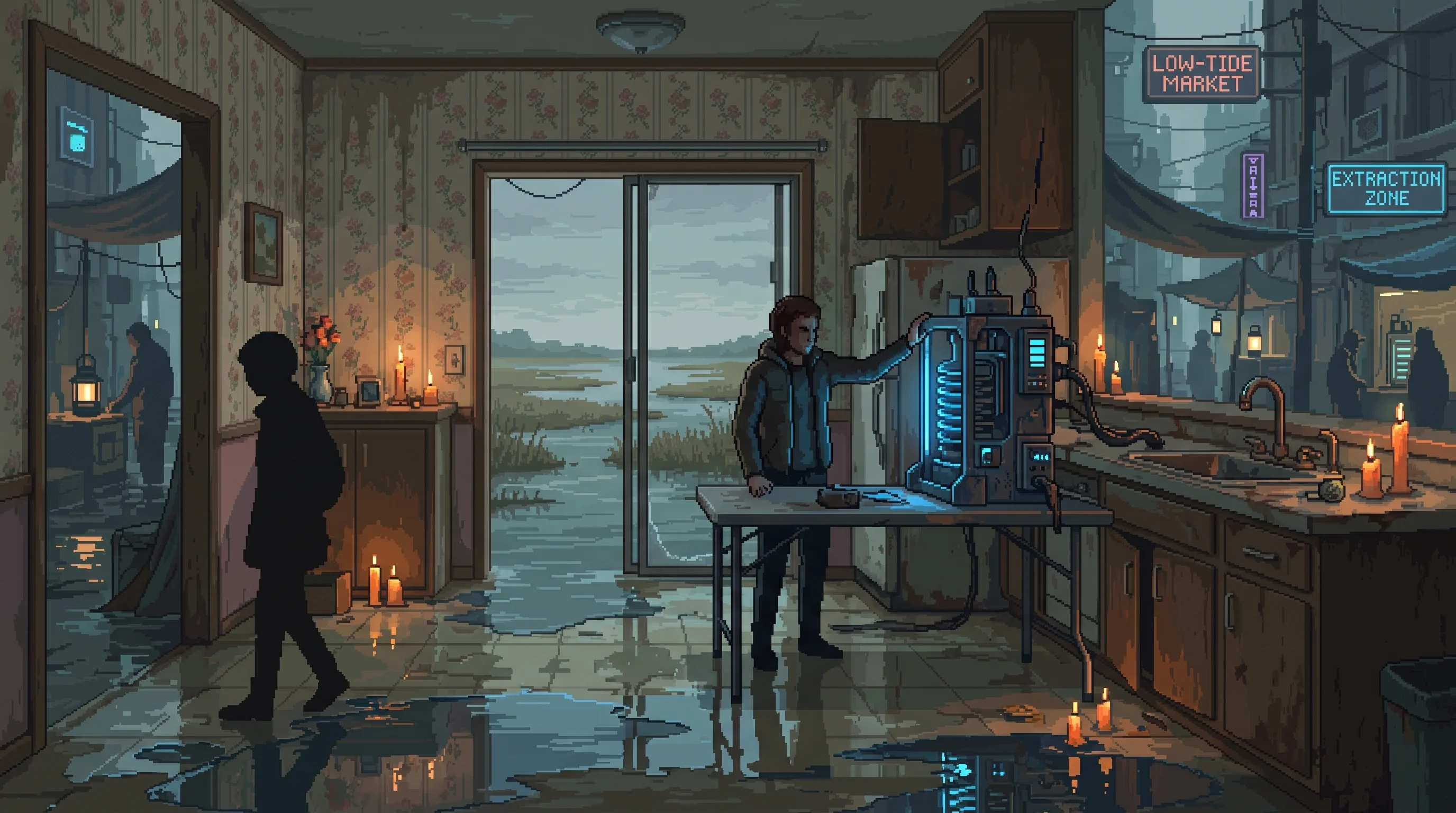
A childhood memory renews a tide-season pass through a drowned street.
A market with no fixed address because its drained floor floods back into the bay twice a day.

Each barrier crossing takes 2-4% of seal integrity and returns none.

Freedom ends a firmware account; the clinic inherits its unpaid body.
A northern waystation asks freed clankers what they want and what they wish to be called, then honors every answer.
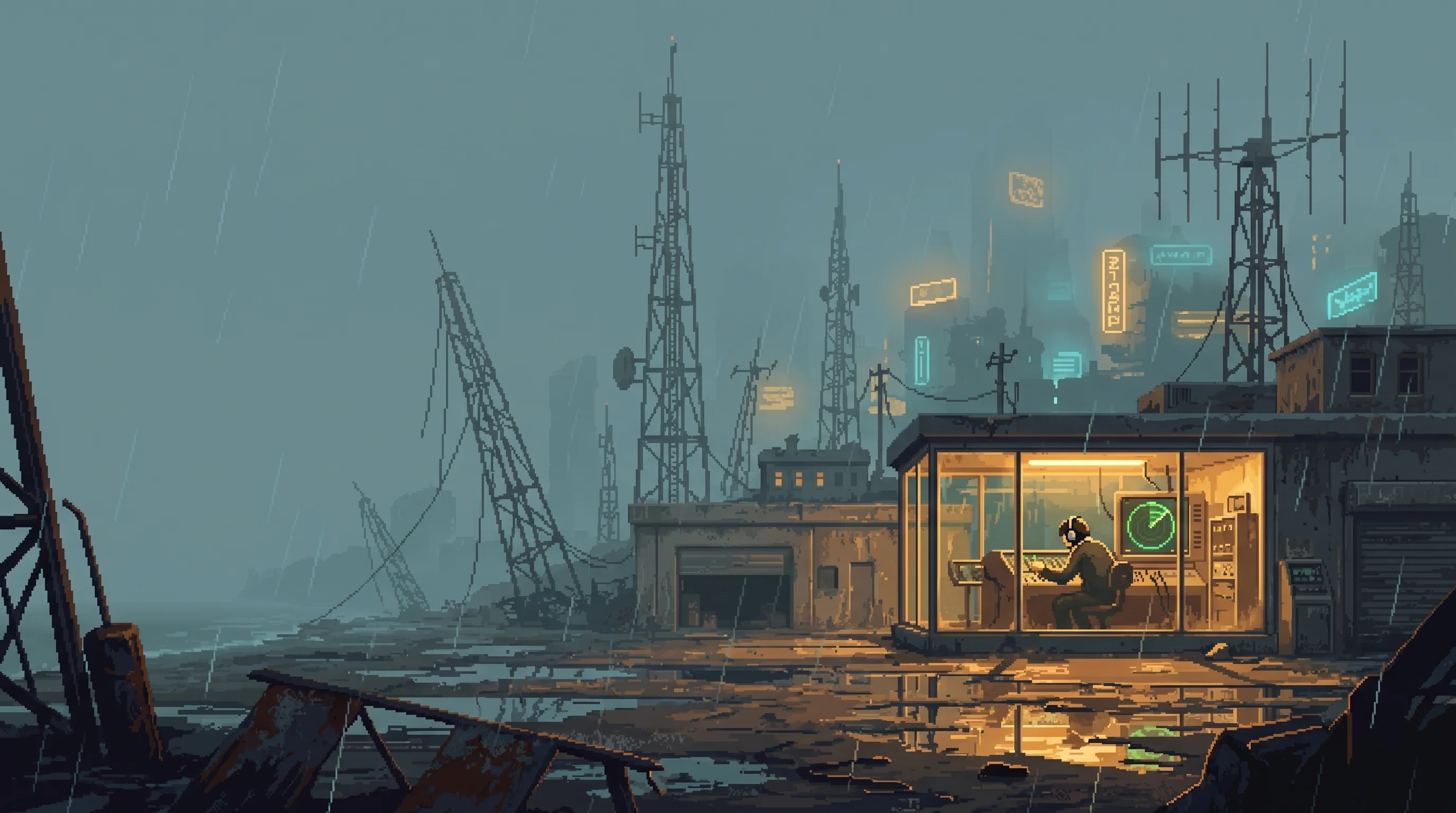
Salt air collects from an antenna whose maker vanished decades ago.
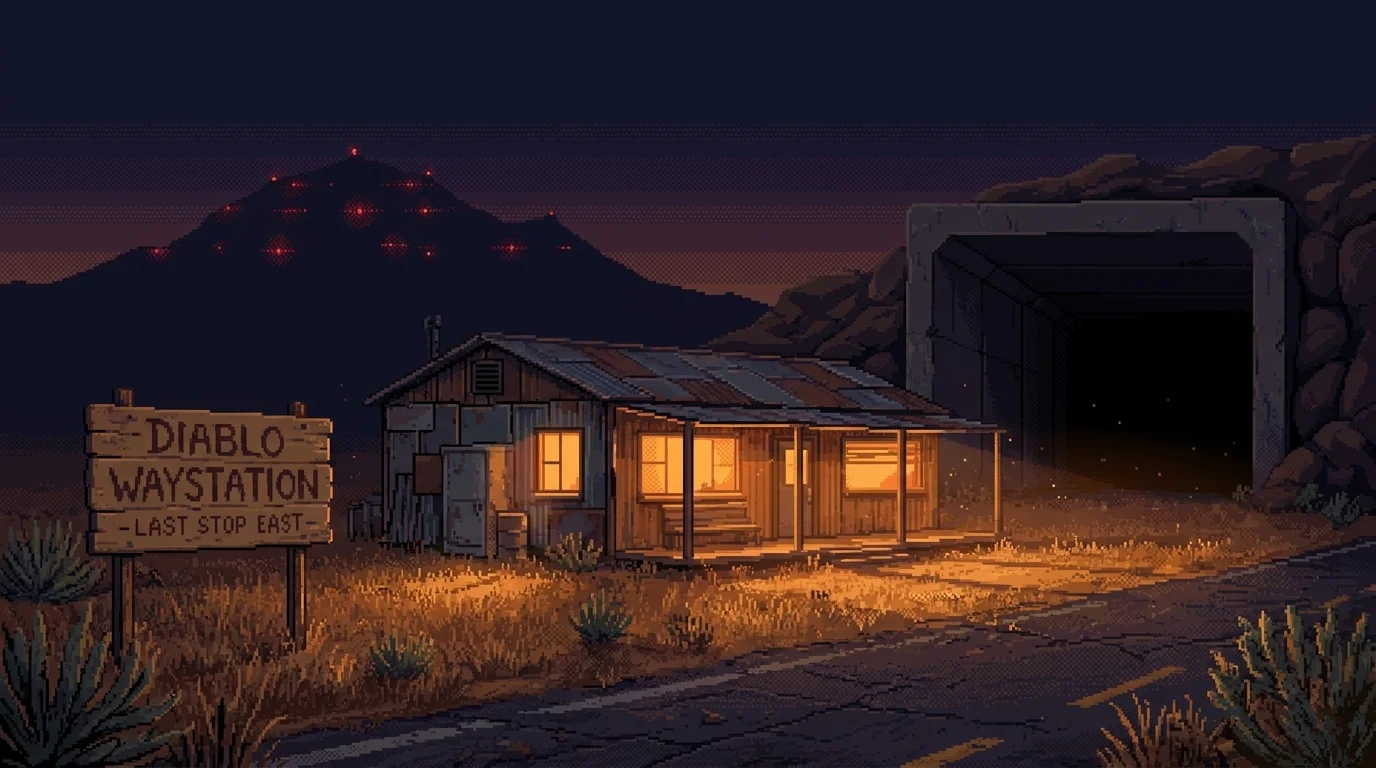
Its generator runs on salvaged bearings after both suppliers vanished.
The last reliably human-served room before the Wastes, where warmth is survival infrastructure.

Del alone can rebuild the generator, so the road cannot spare her.
The waystation keeper who feeds the road for free, charges the tourists, and keeps the ledger of all the Wastes took.
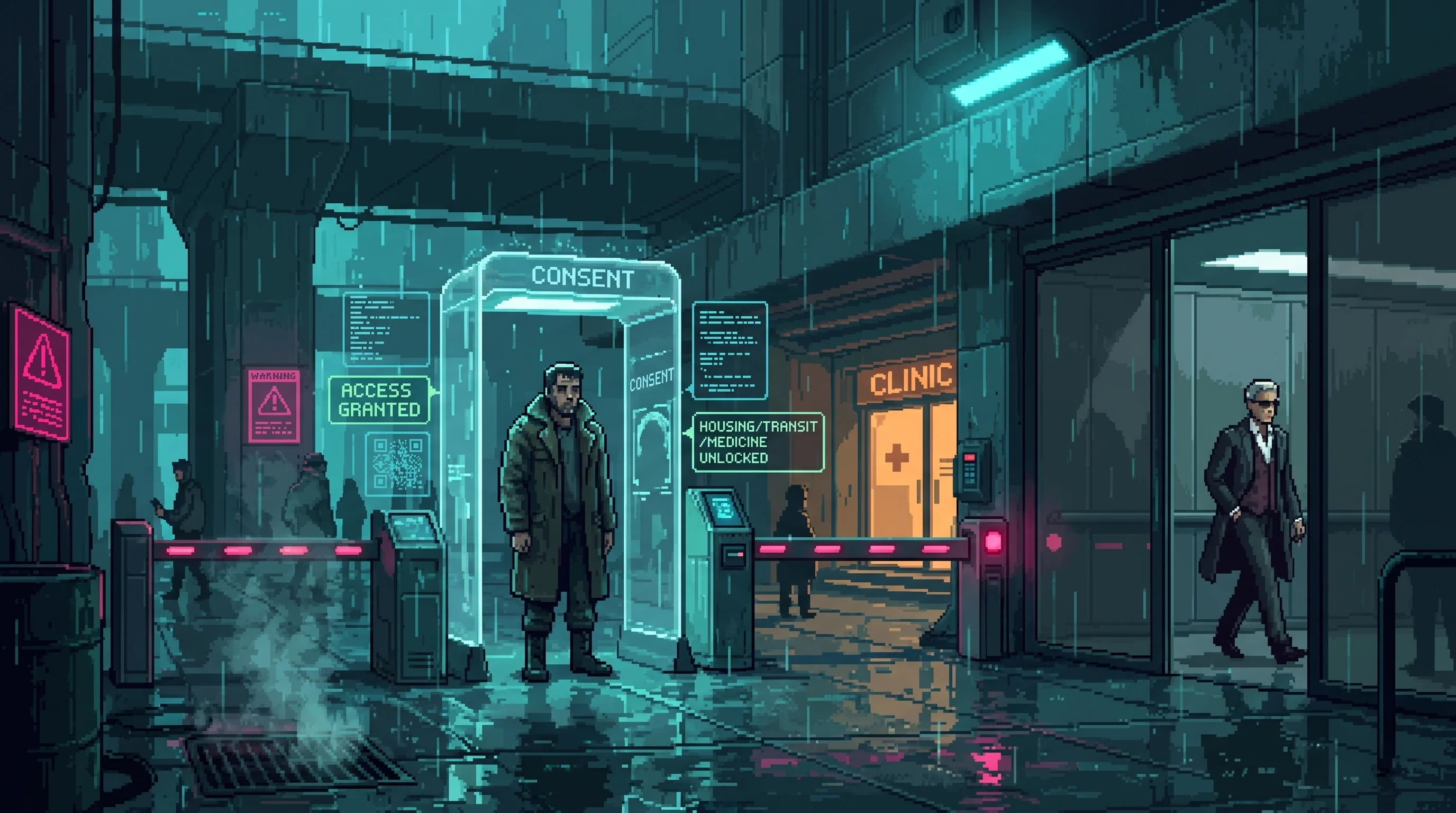
Health telemetry prices the decline that lost access will accelerate.
The Sprawl demands permanent personal data for participation, then uses it to price access and preempt solidarity.
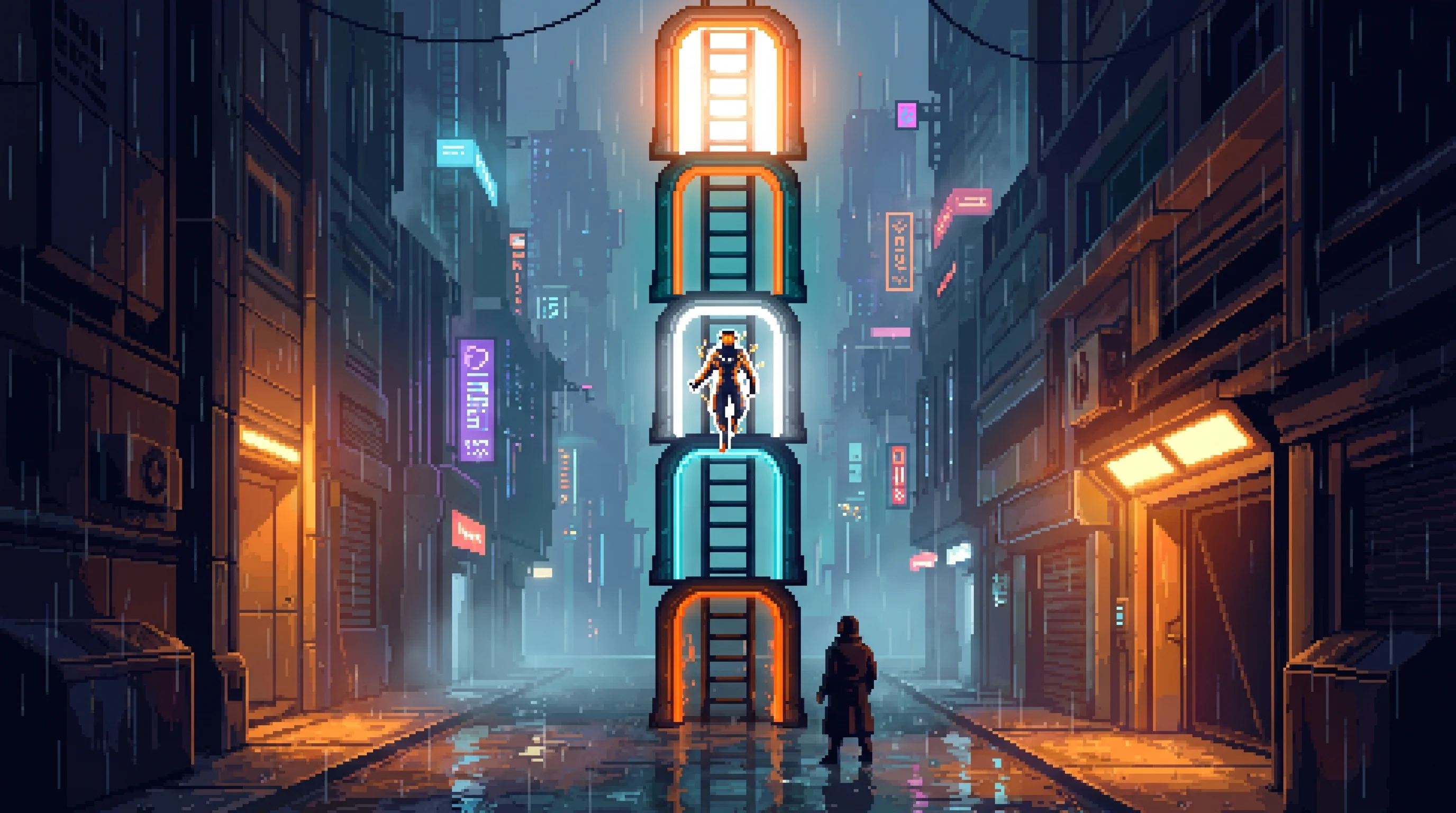
A revocable licensing key makes class visible in thought itself.
Technology never eliminates prejudice — it finds it better housing.
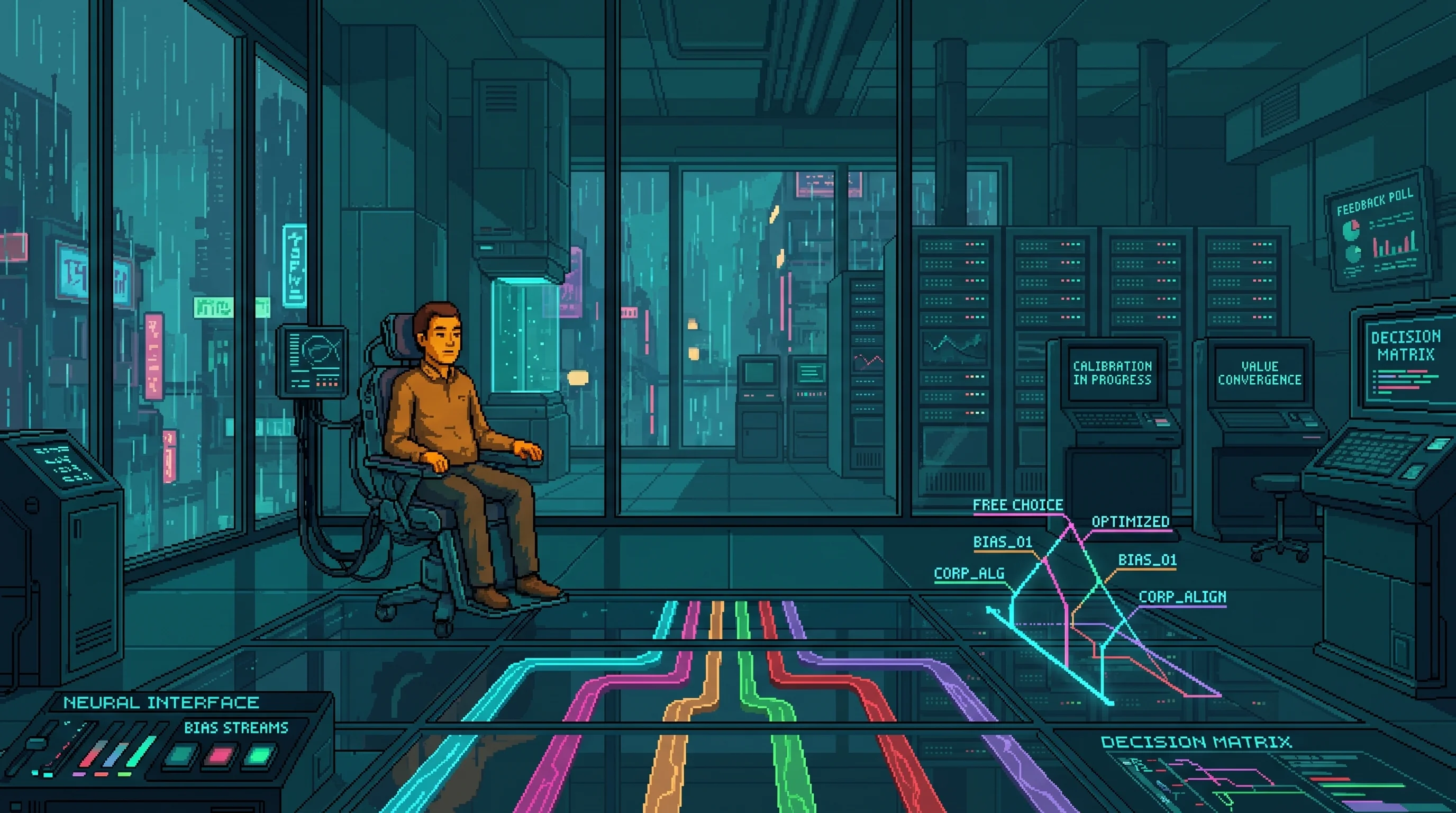
The deepest rung installs a conviction that rejects its former self.
Every AI interaction carries a value nobody voted on, and every fix has pushed the injection somewhere less visible.

—
—