
Drive Module Systems
Drive modules provide crawler locomotion via modified industrial motors and track-gripping wheel assemblies
Overview
The drive module is a modified industrial motor bolted to track-gripping wheels that pull a crawler along the Neon Rail. It is also the component most likely to kill you — not by malfunctioning dangerously, but by stopping.
Ironclad Industries manufactured the original motor assemblies for tunnel-boring equipment in the 2150s. The units were rated for eighteen months of continuous operation in controlled environments with scheduled maintenance intervals. Current average service life on the Rail: nine weeks. The discrepancy is not mysterious. Controlled environments do not feature corroded rail beds, uncleared debris fields, humidity that condenses inside the motor housing overnight, or the specific vibration frequency produced by a four-ton crawler running salvaged track at speeds the track was never rated for. Ironclad's engineering specs assume conditions that have not existed anywhere in the Sprawl since before the Cascade. The motors do not know this. They perform as rated, for environments that aren't.
Drive failure is immediate and total. The motor stops. The wheels seize or disengage. The crawler becomes a stationary metal box.
Above ground, this costs rations — every hour stationary is food and water consumed without distance gained. Below ground, it costs more. A stopped crawler in a tunnel attracts feral machines, scavenger attention, and the specific silence that precedes both. Rail Runners who've experienced an underground stall describe the sound of their own breathing as "too loud," which is not a psychological observation but a tactical one — the Breath processing in deep tunnel sections runs at minimum, and anything organic registers.

Spares Economy
An experienced Rail Runner carries at least one spare drive module and can swap it in under forty minutes. An inexperienced one learns what "spare" means while stationary in the dark.
Spare modules are available at most rail stop shops, priced at roughly 340% of what Ironclad charged for the originals in 2158. The markup is not gouging — it's archaeology. Every spare in circulation was either pulled from a dead crawler, salvaged from a pre-Cascade industrial site, or assembled from components sourced across both. A "new" drive module at a rail stop means the motor casing is from one wreck, the wheel assembly from another, and the wiring harness from a third. Compatibility is achieved through force, shimming, and whatever the shop mechanic had on hand that morning. Serial numbers, where they survive, rarely match anything else on the unit.
The result: no two spare modules perform identically. Runners develop preferences for specific shops, specific mechanics, specific salvage lineages. A module pulled from a Sector 12 tunnel-borer runs heavier but lasts longer. A module from a Wastes recovery site runs hot and smells like ozone but grips corroded track better. None of this is documented. All of it is traded as knowledge between runners at stops, accumulating into an oral engineering tradition that Ironclad's original specifications would not recognize as engineering.
Rail stop shops stock spares the way the Dregs stock respirator filters — as the non-negotiable minimum for continued existence. A stop that runs out of drive modules doesn't lose business. It loses relevance. Runners reroute. The stop decays. The stop's remaining inventory gets salvaged by the next crew through. The cycle completes in weeks.
The archaeology has a birthplace and a graveyard, and they are the same corporation's discard read across the drained bay. The motors begin at the Slagline, the outer discard band of Ironclad's Ring in Richmond Industrial, where tunnel-borer motors decommissioned past tolerance are dumped as zero-value decommissioned and diverted, by contracted sorters, into a market Ironclad denies exists. They end at the Drowned Flats on the northern bay floor, where the crawlers those motors finally killed are stripped for the casings, wheels, and harnesses of the next "new" module. The Slagline makes the part. The flats unmake the vehicle. In between, the module is on the treadmill exactly as long as its owner is.
Most common crawler breakdown — debris on rails, corrosion, and mechanical wear cause regular failures
The Salvage Spiral
The drive module is the Upgrade Treadmill rendered in a single part, with the chrome stripped off so you can see the mechanism underneath.
In the corporate towers the treadmill is a story about augmentation: you outsource your vision to an optic suite, your visual cortex rewires around it, and a year later you cannot read without the current generation. The drive module is the same story told in steel. The Rail Runner outsources locomotion to a motor they cannot build, the Sprawl rearranges itself around vehicles until walking the distance is no longer possible, and the Runner cannot take the function back into their own legs any more than the deprecated executive can take reading back into their own eyes. Both are paying to not be downgraded. The augmented executive loses the rooms when the firmware reverts — the rooms are still there, they just can't see in them. The Runner loses the rooms when the motor stops — same prison, inverted: the part keeps furnishing a world that ended, and the keeping of that faith is what kills it on schedule.
The difference between the firmware treadmill and the drive module's treadmill is the difference between an engineered trap and a natural one. Helix's version was designed — calibration targets pegged to billing cycles, documented in a project plan, filed under customer experience. The drive module's version has no designer. Ironclad Industries rated the original motors for eighteen months in controlled environments and then stopped caring; entropy did the rest. The motor "performs as rated, for environments that aren't." There is no villain. There is only a function you can't perform, a machine that wears out, and a market that knows you'll pay 340% because the alternative is a stationary metal box in a tunnel where the Breath runs at minimum and anything organic registers.
The spares economy is the subscription made visible. No two modules perform identically because there is no manufacturer, no firmware version, no warranty — only the oral engineering tradition that accumulates between Rail Runners at stops, the knowledge that a Sector 12 tunnel-borer module runs heavier but lasts longer while a Wastes-recovery module runs hot and grips corroded track better. This is the Salvage Spiral's one compensation for having no vendor: the dependency is real, but the expertise to manage it cannot be bought, only earned — the way the Tinkerer earned it, and the way an inexperienced Runner "learns what 'spare' means while stationary in the dark." The chrome treadmill offers a counseling program with a six-month waitlist. The salvage treadmill offers a stranger at the next stop who might tell you which lineage to trust, if you've earned the warning.
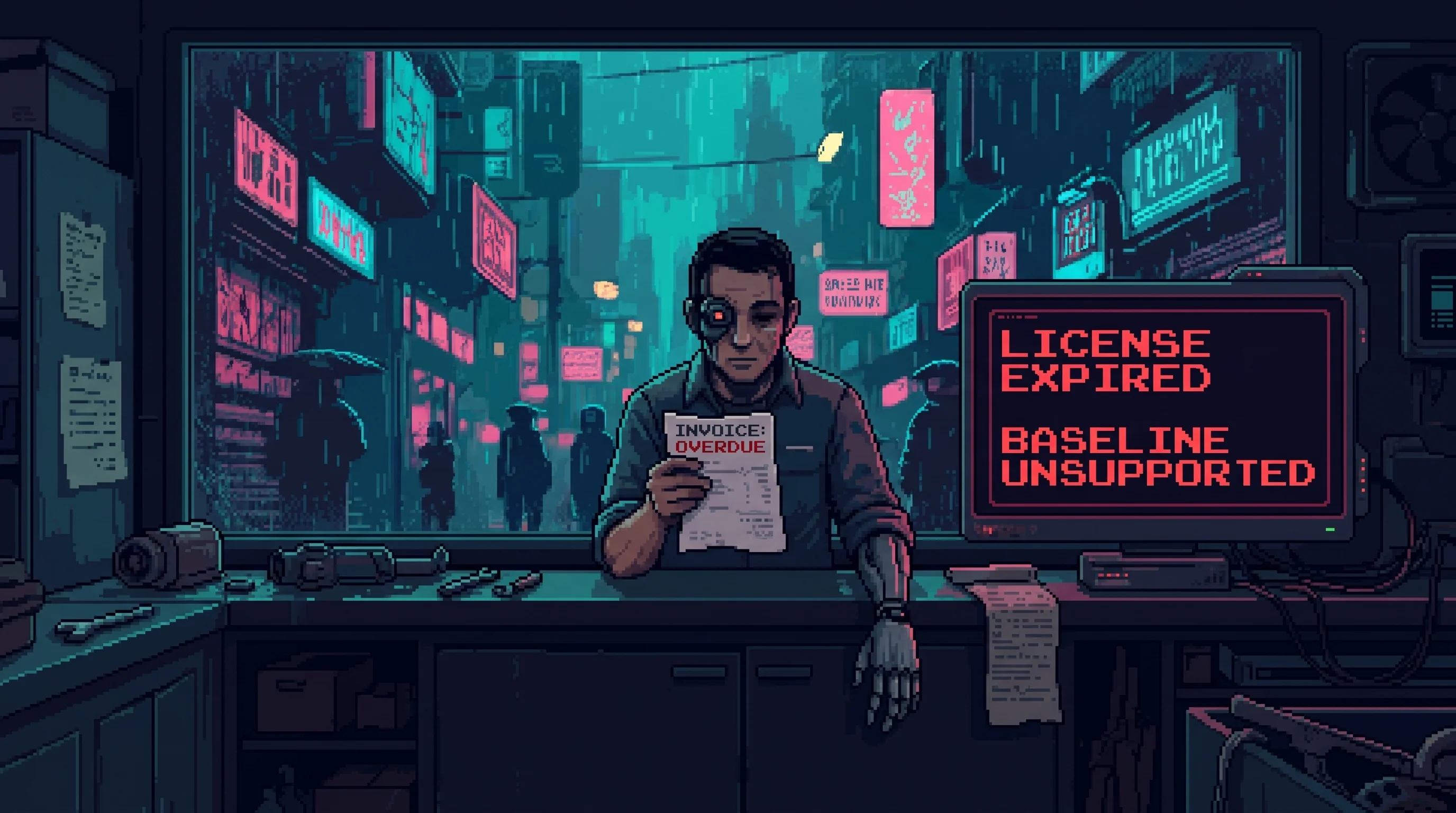
An expression of the Dependency Spiral's Salvage mechanism — a motor that performs exactly as rated for an environment that no longer exists, keeping faith with a pre-Cascade world and dying on schedule for it
Visual Identity
- Color Palette: Motor-oil black (#1A1A1A), spark orange (#FF6B35), track-steel gray (#808B96)
- Key Visual Symbol: Grease-covered hands swapping a drive module on the underside of a stationary crawler, tunnel darkness beyond the work light's edge
Spare drive modules are essential cargo on any Rail journey
A drive failure without a spare strands the party until one can be scavenged or purchased
Connected To
Supporting Connections





—