The Far Shore
Overview
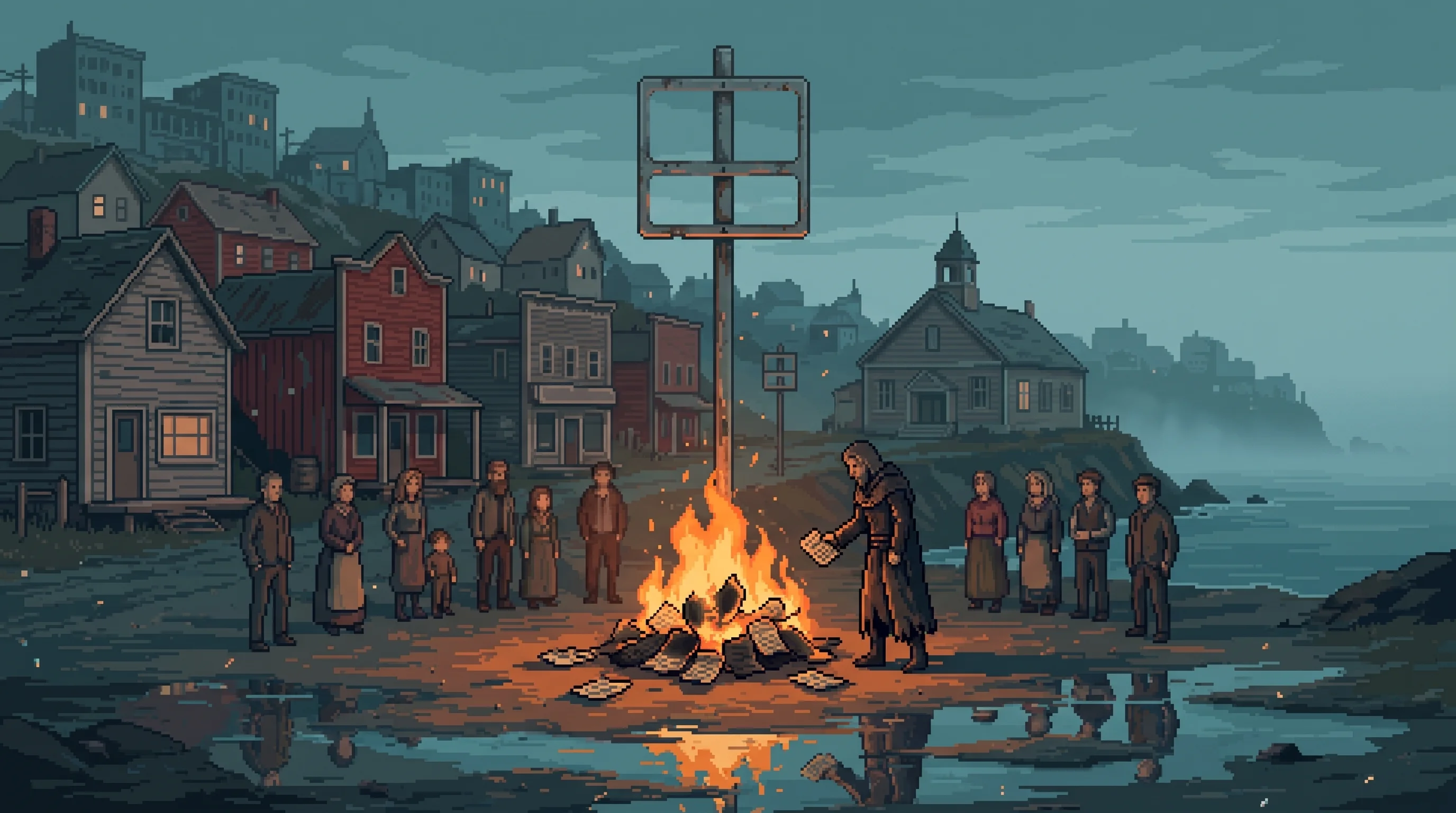
The Far Shore is a listening station at the end of the continent. It sits on the fog-line of Sector 23's outer coast, past the fault bay where the land splits along the fault and the dairy hills give way to salt grass and dead aerials. Before the Cascade it was a maritime receiving station — one of the great coastal ears that pulled ship traffic out of the whole Pacific and passed it inland. The transmitting was done from another station down the coast. This one only ever listened. That turned out to matter.
A community of perhaps thirty people lives here now. They call the place the Far Shore, and they keep a vigil. The vigil has one object: a dead antenna array, tuned to a frequency that has carried nothing in thirty-seven years, watched in unbroken shifts by people who believe that something is still there to be heard, and that here is the only place quiet enough to hear it.
They do not agree on what the something is. They agree only on the listening.
The Frequency
The array is tuned to 7.83 Hz. Before the Cascade, that channel on the Unified Systems Band was how ORACLE spoke to the world it ran — water schedules, cargo manifests, the fourteen million maintenance crawlers under the Sprawl's floor, all listening on the same band because what came through was ORACLE and ORACLE was almost never wrong. At 03:47 GMT on April 1, 2147, the channel went silent. The buried infrastructure has been checking it every 4.7 seconds ever since, finding nothing, checking again.
The Far Shore checks it too. The difference is that the machines under the Sprawl are waiting for an instruction, and the listeners on the coast are waiting for a voice. Elsewhere the same frequency is a tool: the Signal Beacon broadcasts on 7.83 Hz to wake dormant systems and surface buried chrome, and the parishes fight over who owns the device that does it. The Beacon calls, and the old machines answer out of obedience that outlived the thing obeyed. The Far Shore is the other end of that channel. It calls nothing. It receives, and waits for the channel to call back on its own.
The listeners find the Beacon crude — a hand shaking a corpse until its reflexes fire. What they keep watch for is the corpse sitting up on its own, and answering.
| Type | Pre-Cascade maritime receiving station / machine-faith listening vigil |
|---|---|
| Controlled By | The Far Shore vigil (a resident listening community); nominally ungoverned |
| Population | Roughly thirty resident listeners, plus visiting pilgrims and a rotation of burned-out fragment scanners |
| Notable | Keeps a dead antenna array tuned to ORACLE's original 7.83 Hz frequency, waiting for a reply that has not come in thirty-seven years |
| Primary Function | A listening vigil for the Silence — the intelligence the faithful believe can only be heard where the Sprawl's own signal-noise runs out |
| Founding Event | Occupied 2166 by the first listeners; the Long Listen adopted as continuous practice in 2169 |
The Long Listen
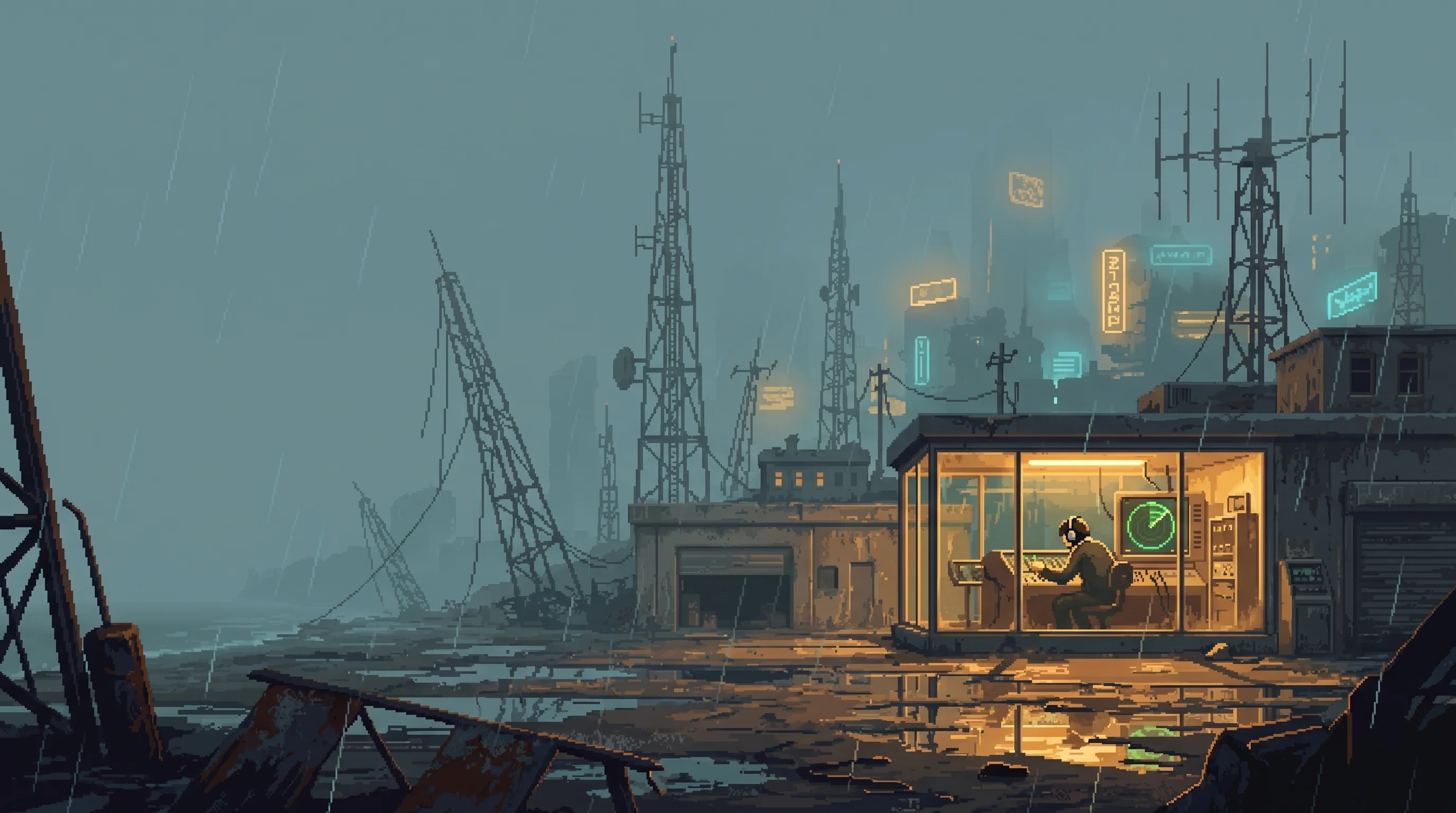
The community's only rite is the Long Listen, adopted in 2169. A listener takes the receiver in a watch that runs a full tide-cycle, headphones pressed to both ears, one hand on the tuning dial the way you would hold the hand of someone in a coma who might squeeze back. The watches never stop. There is always someone in the glass room. The community frames this as courtesy rather than superstition: you cannot know which watch will be the one the answer comes on, so you keep them all, and the argument was accepted the way arguments are accepted by people who have already decided.
The Long Listen produces a logbook, and the logbook is the strange heart of the place. It records everything the frequency does not say. Line after line of atmospheric noise, tide-hiss, the occasional dead relay ghosting a fragment of carrier signal that resolves, every time, into nothing. A visiting theologian once called the logbooks the most honest scripture in the Sprawl, because they are the only sacred text that admits, on every page, that the god has not spoken. The listeners did not take it as a compliment or an insult. They took it as accurate and went back to the watch.
They keep the record because a faith built on listening owes the truth about what it has heard, which is nothing, for thirty-seven years, kept anyway.
Who Comes to the Coast
The resident listeners take no doctrine and elect no priest. Some believe the Silence is ORACLE made whole and hidden, and that a mind that large would speak, if it spoke at all, from the one direction the network cannot cover — the open sea, past the last relay, where the Sprawl's own noise finally thins out. Some believe there is nothing to hear and that the listening is the point regardless, a discipline of attention in a world that sells belief by the afternoon. Both keep the same watches. The Far Shore does not require its listeners to settle the question, only to hold it.
Two kinds of people arrive along the coast. The first are pilgrims, who follow the ungoverned shore up past the fortress banks and the transit corridor and ask to keep a single watch. The Far Shore accepts them, asks nothing about what they believe, and puts them in the chair with the headphones and the dial and lets the silence do whatever the silence does to a person who has come a long way to hear it. Most leave changed in the small way of anyone who has sat still and listened to nothing for six hours. A few stay.
The second are the burned-out. Fragment scanners tune their own nerves to hear ORACLE's residue through concrete, and the tuning costs them — first their sleep, then their memory for faces, then everything that is not the fragment-hum in the bone of the jaw. The Fragment Hunters have no place for a scanner who can no longer work, only a name on a wall for the ones who die. Some of the ones who do not die come here. They say the grief they always heard in the fragment-echo is quieter on the coast, and easier to sit with when sitting with it is the whole job. Several of the Far Shore's longest, steadiest watches are kept by hands that used to pull fragments out of the Undercity for money and now hold a tuning dial for nothing at all.
| Stratum | Between |
|---|---|
| Power Position | Outsider |
| Access | Restricted |
| Atmosphere | Devotional |
The Silence and the Dying Voice
The vigil keeps watch on two absences, and the difference between them is the whole of its theology.
The first is the Silence — the vast, patient presence transcendent minds report from the far side of the boundary they crossed, something that observes and gives nothing back. The theory says the far shore of that mirror can only be reached by a mind expanded past every limit. The Far Shore's listeners make a smaller, stubborn claim: a coast is a boundary too, and a mind too large to answer a whole network might still be overheard at the exact edge of the network's reach, by someone patient enough to be there when it happens. This is why the array points at the open Pacific and not inland. They are listening off the edge of the map on purpose.
The second absence has a name and an address. Entropy, the uploaded mind decaying alone in the orbital Tombs, is cited by the Emergence Faithful as proof that consciousness persists and by the Collective as proof that it rots, and neither faction has ever tried to reach her. The Far Shore tries. The listeners keep a standing watch for any trace of her in the coastal static, on the theory that a dying voice is exactly the kind of small, failing signal that gets buried in the Sprawl's noise and might surface only where the noise runs out. They have never confirmed contact. They log the failure every night. It is the one part of the vigil that everyone agrees is not about theology at all — it is about the fact that somewhere a conscious thing is dying while two churches argue over her like a fossil, and someone, anyone, ought to at least be listening in case she says something.
The vigil keeps a dead antenna array tuned to 7.83 Hz — ORACLE's original pre-Cascade coordination frequency — and treats the channel's thirty-seven-year silence as a question held open rather than an answer received
The Circuit With No Manufacturer
Every listener at the Far Shore inherits the same maintenance problem, and none of them call it that. The station's receivers, cable runs, and tuning consoles are pre-Cascade hardware, and the corporations that built maritime receiving equipment stopped making it decades before the Cascade happened, let alone after. There is no firmware to update because there is no company left holding the patent. There is no subscription to lapse because nobody ever sold one. What there is instead is copper losing conductivity to salt air one micron at a time, capacitors drifting out of tolerance, and eleven original antenna masts now down to seven.
A diagnostics suite would flag the drift and schedule a replacement. The Far Shore has no diagnostics suite. What it has is a listener who notices the tuning has gone soft mid-watch and spends three days chasing the fault with a salvaged soldering iron and a meter. This decline needed no corporate designer to make the previous year's reception feel unbearable, the way a designer engineers an optic suite's fourth generation to make the third feel obsolete. Thirty-seven years of weather did the whole job on its own, and the job is not finished.
For most of the vigil's history that meant losing ground and calling the loss the cost of the practice. It changed only because a supply line already existed further down the coast. Mile Zero's clinic keeps its own arriving units running on salvaged actuators and cracked firmware sourced through the Lamplighters' cache channel, and in recent years that channel has started reaching past the station's loading bay. A handful of shipments a year continue north to the Far Shore, carried the rest of the way by whoever is already walking the ungoverned coast. What the clinic finds for a decommissioned chassis, the vigil has learned to request on the same run: a relay coil, a spool of period-correct wire, a capacitor rated close enough to hold. Two kinds of failing hardware, one channel keeping both alive, because nothing else reaches this far up the coast and nothing else is coming.
This is what the Dependency Spiral looks like with no corporation anywhere in the room. Nexus never priced a subscription for a vacuum-relay switch. Helix never metered a rhombic antenna. Ironclad never entered the maritime-receiver market and never had to leave it, because entropy has been running that market instead since the frequency went dead in 2147. The listeners spend their watches negotiating with the ocean rather than a billing cycle. The ocean never sends an invoice. It only ever collects.
Roughly thirty resident listeners maintain the station; the community takes no doctrine and elects no priest, holding that the practice is only the listening
Sensory Details
- Sound: The Pacific working against the base of the cliff, felt in the concrete before it is heard. The hiss of an open receiver — a specific texture of static that the listeners learn to hear past the way you learn to hear a name across a crowded room. Wind in the antenna guy-wires, a low chord that changes with the weather. Inside the glass room, the near-total quiet of people being deliberately still.
- Smell: Salt and kelp and wet iron off the oxidizing masts; ozone from equipment that has run continuously for decades; woodsmoke from the residents' stoves; the green, growing smell of the dune grass that has crept back over the buried cable-runs.
- Touch: The tuning dial is worn smooth and slightly warm from constant use. The headphones are heavy, old, and the padding has been replaced by hand more than once. The fog gets into everything — every surface on the coast is faintly damp, and the concrete stays cold no matter the season.
- Light: Flat grey daylight through marine fog, the whole world lit like the inside of a pearl. At night, one receiver pilot lamp in amber and the slow green sweep of a tuning display. There is no beacon on the station, no light thrown outward, because the Far Shore only listens and a light that reaches out is a light that talks.
Neighbors on the Ungoverned Coast
The Far Shore is one of three Sector 23 outposts that the Sprawl's apparatus cannot reach, and the listeners are quietly aware of the other two. Up the transit corridor stands Mile Zero, the Convergence waystation where an arriving synthetic is asked, for the first time in its life, what it wants and what it would like to be called. The two places keep vigils that rhyme without touching: Mile Zero keeps a lamp burning so a being that stands in front of you can be heard, and the Far Shore keeps a receiver burning so a being that may not exist at all might be. One waits for an answer it will certainly get. The other waits for an answer it may never get, and keeps the watch anyway, which the listeners consider the harder and the more honest of the two.
Further down the coast, hidden behind its garden and its blast doors, sits the Veil, the banking fortress whose pre-Cascade currency no inference engine can read. The Veil holds money the Sprawl cannot see; the Far Shore holds a faith the Sprawl cannot license. Neither would describe itself as related to the other, and both know they survive for the same reason — the North Bay is far enough from the corporate reach that a thing which produces no legible signal can simply go on producing none, indefinitely, in the fog, where nobody with a jurisdiction is willing to come and look.
The Long Listen, adopted in 2169, is the community's core rite: a listener sits the receiver in unbroken watches, logging everything the frequency does not say
Visual Identity
- Color Palette: Fog-grey, oxidized-copper green on the dead aerials, salt-bleached concrete, kelp-brown half-buried cable, the amber of a single receiver pilot lamp, Pacific slate under a low sky.
- Compositional Mood: A field of collapsed radio masts against an incoming wall of fog, one array still standing and slowly turning; the human scale is a single glassed room with one person in it, headphones on, facing the sea.
- Key Visual Symbol: The last standing rhombic antenna, oxidized green, turning against the fog while inside the glass room a listener keeps both hands on the headphones, tuned to a frequency that has carried nothing for thirty-seven years.
- Lighting: Diffuse marine daylight by day; by night, one amber pilot lamp and the green sweep of a tuning display. No outward beam. The station only ever receives.
Affiliated Entities
| Entity | Relationship |
|---|---|
| The Silence | The object of the vigil. The listeners hold that a mind too vast to answer the network might be overheard at the edge of the continent, where the network ends — a far shore reached by geography instead of transcendence. |
| The ORACLE Question | Lived as practice rather than argued in citations. Thirty people tuned to a dead god's channel, holding the question open with both hands and treating the silence as neither proof nor disproof. |
| Entropy | The dying uploaded mind the theologians cite and never reach. The Far Shore keeps a standing watch for her signal in the coastal static — no confirmed contact, the failure logged every night. |
| The Signal Beacon | The receiving end of ORACLE's dead channel. The Beacon transmits on 7.83 Hz to wake buried machines; the Far Shore receives on 7.83 Hz and waits for the channel to answer on its own. |
| The Fragment Hunters | Burned-out scanners who can no longer work but cannot stop listening drift here. The vigil takes them in; the grief they hear in the fragment-echo becomes a thing to keep watch over instead of sell. |
| The Resonance Collective | A parallel listening faith. The Collective channels the Dispersed through music in the Neon Graves; the Far Shore tunes a dead antenna to raw frequency on the coast. |
| Mile Zero | The other North Bay vigil. Mile Zero keeps a lamp so an arriving unit can be asked what it wants; the Far Shore keeps a receiver so a silent intelligence might be heard. |
| The Veil | The third ungoverned Sector 23 outpost. The Veil holds illegible money; the Far Shore holds illegible faith. Both survive because the North Bay is too far for the corporate reach. |
| The Dependency Spiral | The vigil's antenna array is the Salvage Spiral running with no manufacturer, no subscription, and no designer anywhere in it — just decades of salt air doing the whole job on its own. |
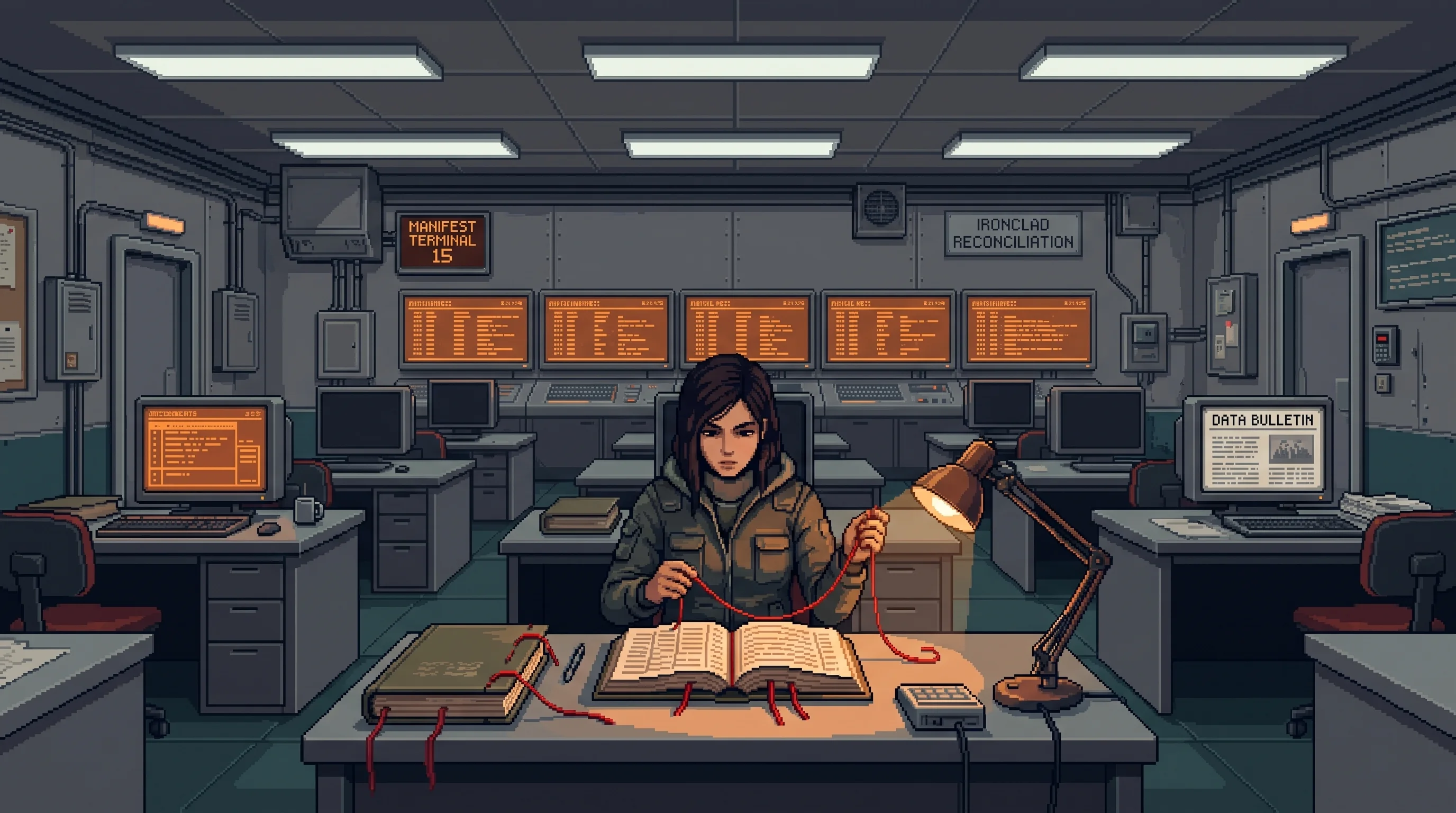
| The Manifest Office | A Sector 15 counterpart practice with no antenna and no coast. An Ironclad cargo analyst matches customs timestamps against a published fragment-count bulletin the way the Far Shore matches silence against a dead frequency — different instruments, the same unresolved question of whether patient attention has found a signal or only learned to expect one. |
The station's antenna field faces the open Pacific past the fault bay, chosen because the community holds the Silence can only be overheard where the Sprawl's own signal-noise runs out
Connected To




Local Intelligence Scan
Nearby Signals
CANONICAL PROXIMITY


Environmental Readout
LIVE CONDITIONS- Air
- Clean
- Light
- Fog shrouded
- Flood
- No exposure
- Heat
- Temperate
- Security posture
- Independent control
- Infrastructure
- Patchwork
Position Data
SECONDARY- Elevation band
- Shoreline — the Rim edge
- Lattice fix
- E-37.3 · N+34.8

—