
Power Tap Network
Power taps are junction boxes where the old BART electrical grid still carries current
Overview
The power tap network is a series of junction boxes where the old BART electrical grid still carries current. They are the only means of recharging crawler power cells along the Neon Rail. Without them, every journey has a fixed range measured in cell capacity and a fixed outcome when it runs out.
There are approximately 340 taps catalogued between the southern terminus and the northern extent of the Rail. Of these, 187 delivered current during the most recent survey cycle. Forty-three delivered current that matched the voltage rating stamped on their housings. The survey was conducted by the Lamplighters in 2182. No survey has been conducted since, because the Lamplighters who conducted it noted in their final report that "conditions change faster than we can walk," and nobody has disputed this.
The network was never designed for crawlers. It was designed for BART trains drawing power from an integrated metropolitan transit grid maintained by a municipal authority that no longer exists, funded by a tax base that no longer files, regulated by an agency whose last employee died during the Cascade or shortly after. The junction boxes were service access points. Technicians reached them by rail car, carrying diagnostic equipment and repair schedules. The fact that someone can now attach a crawler cell to one of these boxes and sometimes receive charge is not engineering. It is coincidence hardened into dependency.
Coverage
Near inhabited stops — Rivet Town, Gaslight Station, a handful of others where enough people live to justify the effort — taps appear roughly every mile. These are maintained by Lamplighters or by locals who've claimed the junction box as a concession. Standard fee: five to fifteen credits per charge cycle, depending on who's asking, who's answering, and whether the person asking has visible alternatives. A crawler operator who arrives at a tap with 4% cell life pays more than one who arrives at 60%. This is not posted policy. It is physics expressing itself as economics.
In remote sections, taps thin to one every eight or twelve miles, then fewer. Maintenance out here is nobody's job. A junction box exposed to thirty-seven years of atmospheric corrosion, seismic micro-shifts, and scavenger attention does not improve with neglect. Some taps present green indicator lights — the original BART status LEDs, still drawing power from the grid connection they're supposedly reporting on — while delivering zero charge to any cell connected to them. The light means the circuit is closed. It does not mean the circuit is useful. This distinction has stranded an estimated seventy-plus crawlers in the past two years, according to Lamplighter recovery logs. The logs note that most operators trusted the green light. The logs do not note what the operators said when they discovered what the green light meant.
In dead zones, the network simply stops. No junction boxes. No grid connections. No current. The map shows the route continuing. The taps do not.
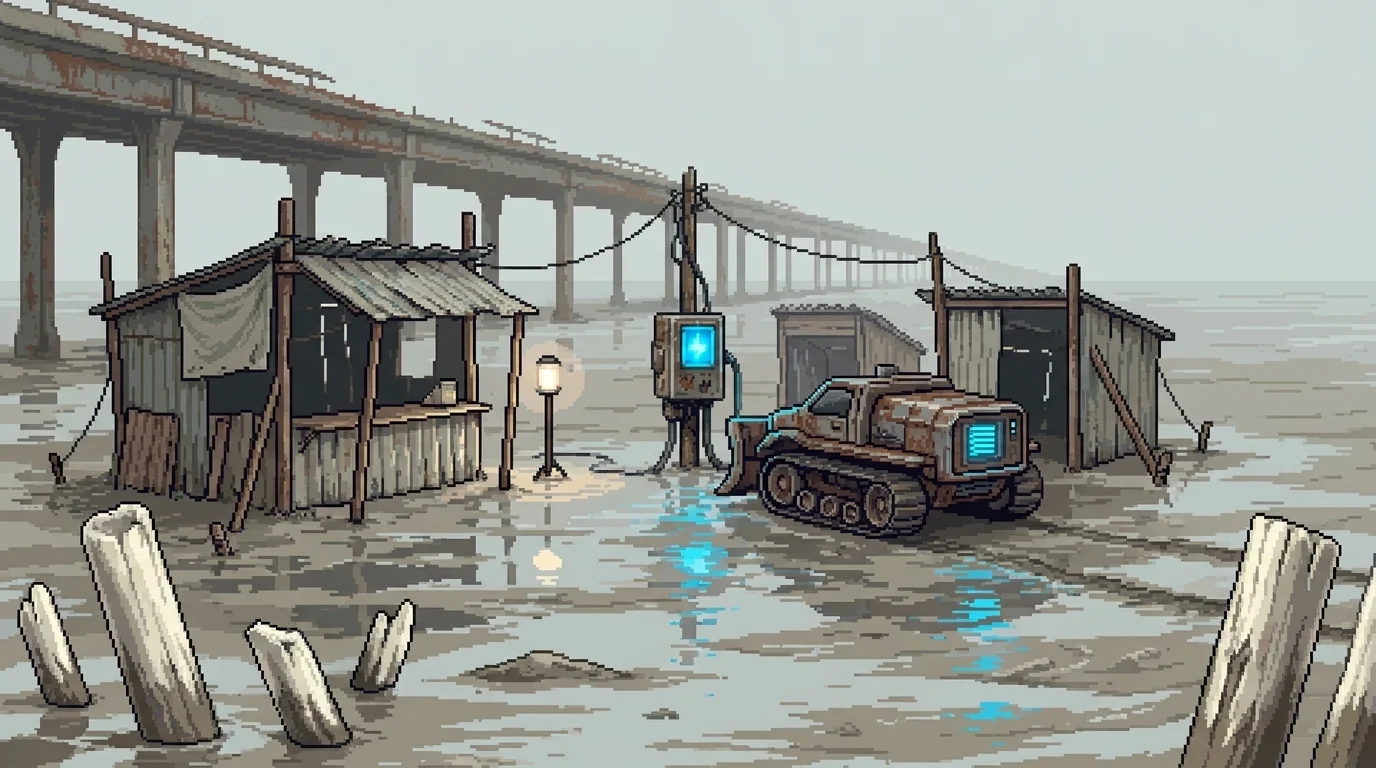
The southern spur has a named edge for this. The Southern Shoals, on the drained floor near the San Mateo Bridge, is the last honest tap. It is a concession maintained because it is its operator's income, sitting at the exact line where trust runs out. South of it, the staked taps are coin flips. The northern floor has the same frontier in reverse. Out on the Drowned Flats, among the crawler wrecks, the staked taps are the purest form of the lying green light: indicators still drawing grid current to report a circuit closed while delivering nothing to the cell you connect. Both edges sell the same commodity by its absence. That commodity is certainty. Both prove the network's cruelest property, that a tap's honesty cannot be determined until you have already bet the crossing on it.
They provide the only means of recharging crawler power cells along the route
The Maintenance Question
The Treaty of Shared Infrastructure declared power systems neutral in 2171. Targeting them is prohibited. Maintaining them is, technically, everyone's responsibility. In practice, a responsibility shared by everyone is a responsibility owned by no one, and the power tap network degrades at the precise rate that reflects this.
The Lamplighters maintain taps near their own operations. Those are grid junctions they need functional for reasons that have nothing to do with crawler traffic. A tap that happens to serve both the Lamplighters' grid work and a passing crawler gets fixed. A tap that serves only crawlers does not. The Lamplighters are not hostile to Rail operators. They are understaffed, overstretched, and realistic about what fourteen people can maintain across a route that spans the Bay Area Sprawl. Their internal maintenance priority index ranks taps by grid significance. Crawler utility is not a field in the index.
The concession operators near inhabited stops maintain their taps because the taps are their income. A dead tap is a lost concession. A concession operator whose tap dies will sometimes walk three miles to the next junction box, test it, claim it, and reroute crawlers to the new location. The old tap remains on every route map until someone updates it. Route maps are updated by people who travel the route. People who travel the route trust the route maps. The circular dependency between map accuracy and travel safety is noted in Lamplighter operational briefs as an "ongoing informational challenge." It is not noted as a problem, because noting it as a problem would imply someone should fix it.
Coverage is inconsistent — some sections have taps every mile, others have none for twenty
The Salvage Spiral
The drive module strands you when it stops. The hardshell fails you when you can't see it failing. The power tap network does something worse than either. It lies: a green LED reporting a closed circuit while the cell you connect draws nothing, seventy-plus crawlers stranded in two years by operators who believed it.
There is a tell, for those who know it. A dead tap and a live one read identically on a voltmeter, because both carry the grid's idle voltage on the line. The difference shows up only under load. A working tap holds its voltage when a cell asks it for current. A lying tap collapses to zero the instant the draw begins. Experienced operators carry a resistor bank and run a two-minute test draw before they trust a strange box. Inexperienced operators carry a voltmeter and a green light. Both agree, right up until the crossing.
This is the Upgrade Treadmill's Salvage mechanism at its most infrastructural, and it rhymes with the Spiral's deepest corporate lesson, the Indispensable Prisoner. The power tap network is load-bearing infrastructure shared by everyone and owned by no one. The Treaty of Shared Infrastructure declared power systems neutral in 2171, and "a responsibility shared by everyone is a responsibility owned by no one, and the power tap network degrades at the precise rate that reflects this." Of ~340 catalogued taps, 187 deliver current and 43 deliver the rated current.
The corporate treadmill traps the Grid maintainer who cannot strike because people die when they stop. The Salvage Spiral traps the crawler operator who cannot not depend on infrastructure that no one is obligated to maintain. The Lamplighters hold "some" of it, emphasis on some, because their maintenance priority index "ranks taps by grid significance. Crawler utility is not a field in the index." Fourteen people cannot maintain a route spanning the Bay Area Sprawl, so the taps that serve only crawlers become arithmetic: charge, distance, drain rate, no partial credit.
And the network's circular failure is the same administrative shrug that runs through every salvaged system in the Sprawl. Route maps are updated by people who travel the route. Those people trust the maps they inherit. The gap between map accuracy and travel safety is filed as "an ongoing informational challenge" and pointedly "not noted as a problem, because noting it as a problem would imply someone should fix it." This is the consumer-grade version of the Lattice Shadow's jurisdictional review, pending since 2169. Both are the same paralysis at two ends of the same Grid. The green light that means nothing is a fire-suppression certification that expired seven years ago, scaled down to the size of a junction box a crawler operator stakes their life on.
An expression of the Dependency Spiral's Salvage mechanism — a responsibility shared by everyone is owned by no one, and the network degrades at the precise rate that reflects this
Visual Identity
- Color Palette: Live-tap green (#00FF41), dead-tap gray (#808080), charge-glow blue (#00BFFF)
- Key Visual Symbol: A crawler connected to a wall-mounted junction box, the charge indicator glowing — or not
Affiliated Entities
- The Neon Rail: Power taps are the Rail's refueling infrastructure — spacing determines journey viability
- Power Cells: Taps recharge cells — without taps, cells drain irreversibly
- Dead Zones: Dead zones exist where the tap network has failed
- The Lamplighters: Lamplighters maintain some power tap connections as part of their grid work — emphasis on "some"
Lamplighters maintain some tap connections; most are unmaintained and degrade over time
Connected To
Supporting Connections
Additional Connections




—