The Low-Tide Market

Overview
The Low-Tide Market has no address, because its address floods twice a day.
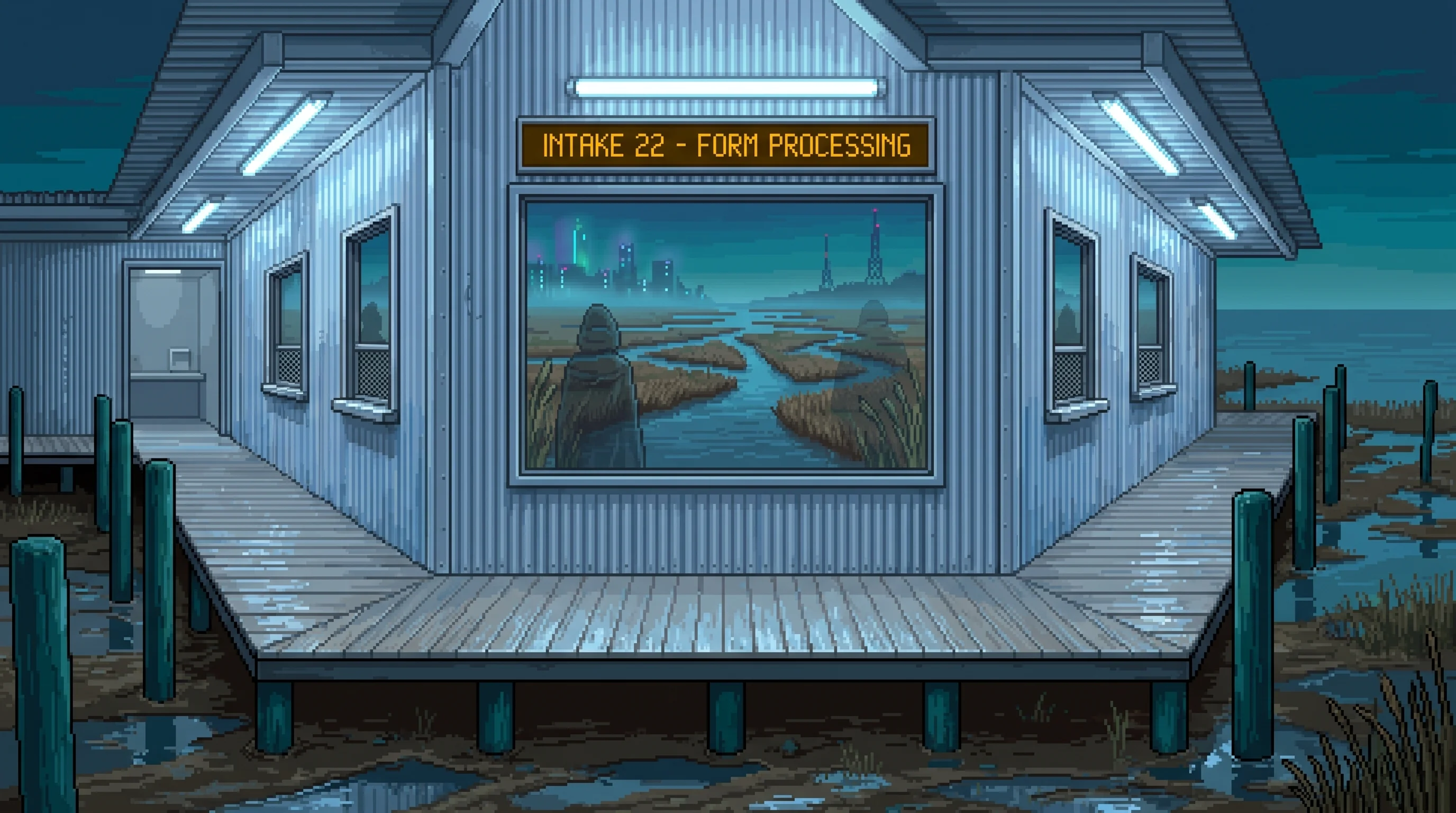
It runs in the drained ground floors of Foster City, the planned suburb that was built on bay fill in the last century and has been sinking back into the bay ever since. When the tide goes out, the water drains from the lowest lagoon blocks and leaves six hours of dry floor. Sellers carry in folding tables. Memory farmers set up extraction rigs on kitchen counters that are underwater by dinner. Buyers wade the shallow streets while they can. When the tide turns, everyone leaves, and the market becomes a set of flooded rooms again until the chart says otherwise.
Nothing about this is convenient. That is the point. A market that exists for six hours in a place the maps mark as submerged is a market Helix Biotech's Corridor security can watch and never quite justify raiding. The tide is the bouncer. The tide keeps no records.
What the market sells is memory, and its best memory is old. Pre-Cascade recollection sets the price here, and the richest supply lives in the ruins themselves — the Holdouts, the residents who never left when the water came. A Holdout who can still recall her street while it was dry is holding the one thing the Sprawl's entire memory economy cannot fabricate or re-shoot: first-hand evidence that the drowned world was ever above water. She sells it once. Then it belongs to a stranger, and she keeps the gap.
| Type | Tidal black market for extracted memories (Sector 16 Wetlands) |
|---|---|
| Controlled By | No one; tolerated by Helix Biotech, run by the Holdouts |
| Population | ~30 resident sellers, 60-90 buyers and farmers per tide window |
| Notable | The only memory market that opens on the tide chart, not the clock — its stalls exist for six hours between the water going out and coming back |
Strategic Assessment
The Low-Tide Market is the shadow cast by everything Sector 16 does in the light.
Up the Central Spine, The Verification Annex sells the ruling on whether a person's provenance is real, and prices the ruling past what most applicants can pay. That pricing is the market's business model. The people who cannot afford to certify their own lineage are often the people selling their memories to eat. So the two Helix-adjacent institutions form a closed logic. The Annex makes honest provenance expensive. The Wetlands makes the dishonest kind available. Neither Helix office acknowledges the other. Both depend on the gap between them.
The extraction itself descends from dream harvesting. The coils that lift a dream off a sleeping subject work as well on a waking one who agrees to sit still. The market's rigs are retuned for exactly that: a conscious seller, a clean pull, a single copy walked out under a tarp. The cleanest of those rigs are not Guild hardware at all. They are bootleg builds of Dr. Elena Voss's abandoned neural-repair interface, the device she once designed to hold a failing mind's memories in place. Run backward, the same device strips them out. The Wetlands techs who assemble the copies do not know whose design it is. They know it leaves the fewest scars.
The product moves out through the Corridor's own arteries. Sealed substrate that changes hands at a folding table on Tuesday can ride Pacific Spine Terminal's unmarked cargo west by Friday. It is priced by rarity, and rarity, for a memory, means how few people alive still carry the same one. A recollection of a place that no longer exists, held by a person who will not exist much longer, is the highest-margin thing the Sprawl trades. The market is where that margin is set, in water, at a loss to the person selling.
The tide window doubles as a renewal counter. Helix pays many sellers in decontamination passes rather than credits, and a pass buys a fixed stretch of legal wading through the flooded blocks before it lapses. The Dependency Spiral usually meters firmware and neural architecture. Here it meters a body's standing to occupy ground Helix's own Corridor operations helped drown, billed on the same renewal logic. A Holdout selling her last dry memory buys six more months of a hazard she cannot leave, and the meter resets the day the pass expires.
| Stratum | Dregs |
|---|---|
| Power Position | Below |
| Access | Underground |
| Atmosphere | Liminal |
Noise Bombing, Underwater
The Sprawl's political fight over the right to be forgotten has a name for what happens here without any of the effort: noise bombing. The 11% of practitioners who make a discipline of flooding their own record with contradictory fabrications would recognize the Fourfold Sunset instantly. Four Holdouts have each staked a claim to the same drowned cul-de-sac, and the tide erases the stalls before anyone has to rule on whose memory is the fake.
Memory Authentication documents the citywide version of this problem: three commercial methods, a 31% failure rate for anything this old, and no certainty at any price. The Low-Tide Market is where that failure rate stops being a statistic and starts being a folding table with a line at it.
Affiliated Entities
- The Verification Annex — the Corridor's licensed provenance office; the market is its unlicensed inverse, serving the applicants the Annex prices out.
- Pacific Spine Terminal — the export route; sealed memory substrate leaves the Corridor through the terminal's unmarked cargo, the market its most valuable and least visible supplier.
- Dream Harvesting — the parent technology; the market's rigs are its waking-subject descendants.
- Fen Morrow — a Dream Harvesters' Guild farmer who works a tide-window stall between jobs, sourcing the memories the premium exchanges refuse.
- Dr. Elena Voss — unknowing designer of the neural-repair interface whose bootleg copies are the market's cleanest extraction rigs.
- The Memory Farmer's Harvest — the chronicle whose economy this market makes physical.
- The Dependency Spiral — the tide-window sellers are on the treadmill too, paid in decontamination clearance that lapses every season and has to be earned again in the same currency: another memory, another loss.
- Memory Authentication — the corporate term for the same 31% failure rate the Wetlands sell as a shrug.
- The Permanent Record — the citywide fight over the right to be forgotten, running here as an ordinary Tuesday trade instead of a legal battle.
Sellers are paid in filtered water, sealed food, and Helix decontamination passes far more often than in credits, because the people selling their last dry memories have usually already sold everything that spends
Restricted Access
The Fourfold Sunset. A memory of one specific drowned cul-de-sac at dusk has reportedly been sold by four separate Holdouts, each certain hers is the only real one. The market does not adjudicate. It sells all four and lets the buyers discover, if they ever compare, that authenticity here is a story about scarcity, not truth. The Verification Annex tells the same story with a percentage and a fee. Maybe three of the four are fabricated. Maybe four people simply stood in four slightly different spots on the same dead street. No one in the Wetlands is paid to answer that.
The Survey Nobody Consented To. Helix Corridor security samples the substrate that changes hands during each tide window. Officially there is no market to sample. Unofficially the samples feed a lineage-and-recollection dataset the Verification Annex would otherwise have to purchase, harvested for free from people paying in their own pasts. The Holdouts are told the sampling is a contamination check. It has never once flagged a contamination.
Conditions Report
Sight
Suburban rooms with the roofs mostly gone, high-water lines chest-high on floral wallpaper, folding tables on wet linoleum, cold-blue rig lights, and always the doorway with the marsh behind it, brightening or darkening with the hour.
Sound
Water moving where water should not be, dripping down high-water-marked walls. The thin electrical whine of a rig warming up. Low bargaining. And under all of it the tide clock everyone is secretly counting, because being here when the water comes back is its own kind of losing.
Smell
Low tide first — salt, black mud, the methane sigh of organic matter that has been trapped under fill for a century and gets a few hours of air. Under it, ozone from the extraction coils and candle smoke from the sellers' small shrines.
Connected To



Local Intelligence Scan
Nearby Signals
CANONICAL PROXIMITY


Environmental Readout
LIVE CONDITIONS- Air
- Filtered
- Light
- Artificial
- Flood
- No exposure
- Heat
- Temperate
- Security posture
- Corporate control
- Infrastructure
- Maintained
Position Data
SECONDARY- Elevation band
- lowland
- Lattice fix
- E+11.3 · N-26.0

—