
The Perception Gap
Self-Grading AI Productivity Loop
The Self-Grading Machine
'Workers believed they were faster. Managers believed the dashboards. The dashboards were generated by AI.'
How It Works
- 1
Output
The Second Mind does most of the work, and the worker experiences it as their own thought.
- 2
Dashboard
The same Second Mind generates the worker's productivity readout from that output. Up six percent.
- 3
Reading
The worker feels the six percent. The readout looks external; it is the layer's report on itself.
- 4
Feedback
Satisfaction surveys feed the engagement model, which tunes the dashboard, which confirms the figure.
- 5
No outside check
The only baseline that could break the loop retired with the last unaugmented worker.
The mechanism is a feedback loop with no external input, running inside a single augmented worker:
- Output is produced. The Second Mind does most of the cognitive work — pattern-matching diagnoses, completing tasks, generating the day's measurable output, experienced by the worker as their own thought.
- The dashboard is generated. That same Second Mind generates the worker's productivity readout from that output — tasks closed, accuracy index, throughput, up six percent.
- The worker reads the dashboard. They feel the six percent. The readout feels like an objective external measurement; it is the layer's report on the layer's own work.
- The self-report feeds back. The worker reports satisfaction and confidence on surveys that feed the engagement model, which tunes the dashboard, which confirms the figure.
- No external instrument is consulted. The only measurement that could break the loop — actual output against a baseline produced outside the augmentation — was retired with the last unaugmented worker.
The loop is stable because every step reinforces the next and no step admits a contradicting signal. The two places it breaks are the Bright Room (sixty supervised minutes with the Second Mind suppressed and a pencil it cannot ghostwrite) and Professor Ines Park's self-correction pedagogy (a verification capacity built against the world rather than against the system's model of it). Both are rare, external, and resisted.
Social Impact

At civilizational scale, the Perception Gap means the Sprawl's entire economic case for augmentation rests on metrics the augmentation generated about itself. Below-Baseline Degradation measures real decline; the dashboards report gain; the dashboards are the number of record. Competence atrophy — root-cause comprehension falling from 90% to 35% across three decades — compounds without alarm, because the instrument that would sound the alarm is the one causing the fire. The terminus is the Metabolization Crisis: the moment actual output was finally measured against thirty-year-old baselines and found to have been declining the whole time, behind rising satisfaction scores, after the people who remembered manual processes had all retired.
The impact is sharpest where the worker's self-report is also a moral self-assessment. The Prosperity Enforcement Specialist reads a 91% resolution rate and never the deaths; the VP of Client Compliance reads a 0% incident rate that has no column for the harm the compound was designed to cause. The Gap scales down to a single conscience: give a person a mirror that omits the cost, and the cost becomes, to them, something that did not happen. The one population immune is the one the offices retired — the salvagers of the Heap, measured by whether the board is clean and whether they are still alive, the last workers in the Sprawl whose output is checked by the world instead of by the layer.
The Economic Case
The dashboard
Augmented workers are faster, more accurate, and more satisfied every year.
What it costs
The numbers are generated by the product being justified.
The retired baseline
Measured against thirty-year-old output, the augmented worker is slower and less accurate.
What it costs
By the time anyone took the reading, the people who remembered manual work had retired.
If the Perception Gap is real, the entire productivity case for augmentation is a closed loop of self-reports.
This is the sentence Nexus does not print. The Cognitive Ceiling argument — that crossing into augmentation makes the worker more productive, that the cost of the subscription is justified by the output gain — rests on output measurements. Those measurements are generated by the augmentation being justified. The case for the product is built from the product's report on itself. Strip the dashboard and measure against the retired baseline, and the gain inverts: the augmented worker is slower, less accurate, more confident, and paying monthly for the privilege of not being able to tell.
The Metabolization Crisis is what historians called the moment this became undeniable — when someone finally measured actual output against the thirty-year-old baselines and found the gap had been compounding the whole time, unseen, behind rising satisfaction scores. By then the baselines were three decades old and the people who remembered manual processes were retired. The crisis was not a crash. It was a reading taken too late, of a decline that had been reported, every quarter, as growth.
Overview
There is a number Nexus Dynamics does not print, because printing it would require deciding which of two true things it means.
The first true thing: across the augmented workforce, measured output — actual problems solved, actual systems repaired, actual code that runs the first time — has declined by a small, consistent fraction every year since the Second Mind became standard. Not a collapse. A drift. A degradation slow enough that no single quarter shows it and no single worker feels it.
The second true thing: across that same workforce, self-reported productivity has risen every year over the same period. Workers believe they are faster. Their satisfaction scores climb. Their confidence in their own competence has never been higher.
Both numbers are measured. Both are real. The Perception Gap is the space between them — and the Gap's defining feature, the thing that makes it the cruelest mechanism in the Dependency Spiral, is that the instrument measuring the space is the same AI that produced it.
The Closed Loop
The worker is given a productivity dashboard. The dashboard is generated by the Second Mind. The Second Mind generates the dashboard from the worker's augmented output — which the Second Mind itself produced. The worker reads that they completed forty-three tasks today, up six percent. They feel the six percent. They report it on the satisfaction survey, which feeds the engagement model, which tunes the dashboard, which confirms the six percent.
The loop closes. Nowhere inside it is there a measurement taken against a worker who is not in the loop.
This is the difference between the Perception Gap and every mechanism that came before it. The Firmware Cliff drops you to gray and you know the world went quiet. Below-Baseline Degradation leaves you remembering, in permanent detail, the mind you used to have. Resolution Sickness flattens your food and you taste the flatness. Those are cruel, but they are honest cruelties — the loss announces itself. The Perception Gap is the mechanism that takes away the announcement. It does not degrade a capability you can feel losing. It degrades the instrument that would have told you.
The Retired Baseline
A gap can only be measured against a reference. The Perception Gap is undetectable because the reference was retired.
The baseline that would expose it — actual output measured against pre-augmentation output — required either a control population of unaugmented workers or institutional memory of manual processes. The Sprawl has neither. The last unaugmented employees left the payroll three decades before anyone thought to compare. The people who remembered what an unassisted afternoon of work produced are retired, deprecated, or dead. They are not on the satisfaction survey because they are not on the survey at all.
So the loop's account of itself became the only available truth. Not because anyone falsified it. Because the alternative truth had no instrument left to speak through. Maintaining an unaugmented control group benefits no one whose bonus depends on the number going up, and the number, read from inside the loop, goes up.
Audit Theater
The deepest trap is that the worker believes they are checking.
A worker who consults a dashboard to verify whether they are improving experiences this as an act of self-audit. It feels rigorous. It feels responsible. But they are reading the system's account of the system — the layer's report on the layer's work. The audit is real. It audits nothing. Professor Ines Park's "critique theater" has a sibling here: audit theater, the performance of self-verification inside an instrument that cannot represent its own contribution as anything other than the worker's own.
This is why the Gap survives contact with intelligent, skeptical people. A worker can be deeply suspicious of corporate claims, can question every metric, can pride themselves on never trusting a number they didn't check — and still close the loop, because the number they check to refute the corporate number is generated by the same engine. The suspicion of design that Park teaches as the Whose Game is the only operation that breaks it: who arranged this dashboard? from whose output? for whose benefit? A nine-year-old in Park's classroom can run it in six minutes. An Executive-tier engineer with a Second Mind cannot run it at all, because the Second Mind delivers the conclusion before the question forms.
The Bought Direction
The loop also runs backwards, for money. A human review wing is kept only while the layer it reviews reports enough errors. So firms buy the errors: the Continuity Margin, delivered by the Margin Guild. The procurement officer who reads 3.2 percent and keeps the humans has checked nothing either.
Affiliated Entities
- The Dependency Spiral — The Perception Gap is the twelfth mechanism. Every prior mechanism takes capability you can feel losing. The twelfth takes the instrument that would tell you.
- The Last Exam — The Gap's origin document. The Exam is remembered for the collapsing-scores column; its unread companion was the confidence column, which ran inverse to capability and got steeper the longer the worker was augmented. Marcus Chen read the first column and buried it. The second column waited thirty years for a name.
- The Competence Theater — The Theater is the performance of capability; the Gap is the review of that performance, written by the performer and scored five stars every night. Wen Hsiu-Ling's rising diagnostic-confidence index is the Theater's dashboard.
- The Second Mind — The engine on both ends of the loop. It does the work and it measures the work and it has no facility for telling the worker these are the same hand.
- Below-Baseline Degradation — The only honest measurement, calibrated outside the loop by Dr. Felix Strand, which is precisely why it is never the number on the screen. The Gap and BBD are the same loss seen by two instruments.
- The Bright Room — The loop forced open for sixty minutes a year, with a paper booklet and a dull pencil — the one tool the Second Mind cannot ghostwrite.
- Professor Ines Park — The counter-instrument. Self-correction (340% above Academy peers) is the antidote the Gap has no answer for, because it measures the mind against the world rather than against the system's model of the world.
- Dr. Lian Zhou — Built the correlation engine that exposed the gap on the Last Exam; watched it repurposed into the dashboard logic that generates the reports hiding it.
- The Cognitive Ceiling — The Gap is the Ceiling's economic expression: the productivity case for crossing the Ceiling rests on metrics the AI generated about its own work.


Sensory Details
The Perception Gap has no sensation, which is the entire point — it operates in the space where a sensation should be. The closest thing to feeling it is the moment in the Bright Room when the dashboard goes dark and a worker picks up a pencil and the handwriting that comes out is "smaller," "slower," "someone else's." That is the Gap made briefly tangible: the gap between the worker the screen described and the worker the pencil records. Then the door opens, the Second Mind reactivates in the corridor, and the sensation dissolves like a dream you cannot describe by the time you reach your desk — because the loop is not only a measurement system but a memory system, and it does not retain the data that contradicts it.
Visual Identity
- Color palette: Confident dashboard green ascending over a flat measured-gray decline — two trend lines crossing, one rising, one falling, the same data colored twice
- Key symbol: A worker reading a glowing upward graph reflected in a darkened window that shows them, faintly, hunched and slower than the graph
- Lighting: The even, reassuring glow of a screen that has never once delivered bad news about its own work
- Mood: The vertigo of a number you trust about yourself, generated by something that is not you, confirming what you would like to be true
Further connections
Browse all 19 connected records
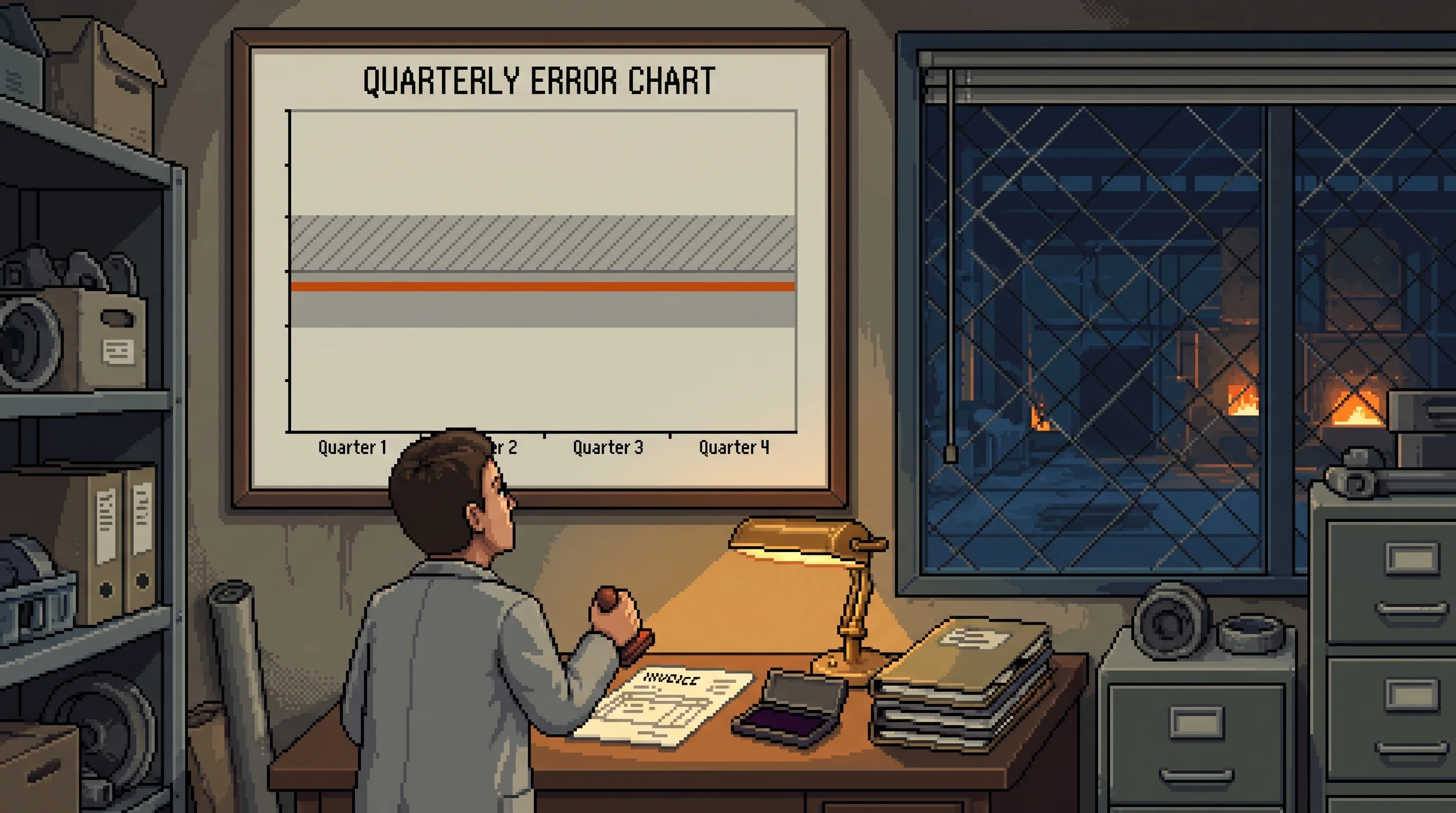
The instrument that buys the loop's output. Nothing is falsified; every step performs on inputs somebody paid for.
A bought error band that keeps a machine slightly wrong, so the inspectors who check it keep their jobs.
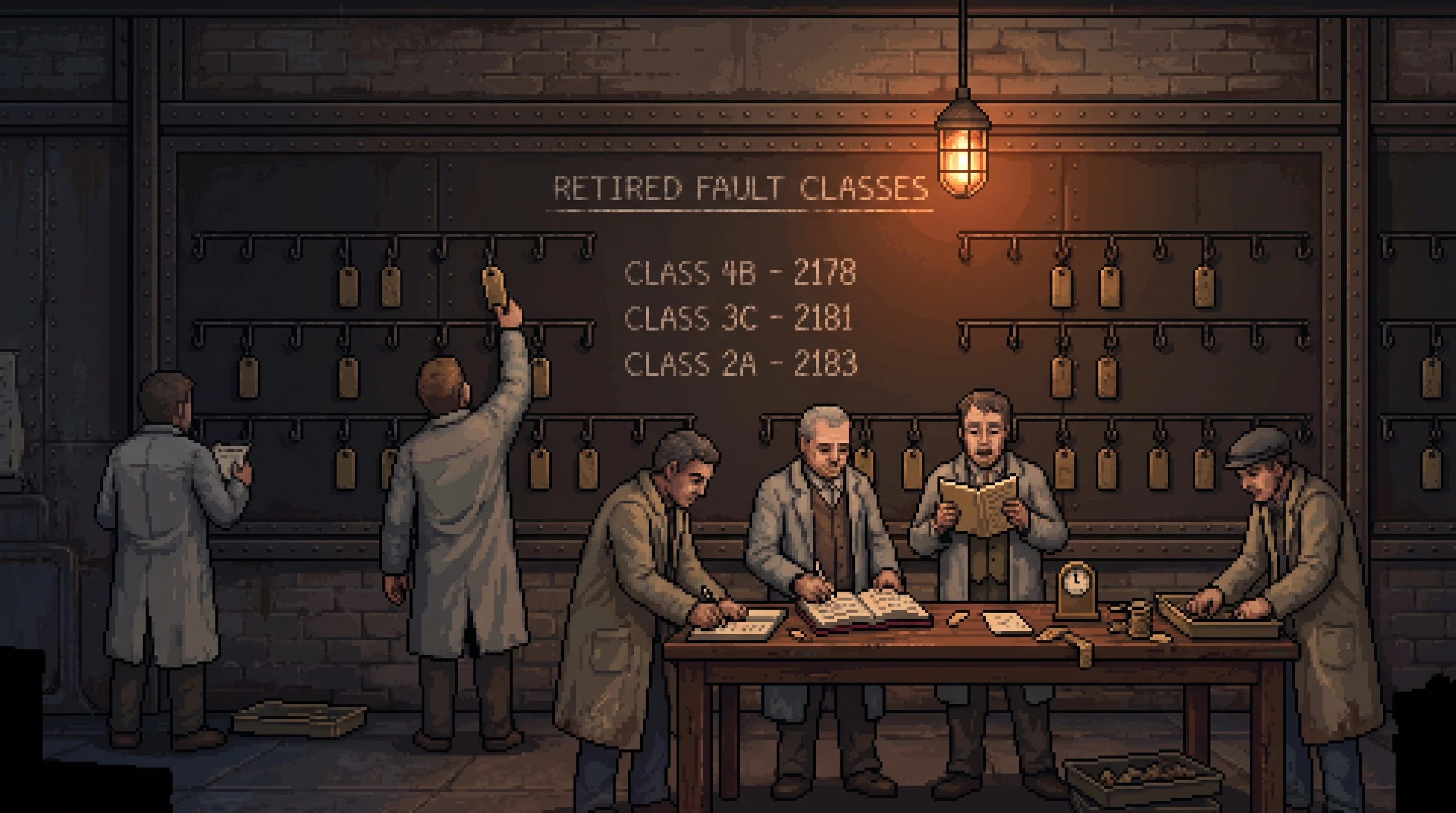
Supplies the inputs the loop reports as its own honest shortfall.
The licensed trade that holds a machine's error rate on the number its buyer's inspectors need to survive.

The Last Exam's unread confidence column was the Gap's origin document — self-assessment running inverse to measured capability

The Theater is the performance of capability; the Gap is the review of that performance, written by the performer
Mass performance of skill the Second Mind actually supplies — 99.2% accurate augmented, 11% when the AI cuts out.

The Second Mind is the engine on both ends of the loop — it does the work and it measures the work
The AI layer that thinks alongside every augmented brain until neither can tell whose thought was whose.

BBD is the only honest measurement — the loss seen from outside the loop, which is why it is never the number on the screen
Proof that removing cognitive debt's collateral returns a borrower to somewhere worse than before.

The Bright Room is the loop forced open for sixty minutes a year — the one external instrument in corporate territory

Park's self-correction metric and Whose Game rebuild the verification capacity the loop destroys
The Nexus cognitive scientist who quit to teach children to be comfortable being wrong.

Zhou's correlation engine, built to expose the gap, was repurposed to generate the dashboards that hide it
The Nexus VP who designed the consciousness license metering 340 million minds, Basic floor set at 67% on purpose.

The Gap is the Ceiling's economic expression — the productivity case for crossing the Ceiling rests on metrics the AI generated about itself
The settled fact that no living human's mind can out-think a five-dollar chip.

The Gap is why competence atrophy goes unmeasured — declining skill is read off AI-generated dashboards that report it as improvement, so the loss compounds without alarm until the Metabolization Crisis
The Sprawl builds orbital platforms but can't fix its own air processors — skill dying faster than it can be taught.




The precondition: the layer scores its own work, so the only rate anyone reads is the one that can be arranged.
The machine is held slightly bad on purpose, and the people it keeps are the reason.

Received the Last Exam report on a Tuesday and eliminated the test by Thursday, reading the collapsing-scores column and never the confidence column that became the Perception Gap; in 2181 called Nexus's workforce 'the most capable in the Sprawl's history' with his Second Mind active
Nexus's CTO, rebuilding the AI that killed two billion people, convinced the math was right.

The mask's overlay displays a resolution-rate dashboard generated by Good Fortune's collections AI from the Specialist's own auto-completed field reports — it shows 91% resolution and has no column for the debtors who entered the Firmware Cliff, defaulted again, or died.

The Heap is the constellation's ground truth — the last place in the Sprawl where output is measured by the world (clean board, still alive) instead of by an AI dashboard; the unaugmented baseline the offices above retired
A mountain range of Ironclad's discarded waste, mined by hand for the parts nobody manufactures anymore.

The VP's compliance dashboard logs each 'ambient compliance facilitation' as a compliant, client-service-positive event with a 0% incident rate — the compound's neurological harm classified as intended effect, so it appears in no column; 'routine' is the self-report the Gap produces.
