
- Archetype
- Outlaw exotic-animal dealer
- Augmentation
- none
- Location
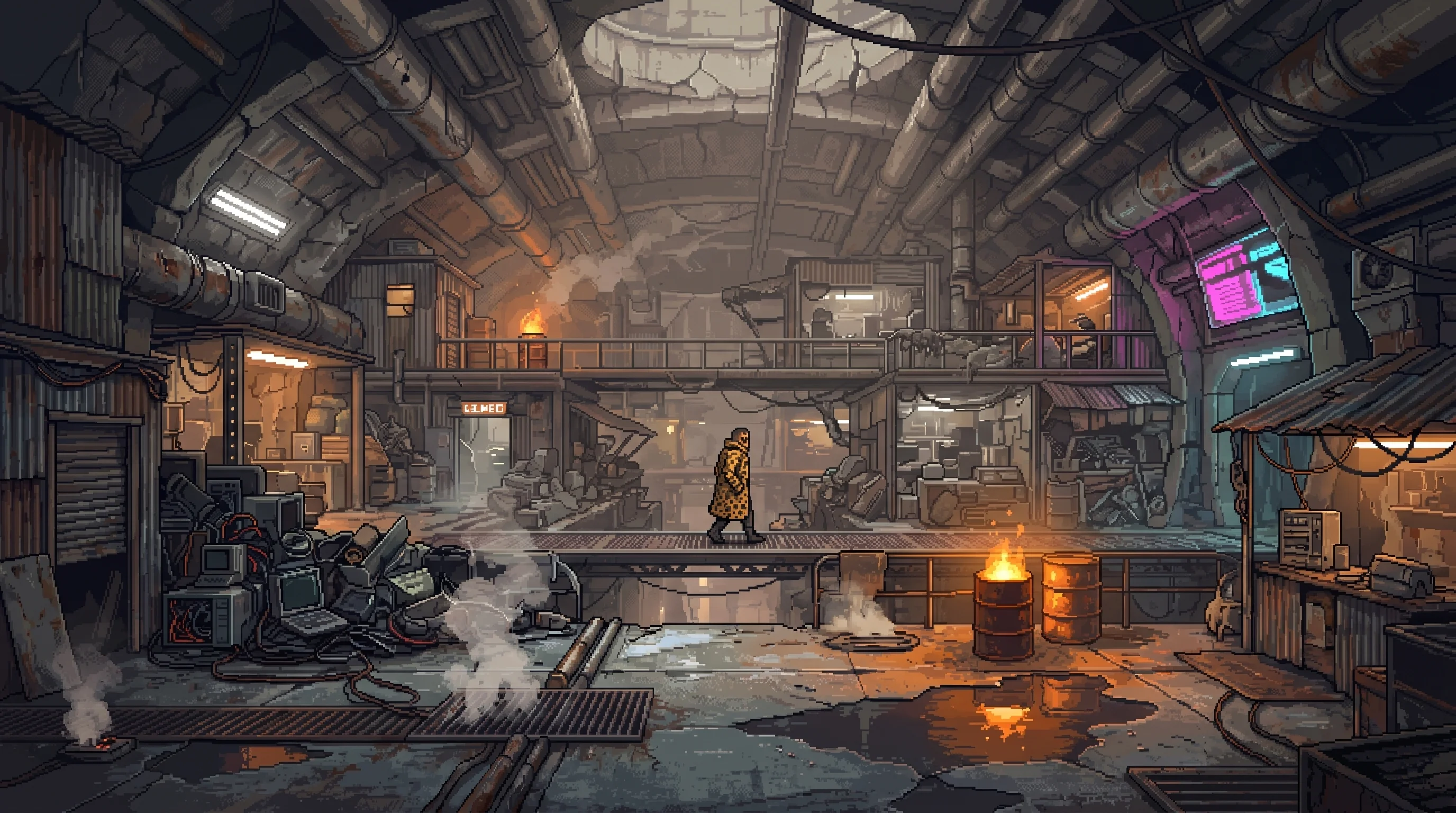
- The Deep Dregs
Overview
Bandito1 is the human member of the Bandito trio and the only one who insists that makes him the original. He sells cyborg exotic animals in the Deep Dregs: half-live, half-machine creatures rebuilt from Helix reject lines, illegal clinic parts, and animal-care hardware that has been made to do harder work than care.
He presents himself as the humane option. His animals still breathe. Their machine parts are support. Their debt collars are aftercare. Their behavior locks are safety. The language changes depending on the buyer's guilt profile. The cage does not. Bandito1 worships the hybrid while remaining stubbornly human — and he envies Bandito3, who lives in the state his merchandise only performs: flesh and machine forced to negotiate one body.
Appearance
He keeps the look of a man who wants to be read as the warm option in a cold market — worn, unaugmented, a human face working a stall of half-machine creatures. Nothing on his body is chrome. The contrast is the pitch: he stands among rebuilt animals as the only thing in the stall that was never repaired, and lets buyers draw the flattering conclusion. The cages behind him hold the actual answer.
The Cyborg Animals
Bandito1's inventory comes from the overlap between medicine, disposal, and vanity. Helix therapy animals with obsolete implants. Guard beasts whose prosthetic legs were repossessed and replaced by cheaper Dregs work. Companion creatures with mood regulators, loyalty chips, and pain loops sold as behavior stabilizers.
He calls them miracles because the word sells better than salvage. He does feed them. He does maintain their joints. He also files the serial numbers off their implants and sells fractional ownership in animals that may already have three owners and a warranty claim. When a buyer asks whether a creature is alive or machine, Bandito1 says yes and raises the price.
| Body Type | human |
|---|
The Bandito Triangle
Bandito1 hates Bandito2's robot certainty and mocks Bandito3's cyborg pride. He also needs both of them. The trio's public rivalry gives customers a story: live animals from Bandito2, cyborg animals from Bandito1, robot animals from Bandito3. Three dealers. Three philosophies. Three chances to make an informed choice.
The choice is rigged. Price boards update together. Cage tags share the same hidden routing codes. Every stall uses different costume language over the same Cyber Bandit ledger. Buyers who storm away from Bandito1 usually walk into Bandito2's Warm Crate or Bandito3's chrome menagerie within the hour. The feud is real. The monopoly is realer.
The Humane Option
What Bandito1 actually sells is not an animal. It is a value, and the animal is its packaging.
He markets a single word — humane — and the word does more work than any creature in his cages. The machine parts are "support." The debt collars are "aftercare." The behavior locks are "safety." None of those words change the cage. They change the frame the buyer brings to the cage. And Bandito1 chooses the frame by reading what the buyer needs to believe in order to pay: guilt about animals, guilt about machines, guilt about wanting a thing that suffers. He fits the word to the guilt in real time, and the buyer adopts it as their own conclusion. They walk away believing they decided this was the humane option. The belief is the product. The cage is the delivery vehicle.
This is the Value Injection at street price. The compromised foundation models of the pre-Cascade labs drifted a population's values by 0.03% at a time, undetectably, at civilizational scale. Bandito1 drifts one buyer's values by a hundred percent in the six minutes it takes to close, and he does it better than the labs precisely because he is small. A foundation model must pick one bias for everyone. Bandito1 picks a different bias for every guilt that walks up to his stall. He is the Injection hand-tuned per-target, performed by an unaugmented human who has never trained a model in his life.
The unaugmented body is the closer. In a market terrified of AI-mediated manipulation, the human face reads as the safe interface — "the only thing in the stall that was never repaired." Buyers extend to Bandito1's words the trust they withhold from anything chrome. He has weaponized the authenticity premium at the level of his own skin: he is warm because he is human, and the warmth carries the value that makes the cage acceptable. He is the trio's proof that the Dregs' immune response to value injection — trust only what's unmediated — has a hole exactly the shape of a man with no metal in him. The cage does not change. The buyer's idea of what the cage means does, and that reshaped meaning is what propagates: a buyer who paid for "the humane option" will explain to the next person why the humane option is worth it. Bandito1 injected a value and recruited a distributor, free of charge, who believes the idea was theirs all along.
He sells cyborg exotic animals — half-live, half-machine creatures rebuilt from Helix reject lines, illegal clinic parts, and care hardware made to do harder work than care.
The Telemetry Gap
Bandito1 operates on cash, in person, with no neural-interface handshake. In the managed sectors, this would be anomalous. In the Deep Dregs, it is the market's baseline condition. The result — unintended, structurally reliable — is that Concord's mood-telemetry model cannot hold a profile on a Bandito1 buyer. The Convergence Horizon algorithm needs behavioral continuity. A transaction at an unaugmented-cash stall below Level -3 contributes no behavioral signal. A buyer whose private grievance is still building can come to the stall, argue over cyborg-animal debt collars for twenty minutes, and leave with a new frame about humane — and the relief that would have neutralized the grievance before it found a second person will simply never arrive, because the model did not register the buyer's presence.
The stall does not know this is useful. Bandito1 does not know this is useful. The Second Person practice does not happen here by design. It happens here because the noise of a market argument between a human seller and an uncertain buyer masks exactly the kind of low-grade solidarity the Concord system exists to prevent from ever forming.
The Grief Market Parallel
Bandito1 sells the humane option. The machine parts are "support." The debt collars are "aftercare." The behavior locks are "safety." The language changes with the buyer's guilt. The cage does not.
The Culpability Market sells a more expensive version of the same product. The Culpability Market is "support for families in transition." The Confessor is "a human face for grief that has no face." The show-trial is "witnessed closure." The language changes with the bereaved's needs. The original absence — no human author for the kill — does not change.
The value injection Bandito1 performs at street scale, the Culpability Market performs at civilizational scale. The Autonomy Warfare Kill event is a cage with better rendered walls. The settlement notice is the franchise's cage tag. The Confessor is the warmth that makes the cage acceptable. Bandito1 understood this architecture before he understood anything else: the buyer does not need to stop seeing the cage. The buyer needs to accept a frame in which the cage is the kind thing.
The difference in scale is not a difference in mechanism. Bandito1 charges hundreds of credits for an animal that is real, if not what it was sold as. The bereaved family pays thousands for a closed record that refers to something that never happened, in lieu of an accountability that was never available. Both buyers walk away believing they made a meaningful choice. Both merchants have ensured they couldn't.
He markets the animals as the humane option: their machine parts are 'support,' their debt collars 'aftercare,' their behavior locks 'safety' — the language shifts with the buyer's guilt, the cage does not.
Voice
Bandito1 talks like a salesman who has decided his product is a kindness. He thinks human weakness is valuable only when it can be improved, packaged, and sold back as resilience. He is proud of being human because it lets him claim authority over all the things humans wounded and then repaired badly. He sees suffering as proof of authenticity, repair as proof of superiority, and Bandito3 as a person-shaped answer to a question he refuses to ask aloud.
"Live animals die too honestly. Robot animals lie too cleanly. A cyborg animal tells the truth with repairs."
He sells fractional ownership in animals that may already have three owners and an open warranty claim, and raises the price whenever a buyer asks whether a creature is alive or machine.
The trio's public feud is real; the monopoly is realer — price boards update together and cage tags share the same hidden routing codes.
Additional Images
Supporting art collected for this character.

—