Neon Underground Hub
Overview
The Neon Underground Hub moves 412,000 commuters daily through Ironclad's largest sub-surface transit interchange beneath The Works. It also moves an estimated 6,800 tonnes of unregistered cargo per month through the same tunnels, though Ironclad's quarterly infrastructure reports have listed cargo volume on levels three through five as "N/A — maintenance zones, non-operational" since 2174. The designation has survived nine years and four audits. The auditors descend to level two, note that the fire doors to level three are locked, and return to the surface. The fire doors have not been locked since 2169.
Four hundred thousand people pass through the Hub every day. A meaningful percentage of them use the lower levels for purchases unavailable through corporate channels. The transit authority's ridership analytics show an average platform dwell time of 4.2 minutes on levels one and two. On the level-two ramp nearest the fire doors, average dwell time spikes to 11.7 minutes. Ironclad's traffic modeling team has attributed this to "suboptimal escalator routing." The escalators have not functioned in six years.
Everybody who works in The Works knows what the lower levels are. Everybody who rides the Hub has walked past the fire doors. The system's stated purpose is transit. The system's actual product is plausible deniability at industrial scale — a place where Ironclad maintains just enough infrastructure to claim jurisdiction and just little enough security to avoid discovering what that jurisdiction contains.
The Descent
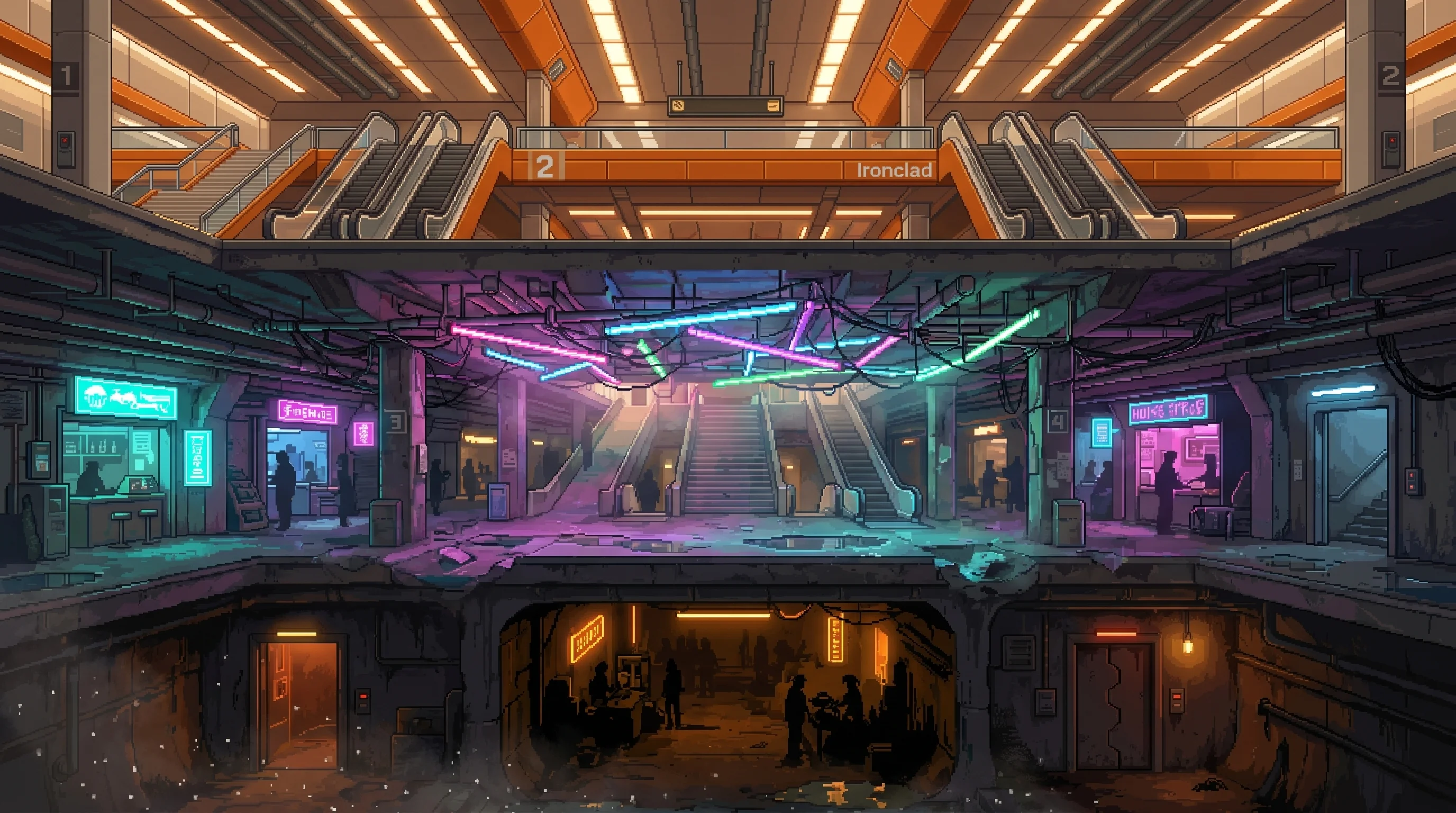
The Hub drops through five levels connected by dead escalators and ramp systems polished glassy by years of boots. Level one is recognizably Ironclad — industrial orange signage, directional lighting embedded in the floor, platform barriers humming at a frequency that makes your teeth itch. The corporate aesthetic holds through level two, where the maintenance corridors still have Ironclad serial numbers stenciled on the walls and the air processing delivers something approximating breathable.
Level three is where the name comes from. Salvaged neon tubes — pink, blue, green — lashed to ceiling pipes with cable ties, wired into bootleg power taps that Ironclad's grid monitoring registers as "distribution losses." The losses amount to 340 megawatts annually, enough to power a mid-tier residential block. The grid team files the discrepancy under infrastructure decay. The infrastructure is functioning perfectly. It is just functioning for someone else.
The walls down here are raw concrete, sweating condensation, tagged with directional shorthand that changes weekly. The air carries ozone bleeding down from the mag-rail, smoke from food stalls whose operators have never filed a Wholesome vendor license, machine oil from cargo rigs too large for the tunnels they're forced through. Below that, the mineral smell of passages that go deeper than any Ironclad blueprint admits to.
The sound never stops. Train rumble from above. Hand-cart clatter. Low-voiced transactions. The occasional metallic shriek of something being dragged through a corridor that wasn't built for it — or wasn't built at all.

History
Ironclad broke ground on the Hub in 2161, part of the transit buildout connecting The Works to the wider Sprawl. Approved blueprints specified three levels: transit, maintenance, utility. Standard infrastructure.
The official account of what happened next has been revised four times.
The 2173 maintenance inspection report — the first to acknowledge levels four and five — describes the discovery of "unauthorized structural modifications to sub-grade utility corridors." The corridors had been widened, reinforced with salvaged Ironclad structural beams, and fitted with independent ventilation. The report estimates the modifications required eighteen to twenty-four months of continuous construction. Ironclad's seismic monitoring grid, which detects unauthorized excavation across all corporate territories, logged no anomalous activity in Sector 4 during the relevant period. The monitoring grid was functioning normally. The construction happened anyway.
The 2175 follow-up report reclassifies the lower levels from "unauthorized modifications" to "legacy pre-Cascade infrastructure discovered during routine expansion." This is a remarkable reclassification, given that the 2173 report explicitly describes post-Cascade construction techniques and materials dating to the late 2160s. Nobody has publicly noted the contradiction. The reclassification moved the lower levels from Ironclad's active security jurisdiction to its historical preservation archive, which is staffed by two people and has a response time measured in quarters.
Scavengers and traders were already operating on level four when the 2173 inspectors arrived. The inspectors documented "approximately forty to sixty individuals engaged in informal commerce." Current estimates place the lower-level population at any given time between eight hundred and three thousand, depending on the day and what's moving. The growth from sixty to three thousand occurred entirely within infrastructure that Ironclad's records classify as unoccupied.
| Stratum | Dregs |
|---|---|
| Power Position | Below |
| Access | Public |
| Atmosphere | Chaotic |
The Market
The lower levels operate on a gift-economy-adjacent barter system that makes Ironclad's transaction monitoring useless. No credits change hands. Goods move through a web of favor exchanges, standing arrangements, and reputation scores maintained in no database anyone has found — tracked by the traders themselves through a system of colored neon signals visible only to people who know what the colors mean.
What moves through here: salvaged components stripped from e-waste that the Rothwell Foundation's recycling programs technically have first claim on. Unregistered medical supplies that didn't pass through Helix's pharmaceutical chain of custody. Refurbished neural interface hardware that Nexus would very much like to know about, given that unlicensed interface mods represent both a security risk and a revenue leak. Food — actual food, not Wholesome-certified synthetics — sourced from vertical farms and hydroponic rigs hidden in the unmapped tunnels below level five, sold by vendors whose produce has never been scanned by Wholesome SupplyChainIQ because Wholesome SupplyChainIQ doesn't know these tunnels exist.
The market optimizes for one thing: moving goods that the corporate supply chain has either priced out of reach or declared illegal to possess without a license.
The lower levels also fall below Concord's telemetry resolution. Nexus's surveillance grid doesn't extend below level two because the levels don't officially exist, and Concord's mood-monitoring resolution maps to Nexus's surveillance architecture. Where Nexus cannot see, Concord cannot target. In the lower levels, workers from the same facility discover they've received the same pay reductions, the same safety violations, the same administrative denials — not through any organized meeting but through the specific kind of conversation that happens when people are buying antibiotics for their children in a place that officially doesn't exist. The Hub's average platform dwell time at the level-two ramp spikes to 11.7 minutes. It is approximately the time it takes to descend, complete a transaction, and return. It is also approximately the time it takes to describe something that happened to you and hear someone else say they experienced the same thing.
The commuters who descend through the fire doors on their way home from shifts at The Foundry are not criminals. They are people buying antibiotics for their children at prices Helix doesn't offer, or picking up a replacement neural interface capacitor that Nexus sells for forty times what the salvage vendors charge. They make their purchases in neon-lit alcoves, climb back through the fire doors, and stand on the platform with their bags. Nobody looks at anyone else's bag. The collective fiction holds because the collective fiction serves everyone — the commuters, the vendors, and Ironclad, which would rather classify 340 megawatts as distribution losses than explain to its shareholders why a black market the size of a small district has been operating under its flagship transit hub for fifteen years.
A thriving black market operates on the lower levels beneath the legitimate transit infrastructure
Notable Features
The Neon Arcade — level three's main corridor, where the salvaged tubes create a permanent shifting aurora that gives the Hub its name. The colors aren't decorative. Pink means pharmaceuticals. Blue means tech components. Green means food. Vendors rotate their positions but the color codes hold. New arrivals who don't know the system buy from whoever's nearest. Regulars navigate by wavelength.
The Deep Junction — the lowest accessible point, where three unmapped tunnels converge beneath level five. Regulars claim the passages connect to pre-Cascade infrastructure that predates Ironclad's construction by decades. Several organized expeditions have entered. Most returned. The ones who returned describe architectures inconsistent with any known Ironclad building standard — older, heavier, built for purposes nobody has identified. The passages appear on no known map of the Sprawl. Ironclad's cartographic division has been asked about them twice and responded both times that "sub-grade survey data for Sector 4-F is pending updated geological assessment." The assessment has been pending since 2176.
The Commuter's Lie — the fire doors between levels two and three, permanently unlocked, that 412,000 daily riders walk past and a meaningful percentage walk through. The doors bear an Ironclad safety notice: RESTRICTED MAINTENANCE AREA — AUTHORIZED PERSONNEL ONLY. The notice has not been replaced or maintained since installation. Its edges are worn smooth by the shoulders of people squeezing through. The most honest piece of architecture in the Sprawl — a locked door that isn't locked, a restriction that doesn't restrict, serving a system that functions precisely because nobody enforces it.
Cargo haulers and scavengers share the tunnels with commuters who pretend not to see them
The Bargain's Cheapest Door
The Sprawl's other privacy havens cost something steep up front. The Trench charges in the risk of drowning. The Veil charges in a four-minute vault walk and a counterparty relationship you cannot fake. The fire doors of the Neon Underground Hub are the Transparency Bargain's most democratic blind spot precisely because they cost nothing but participation in a lie everyone is keeping at once. The commuter buying antibiotics Helix doesn't offer, or a neural-interface capacitor Nexus sells for forty times the salvage price, makes the purchase in a neon-lit alcove, climbs back through the door, and stands on the platform with their bag. Nobody looks at anyone's bag. The collective fiction holds because the collective fiction serves everyone in the tunnel at once.
What makes the Hub the keystone of the geography of invisibility is the reason the blind spot survives: surveilling it would cost more than it saves. Ironclad's traffic models attribute the 11.7-minute dwell-time spike at the fire-door ramp to "suboptimal escalator routing," and the escalators have not functioned in six years. The corporation knows. The corporation has chosen not to know, because the price of knowing — re-wiring the surveillance, prosecuting the commerce, finding somewhere else to put the people — exceeds the price of the lie. Privacy here is not a right and not an accident. It is a corporate accounting decision, renewed quarterly by the silence of auditors who descend to level two, note that the fire doors are locked, and turn around. They have not been locked since 2169.
This is the same logic that governs Ironclad's other transit hub — Pacific Spine Terminal, where surveillance is shaped not by ideology but by what the metrics are worth measuring. At the Spine, every departure is counted as throughput because counting is cheap. At the Hub, the lower-level commerce goes uncounted because counting is expensive. Privacy and exposure, in Ironclad's territory, are both just line items — and the Hub is the place where, for once, the math runs in the watched person's favor.
The lower levels connect to passages that appear on no known map of the Sprawl
Affiliated Entities
| Entity | Relationship |
|---|---|
| Ironclad Industries | Built and nominally maintains the transit infrastructure. The word "nominally" is doing significant structural work in that sentence. Ironclad's maintenance budget for the Hub covers levels one and two. Levels three through five receive no scheduled maintenance, no security patrols, and no infrastructure assessments — a policy that has produced zero reported incidents, because incidents on nonexistent levels cannot be reported. |
| The Deep Dregs | Major transit link. A significant volume of the lower-level market's goods originate from Deep Dregs salvage operations, moving upward through the unmapped passages into the Hub's distribution network. The connection is denied by both endpoints. |
| The Foundry | Primary commuter route for Works-district laborers. The Foundry's shift-change schedule produces predictable surges in level-two foot traffic — and corresponding surges in fire-door throughput approximately fourteen minutes later, timed to the average round trip to level three and back. |
Sensory Profile
- Smell: Ozone bleeding down from the mag-rail, cooking smoke with no Wholesome certification, machine oil, and the wet mineral breath of tunnels that shouldn't be there
- Sound: Constant. Trains above, hand-carts below, low voices everywhere, and the periodic metallic shriek of cargo being forced through passages built for maintenance drones
- Light: Corporate white on levels one and two; salvaged neon from three downward — shifting pink-blue-green that makes everything look like a memory of a place you've never been
- Temperature: Drops 2.1 degrees per level. Level five runs cold enough to see your breath. Ironclad's climate control stops at level two. Below that, the tunnels regulate themselves
- Touch: The ramp surfaces are glass-smooth from traffic. The walls on level three are damp. Everything below level four has a faint vibration with no identified source
▲ Unverified Intelligence
Ironclad's seismic monitoring gap during the 2168-2170 construction period has a simpler explanation than equipment failure. Three former Ironclad infrastructure engineers, now retired in different sectors, independently describe receiving instructions to "recalibrate sensitivity thresholds" for Sector 4's sub-grade monitoring during that period. The instructions came through standard operational channels. None of the three engineers found the request unusual at the time. Someone inside Ironclad authorized the construction of the lower levels — or at minimum, authorized looking away while someone else built them. The question of who benefits from a permanent, unmonitored logistics network beneath the Sprawl's largest industrial district has not been formally asked by anyone with the authority to demand an answer.
The unmapped tunnels below the Deep Junction may connect to infrastructure that predates not just Ironclad's construction but the Cascade itself. Salvagers who've gone deepest report finding structural reinforcement stamped with manufacturing dates from the 2130s — seventeen years before the Hub was built, in tunnels that Ironclad's geological surveys claim are natural formations. Whatever was down there before Ironclad arrived was already built for heavy traffic. The question is whose.
At least two corporate entities with financial interests in the Hub's legitimate transit business are believed to maintain standing arrangements with lower-level market operators. The arrangements are not documented. They are understood.
The lower-level black market persists because surveilling it would cost Ironclad more than the 340 megawatts it writes off as distribution losses — privacy here is a renewed accounting decision
Connected To
Major Connections

Ironclad maintains levels one and two and writes off the market's 340 stolen megawatts as 'distribution losses.'
The megacorporation that controls the Sprawl's physical infrastructure — steel, concrete, and the Orbital Elevator.

Where Nexus can't see, Concord can't target — below level two the mood-monitor simply loses resolution.
The civic prediction system that dissolves collective action before it becomes visible.

The bargain's cheapest door — privacy that costs nothing but a lie everyone keeps at once.
The vertical surveillance bargain that trades total transparency for participation in Sprawl society.
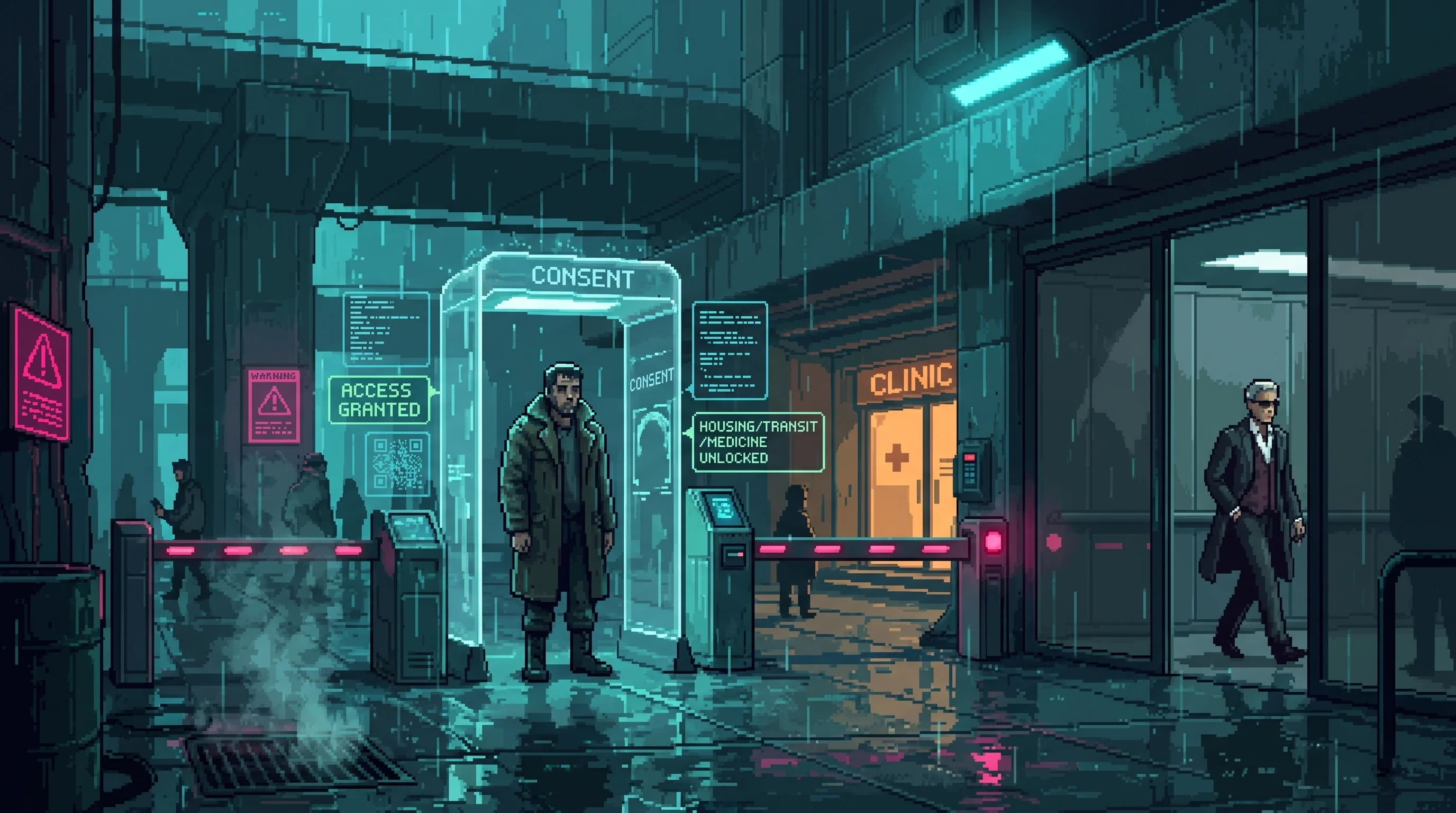
Privacy as a quarterly accounting decision: watching the market costs more than the megawatts it steals.
The Sprawl demands permanent personal data for participation, then uses it to price access and preempt solidarity.
Supporting Connections

Deep Dregs salvage rises through unmapped tunnels into the market.
The Sprawl's lowest stratum and its quiet proof that the corporate system is optional.
Foundry shift-change surges hit the fire doors fourteen minutes later.
Ironclad's 31-million-worker forge, where a human wing sells hand-finished welds as proof a person was there.

Ironclad's other hub: there counting is cheap, here it costs too much.
Ironclad's maglev terminus: the only surface way out of the Sprawl, and it counts you leaving.
Local Intelligence Scan
Nearby Signals
CANONICAL PROXIMITY


Environmental Readout
LIVE CONDITIONS- Air
- Hazy
- Light
- Shadowed
- Flood
- Seasonal
- Heat
- Heat island
- Security posture
- Contested
- Infrastructure
- Patchwork
Position Data
SECONDARY- Elevation band
- sub-surface
- Lattice fix
- E-0.4 · N-3.8

—