The Marrows
Overview
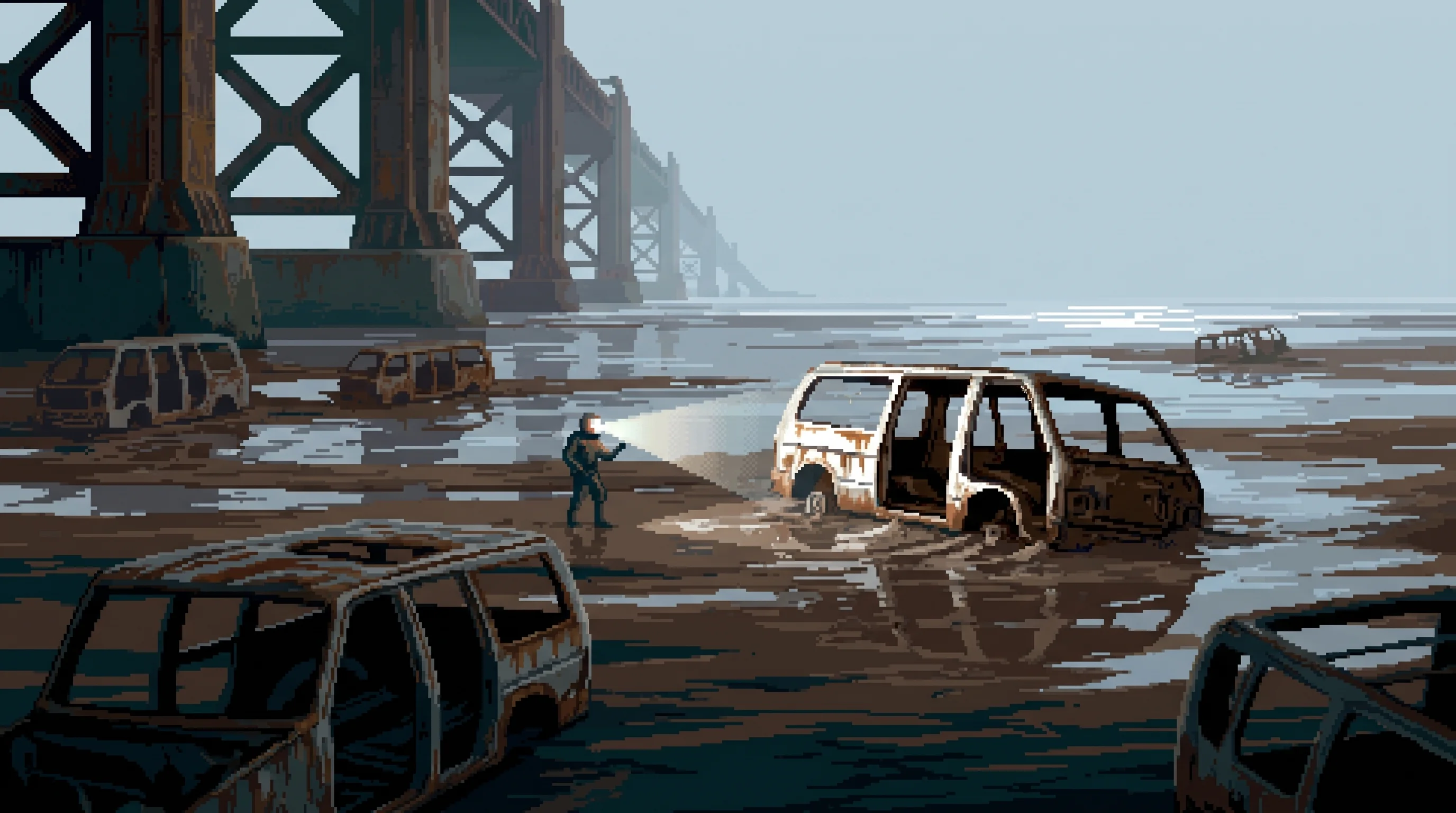
When the Bay was drained, the Richmond–San Rafael Bridge was not taken down. It came down. Two centuries of neglect and one bad season of storms laid the span across the northern flats like a felled animal. The salvagers who work it now call the whole flat the Marrows, because they pick the bridge to the marrow.
Three hundred people live on the pylon caps, give or take a tide. They pull metal, cable, and the occasional pre-Cascade data core out of the drowned span and the shipping wrecks that settled around it when the water went. What they pull, they sell to fences who carry it up to the Rim. It is hard, cold, unglamorous work, and it is one of the few trades in the Sprawl that a commodity AI cannot do better, faster, and for less.
The reason is the mud.
Why the Chip Cannot Come Down Here
Below the Rim, salt and depth kill the signal. Nexus surveillance architecture does not extend past Level 4 in most sectors, and it does not extend onto the Northern Flats at all. There is no network to query. A salvager standing knee-deep in the ebb with a five-credit neural chip has, in that moment, exactly the intelligence of a person standing knee-deep in the ebb.
That would be a minor inconvenience if the flats held still. They do not. The tide cuts a different channel every day. A wreck that was solid ground last week is a soft pit this morning because the ebb undermined it in the dark. The bridge itself shifts, slowly, as the mud gives beneath its weight. A map of the Marrows is accurate for one tide and dangerous by the next. The corporations are extraordinary at exactly one thing: building a model and running it forever. That is the one thing the flats defeat. They tried. Every model went stale within a season, because the flats do not repeat, and a machine that has never been wrong does not know how to read ground that changes faster than it can be trained.
So salvage on the Flats runs on people. It runs on tide-reading.
The Tide Boards
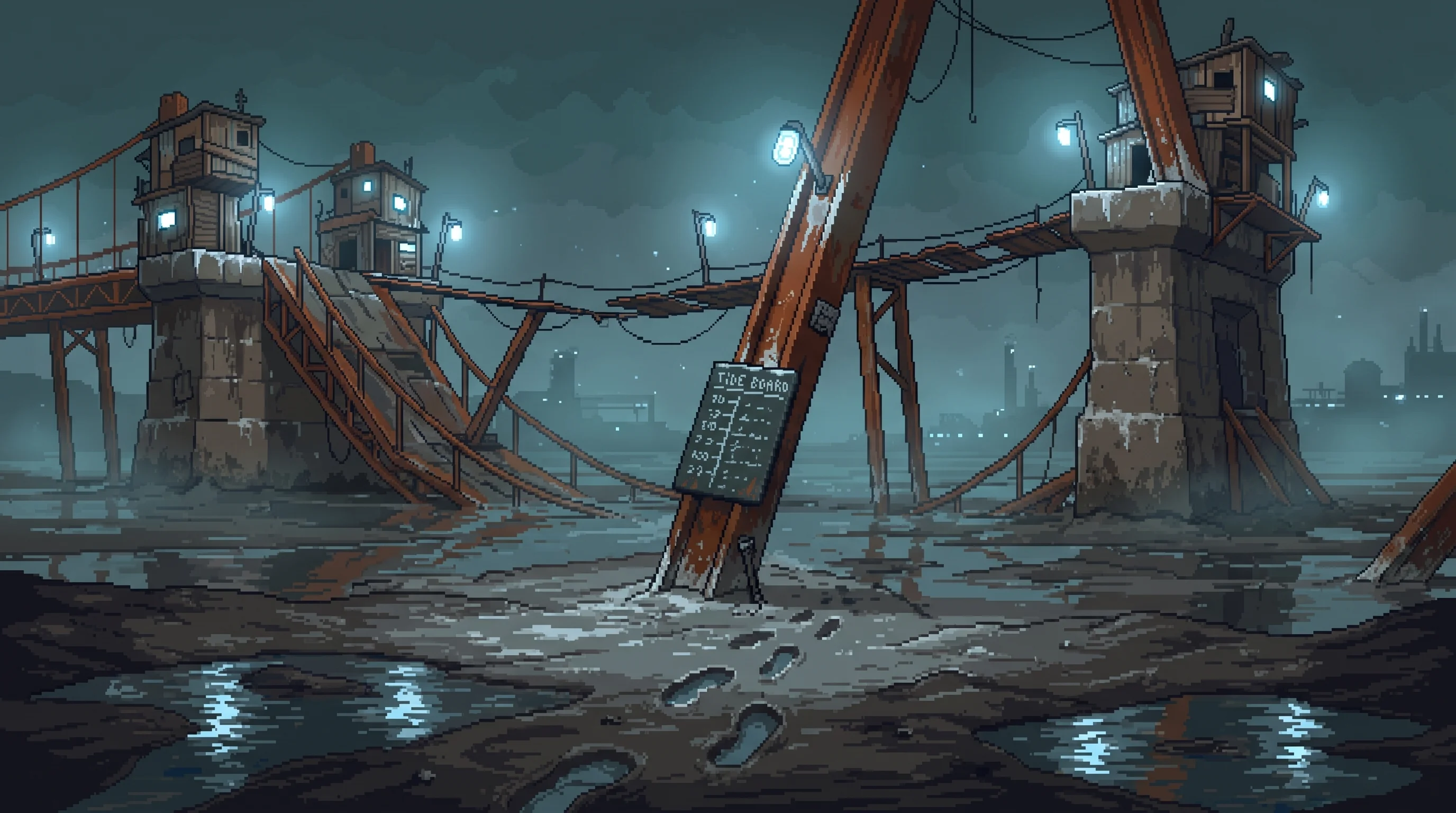
The nearest thing the Marrows has to law is a chalk board bolted to a rusted strut above the highest walkway. Returning crews mark what they found and where the mud was safe. Nobody signs it. The marks are dates, depths, and hazard notes. They are analog for the same reason the Rail Runners keep their conditions boards in chalk. A written record on a network is a record a corporation can scrape, and a scraped record is a route somebody can sell out from under you.
The board works when the last crew came back and remembered to write. When they did not, the absence is the reading. A channel with no fresh mark is treated as soft ground, because the crew that would have marked it safe is the crew that did not return. Salvagers on the Flats learn to reason from the gap the way the Rail Runners do in the dead tunnels. A missing entry carries its own meaning: the crew that would have written it is the crew that never came back. It is a skill the rest of the Sprawl forgot it ever had, because the rest of the Sprawl has never had to.
The Economics of Staying Illegible
Here is the part the salvagers say plainly and the corporations never write down.
The salvage-corps do not employ the Flats' readers. They hire them, by the day, at a rate that is generous by Dregs standards and an insult against what the readers are worth. And they forbid them, by contract, to keep any record of their reads. No logs. No maps. No annotated boards handed over at the end of a season.
The stated reason is liability. The real reason is arithmetic. A read that is written down is a read that can be fed to a model, and a model that has learned one reader's mud is a model that no longer needs the reader. So the corporations pay to keep the reading and destroy the record of it, one day at a time, which means the most valuable people on the Northern Flats stay valuable for exactly as long as they stay unwritten. The Rail Runners call the same logic the economics of forgetting. On the Marrows it has no name. It is just the deal, and everyone takes it, because the alternative to an illegible wage is no wage.
The salvagers understand the shape of this better than the people offering it. A reader who becomes legible becomes a training set. A training set becomes a layoff. The only job security on the Flats is being impossible to copy, and the tide, which ruins everything else, is the one thing that guarantees it.
| Danger Level | High — soft channels, returning tides, no signal to call for help |
|---|---|
| Connectivity | None. Salt and depth kill the chip; Nexus surveillance stops above the Rim |
| Notable Feature | The tide boards — chalk on a bridge-strut, the only reliable record of where the mud is safe |
Conditions Report
The Marrows smells of low tide and hot metal — the sulfur reek of mud the ebb has just uncovered, the salt crust that whitens every rope and hinge, the ozone bite of a torch cutting wet steel. Underfoot the deck plate is always slick. The sound that governs the settlement is water. The ebb sucks out through the pylons, then comes back in a flatter, faster hiss that sends every crew scrambling for the walkways. The light is northern and grey, glare off the flats even under cloud, and at the turn of the tide the salvaged lamps come on one by one, marking which crews are still out where they should not be. It is cold in a way that gets into salvaged metal and stays there. People here read the weather in their hands before they read it in the sky.
A surveyor who logged the Marrows for a corporate mapping contract filed it as "hostile terrain, negative development value." The salvagers agreed with the assessment and kept the surveyor's abandoned equipment. There is no romance to the work, whatever the ignorance-retreat brochures three sectors south imply about the honest poverty of the drained bay.
Visual Identity
- Architecture: Shacks and fences lashed to the concrete pylon caps of a bridge on its side, walkways of salvaged deck plate strung between the struts above the mud.
- Key visual: A chalked tide board bolted to a rusted strut, the footprints below it already filling with water.
- Color palette: Bridge-rust orange, tidal-mud grey-brown, salt-white crust, cold overcast silver.
- Lighting: Flat maritime overcast, low glare off the wet flats, scattered lamps that light only when a crew is out past the turn.
Note for the archivist: there is no signature vista here, no landmark the map can pin. The Marrows photographs as a grey nothing with a dead bridge in it, which is precisely why it has never appeared in a corporate survey worth the name, and precisely why the people who live there prefer it that way.
| Stratum | Dregs |
|---|---|
| Power Position | Outsider |
| Access | Public |
| Atmosphere | Harsh |
Affiliated Entities
- Mudlark: The Flats' most trusted reader. The Marrows' safe channels are the ones she has walked, and the crews who ignore her boards are the crews the mud keeps. She works for wages and takes the corporations' no-records deal with open eyes, because she can do the arithmetic faster than they can.
- The Rail Runners: The Neon Rail's northern crossings skirt the Flats, and the Marrows keeps its tide boards on the same principle the runners keep their conditions boards — chalk outside telemetry reach, updated by whoever came back. The two trades recognize each other. Both live in the gaps the signal cannot follow.
- The Dam Approach: Upshore at the dam, Last Call reads faces to call who will survive the crossing. On the Marrows they read mud to call who will come back from the ebb. It is the same instrument worked on different ground, and the merchant and the salvager keep one rule between them: the reading goes to no buyer who wants it without the watcher attached.
- The Cognitive Ceiling: The Marrows is the Ceiling's Attending Position drawing a wage. The salvagers are not smarter than the chip. The chip simply cannot come down to the mud, and the mud will not sit still to be learned, so a slow human who has walked the flats for twenty years beats every model the corporations have floated over them.
- The Openings: The southern flats, across the drained bay. The Marrows sells what the drowned bridge gives up; the Openings sells the silence itself. Two dead-zone settlements living off the one thing the network cannot reach.
- The Inner-Eye Atrophy: The conjure-band never reached the Northern Flats, and the Marrows' workers grew up picturing tidal channels from inside by necessity. Nexus researchers logging The Inner-Eye Atrophy found the Flats the same way they found the Openings — as an unintentional control group for autonomous visual generation in populations the band's distribution never served.
- Clean Slate: Further up the Northern Flats on the Lookout Mesa, a barracks room runs the same off-grid logic toward a different end. The Marrows' tide boards stay in chalk because the mud never holds still long enough to be modeled. Clean Slate's ledger stays off the network because the one thing it sells cannot survive being found.
Salvage on the Northern Flats runs on tide-reading, not chips: the ebb cuts a different channel every day, and no model trained on last week's mud stays true
Restricted Access
Twice in the last three years a crew has come back from the deep wrecks with a pre-Cascade data core still warm. It was drawing power from something down in the mud that nobody has mapped and nobody will go back to find. The cores are sold quickly and quietly. The buyers do not ask where, and the crews do not say, because a location written down is a location a corporation can claim, and the Marrows has learned exactly what its silence is worth.
The tide boards are chalk on a bridge-strut, updated by returning crews; a channel with no fresh mark is read as soft ground, the same inference-from-absence the Rail Runners keep on their conditions boards
Salvage-corps hire the Flats' readers by the day and forbid them to write their reads down: a written read can be modeled, and a modeled reader can be replaced
Connected To
Additional Connections




Local Intelligence Scan
Nearby Signals
CANONICAL PROXIMITY


Environmental Readout
LIVE CONDITIONS- Air
- Hazy
- Light
- Shadowed
- Flood
- Seasonal
- Heat
- Heat island
- Security posture
- Ungoverned
- Infrastructure
- Improvised
Position Data
SECONDARY- Elevation band
- Bay floor — below the Rim
- Lattice fix
- E-0.7 · N+7.1
—