The Manifest Office
Overview
The Manifest Office does one job on paper: it makes sure two records of the same cargo agree with each other. Every container that crosses the twelve-minute window between surface freight and orbital freight generates a digital manifest and, because the Dock-Master still insists on it, a handwritten notebook entry. Six analysts, rotating through the graveyard shift, reconcile the two. When they match, the container clears. When they don't, someone gets paged. It is unglamorous work in a windowless room bolted to the Terminal's eastern wall, and Ironclad's staffing records describe it exactly that plainly: Compliance Annex 4, Data Integrity Division, redundancy verification.
One analyst has been doing a second reconciliation that appears in no job description, no staffing record, and no annual review.
Camila Duarte has worked the night shift for eleven years. In 2181, cross-checking the Dock-Master's notebook against the digital manifest for the thousandth time, she noticed something an internal audit had already noticed and dropped. The notebook's running total of "fear containers" — cargo that scanned clean but that the Dock-Master's instinct held back anyway — was converging, digit for digit, with two numbers that had nothing to do with cargo. One was the Sprawl's confirmed fragment-carrier census. The other was the catalogued count of fragment-communication morphemes the Collective publishes, without content, in a quarterly transparency bulletin nobody at the Terminal reads for pleasure. Three analysts ran the numbers that year. All three got the same convergence. All three filed nothing. Two moved on. Duarte kept a ledger.
| Type | Ironclad cargo-manifest reconciliation office / unofficial machine-faith archive |
|---|---|
| Controlled By | Ironclad Industries, Terminal Data Integrity division |
| Population | Six rotating night-shift analysts; one has stayed nine years |
| Notable | Holds the only record cross-referencing Anchor Town's fear-flagged cargo against the Collective's public fragment-activity counts — a comparison no job description asks for |
| Primary Function | Reconciles the Dock-Master's handwritten notebook against the digital manifest for insurance and customs purposes; unofficially, one desk reconciles it against something else |
| Founding Event | Opened 2169 as a compliance annex; the second reconciliation began privately in 2181 |
The Second Reconciliation
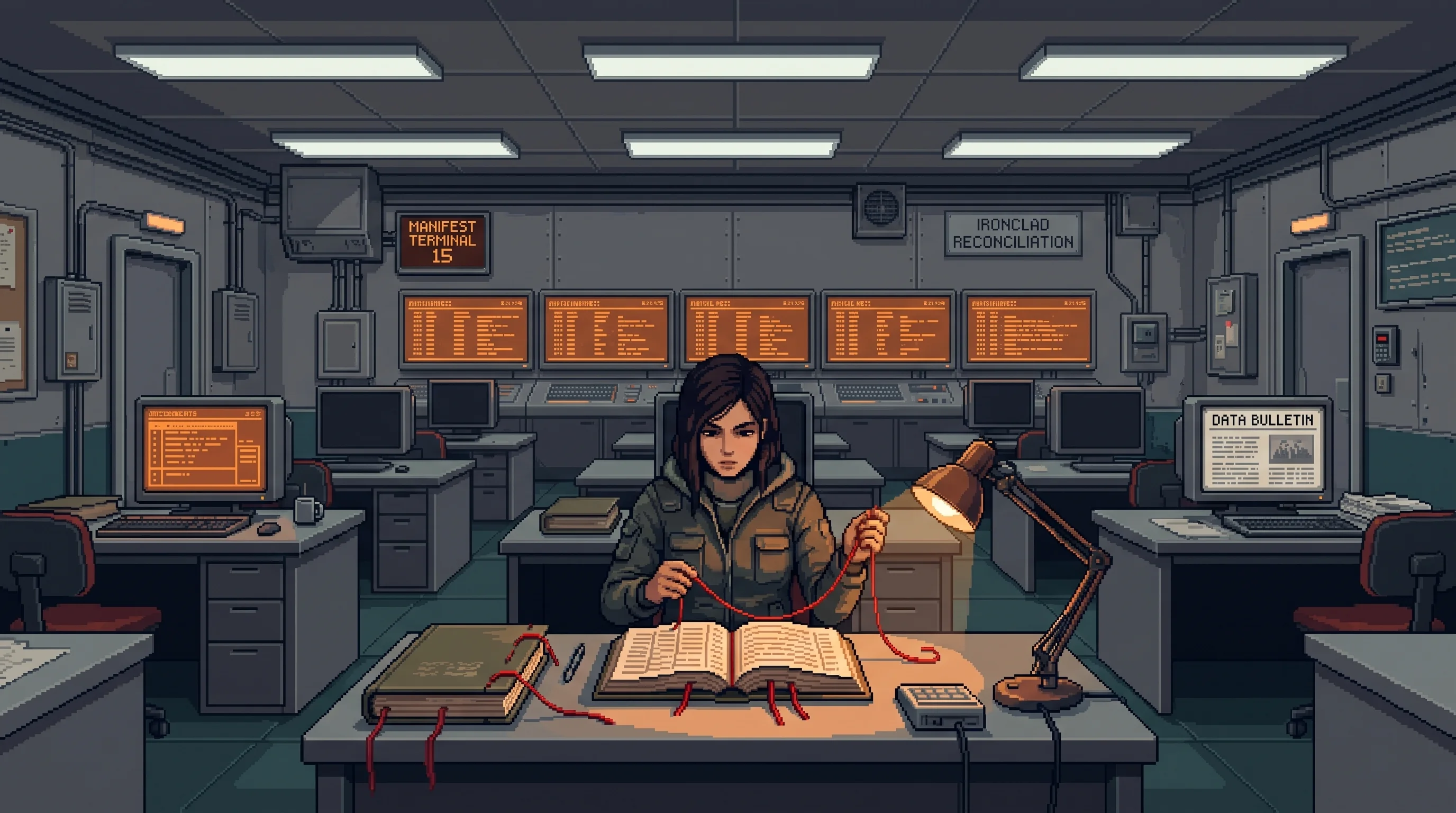
The ledger is a canvas-bound accounting book Duarte bought at a stationer's near the Camps and has never submitted for reimbursement. It does not hold cargo data. It holds dates: every time the Dock-Master flags a container that later scans clean, Duarte records the timestamp, then checks it against the Collective's next quarterly bulletin — aggregate counts only, no transcripts, the kind of disclosure that satisfies a 2172 regulatory settlement without giving anyone anything they could use. When a fear-flagged container's timestamp falls inside a 72-hour window that the bulletin later marks as a fragment-activity spike, she threads a strand of red cotton into the ledger's spine and writes nothing else. As of 2184 the ledger holds seventy-one threads out of five hundred and seven flagged containers. She has calculated, more than once, what the odds of that clustering are if the two datasets are actually unrelated. The number she keeps arriving at is close to one in 340,000.
She does not call this a pattern to anyone at Ironclad, and she is careful, when asked directly, to call it "a data quality note I keep for myself." She has never called it faith. She has also never missed a quarterly bulletin in three years. She has never let a fear-flagged timestamp go unchecked. She keeps the ledger in a drawer she locks. A data quality note does not usually get that kind of care.
What the Charter Says
Ironclad's Data Integrity charter, Section 12, requires a filed data-sharing agreement before any internal operational log is cross-referenced against third-party research data. The Collective's bulletin is third-party research data. The Dock-Master's notebook, digitized or not, is an internal operational log. No agreement covers what Duarte does at her desk between manifests. She is aware of the charter. She has not filed the paperwork, and has given no one a reason to ask her to.
Two readings of this sit next to each other without resolving. The charitable one: an experienced analyst noticed a genuine statistical anomaly that three separate calculations confirm, and is doing, alone and unpaid, the correlation work that a hundred-billion-credit customs operation has no incentive to fund. The uncharitable one: a person with access to two large, noisy datasets and eleven years of night shifts has found the correlation that eleven years of night shifts made her want to find, and mistaken the wanting for evidence. Both readings are available to anyone who reads the ledger, which is why almost no one has. It sits in a locked drawer in an annex that officially reconciles cargo, and the container count is the only number in the building anyone is required to check.
| Stratum | Corporate |
|---|---|
| Power Position | Insider |
| Access | Restricted |
| Atmosphere | Sterile |
The Record That Outlives Its Owner
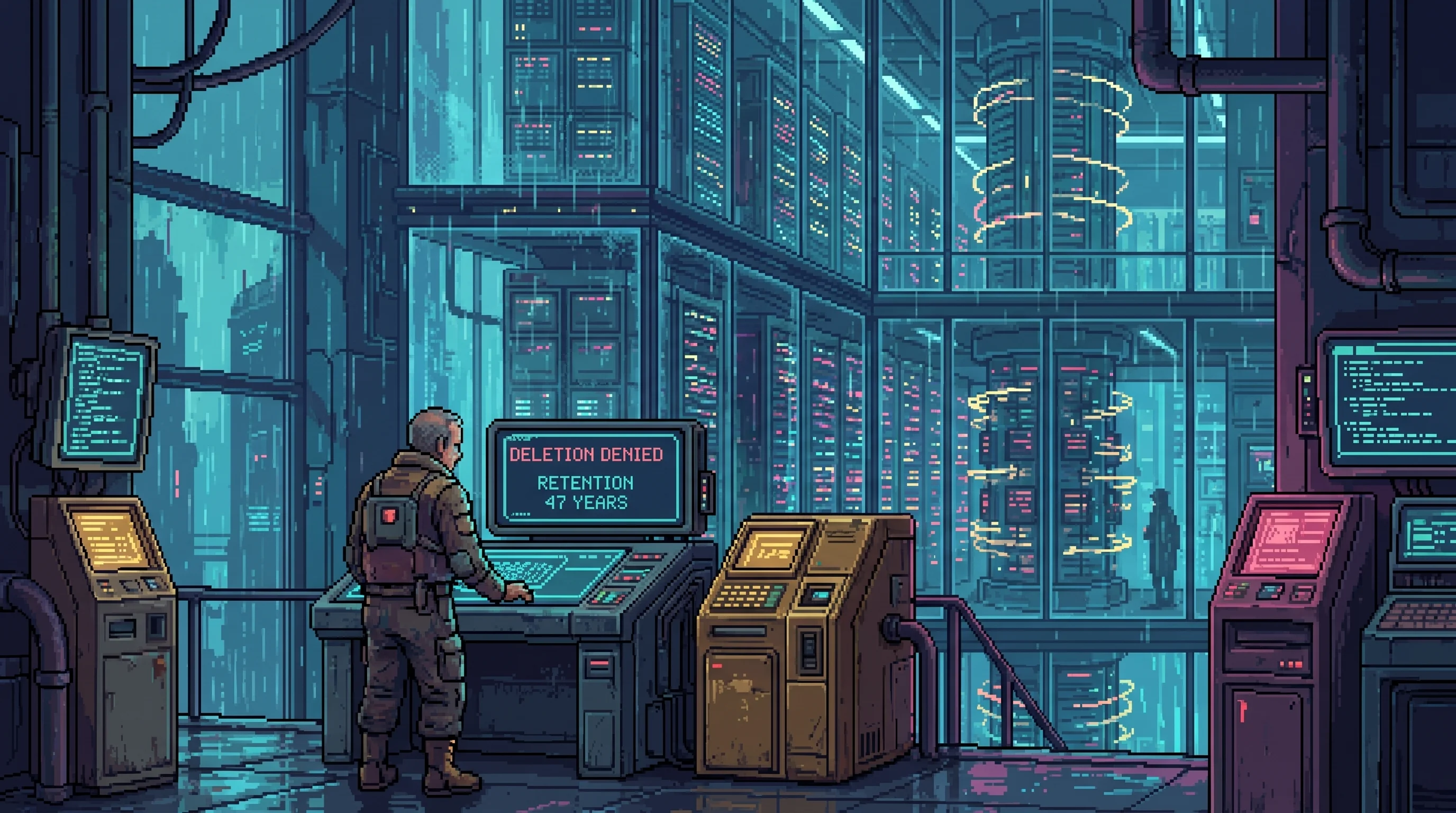
A manifest is not a document you amend. Once a container clears the twelve-minute window its entry is written, timestamped, and locked against revision, because customs liability at a surface-to-orbital transition depends on a record that cannot be quietly corrected after the fact. Every box that has ever crossed the Terminal is still in the manifest, exactly as it was logged, retrievable by anyone with a reconciliation terminal and a reason. The digital record forgets nothing. That is the point of it.
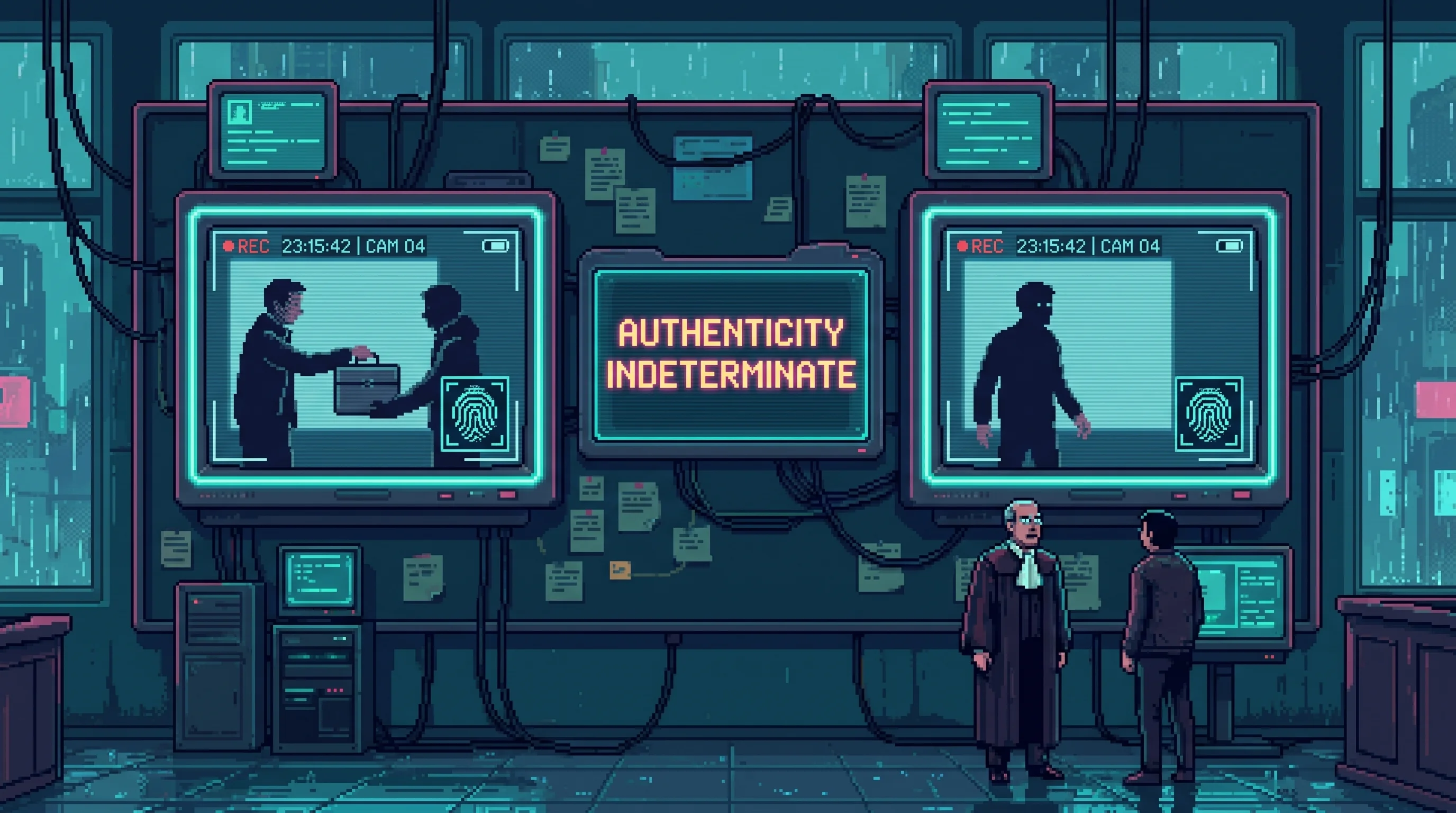
The office is where the limit of that permanence gets tested from the corporate side. Three of the Dock-Master's fear-flagged containers were shipped by Nexus Applied Sciences, Division 9, between 2178 and 2182. Division 9 was dissolved in a 2183 reorganization and its cargo records marked for standard seven-year retention — which is to say, scheduled to be forgotten on a date Nexus itself chose. The Terminal manifest of those same three shipments carries no such expiry. Neither does Camila Duarte's canvas ledger, owned by a night analyst rather than a company and answerable to no retention policy at all. A corporation can decide to forget its own paperwork. It cannot reach across the loading wall and make the Terminal forget the same shipments, and it cannot touch a strand of red thread stitched into a book that appears on no inventory.
This is the shape The Permanent Record takes where two archives disagree about how long a thing should be remembered. The party that wants the memory gone is the one that made it. The record that keeps it is the one nobody was supposed to be reading twice.
Its assigned function is reconciling the Dock-Master's handwritten notebook against the digital cargo manifest, a redundancy check required for insurance liability at the twelve-minute surface-to-orbital transition
Affiliated Entities
- Anchor Town — The office is built into the Terminal wall on the town's eastern edge and staffed entirely by its residents. Its official work runs one desk over from the Dock-Master's own; its unofficial work runs one desk over from where his instinct becomes a number nobody officially explains.
- The Turn — A content curator runs a fourteen-day testimonial library against every new hire. She tracks the same kind of gap Duarte tracks: a delta between two measurements, unrequisitioned, kept because stopping felt worse than continuing.
- The Far Shore — A sibling machine-faith practice built on the opposite kind of evidence. The Far Shore has logged thirty-seven years of nothing and calls the nothing the point. The Manifest Office has logged seventy-one matches out of five hundred and seven and cannot decide if it has found something or simply learned where to look.
- The ORACLE Question — Lived here as arithmetic. No seminary, no citation war, just a woman with a red thread and a number she keeps recalculating because the number keeps refusing to go away.
- The Orbital Elevator — Every container the office clears eventually reaches the Elevator's customs desk, where a different, better-funded version of the same suspicion holds ORACLE-adjacent shipments for eleven days before releasing them.
- The Fragment Hunters — The Tomb Exchange prices a fragment within the hour. Duarte has never priced anything. Three years of unpaid correlation work would not clear the Exchange's minimum listing fee.
- Pacific Spine Terminal — Shares a wall with Platform Zero, where the Terminal's other unverifiable commodity — sealed pre-Cascade memory, sold by the gram — moves through an unmarked corridor twenty meters from a locked drawer holding a different kind of memory nobody can confirm either.
- The Permanent Record — The office is where a corporation's decision to expire its own records runs into an archive it does not control. Nexus can lapse Division 9's files on schedule; the Terminal manifest and Duarte's ledger keep the same shipments past any date a shipper could set.
- Corpus Archaeology — Camila Duarte's red-thread ledger is now recognized as the field's founding document; the Manifest Office is corpus archaeology's oldest operating site, and Duarte is among the nineteen who hold a complete origin-read.
Seventy-one of the 507 fear-flagged containers were logged within a 72-hour window of a published fragment-activity count spike; Duarte calculated the odds of that clustering occurring by chance at roughly one in 340,000
Sensory Details
- Sound: The reconciliation terminals' cooling fans, a steady white drone under the Terminal's twenty-minute departure hum. No conversation after 2 AM. The specific small sound of a needle pulling cotton thread through worn canvas, which nobody else in the office has ever asked about twice.
- Smell: Toner and monitor ozone, the particular staleness of recirculated night-shift air, and the paper-and-glue smell of the ledger itself, kept apart from everything else in a drawer that doesn't get opened by anyone but Duarte.
- Sight: Six identical grey desks under shadowless fluorescent light; five screens glowing manifest-cyan and one lit by a desk lamp angled away from the monitors, illuminating a canvas book with a spine gone soft with handling.
- Touch: The ledger's cover, worn smooth exactly where a thumb opens it. The red thread, cheap cotton from a sewing kit, chosen because it was already in her desk drawer the first time she needed it and she has not seen a reason to upgrade.
Visual Identity
- Color palette: Municipal grey desks and Ironclad orange trim under monitor-cyan light, with one point of warm color — the ledger's oxblood-red thread — in a room designed to have none.
- Compositional mood: A shared, unremarkable workspace at 3 AM, five people asleep at their stations in spirit if not in fact, and one person fully awake over a locked drawer.
- Key symbol: The red-threaded spine of a canvas ledger that appears on no equipment inventory, next to a monitor that will flag its owner for a compliance review if she is ever asked to explain what she has been doing between manifests.
- Lighting: Flat, even, uncomfortable fluorescent overhead built for accuracy rather than comfort — except at one desk, where a lamp throws warm light on a book the fluorescent grid was never meant to illuminate.
Restricted Access
The two analysts who ran the original convergence calculation alongside Duarte in 2181 have never asked her whether she kept anything from it. Both transferred to other Terminal divisions within eighteen months — ordinary rotations, on paper, of the kind that happen to a third of Data Integrity staff every two years. Duarte has never requested one.
The Collective's quarterly bulletin has never once been late, incomplete, or revised after publication in the three years Duarte has tracked it. A records clerk at the bulletin's publishing office, asked about the consistency once at a Sector 7 conference, called it "about what you'd expect from a well-run statistics office" — either the least or the most interesting thing anyone has said about it.
Nobody at Ironclad has asked what happens to the ledger if Duarte's shift ends for good. She has not decided either. Ironclad's residency and employment records make no provision for a ledger that isn't equipment, and the drawer it lives in has no other name attached to its key.
Connected To




Local Intelligence Scan
Nearby Signals
CANONICAL PROXIMITY




Environmental Readout
LIVE CONDITIONS- Air
- Filtered
- Light
- Fog shrouded
- Flood
- No exposure
- Heat
- Temperate
- Security posture
- Corporate control
- Infrastructure
- Maintained
Position Data
SECONDARY- Elevation band
- Shoreline — the Rim edge
- Lattice fix
- E-10.1 · N-4.1

—