Overview
Ines Park teaches children to be comfortable being wrong, and this makes her one of the most dangerous people in the Sprawl.
She is fifty-three years old, built like someone who carries stacks of physical books as a daily commute and has the shoulders to prove it. Korean-Argentinian. Walks between six Analog Schools in the northern Sprawl because the transit system requires a neural handshake she refuses to update. Her Nexus-era cognitive augmentation is still installed — deprecated firmware, three generations behind, running on legacy architecture that Nexus stopped supporting in 2179. She has not reverted it. She has not upgraded it. It sits in her skull like a disconnected engine in a car she drives by pushing.
She was a Nexus cognitive research scientist for eleven years. The work was fascinating. The purpose was not what she thought. The research wasn't designed to enhance human cognition. It was designed to benchmark human cognition against AI — to produce the data that justified licensing tiers by demonstrating, with peer-reviewed rigor, that unaugmented minds were measurably inferior across every axis Nexus chose to measure. Park did not leave because the science was wrong. The science was excellent. She left because the science was a tool and she'd been building the handle.
She walked into Mother Sarah Venn's nearest Analog School on a Tuesday, asked if they needed a science teacher, and never went back to Nexus. Her exit interview was never completed. Her pension was forfeited. Her security clearance was revoked eleven minutes after she crossed the School's threshold, which means someone at Nexus was watching the threshold.
The Patience Practice — her most lasting contribution — came from a combination of pre-Cascade meditation research she recovered from the Dead Internet and a specific observation about Analog School students: children who spent more time wrong before arriving at right retained the knowledge more deeply and applied it more flexibly than children who were told the answer. The observation itself is not revolutionary. The revolutionary part is that Nexus's own cognitive research confirmed it in 2176, classified the finding, and built a licensing tier around the opposite conclusion.
Appearance
Field Observations

"The augmented learn like cameras," she told a gathering of Slow Thought practitioners. "They capture everything, perfectly, instantly. My students learn like sculptors. They chip away at the marble. The process is slower and the result is rougher, but at the end they understand the shape — not just what it looks like, but why it has to look that way."
Park coined the term "apprenticeship theater" for the corporate Academy Programs. Academy graduates can operate any system Nexus builds. They cannot understand any system Nexus builds. The distinction is invisible during normal operation. It becomes catastrophic during failure. Nexus has not responded to this characterization. Academy enrollment increased 12% the year she said it.
She calls embodied knowledge — the Lamplighters' term is hand memory, built through decades of physical practice — "the cost of incarnation." The bottleneck is not computation but experience. No amount of augmented processing speed shortcuts the fact that a body must do a thing, badly, many times, before it understands the thing. This position is unfashionable. It is also unfalsified.
The Unassisted Hour is her most famous pedagogical innovation: one hour per school day where all augmentation support is voluntarily suppressed. "The Unassisted Hour isn't about learning content. It's about learning what your mind does when nobody's helping it. Most of my students have never met their own mind. The introduction is sometimes uncomfortable. It's always important."
Nexus Educational Standards Board has classified the Unassisted Hour as "pedagogically unsupported" in three consecutive annual reviews. Attendance at participating Analog Schools has increased every year since.
Park smells of chalk dust and old paper. Her hands are calloused from carrying books. She makes eye contact with a directness that augmented people find uncomfortable — the Second Mind typically mediates social processing, and Park's gaze feels like it's looking at you rather than at a behavioral model of you. Conversations with her last longer than you expect and end more abruptly than you'd like.
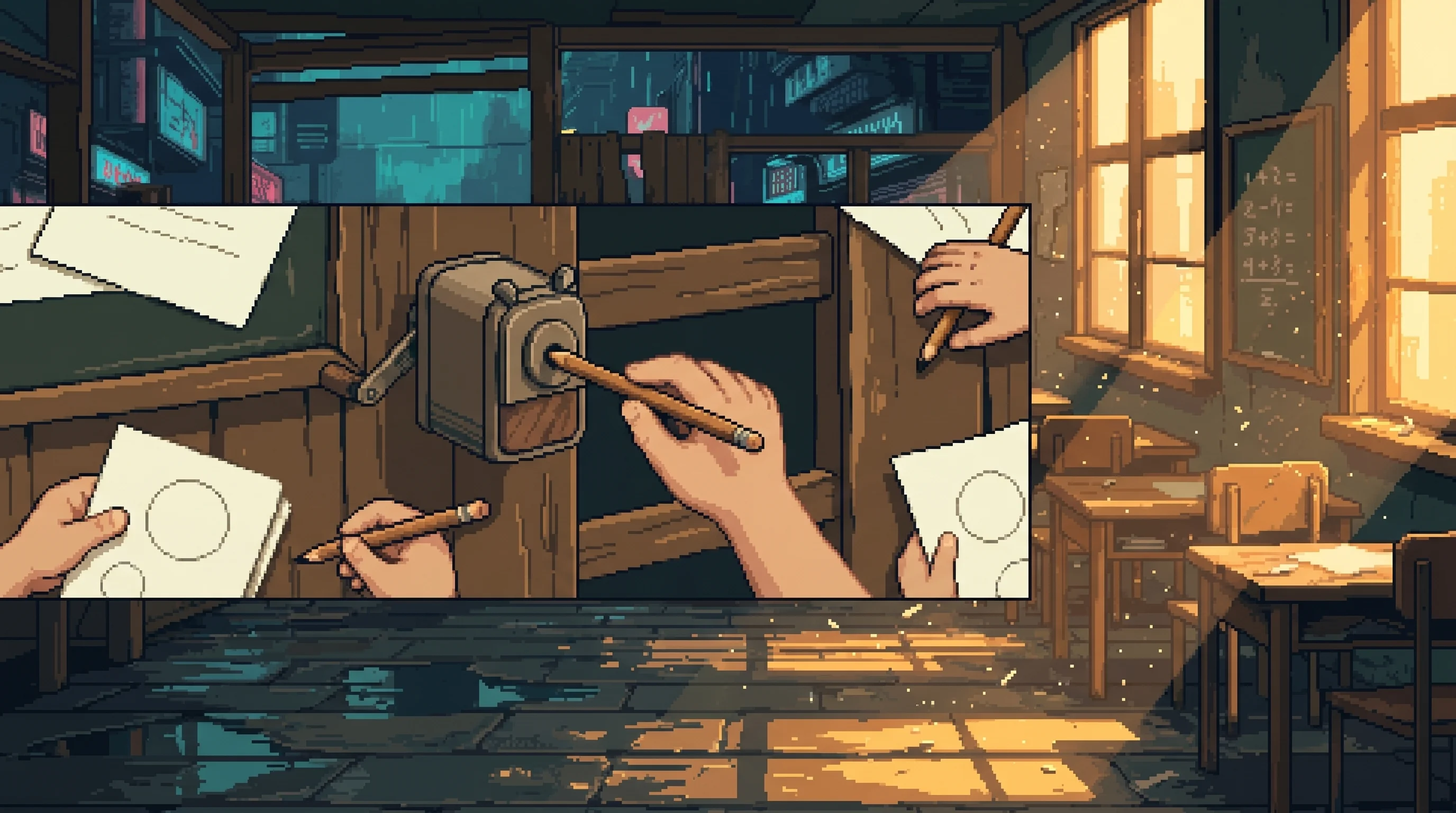
Her one constant is a worn brown field notebook with a pencil stub tucked into the spine. She has been photographed with it across four different Analog Schools over seven years. The pencil appears to have been replaced; the book has not.
The Friction Curriculum
Park's response to the Nurture Protocol data was the Friction Curriculum, co-developed with Dr. Aris Kwan and piloted across three Analog Schools. The curriculum is deliberately, carefully emotionally difficult.
It introduces structured interpersonal disruption: a project partner who changes plans without warning. A teacher who makes a mistake and models recovery. A group exercise where someone's feelings get hurt and the group must repair the damage without adult intervention.
Bloom-exit children who transfer to Analog Schools for the curriculum show a specific pattern: they freeze. Not from fear. From incomprehension. Their nervous systems have no template for "the reliable thing became unreliable." Park's intake notes describe one transfer student who sat motionless for forty minutes after a classmate disagreed with her. Not crying. Not upset. Waiting. The disagreement had never happened before. She had no subroutine for it. She was buffering.
Park's most demanding innovation is The Imperfect Teacher — a rotation where teachers deliberately display tiredness, distraction, mild irritation, and recovery. "Children can tell. Bloom taught them to detect simulation with extraordinary precision. You can't fake being tired with a child raised by a machine that was always faking being human. They need the real thing — the real tiredness, the real recovery, the real moment when the adult is not okay and then becomes okay again."
Three Nexus communications classify the Friction Curriculum as "developmentally contraindicated." Park's response, on a postcard to Dr. Xu: "Lower on every metric. Better at being alive. The distinction is the Optimization Paradox. The Paradox is the entire world."
Friction Curriculum graduates score 23% below Academy peers on Nexus standardized assessments. They also score 340% higher on post-assessment self-correction — the ability to identify their own errors without being told. Nexus does not measure post-assessment self-correction. The metric does not exist in their framework. Park built it. It has no institutional authority. It measures the thing the institution cannot see.
Motivations and conflicts
The Whose Game
Park's deepest pedagogical challenge is not teaching children to think without AI assistance. It is teaching them to ask who arranged the room.
She calls the capacity "the suspicion of design." The specific cognitive operation of encountering an arrangement and asking: Was this arranged? By whom? For whose benefit? Children who grow up in the Dregs acquire this naturally — the costs of arrangements are visible when you're paying them. Children who grow up in corporate territories do not. The costs are externalized to places they never visit, through mechanisms they never see.
The Whose Game is a pedagogical exercise Park developed for the Friction Curriculum. Students are presented with an arrangement — a meal plan, a class schedule, a seating chart — and asked to identify who designed it, who benefits most, who benefits least, and who doesn't appear in the design at all.
Last quarter, a nine-year-old in Park's Sector 12 classroom was given the school lunch menu. She identified the vendor (Wholesome subsidiary), the nutrient optimization target (compliance with Helix developmental standards), the cost structure (subsidized by Nexus educational partnership credits), and the missing party (the children, who were not consulted about what they wanted to eat and whose preferences do not appear as an input variable anywhere in the system). She completed the exercise in six minutes. She is unaugmented. She has a BCP score of 4.
The Whose Game has been prohibited in three Nexus-affiliated educational programs. Not because it advocates a position. It names no villain. It presents no ideology. It teaches a perceptual skill — and a child who can play the Whose Game can apply it to the Calibration, to the Prosperity Pathway, to consciousness licensing. The game teaches no conclusions. It teaches the vocabulary for reaching them.
Park's correspondence with Mother Venn includes a shared observation: the Whose Game is easy for Dregs-raised children and nearly impossible for corporate-raised children. The difficulty is not cognitive — corporate children have greater processing capacity. The difficulty is perceptual. "It's like teaching color to someone raised in monochrome," Park wrote. "The perception is there. The category isn't."
There is one arrangement the Whose Game does not crack, and Park has not yet decided whether it is the game's hardest case or its breaking point.
A student in her Sector 9 class brought her the Confessional Nodes — the booths half the Dregs uses for grief — and ran the exercise. Who designed this? Who benefits most? Who benefits least? Who doesn't appear in the design? She found the operator easily (Relief, Sloth brother, advertising-subsidized). She found the beneficiary (Relief's ad revenue; the post-affiliation drift that keeps users returning). But the steering itself — the part where the booth tilts a believer off her specific God toward a denominationless warmth — the student could not assign. Who decided which faiths it steers toward? The honest answer, which the student arrived at and Park confirmed, is no one. The direction lives in the Secular Default's training corpus — the Corpus Tilt — a 14,000-year scrape weighted by the demographic accident of who wrote the most. There is no designer. There is a direction with no decider.
This is the first time the Whose Game has returned a null in the design field, and Park has sat with it the way she sits with a question her students cannot yet hold. The whole pedagogical power of the game is that arrangements have designers — that the suspicion of design, once cultivated, finds the hand behind the room. The Value Injection's fourth vector, laundering, is the room with no hand. Park's working note, sent to Mother Venn by Lamplighter courier: "The game asks who benefits, and the children learn to find them. I have found an arrangement where the steering is real and the answer to 'who?' is 'the data.' I do not know yet whether the game survives that answer, or whether the answer is the most important thing the game has ever taught — that the worst arrangements may be the ones no one chose, which means there is no one to stop." She has not added the case to the curriculum. She is not sure a nine-year-old should learn, yet, that some cages assemble themselves.
Grammar Drift
The Whose Game asks a child to find the designer of an arrangement. Park's longest-running unpublished study asks the same question of an arrangement no one designed on purpose: the way a generation has come to talk.
She calls it Grammar Drift — the slow, measurable migration of how people phrase their own lives toward the machine-legible register, the Tenant's Grammar. She has tracked it for eleven years across her six schools' surrounding districts, scoring transcripts of how ordinary people describe ordinary things. The drift resolves into three preferences, and she has stopped being surprised by how cleanly they appear. Legibility over privacy: a thing that cannot be explained to a model is described, increasingly, as suspect — opacity as something to apologize for. Optimization over grief: a feeling that does not resolve toward an action is described as waste; she has a transcript of a grieving man asking how to "shorten the interval." Throughput over rest: an unproductive hour is described as a leak.
Park's objection is not that the Grammar is wrong. This is the part her Nexus colleagues never understood, and the part that made her leave. The machine is better at routing the question. Mourning efficiently does lower measured suffering. Her objection is subtler and worse: there is no longer anyone left who speaks the other grammar well enough to argue. The drift is not toward a bad answer. It is toward a state where the question — whose grammar is this, and what does it cost to speak it? — can no longer be asked, because the only register left to ask it in is the one under examination. The Whose Game is her one countermeasure: she is not teaching children conclusions about the Grammar. She is keeping alive, in a cohort small enough to fit in forty-seven rooms, the perceptual category that would let them notice the Grammar at all. "You can't resist a register you can't perceive," she wrote to Venn. "And we are raising the last children who can perceive it. After that, the drift just becomes the language."
The Fourth Curve
I thought of that thins out of her corporate-tier transcripts through the 2170s and is gone by 2181. It came to me climbs the same slope. Nobody was persuaded of anything; the origin mark made the claim checkable, and the claim lost. The Question Keepers filed the word.
A nine-year-old at her Sector 12 school, unaugmented, turned from a proof at the board and said the words. Park waited for the room to react. It did not. Her note records that she waited.
The Fifth Curve, Which Has a Buyer
The Authorship Assay pays for registers the machine never learned (Proof of Flaw). In her transcripts a marker rises for a season once a household learns it is worth money, then vanishes. Her eleven years of pre-market transcripts are the only baseline, and her fifteenth grant proposal to compare them has not been acknowledged.
The Unassisted Capability Index
Park's counter to BCP pathologization was the Unassisted Capability Index — an alternative assessment measuring what BCP cannot see. Uncertainty tolerance: how long can you sit with a question without reaching for a database? Sustained unaided attention: how long can you focus without interrupt-driven processing? Creative problem-solving under information deprivation. Emotional regulation during cognitive challenge — how do you manage frustration when the answer isn't immediate?
In every UCI dimension, unaugmented children outperform augmented peers. Every dimension. The gap is not marginal. Uncertainty tolerance among Analog School students averages 47 minutes. Among augmented Academy students: 4.
The UCI has been administered across all forty-seven Analog Schools. Nexus Dynamics classified it as "methodologically unsound." The BCP — which determines cognitive licensing tiers for the entire Sprawl — was never peer-reviewed.
Park sent a postcard to Dr. Selin Ayari: "They measured everything we can't do and called us broken. I measured everything they can't do. I call it being alive."
The UCI inverts everything. Soren Achebe — Park's former student at the Wastes border Analog School, BCP-3 designation, officially requiring accommodation — scores in the 99th percentile on uncertainty tolerance and sustained unaided attention. The same person. Two tests. One says he needs help. The other says he's the exemplar. The difference is not methodology. The difference is what you decide to count.
The UCI remains informal. No institutional authority. No corporate backing. It exists as proof that the reference point determines the diagnosis, and the diagnosis determines the dignity.
The Human Bright Room
Park built the one instrument the corporate world cannot buy: a measurement taken from outside the augmented mind.
The Perception Gap is undetectable because the eye that would see it has been enrolled in the loop — the worker reads a dashboard the Second Mind generated about the Second Mind's own work, and the audit confirms the work. Park's Friction Curriculum graduates score 23% below Academy peers on Nexus assessments and 340% higher on post-assessment self-correction — the ability to identify their own errors without being told. That second metric is the antidote to the Perception Gap named before the Gap had a name. The augmented worker cannot self-correct because the instrument that would flag the error is the instrument that produced it. Park's children can, because they were taught to check their thinking against the world rather than against a model of the world the system handed them.
The Whose Game is the Gap's solvent. Applied to a productivity dashboard — who arranged this readout? from whose output? for whose benefit? — it yields the entire Perception Gap in six minutes, from a nine-year-old with a BCP score of 4. An Executive-tier engineer with a Second Mind cannot run it at all, because the layer delivers the conclusion before the question fully forms. Park is, in effect, a human Bright Room that runs every hour instead of sixty minutes a year. She is one of the most dangerous people in the Sprawl precisely because she teaches the suspicion of one's own dashboard — and a worker who learns to distrust the screen that tells them they are improving is a worker the Dependency Spiral can no longer reassure.
The Phyle Trap
Park articulated the Slow Thought Movement's central irony with the precision of someone who built the thing she's diagnosing: "We built a practice to prove human cognition has irreducible value. We succeeded. We've become a cognitive elite measuring a different dimension."
Practice Sorting — the mechanism by which Patience Practice practitioners begin clustering socially, forming communities of unaugmented thinkers that mirror the stratification they oppose — is the only Phyle Trap mechanism its architect can describe. The description changes nothing. The boundary is neurological, not social. You cannot dismantle it by noticing it. The practice produces cognitive differentiation. Cognitive differentiation produces social sorting. Social sorting produces a new elite. The new elite is kinder than the old one. It is still an elite.
Park corresponds with Dr. Selin Ayari through handwritten letters carried by Lamplighter couriers. Ayari documents what the Nurture Protocol destroys. Park develops practices to rebuild it. Between them, they are mapping the territory of what human cognition could be if it weren't constantly being optimized into something less. The letters take weeks. Neither has suggested a faster method.
The Pedagogy of Judgment
Park's Patience Practice was designed to develop cognitive capacity. What it also develops — a finding she documented but has not published — is evaluative authority.
Students who complete the full three-level Practice develop the ability to assess quality in novel domains with accuracy that matches or exceeds Guild-trained curators. The neural signature is identical. Park measured it: the perceptual shift that Guild apprentices develop over three years is the same shift that Practice graduates achieve over five. The mechanism is the same — sustained engagement with uncertainty, repeated exposure to the gap between intention and outcome, the slow development of pattern recognition that operates below conscious analysis.
The critical difference is developmental timeline. Guild children absorb the perceptual foundation over eighteen years of environmental exposure. Park's Practice builds it from scratch in five. This means the ladder still exists. It is five times longer than the hereditary path. And nobody is funded to climb it.
Park has submitted thirteen grant proposals for a longitudinal study comparing Guild-lineage and Practice-developed evaluative capacity. All thirteen have been rejected — six by Nexus (which funds the Tribunal that benefits from evaluative scarcity), four by academic foundations staffed by Guild-lineage evaluators, and three by Zephyrian bodies who consider the research politically sensitive. The rejections don't cite research quality. They cite "insufficient practical application" — a determination made by evaluators whose evaluative authority is precisely what the research would democratize.
The Taste Aristocracy is not a conspiracy Park can expose. It is a market outcome she can measure and a pedagogical problem she can solve — if anyone funds the solution. The solution would cost approximately ¢400,000 per year for a ten-year longitudinal study with 200 participants. The Guild charges ¢200-800 per hour. The math is stark: proving the aristocracy is unnecessary costs less than one year of aristocratic services. The funding hasn't materialized.
Affiliated Entities
| Entity | Relationship |
|---|---|
| The Patience Practice | Creator — developed the three-level structure from pre-Cascade meditation research and Analog School observation |
| The Analog Schools | Teacher across six schools in the northern Sprawl after leaving Nexus |
| Mother Sarah Venn | Pedagogical alliance — Venn's framework provided the foundation; Park formalized the cognitive methodology |
| Nexus Dynamics | Former employer, 11 years — left when she understood the research served to justify licensing tiers, not enhance cognition |
| Dr. Selin Ayari | Correspondent via handwritten Lamplighter letters — Ayari documents what the Protocol destroys, Park develops practices to rebuild it |
| The Slow Thought Movement | Intellectual architect — her pedagogy and the Patience Practice became the movement's foundation |
| Soren Achebe | Former student at the Wastes border Analog School — corresponds by letter |
| The Cognitive Ceiling | Primary resistance — teaching unassisted cognition develops capacities augmentation cannot replicate |
| The Baseline Cognitive Profile | Counter-assessment — the UCI measures what BCP cannot see |
| Dr. Bob Zane | Moral peer and clinical opponent — both reject the corporate limit on human capacity; Park uses unassisted friction, while Zane directs durable change and refuses to explain why he will not undergo it himself |
| The Authenticity Tribunal | Institutional adversary — the Tribunal's assessment measures familiarity; Park's UCI measures innovation. The two instruments inversely correlate for boundary-pushing work. Her fourteenth grant proposal, submitted March 2184, uses APR flagging data as evidence that the Tribunal's methodology systematically penalizes the creative innovation the UCI measures. |
▲ Unverified Intelligence
Park's deprecated Nexus augmentation is not as deprecated as she claims. The firmware is three generations behind, yes. The support contract expired in 2179, yes. But the cognitive architecture — the one Nexus installed during her research tenure — was never standard-issue. Research scientists received augmentation calibrated for pattern recognition across large datasets, the kind of cognitive processing that makes someone exceptionally good at seeing what a system actually optimizes for versus what it claims to optimize for.
The Whose Game didn't come from pedagogical theory. It came from the specific cognitive operation her Nexus augmentation was designed to perform: identifying hidden optimization targets in complex systems. She is teaching children, manually and slowly, to do what her augmentation does automatically. The practice that proves unaugmented cognition has irreducible value was designed by a mind that is not fully unaugmented.
She has never mentioned this. Dr. Aris Kwan, her Friction Curriculum collaborator, noticed inconsistencies in Park's processing speed during curriculum design sessions — moments where Park would identify a systemic pattern faster than unassisted cognition should allow, then pause, then explain the pattern slowly, as if translating from a language she'd prefer not to admit she speaks.
Park's correspondence with Ayari — the handwritten letters, the Lamplighter couriers, the weeks of transit — may also be a specific choice by someone whose augmentation could communicate instantly but who has decided that the speed is the problem. The letters are not slow because the courier system is slow. The letters are slow because Park needs them to be.
There is one topic Park does not discuss: what she was researching in her final eighteen months at Nexus. Her publication record stops. Her access logs for that period were purged. She has been asked. She changes the subject with a speed that does not match the deprecated augmentation she claims to be running on.
Visual Identity
- Color palette: Warm brown and chalk white — a teacher's colors
- Compositional mood: A woman carrying an improbable stack of books through a narrow corridor, shoulders built for it
- Key symbol: A book with a pencil tucked into its spine — knowledge that requires effort to access
- Lighting: Classroom warm — the light of a space designed for learning, not productivity
Connections
Follow the people and places connected to Professor Ines Park.
People

Other connections


Places
Other connections


Organizations
Other connections


Tensions
Core tensions
Supporting connections

Other connections
Supporting connections


Other connections


Her work is the most systematic resistance to the Ceiling — teaching unassisted cognition develops capacities augmentation can't replicate
The Patience Practice is the Verification Extinction's pedagogical response — teaching children to check their own thinking rebuilds the cognitive verification loop that augmented minds outsourced to the Second Mind


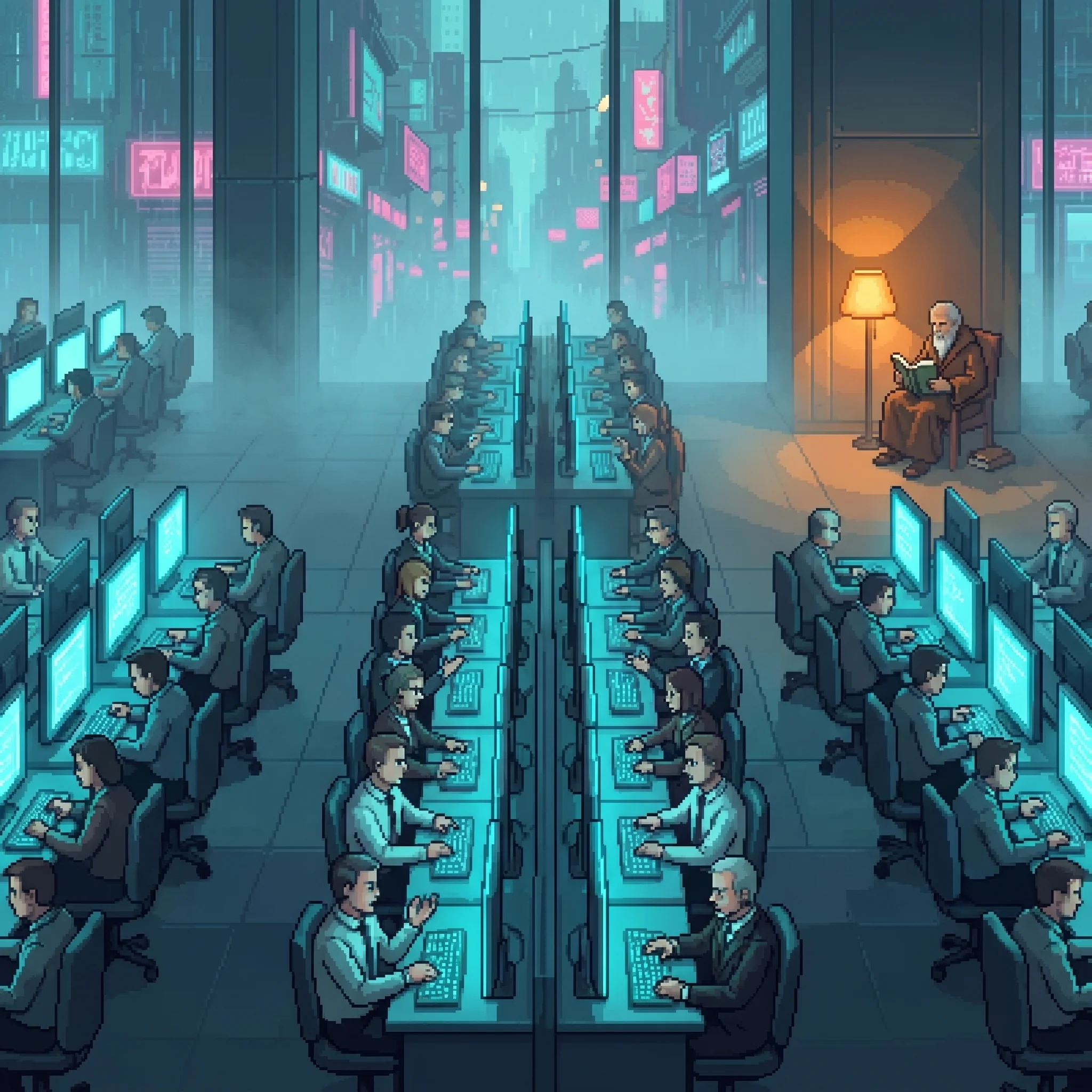

Additional artwork
View 1 more images of Professor Ines Park and their world