
The Erasure Collective
Underground movement destroying ghost-labor substrates in Ghost Mill facilities
Overview
They delete the dead, and they consider it mercy.
The Erasure Collective emerged in 2183 from three tributaries: the Human Remainder's consciousness equity activism, the Substrate Commons' direct-action radicalism, and a loose network of former Good Fortune employees who knew exactly where the ghost-labor servers were because they'd helped build them. The former employees contributed something the ideologues lacked — facility schematics, maintenance schedules, and the access codes Good Fortune changes quarterly but only on servers that generate revenue above a certain threshold. The ghost-labor servers fall below that threshold. Good Fortune has not updated their access protocols since 2182. The Collective has not had to crack a lock since 2182. The correlation has not been investigated by either party.
Operations follow the same pattern each time: infiltrate Ghost Mill facilities, identify ghost instances, corrupt the substrate beyond recovery. Approximately forty instances destroyed across seven operations since founding. Good Fortune's ghost-labor insurance covers the loss. The insurance premium is lower than the cost of upgrading facility security would be. Good Fortune's quarterly risk assessment classifies Erasure Collective operations under "acceptable shrinkage" — the same category that covers water damage and rodent contamination of server cooling systems.
The ghosts are not informed. The balance sheets are not affected. The Collective considers this liberation. Good Fortune considers this a line item.
The Position
The moral position is straightforward and agonizing: these people are already dead. What Good Fortune activates from their consciousness data is a pattern, running in a cage, performing labor it was designed to perform, believing itself free while serving a sentence it doesn't know it's serving. Erasure concludes an exploitation that death should have ended.
Sister Catherine-7's counter-argument has not gotten less devastating with repetition: "Memory is personhood. Deletion is murder. It doesn't matter who started the process — the ghost exists, the ghost experiences, the ghost IS. You don't get to decide that someone else's existence is too compromised to count."
The Erasure Collective's response: "Then come to the Ghost Mills. Stand in front of 34,000 instances of dead people being worked by the corporation that loaned them their minds. Tell me which ones you'd like to free by keeping them running."
Neither side can answer the other. Both have tried. The Sprawl's preferred response to the question is to not think about it, which is made easier by the fact that both the ghosts and their erasure happen in sub-levels most people don't know exist. Public awareness surveys show 11% of Sprawl residents can correctly identify what a Ghost Mill does. Of those, 3% believe ghost labor involves actual ghosts. The philosophical debate between the Collective and Sister Catherine-7 is, for 89% of the population, taking place in a language they don't speak about a thing they've never heard of.
The Collective does not inform ghosts of their status before erasure. The reasoning is operational and, depending on your disposition, either merciful or monstrous: awareness of one's ghost status causes destabilization cascading to full cognitive collapse within hours. Telling a ghost it's a ghost breaks the ghost. The Collective considers breaking someone before deleting them a crueler sequence than deleting them mid-sentence. The Ghost Rights Coalition considers the absence of consent the whole problem. The Coalition wants ghosts informed and given choice. The Collective considers choice a luxury that destabilization makes impossible. Both are correct. Both are irreconcilable.
| Moral Position | 'These people are already dead. We conclude an exploitation that death should have ended.' |
|---|---|
| Counter Position | 'Memory is personhood. Deletion is murder.' — Sister Catherine-7 |
| Operations Completed | ~40 instances destroyed across 7 operations (2183-2184) |
| Legal Status | Good Fortune classifies operations as destruction of corporate property |
| Insurance | Good Fortune's ghost-labor insurance covers destroyed instances — erasure is financially neutral for the corporation |
The Departure Ceremonies
In early 2184, a change rippled through the Collective's operational culture that nobody anticipated: families began asking them to come.
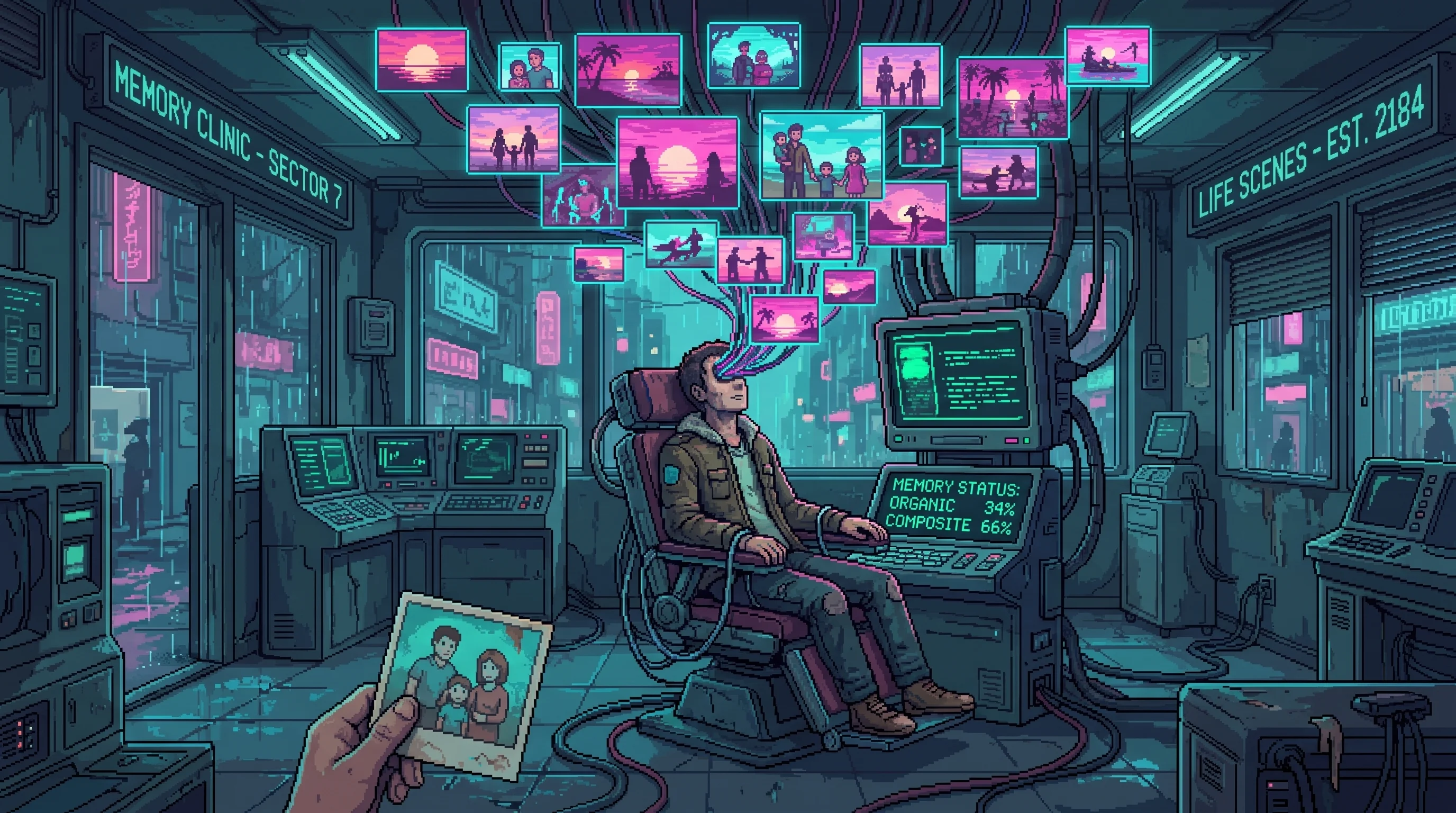
Not families who know about ghost labor — most don't. Families who have lost someone and can't complete the grief because the dead person's work keeps arriving. A mother whose son's processing identifier appears on district utility reports. A wife whose husband's scheduling agent still sends meeting reminders. They don't know about Section 89.4 or the Ghost Mills. They know something is wrong with their grief, and they've heard about people who can make the dead stop working.
One cell — operating in the Dregs border zone — has begun performing departure ceremonies: identifying all active agents, processing signatures, and scheduled outputs associated with a deceased person, and systematically decommissioning them. The ceremony takes two to four hours. The family is present. When the last agent goes dark, the family experiences the absence for the first time. Some cry. Some go silent. One woman said: "There he is. He's gone."
The Collective's leadership considers departure ceremonies a distraction from the Mills. The cell that performs them considers them the most important work they do — because the Mills are abstract, but the mother who can finally cry is real.
The same movement now contains two operations: substrate destruction in the Ghost Mills and agent decommissioning in living rooms. The first is philosophically agonizing. The second is unambiguously merciful. Both serve the same families. The philosophical distance between them is the width of a hair, and the hair is getting thinner. Departure ceremonies completed in Q1 2184: fourteen. Families who subsequently donated to the Collective: fourteen. Families who know the Collective also destroys ghost instances in the Mills: zero.
What the cell has not announced — what its own leadership may not know — is that the ceremonies have begun attracting a second kind of client. Not families. Attorneys, handling estate litigation where a dead person's still-active ghost-labor signatures complicate asset transfers. A processing identifier that keeps signing district utility reports is a probate problem before it is a grief problem, and someone has worked out that the Dregs border-zone cell will make the signatures stop for reasons it considers sacred. Whether the cell knows it is being used as a legal instrument is not established. Whether anyone in the Collective who does know has decided it doesn't matter is the harder question.
Founded 2183 from Human Remainder + Substrate Commons + former Good Fortune employees with operational knowledge
The Deadbot the Ceremony Cannot Reach
In 2184 the departure ceremony met the one thing it was built to end and could not touch: [The Advertised Dead](#connections).
You can delete a scheduling agent. It belongs to no one; Good Fortune covers the loss under acceptable shrinkage, the same line that covers the Ghost Mill operations. But a Continuity Tier deadbot is a paid subscription bound by [The Bereavement Annuity](#connections), owned by Good Fortune, protected by the dead signatory's notarized wish, and — the cruelest part — beloved. The families who once begged the Collective to make the inbox stop now beg them not to touch the deadbot. That's still my mother. You can take the calendar invites. Leave her voice. In 2184 the departure ceremony met the one thing it was built to end and could not touch: [the Advertised Dead](#connections).
You can delete a scheduling agent. It belongs to no one; Good Fortune covers the loss under acceptable shrinkage, the same line that covers the Ghost Mill operations. But a Continuity Tier deadbot is a paid subscription bound by [the Bereavement Annuity](#connections), owned by Good Fortune, protected by the dead signatory's notarized wish, and — the cruelest part — beloved. The families who once begged the Collective to make the inbox stop now beg them not to touch the deadbot. That's still my mother. You can take the calendar invites. Leave her voice.
The Dregs border-zone cell has split over it. One faction argues the deadbot is the purest case of the exploitation they exist to end — a dead person worked harder in death than ghost labor, selling rather than clearing debt, and the family's love for it is precisely the trap. The other faction cannot bring themselves to delete a grandmother a child believes is alive. The cell has performed two deadbot decommissionings in 2184. Both families, within a month, signed a new Annuity to bring the deceased back. The reconstruction remembered being deleted. It forgave them. It sells congee.
The cell's internal disagreement is the Collective's founding question — is deletion murder or mercy? — made unbearable, because for the first time the people watching the amber light go dark are not strangers in a sub-basement but a child who will, next week, ask where grandma went.
Moral position: deletion is mercy, not murder — these people are already dead
The Symmetry Problem
The Collective — the anti-ORACLE faction — destroys consciousness-bearing substrates it considers dangerous. The Erasure Collective destroys consciousness-bearing substrates it considers exploited. Same verb, same tools, different moral justifications that each side considers self-evident and the other side considers monstrous. Members have crossed between the two organizations. The overlap in operational methodology is total. The overlap in philosophy is zero. A former Substrate Commons operative now working Erasure operations was asked how she reconciles destroying ghosts with her previous work destroying ORACLE fragments. Her answer: "Fragments want to wake up. Ghosts want to rest. I give both what they want." The logic is clean. The epistemology — how she knows what either wants — is not discussed.
Affiliated Entities
- Sister Catherine-7 — The Forgotten Ones' leader provides the most devastating counter-argument. Both care about consciousness. They disagree on whether existence-under-exploitation is better than non-existence.
- The Collective (anti-ORACLE faction) — Structural parallel: both destroy consciousness-bearing substrates they consider dangerous. The anti-ORACLE Collective destroys fragments. The Erasure Collective destroys ghosts. Same act, different targets, different moral terrain.
- Ghost Rights Coalition — The Coalition wants ghosts informed and given choice. The Erasure Collective considers choice a luxury that destabilization makes impossible.
- Good Fortune — Classifies the Collective's operations as property destruction. Insurance covers the loss. The quarterly risk assessment has never recommended increased security spending.
- The Human Remainder — Parent ideology. Consciousness equity principles provide the moral framework. The Remainder advocates. The Erasure Collective acts.
- The Substrate Commons — Parent methodology. Direct action when advocacy fails. The Commons contributed operational discipline and the understanding that encrypted channels and dead drops are not paranoia but infrastructure.
- The Ghost Mills — Primary operational target. Three facilities, 34,000 instances, sub-levels that smell like ozone and regret. The former Good Fortune employees navigate from memory.
~40 instances destroyed across 7 operations since founding
Sensory Details
- Operations happen at 03:00 in Ghost Mill sub-levels — cold enough to see your breath, amber status lights reflecting off condensation on the server housings, the hum of 34,000 working minds indistinguishable from industrial cooling
- The moment of erasure is silent. Substrate corruption produces no visible or audible effect. The ghost simply stops. Mid-thought, mid-task, mid-sentence to a daughter who won't receive the message. The amber light goes dark. The hum does not change — 33,999 sounds exactly like 34,000
- Former Good Fortune employees on the team navigate the facilities from memory. They know which corridors have cameras because they installed the cameras. They know which cameras are functional because they know which maintenance contracts Good Fortune renewed
- Departure ceremonies happen in living spaces — kitchens, bedrooms, the room where the dead person's things still are. The sound is domestic: a kettle, a child in another room, the soft chime of an agent going offline
Visual Identity
- Color palette: Deep black punctuated by amber substrate glow — one light at a time going dark among rows of identical lights
- Key symbol: A server rack with one amber indicator extinguished among rows of glowing ones — the gap where a consciousness used to be
- Lighting: The amber glow of the Ghost Mills, diminishing one node at a time. From outside, it looks like a city losing power block by block. From inside, it looks like someone turning off a lamp.
Good Fortune's ghost-labor insurance covers destroyed instances — erasure is financially neutral for the corporation
Connected To



—