Overview
Workers sell twelve hours of compressed consciousness at fair market rates for precision labor. Financial stability for anyone willing to sit in a pod. An entire workforce whose capacity for self-reflection, relational presence, and memory formation is systematically harvested during the hours the meter runs — and whose families absorb the deficit during the hours it doesn't.
This is what a forced-focus shift feels like from inside.
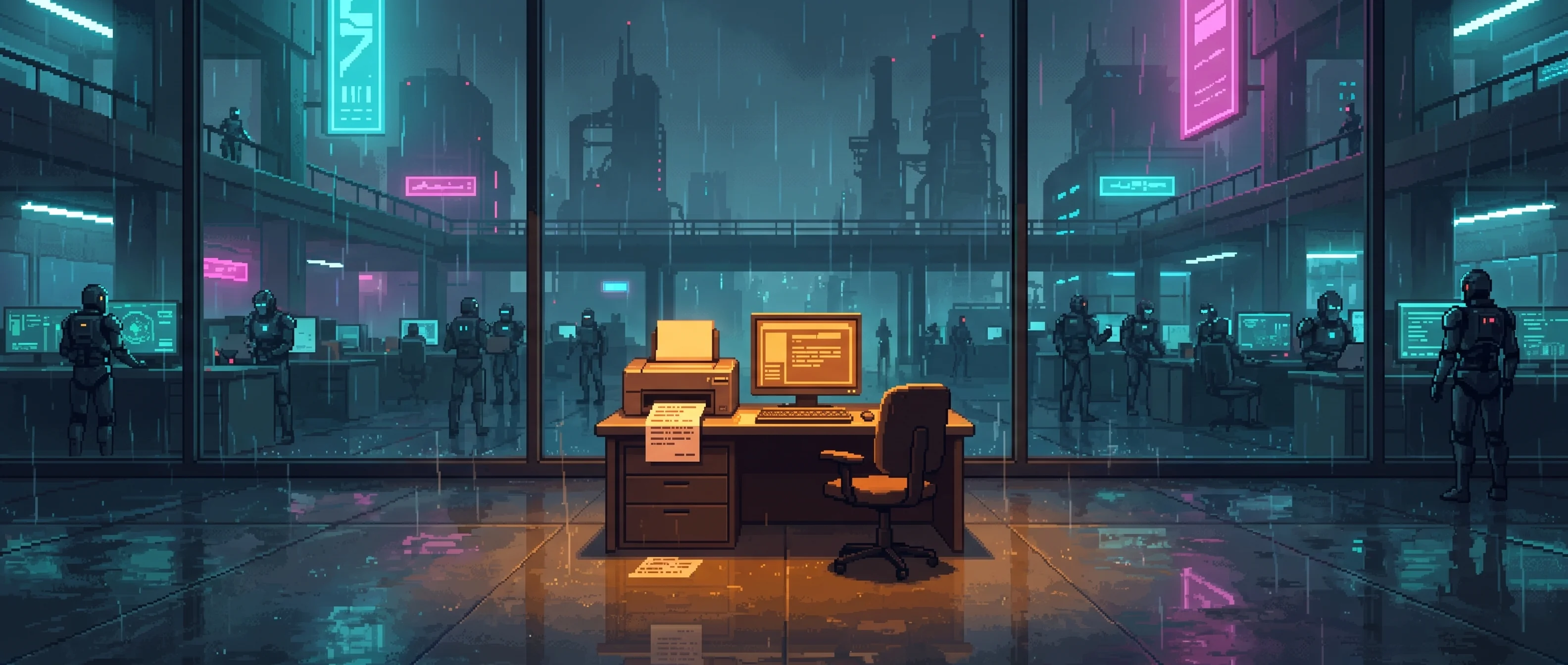
Not according to the worker. According to Nexus Dynamics' NeuroLabor division, which monitors cognitive compression in real time across 14,000 active pods and publishes quarterly productivity reports that have never once included a field titled "post-shift cognitive function." The reports measure output per locked hour. What happens after the Unlock is the worker's problem, occurring on the worker's time, in the worker's home, to the worker's family. The efficiency numbers are extraordinary. They have been extraordinary every quarter since the Focus Mills opened.
The following account is compiled from 3,200 post-shift interviews conducted by an independent research initiative that lost its funding nine weeks after publishing preliminary findings. The data survives. The initiative does not.
What Forced Focus Feels Like from Inside
- Subject
- An unnamed mill worker (composite character)
- Duration
- 0600-1900 — shift plus recovery and homecoming
- Central insight
- 'How was your day?' is the most complex cognitive task he's encountered in twelve hours
- Form
- Experiential narrative — forced-focus shift from inside
- Status
- Active
The Focus Mills
A concentrated cognitive-processing center where forced-focus contracts narrow debtors' minds to service loans.

0600 — The Lock
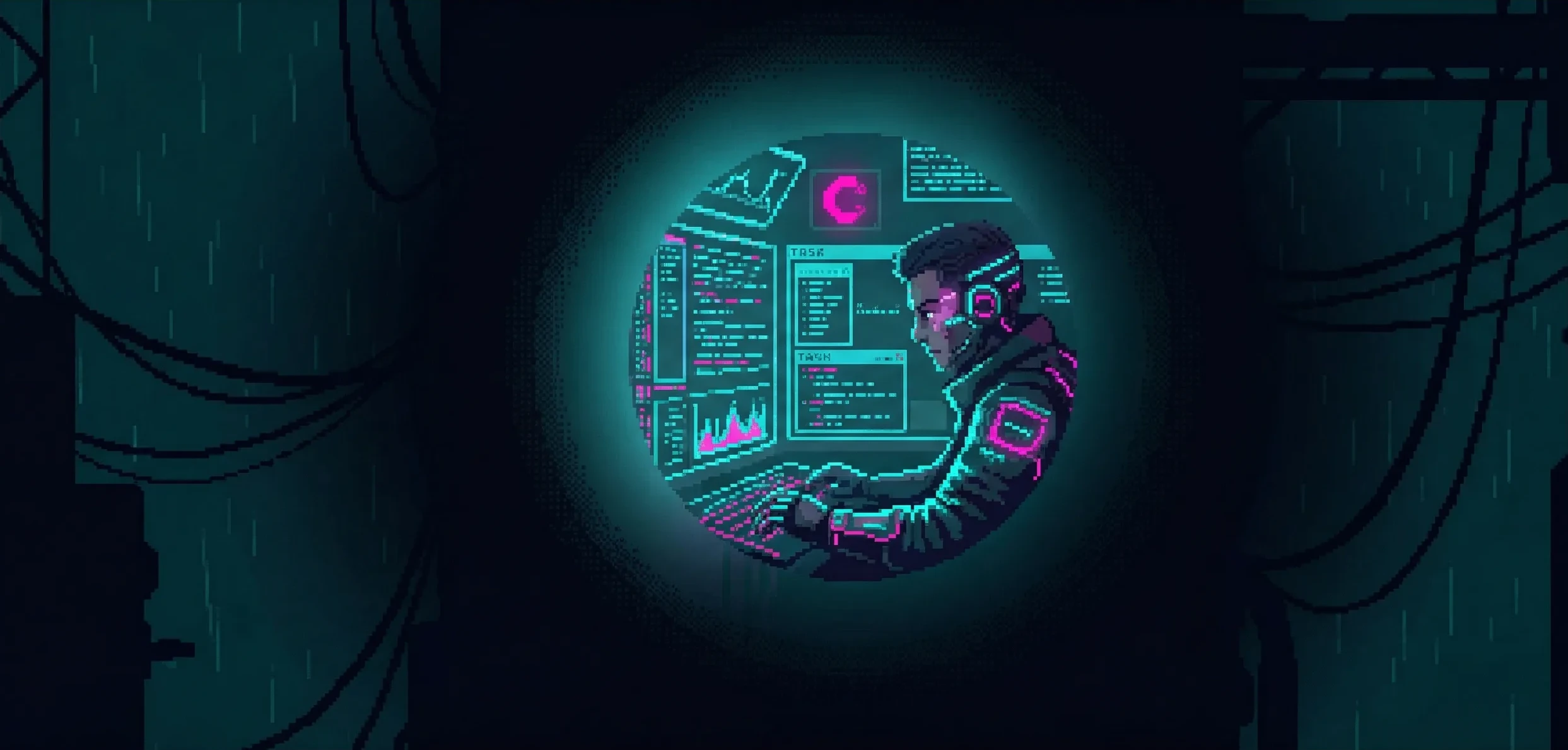
You arrive at the mill. You sit in your pod. The interface engages.
The lock takes approximately forty-five seconds. It doesn't hurt. Veteran workers describe a gentle constriction — someone slowly closing their hands around your field of vision. The world's edges darken first. Ambient sound drops to a muffle, then disappears. Color drains from the periphery inward. The task appears.
By the time the narrowing completes, there is no "you" attending to a task. There is a task. Consciousness has been compressed to a single thread, and the thread does not include self-awareness, because self-awareness competes with throughput. NeuroLabor's onboarding materials describe this as "optimized cognitive allocation." Workers who've done it for more than six months don't describe it at all. Not because they can't. Because describing requires the peripheral processing the lock suppresses, and by month six, the habit of not-describing has outlasted the shift.
Focus Mill recruitment campaigns emphasize precision, fulfillment, and flow state. Exit interviews — the ones conducted by the initiative, not the ones conducted by the mills — use the word "erasure" at four times the Sprawl baseline for labor-related language.
0900 — The Break
A break. You can blink. You can drink water. You can stand, stretch, use the facilities. The cognitive lock remains engaged.
NeuroLabor classifies these as "full recovery intervals." The word "full" is doing considerable work. Physical needs are serviced. Cognitive breadth stays compressed. A co-worker passes you in the corridor and you recognize them the way you'd recognize a data point — present, categorized, filed. No warmth. Warmth requires peripheral bandwidth.
Lunch at 1200 follows the same architecture. Food has no taste because taste evaluation competes with task processing. You consume calories. The cafeteria menu is optimized for caloric density and speed of ingestion. It has never been optimized for flavor. No one has complained, because complaining requires evaluative capacity the lock has removed, and by the time the Unlock restores it, the meal is seven hours gone and the memory has the emotional weight of a spreadsheet entry.
Worker satisfaction surveys administered during locked hours show 94% of respondents rating their break experience as "adequate or above." Surveys administered during unlocked hours — the ones from the defunded initiative — show 31%.
1500 — The Eighth Hour
The cracks.
Somewhere around hour eight, suppressed peripheral systems push back. A flash of your daughter's face between data points. The smell of home cooking, immediate and wrong, because you are in a pod that smells like recycled air and polymer. Each micro-breakthrough is suppressed by the lock within milliseconds. Efficiency drops 2-3%.
NeuroLabor's internal documentation refers to this as "peripheral intrusion noise." The word they don't use is "rebellion." The locked brain, after eight hours, begins fighting for its own breadth against a system designed to deny it. The intrusions are not random. Analysis of the 3,200 interviews shows a consistent pattern: 74% of eighth-hour breakthroughs involve family members. 12% involve meals. 9% involve sunlight. The locked mind, when it briefly escapes, does not reach for entertainment or status or ambition. It reaches for the simplest things it's been denied.
The 2-3% efficiency decline is the only place this rebellion appears in NeuroLabor's reports. It is classified as a known loss factor with no remediation pathway, because the alternatives — shorter shifts or deeper locks — either reduce revenue or produce the kind of cognitive damage that generates workers' compensation claims. The current calibration is, in NeuroLabor's published assessment, "the optimal balance between sustained output and workforce durability."
Workforce durability. Not workforce wellbeing. The terminology is precise.
1800 — The Unlock
The Unlock takes approximately twenty minutes. NeuroLabor's public documentation says "moments."
It is cognitive vertigo. The world's edges brighten. Sound returns in layers — first mechanical hum, then voices, then the specific texture of the air outside the pod. Colors flood back oversaturated, painful. Workers leaving the mill walk with the particular careful gait of people whose spatial processing is still recalibrating. Sector 9 transit authorities have requested that Focus Mill shift changes be staggered to reduce pedestrian incidents during the post-Unlock window. The request was denied. Staggering shifts would reduce pod utilization by 4%.
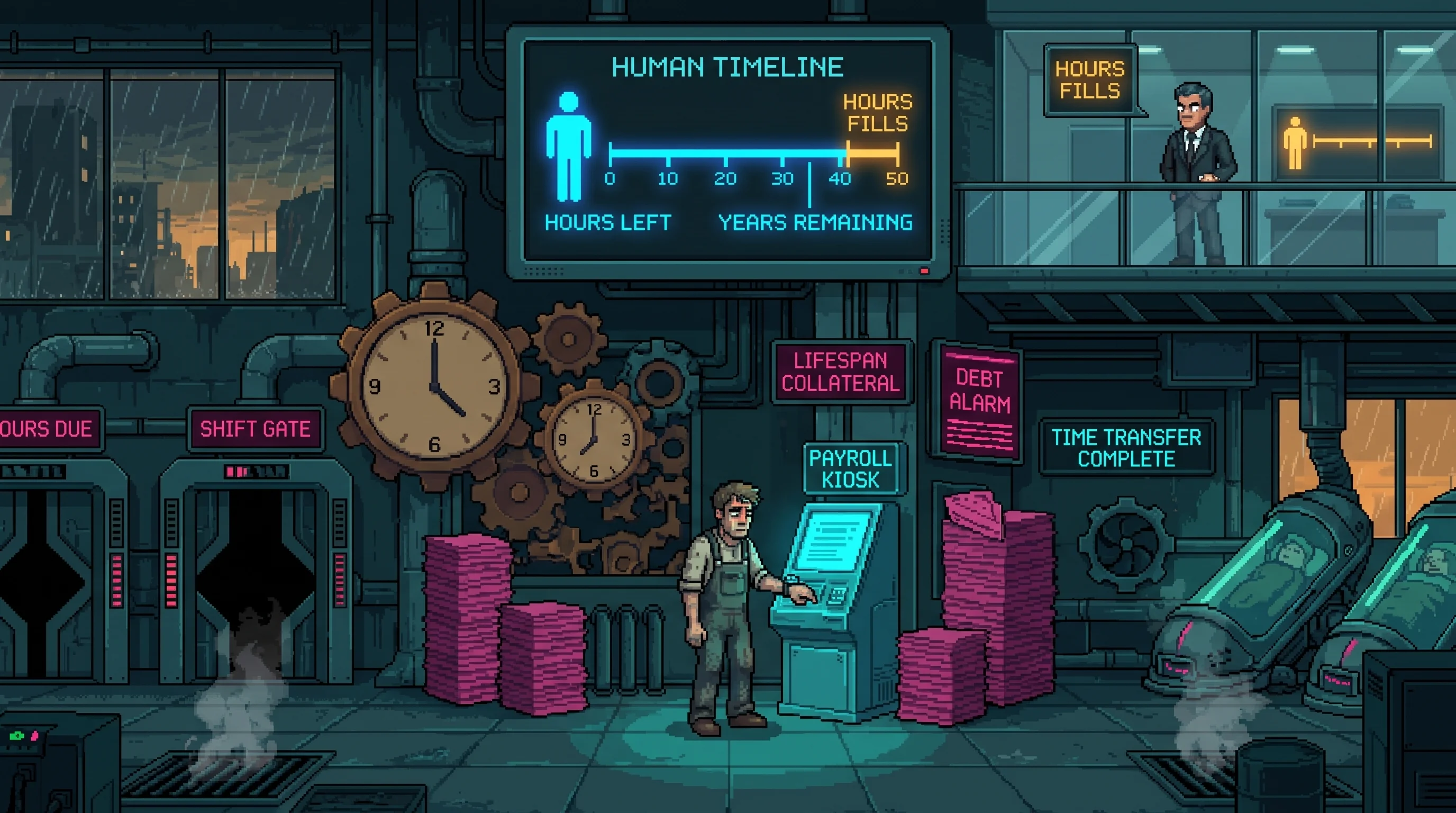
The twenty-minute recovery window does not appear in any productivity calculation. The walk home does not appear. The forty-five minutes of diminished cognitive function after arrival does not appear. NeuroLabor measures a twelve-hour shift. The worker experiences a thirteen-hour-and-five-minute reduction in full cognitive capacity. The gap — one hour and five minutes, daily, across 14,000 workers — represents approximately 255,000 hours per year of human life that exists in no report, no metric, no efficiency calculation. It is not hidden. It is simply not measured. Things that are not measured do not exist in systems that optimize for what they measure.
1900 — Home
Mia is at the kitchen table.
She is beautiful and complex and present and you can see approximately sixty percent of it because your peripheral processing is still recovering. The other forty percent — the part that reads micro-expressions, registers emotional nuance, connects this moment to the accumulated history of your partnership — that part is somewhere in the twenty-minute Unlock sequence, still expanding, still recalibrating. It will be fully online around 1945. By 1945, Mia will be doing the dishes.
She asks: "How was your day?"
The answer requires reflection, evaluation, context — the exact cognitive capacities that twelve hours of forced focus has spent the day suppressing. This is the most complex cognitive task you've encountered since 0600. More complex than the work. The work required one thread, driven forward by the lock. "How was your day?" requires pulling together a scattered field of recovering faculties to produce a summary of an experience you weren't fully present for, because the version of you that was present was a single thread without the bandwidth for memory formation beyond task completion.
"Fine" is the most common post-shift response to spousal inquiry among Focus Mill workers. Three standard deviations above the Sprawl average for the word "fine" in domestic conversation. There is no corresponding decline in self-reported relationship satisfaction scores, because the satisfaction survey is administered at the mill during locked hours, when the worker cannot access the emotional bandwidth required to feel dissatisfied.
You say: "Fine."
Mia nods. She has heard "fine" every evening for two years. She has not asked a follow-up question in nine months. Not because she stopped caring. Because she learned that the follow-up produces the same word again, spoken with slightly more effort and slightly less eye contact, and the effort costs him something she can see even if he can't.
The Focus Mill productivity reports for Q2 2184 show a 12% year-over-year increase in output per locked hour. Domestic counseling referrals in Sector 9's mill-adjacent residential blocks are up 340% over the same period. These two data points have never appeared in the same document.
Sensory Log
The Lock
Tunnel vision closing in. Colors fading at the periphery. Sounds disappearing one by one — first ambient hum, then voices, then your own breathing. The world shrinks to a point.
The lock begins — a gentle constriction, like someone slowly closing their hands around your field of vision.
Focus lock takes approximately 45 seconds to engage.
The Task
Sharp, clear, brilliant — the only thing. Data in perfect focus, every pattern obvious. The single thread of compressed consciousness does its work with terrible efficiency.
The Unlock
A dam breaking. Colors too bright. Sounds too loud. The smell of food hitting like a physical blow. Twenty minutes of the world flooding back through channels closed for twelve hours.
The Unlock takes approximately twenty minutes. NeuroLabor's public documentation says "moments." It is cognitive vertigo — the world's edges brighten, sound returns in layers, colors flood back oversaturated. Workers leaving the mill walk with the careful gait of people whose spatial processing is still recalibrating.
Across 14,000 workers, this represents approximately 255,000 hours per year of human life that exists in no report, no metric, no efficiency calculation.
Home
Sixty percent visible. Forty percent still recovering. Your partner's face half-clear, her voice fully present, your ability to respond to either still reassembling itself.
Open Questions
Is the 2–3% Efficiency Loss Recoverable?
The mills model it as a fixed cost. Workers who've run consecutive high-compression weeks report the eighth-hour cracks arriving earlier — at hour six, then hour five. Nobody in a position to measure this officially wants to publish what they find.
What Does the Child Learn?
Mia asks. He says "Fine." She learns that adults come home from work unable to describe what they did there. Whether she learns to ask different questions, or stops asking at all, depends on factors the Attention Economy does not track.
Does the Unlock Ever Complete?
Twenty minutes is the clinical estimate for post-shift cognitive expansion. Several workers who've kept informal journals describe partial narrowing persisting into the following morning. Their doctors call it residual fatigue. They call it something else.
The Shift
First Break
The lock remains. You can stand and stretch.
Midshift
Worker satisfaction surveys administered during locked hours show 94% of respondents rating their break experience as "adequate or above." Surveys administered during unlocked hours show 31%.
Linked Files
The Twelve-Hour Mind is the universal account. Tomiko Vasquez's story is the personal one — debt-driven, named, specific, with a creditor and a number and a countdown. Together they bracket what forced-focus contracts cost at the individual and aggregate level. The Focus Mills are the physical infrastructure that makes this experience repeatable at scale. The Attention Economy is the system that decided it was worth building.
Affiliated Entities
- Forced-Focus Contracts
This narrative documents the subjective interior of what those contracts purchase — twelve hours of cognitive compression sold as "precision labor"
- The Focus Mills
The physical setting; 14,000 pods, quarterly reports, the cafeteria that has never been optimized for flavor
- Tomiko Vasquez
The personal version — debt-driven forced focus with a name, a history, a specific creditor; this is the universal version, the composite, the 3,200 interviews averaged into one shift
- The Attention Economy
The system that made this experience necessary and profitable — where human cognitive bandwidth is the commodity, and the price is paid after the meter stops running