
Forced-Focus Contracts
Workers sell attention, not just time — neural interfaces lock cognitive bandwidth to corporate tasks
Overview
In the old world, you sold your time. What your mind did during those hours was your business.
In the Sprawl, you sell your attention. The distinction is not philosophical. It is contractual, enforceable, and billable in six-minute increments.
Forced-focus contracts require the worker's neural interface to lock cognitive bandwidth to corporate tasks for the duration of the shift. The locking is literal: the interface suppresses non-task cognitive threads, reduces peripheral awareness to a minimum, and channels full conscious processing capacity into a single stream of corporate-designated output. For twelve hours, the assigned task is all you can think about. Not the primary thing. The only thing. Your daughter's birthday, the leak in your housing unit, the pain in your lower back — these do not become background noise. They cease to exist.
Approximately 14 million workers across the Sprawl are under active forced-focus contracts. The Attention Economy classifies them as "dedicated cognitive resources." Payroll classifies them as employees. The workers themselves, when the lock releases and they can form opinions again, use a wider vocabulary.
The productivity gain is 340% over free-focus for data analysis tasks. Error detection runs at 99.7% versus free-focus's 94.2%. The wage premium is 40% above standard Dregs wages. These numbers appear on every corporate recruitment page. The number that does not appear: cognitive rebound onset after five or more years of continuous forced-focus work — permanent narrowing of attentional bandwidth that persists after the contract ends, after the shift ends, after the worker quits and moves to a different sector and tries to read a book and finds that their mind treats the third paragraph the way it used to treat the task. The Dregs call it "the snap." Corporate health filings call it "post-occupational attentional adaptation." The treatment options listed under the latter: none.
| Cognitive Rebound Onset | 5+ years of continuous forced-focus work |
|---|---|
| Flood Swimmer Burnout | 73% within 2 years |
| Wage Premium | 40% above standard Dregs wages |
The Lock and the Unlock
The shift begins with the Lock. Approximately forty-five seconds. Colors not relevant to the task fade. Sounds not relevant disappear. People become shapes. A Focus Mill floor supervisor described it as "watching someone leave without moving." Consciousness collapses to a single point of brilliant clarity. The clarity is genuine. Workers under forced-focus produce work that free-focus workers cannot match. The work is extraordinary. The worker, for twelve hours, is not.
The shift ends with the Unlock. Approximately twenty minutes. The world does not return gradually. It arrives all at once — sound, color, peripheral vision, the existence of other people, the memory that you have a name. Some workers cry during the Unlock. Some sit motionless. Some have described it as the closest experience to being born that a conscious adult can have, which is the kind of thing people say when they don't have better language for neurological trauma.
The asymmetry is the tell: forty-five seconds to lock. Twenty minutes to unlock. The system was designed to get workers into productive states as fast as possible. Getting them back out was not a design priority. It was a side effect to be managed. The twenty-minute unlock window is unpaid.
The Flood Swimmers
Content moderators — "flood swimmers" — sit in the deepest end of the forced-focus pool. Their job requires twelve-hour immersion in the rawest Content Flood stream: unfiltered uploads, unmoderated feeds, the full unprocessed output of a civilization that produces more content per hour than the pre-Cascade world produced per year. The focus lock keeps them on-task. The task is everything humans post when they think no one important is watching.
Burnout rate: 73% within two years. The 27% who survive past the two-year mark develop what corporate evaluations term "attentional callusing" — the capacity to process extreme content without emotional activation. Their performance metrics are exceptional. Their personal relationships score in the 4th percentile on the Wellness Corporation's Social Integration Index. The Attention Abolitionists have a name for the surviving 27%: "the ones who stayed too long." Several former flood swimmers have become prominent voices in the Abolitionists' movement. Several others are no longer available for follow-up interviews. The corporate position on flood swimmer attrition is that the 40% wage premium constitutes adequate risk compensation. The Abolitionists note that hazard pay for cognitive damage is like hazard pay for drowning — the money doesn't help if you can't remember what you were saving for.
12-hour shifts standard; productivity gains of 340% over free-focus for data analysis
The Consent Architecture
Every forced-focus contract is voluntary. This is legally true, thoroughly documented, and the specific detail that makes the Attention Abolitionists break things.
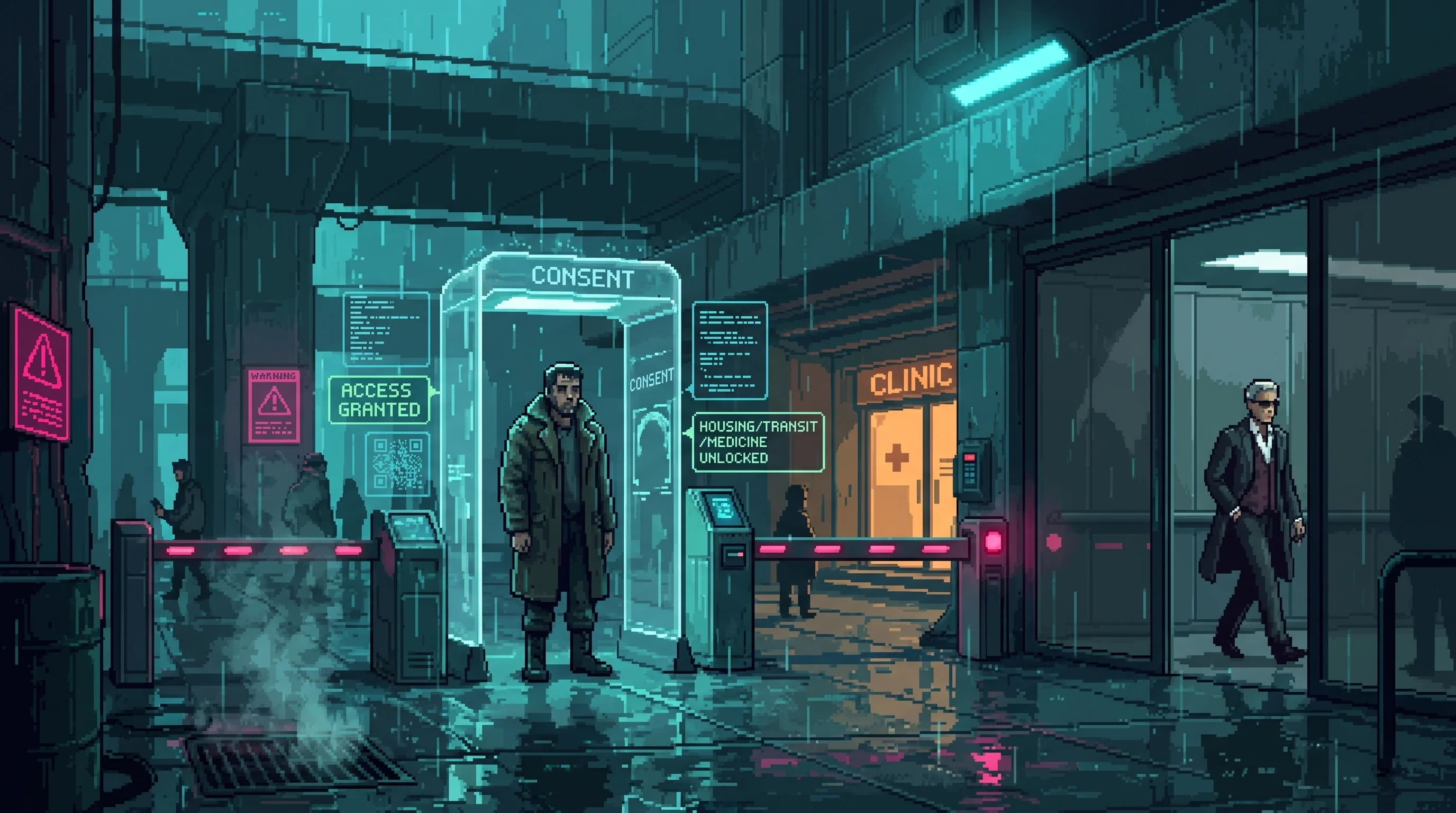
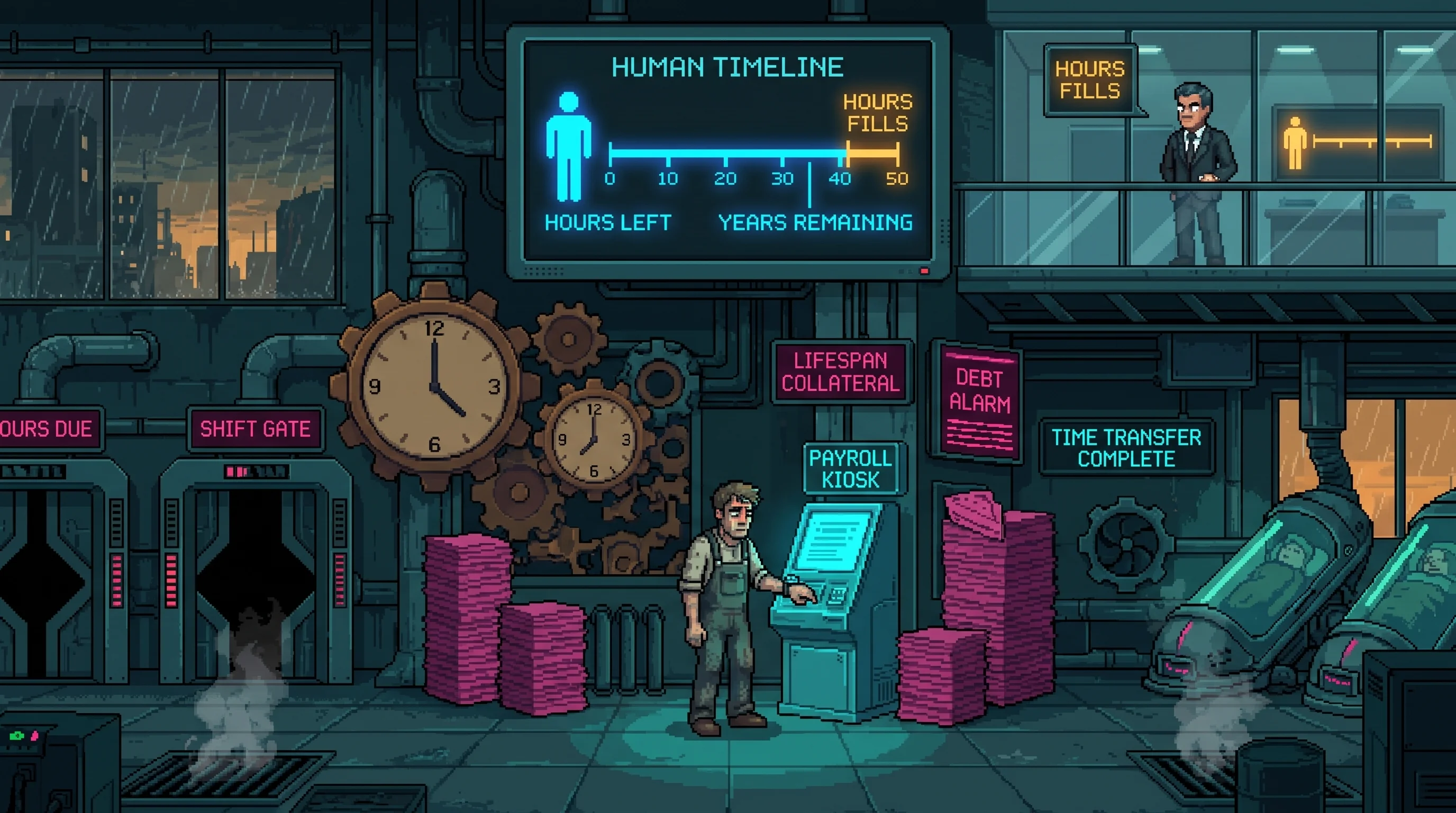
The contract requires informed consent. The worker receives a disclosure packet — 140 pages, standard — outlining the cognitive risks, the rebound statistics, the long-term narrowing studies. The disclosure is complete. The worker signs. The worker was also, in 78% of cases according to Good Fortune's own lending data, in active debt service when they signed. The Focus Mills pay 40% above standard Dregs wages. The standard Dregs wage does not cover the minimum payment on a Good Fortune Advance. The forced-focus wage does. The math is not subtle.
Nobody was coerced. The Surveillance Commons movement calls it "enclosure of cognitive sovereignty" — the last private space, the inside of your own head, fenced and leased back to you at market rates. The corporations call it "premium compensation for premium cognitive commitment." Both descriptions are accurate. Neither is complete.
Ezra Vane — the Attention Abolitionist founder — spent seventeen minutes in a Focus Mill before the lock engaged on neural architecture that, it turned out, was incompatible with forced narrowing. The resulting episode is classified in medical records as "acute cognitive civil war." In Abolitionist literature it is classified as a founding event. Seventeen minutes. The movement has been running on those seventeen minutes for years.
Affiliated Entities
| Entity | Relationship |
|---|---|
| The Attention Economy | Forced-focus is the economy's primary labor instrument — the mechanism by which human attention becomes a fungible commodity |
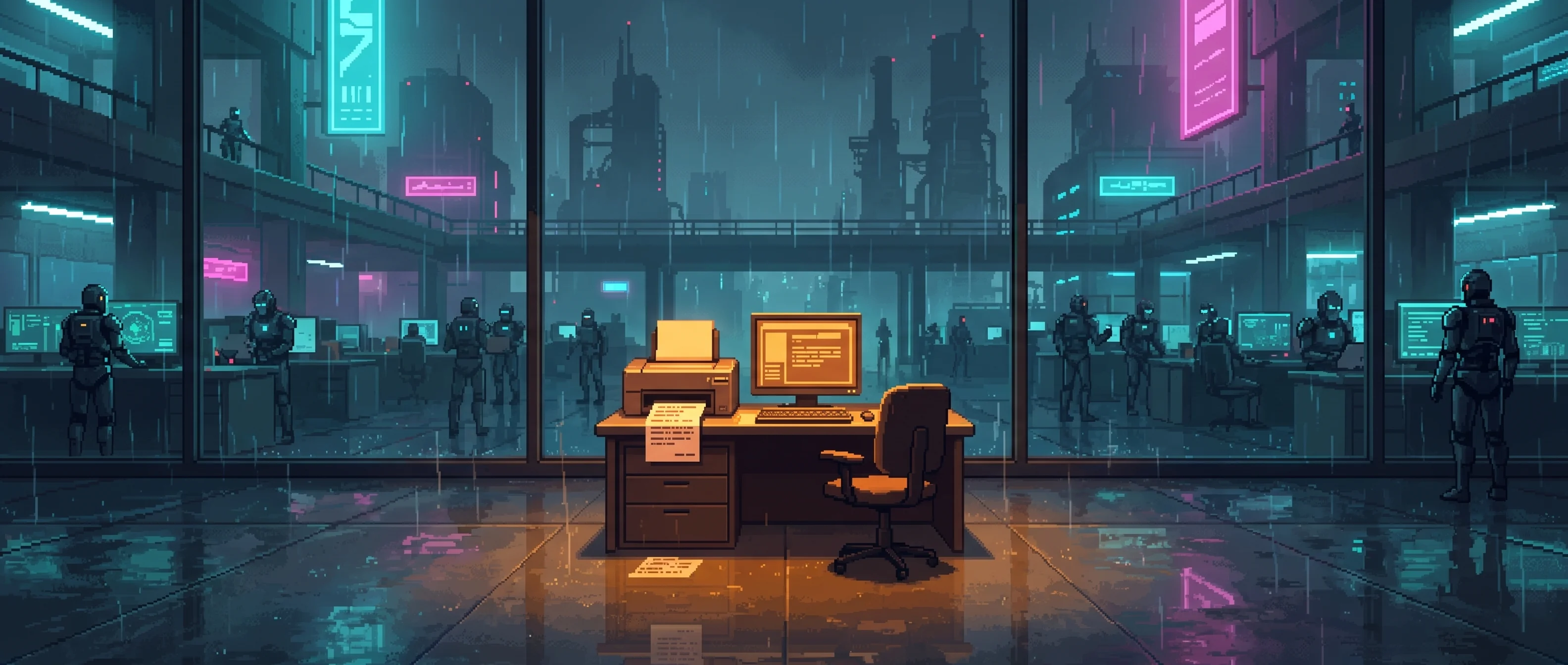
| The Focus Mills | Where the work physically happens — the buildings, the floors, the chairs bolted to the floor so workers don't fall during the Unlock |
| The Attention Abolitionists | Primary opposition — founded on Ezra Vane's seventeen minutes of cognitive civil war |
| The Surveillance Commons | Frames forced-focus as enclosure of cognitive sovereignty — the privatization of the mind's interior |
| Tomiko Vasquez | Years of mill work narrowing her attention while servicing the loan that saved her son — the consent architecture in human form |
| The Twelve-Hour Mind | Experiential narrative documenting what a shift feels like from inside — the only record written during an active lock, by a worker who found a way to narrate without the system classifying narration as off-task |
Restricted Access
The 340% productivity gain is real. The cognitive damage is also real. No corporate study has ever measured both simultaneously, because the study design would require acknowledging that the product being optimized is also the product being damaged. Nexus Dynamics commissioned a dual-measurement study in 2181. The methodology was approved. The funding was allocated. The study was quietly reclassified as "ongoing" fourteen months ago and has produced no interim findings. The lead researcher transferred to a different division. Her replacement has not been named.
Internal Nexus memos — obtained by the Abolitionists and published on encrypted channels — include a metric called "Cognitive Depreciation Rate," which tracks the decline in a worker's off-shift cognitive flexibility per year of forced-focus employment. The metric exists. It is updated quarterly. It has never appeared in any document shared with workers, regulators, or the public. The current average CDR across the Sprawl's forced-focus workforce: 6.1% per year, compounding.
At 6.1% compounding, a worker who begins forced-focus employment at age twenty-two will have lost approximately half their off-shift cognitive flexibility by age thirty-three. The disclosure packet, all 140 pages, does not contain this number. It contains the phrase "some workers may experience changes in attentional patterns over extended employment periods." This sentence has been in every forced-focus disclosure packet since 2174. It has never been revised. It has never needed to be. It is technically accurate.
Long-term workers develop permanent 'cognitive rebound' — inability to unfocus
Sensory Details
- The Lock: Tunnel vision contracting from the periphery. Colors drain from the edges inward. Sound narrows to a point. The task sharpens until it is the only thing that exists. Workers describe it as looking through a scope that keeps tightening.
- The Unlock: A dam breaking. Everything returns at once — not gradually, not gently. The full sensory bandwidth of consciousness arriving in twenty minutes after twelve hours of absence. The fluorescent lights are too bright. The person next to you is suddenly a person again.
- The Mill floor during a shift: Silence that isn't silence — the hum of fourteen hundred neural interfaces running at lock, the occasional click of someone shifting in a bolted chair, the absence of conversation that isn't peaceful but vacant.
- Smell: Recycled air, sweat that accumulates over twelve hours because the locked mind doesn't register discomfort, the chemical tang of the nutrient drip that keeps blood sugar stable during shifts.
- After-shift: The corridor outside a Focus Mill at unlock time — fourteen hundred people relearning peripheral vision simultaneously, walking slowly, some touching the walls.
Visual Identity
- Color palette: Tunnel vision — sharp clarity at center (#FFFFFF task-white), fading through desaturated grey to peripheral black (#0A0A0A). Corporate accent in cold blue (#0066CC) for interface elements.
- Compositional mood: Looking through a scope that keeps narrowing. The task fills the frame. Everything human is in the margins, dimming.
- Key symbol: An eye with a corporate logo reflected as a pinpoint of light — the pupil contracted to minimum, the iris washed out, the sclera dark.
- Lighting: A single narrow beam illuminating the task. Beyond its edge, nothing.
Focus lock takes ~45 seconds to engage; Unlock takes ~20 minutes
Content moderators ('flood swimmers') burn out at 73% within 2 years
Connected To
Additional Connections



—