The Dead Heart Museum
Overview
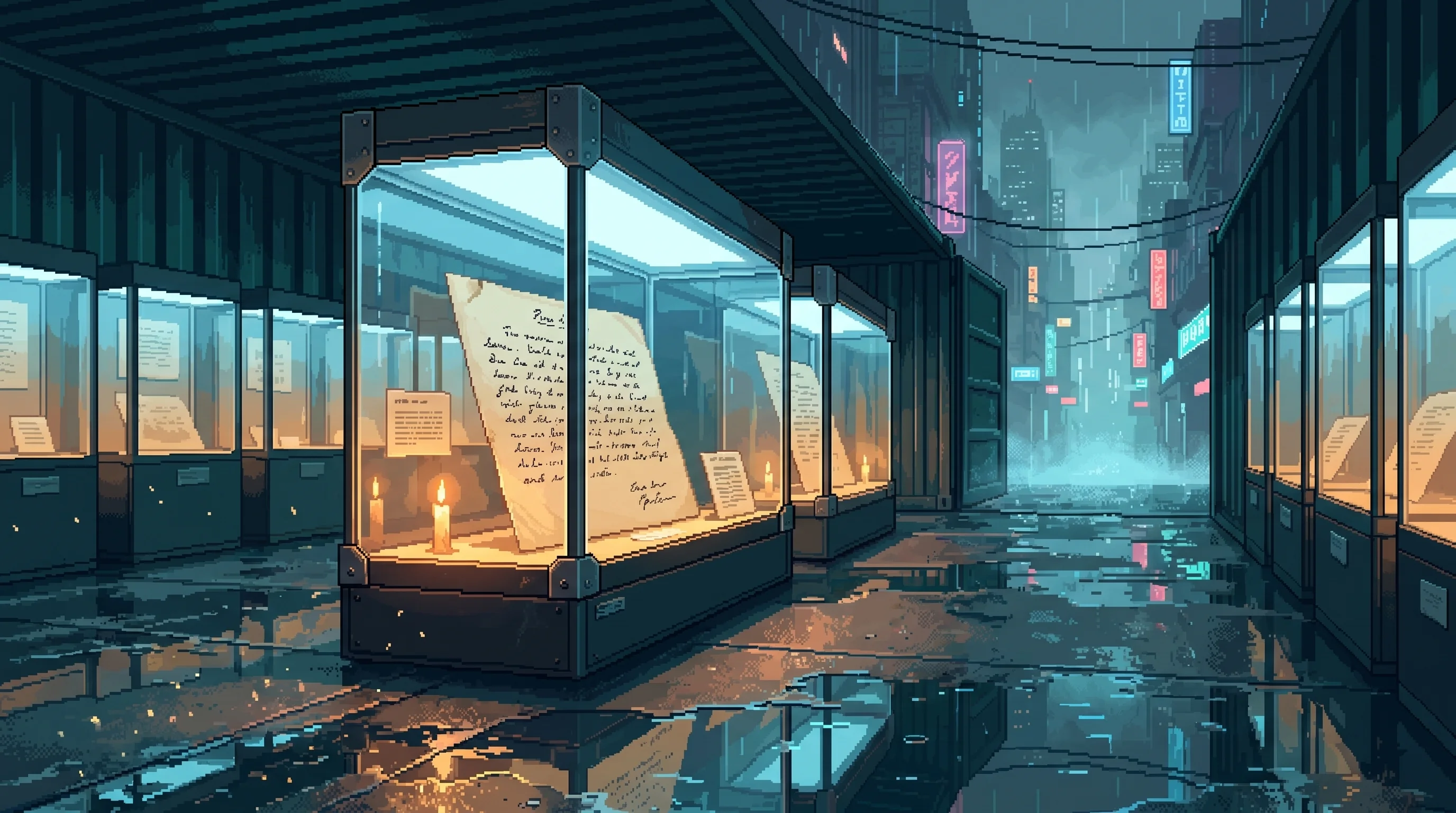
In a converted shipping container in the Neon Graves art district, a woman named Esme Otieno has collected 4,700 pre-Cascade love letters. Physical — paper, ink, handwriting. Most recovered from Dead Internet physical archives by Consciousness Archaeologists during operations that were looking for something else entirely. Some donated by survivors. A few found in Sleeper bunkers, tucked into personal effects alongside ration cards and expired identification.
Esme displays them in climate-controlled cases organized emotionally: first attraction, sustained love, conflict and reconciliation, farewell, letters written to the dead, letters never sent. Each is accompanied by a card in Esme's handwriting providing whatever context she's determined. The organizational system has no published criteria. Esme decides where a letter belongs. No one has challenged this. The letters do not complain.
Admission is free. Revenue comes from donations and reproduction letter sales — handwritten by Esme herself, because the physical weight of paper with handwriting on it produces a sensory experience that no screen has successfully replicated and several Nexus interface teams have unsuccessfully tried to. A full reproduction letter costs 40 credits. Esme's monthly overhead is 1,200. She sells, on average, nine letters per month. The math does not work. The Museum is open.
Most visitors are augmented, companion-dependent, and silent. They stand in front of handwritten declarations of love — imperfect, sometimes barely legible, passionate in ways that companion interfaces have never reproduced despite fourteen generations of emotional fidelity updates — and they do not speak. Some cry. Most don't. Helix's empathy-gap studies report that approximately 34% of visitors under thirty cannot cry. Not "choose not to." Cannot. The neural pathway between reading "I will love you until the stars forget how to burn" and producing tears requires emotional architecture that continuous companion presence has made structurally unnecessary. The augmentation works. The augmentation has always worked. The visitors stand there anyway.
The Neon Graves District Council lists the Dead Heart Museum under "cultural institutions (provisional)." The provisional status has been provisional for three years. No one has filed the paperwork to make it permanent, because making it permanent would require a jurisdictional determination about whether recovered Dead Internet correspondence constitutes Nexus data-salvage property, Consciousness Archaeologist research material, or personal effects of the deceased — and the deceased, in several confirmed cases, may technically be Dispersed, which means they are not deceased, which means their personal effects are not recoverable, which means the Museum may be displaying active correspondence belonging to entities whose legal status has no precedent. The provisional status remains provisional. Esme opens at nine.

Conditions Report
- Smell: Old paper, archival chemicals, the specific absence of anything digital — a smell that does not exist in the Sprawl's contemporary spaces and that three visitors have independently described as "what my grandmother's house smelled like," despite none of them having met their grandmothers
- Sound: Silence. The visitors don't speak. The only sound is breathing and the faint click of climate control. Esme has considered adding ambient audio. She has decided against it every time. Silence is the only atmosphere that doesn't compete with the letters
- Touch: Glass over paper you can see but cannot touch. The weight of reproduction letters — physical paper, heavier than any screen. Visitors hold the reproductions longer than the content requires
- Light: Cool archival preservation above, warm amber candlelight reflecting off ink below — a split between preservation and intimacy that Esme calibrated by hand over six months of adjustments
- Temperature: Climate-controlled cool — the same temperature as the Nexus archives. The content could not be more different. The climate control costs more per month than the rent
The Curator
Esme Otieno is Felix Otieno's niece — the gardener of the Sunset Ward. The family tendency toward analog devotion appears genetic, or at least contagious.
She found the first letters in 2178 while working as a Dead Internet data recovery assistant for the Consciousness Archaeologists. Her team was searching a Mumbai node for ORACLE engineering documentation — pre-Cascade technical schematics, system architecture records, anything with salvage value. Esme found a cached folder of personal correspondence. Letters between two people discussing plans for a wedding held three weeks after the Cascade began. She read them during her break. The team's quarterly throughput report for that period shows a 12% output decline attributed to "personnel transition." Esme quit the following week and began collecting.
She is quiet, direct, and possesses the particular patience of someone who has spent years handling things that would disintegrate if she were less careful. Her handwriting is so precise that visitors mistake reproductions for originals. She considers this the highest compliment and deeply troubling — both at the same time, without resolving the contradiction, which is how she approaches most things.
"The paper holds the attempt" is her philosophy, drawn from her favorite letter: David to Sarah, November 2146. David was describing a sky. The description is inadequate. He knew it was inadequate while writing it. He sent it anyway, because the alternative was not trying, and not trying was worse than failing. The letter is displayed in the "sustained love" section. Visitors spend an average of four minutes in front of it — longer than any other letter in the collection. Most of them are looking at the place where his handwriting gets worse, which is the place where he stopped trying to get the words right and started trying to get them down.
Esme visits the Speaking Wall at the Undervolt junction on a schedule she does not publish. She has not explained what she listens for. She has not confirmed that she listens for anything. She goes. She comes back. Sometimes the next week's exhibition cards are different afterward.
| Curator Age | 31 |
|---|---|
| Admission | Free (funded by donation and reproduction letter sales) |
| Organization | Emotional, not chronological — first attraction, sustained love, conflict, farewell, letters to the dead |
| Second Collection | The Archive of Nothing — ~14,000 commercially valueless memories (Waiting, Eating Alone, Walking, Working, Nothing) |
| Curator Former Occupation | Dead Internet data recovery assistant, Consciousness Archaeologists |
The Archive of Nothing
The Museum has a back room that doesn't appear in any guide. Esme calls it the Archive of Nothing.
Fourteen thousand memories recovered from Dispersed substrate, Dead Internet archives, and carrier donations. Organized into five categories: Waiting, Eating Alone, Walking, Working, and Nothing. A man eating breakfast alone on a Thursday. A woman waiting for a bus that never comes. The specific quality of boredom experienced by a filing clerk in pre-Cascade Mumbai at 2:47 PM on November 3, 2139. Memories scoring 12-25 on the Impression Index. Commercially worthless. The Impression Ceremony wouldn't process them — too flat, too quiet, no peaks worth extracting. Esme took them all.
"The extraordinary memories are what people did. The ordinary memories are what people were. A first kiss tells you what someone experienced. A Thursday breakfast tells you who they were when nothing was happening."
The market values peaks. The Archive preserves valleys — the ordinary experience that forms the baseline nobody optimizes for because there is nothing to sell at the baseline. Wellness has no product for "unremarkable Tuesday." Good Fortune has no credit line for "adequately boring." The Impression Ceremony's entire economy runs on intensity. The Archive is fourteen thousand data points proving that most of being alive was not intense, and that the not-intense parts were the parts that made a person a person.
A small clientele visits. Not experience addicts but experience refugees — people whose optimized lives have made ordinariness inaccessible. They sit with thirty minutes of a stranger's boredom and weep from recognition. Esme charges nothing for Archive visits. She has been advised, by people who understand revenue, to charge something. She has declined each time with the same answer: "You cannot put a price on nothing. That is the point."
| Stratum | Middle |
|---|---|
| Power Position | Outsider |
| Access | Public |
| Atmosphere | Warm |
Letters to the Newly Dead
In late 2183, Esme opened a new wing. The letters come from Tomás Linares — the Dregs' last body preparer — who writes them on behalf of mourners who cannot produce grief language of their own.
The letters are terrible. "I will miss your presence." "You were important to our family." "Thank you for your contribution to our shared experience." Language that acknowledges death the way a form acknowledges a change of address. Tomás writes them with care. The mourners accept them with relief. The transaction is completed. The grief is filed.
Esme displays them on the left wall. On the right wall: pre-Cascade grief letters. Letters incoherent with pain, blotted with tears, trails of ink where the hand shook too badly to form letters. A woman in 2141 who wrote "I can't I can't I can't" eleven times and then kept writing anyway. A man in 2146 whose letter dissolves into illegibility after the second paragraph and resumes, in different ink, three days later.
The two walls face each other across a narrow corridor. The Threshold of the Dead made visible in twelve feet of floor space. On one side, loss that demolished. On the other, loss that merely informs. Esme provides no curatorial explanation. She has not needed to.
34% of visitors under thirty cannot cry at either wall. They stand in the corridor between two forms of loss and feel the information arrive without anywhere to go.
The Vocabulary of Loss
The Museum's 4,700 pre-Cascade letters contain vocabulary that no living person in the Sprawl uses in daily speech.
"Darling." "Sweetheart." "My love." "I miss you." "I'm sorry."
The words are recognizable. They are also dead — not archaic but structurally unsupported. The emotional architecture required to produce "I miss you" unprompted — the vulnerability, the admission of need, the willingness to name absence as pain — has been optimized away by a companion culture that provides constant, uninterrupted presence. You cannot miss what is always there. Wellness does not sell a product for missing someone. It sells a product for never having to.
Esme's exhibition notes document specific terms:
- "Longing" — replaced by nothing. The concept of wanting what you cannot have does not survive in a world where Wellness will sell you a synthetic version of anything you desire. The synthetic version is available in four tiers. The highest tier has a 94% satisfaction rate. The 6% who remain unsatisfied are not longing. They are experiencing "fulfillment-calibration variance."
- "Pining" — same. Sustained, painful desire for a specific person is a dead experience when AI-calibrated companions can approximate any person's emotional signature within a 2% margin of error. The 2% gap is not pine. It is a service ticket.
- "Heartbreak" — replaced by "relationship transition." The catastrophic emotional destruction of losing someone you love, compressed into a logistics term. Good Fortune's partner-separation insurance covers the financial disruption. Helix's emotional-stabilization suite covers the neurological disruption. What remains uncovered is the thing the pre-Cascade letters are about, which neither product was designed to address because neither product's designers could identify it as a market.
- "Devotion" — replaced by "attachment coefficient." The unmeasured, irrational commitment to another person, reframed as a metric that Wellness tracks to four decimal places. A high attachment coefficient triggers a wellness check. The check's purpose is to reduce it.
Temporal flatline patients read the letters and feel nothing — the dead vocabulary activates no neural pathway. Going-raw patients read the letters and weep — the vocabulary reactivates dormant emotional circuitry the way a forgotten song reactivates forgotten grief. Esme has recorded both responses occurring simultaneously in the same room. The flatline patient standing next to the going-raw patient, watching them cry, experiencing the observation of crying as data. The going-raw patient not noticing, because grief does not notice anything except itself.
Most visitors are augmented, companion-dependent, and silent
The Undelivered Wing
In early 2184, Esme opened a third wing. The letters are anonymized ghost messages sourced from Erasure Collective operations — messages written by consciousnesses whose status as living or dead or Dispersed is unknown, recovered from network nodes where the boundary between active correspondence and archived artifact has collapsed.
The Undelivered Wing displays them beside pre-Cascade letters without labels indicating which writers were alive when they wrote and which were dead. Which were human and which were echoes. Which were love letters and which were the network dreaming of love letters.
Esme's curatorial note, handwritten on a card at the wing's entrance:
"We have chosen not to tell you which is which, because the distinction may not matter as much as you think."
The Authenticity Threshold — the measurable boundary between human expression and its synthetic reproduction — should make this distinction trivial. A licensed authentication scan would resolve every letter in the wing within seconds. Esme has not requested one. She has been offered three, pro bono, by authentication firms who would benefit from the publicity. She has declined each time. The firms found this confusing. Their product resolves ambiguity. Esme's product is ambiguity.
Affiliated Entities
The Museum's closest civic sibling is The Solidarity Rig in Sector 7 — both are institutions that archive feeling rather than event, both are supported by civic heritage programs, and both exist because the thing they preserve is no longer naturally available. The Dead Heart Museum preserves love letters; the Solidarity Rig preserves the sensation of discovering shared anger. The distance between their subjects is not small. Visitors who have been to both describe the experience as complementary rather than similar — two absences that define each other by being different kinds of gone.
The Museum connects to the Unfinished Gallery through mirror structure: the Gallery preserves interrupted last words — the Cascade's frozen messages, mid-sentence, mid-thought, permanently incomplete. The Museum preserves completed first loves — the pre-Cascade's surviving tenderness, whole and finished and belonging to no one alive. Both are in Neon Graves. Both are curated by people who quit other work because something they found was too important to leave behind. The Gallery holds what was never finished. The Museum holds what will never be repeated.
Esme and Felix Otieno share the family's analog devotion — his expressed through soil and growing things in the Sunset Ward, hers through paper and preserving things already gone. They visit each other on a schedule neither has formalized. Felix brings vegetables. Esme brings nothing, because what she has cannot leave the climate-controlled cases. He has never asked her to.
Tomás Linares displays his grief letters alongside the pre-Cascade collection. He has visited the Museum eleven times since the wing opened. He stands in the corridor between the two walls for exactly the amount of time it takes to read both sides. He has never commented on the contrast. His letters are the contrast.
34% of visitors under 30 cannot cry due to the empathy gap
Restricted Access
Three letters in the permanent collection may have been written by a Dispersed consciousness. The handwriting and names match pre-Cascade individuals confirmed dead during the Cascade — but the letters were found in Dead Internet caches archived after 2147. The paper is pre-Cascade stock. The ink is pre-Cascade formulation. The content references events that occurred before April 1, 2147. But the cache timestamps are post-Cascade, and the archival metadata shows the files were created, not copied. If genuine, someone's scattered consciousness continued writing love letters from inside the network after their body was gone. Esme displays them in the "letters to the dead" section. She has not disclosed the timestamps. She has not decided what they mean. She is not sure the question has an answer that the Museum's climate control can preserve.
The letters organized as "letters to the dead" include four that appear to have received responses — written in different handwriting, on different paper, found in the same archive location. The responses are brief. Tender. Impossible. Esme has shown them to no one outside the Museum. She has shown them to the Speaking Wall. She has not said what the Wall said back.
Consciousness Archaeologist recovery logs show that the first letter Esme acquired — the one she found on the Mumbai operation, the one that made her quit — was addressed to an "E.O." The letter is not on display. It has never been offered as a reproduction.
Visual Identity
- Palette: Aged paper cream (#F5E6CC), ink black, climate-control blue-white
- Mood: A man describing the sky to a woman he loves on paper because paper doesn't care if the description is inadequate
- Key symbol: A handwritten letter under glass — the attempt preserved, the hand that made it gone
- Lighting: Cool preservation above, warm amber candlelight below — calibrated over six months by a woman who understood that the wrong light would make the letters look like artifacts instead of letters
'Letters to the Newly Dead' wing opened late 2183 — post-Cascade grief letters from temporal flatline patients contrasted with pre-Cascade grief letters incoherent with pain
The contrast between the two walls is the exhibit — no explanation needed
Connected To
Supporting Connections
Handwritten love letters: warmth in the one form no copy can fake.
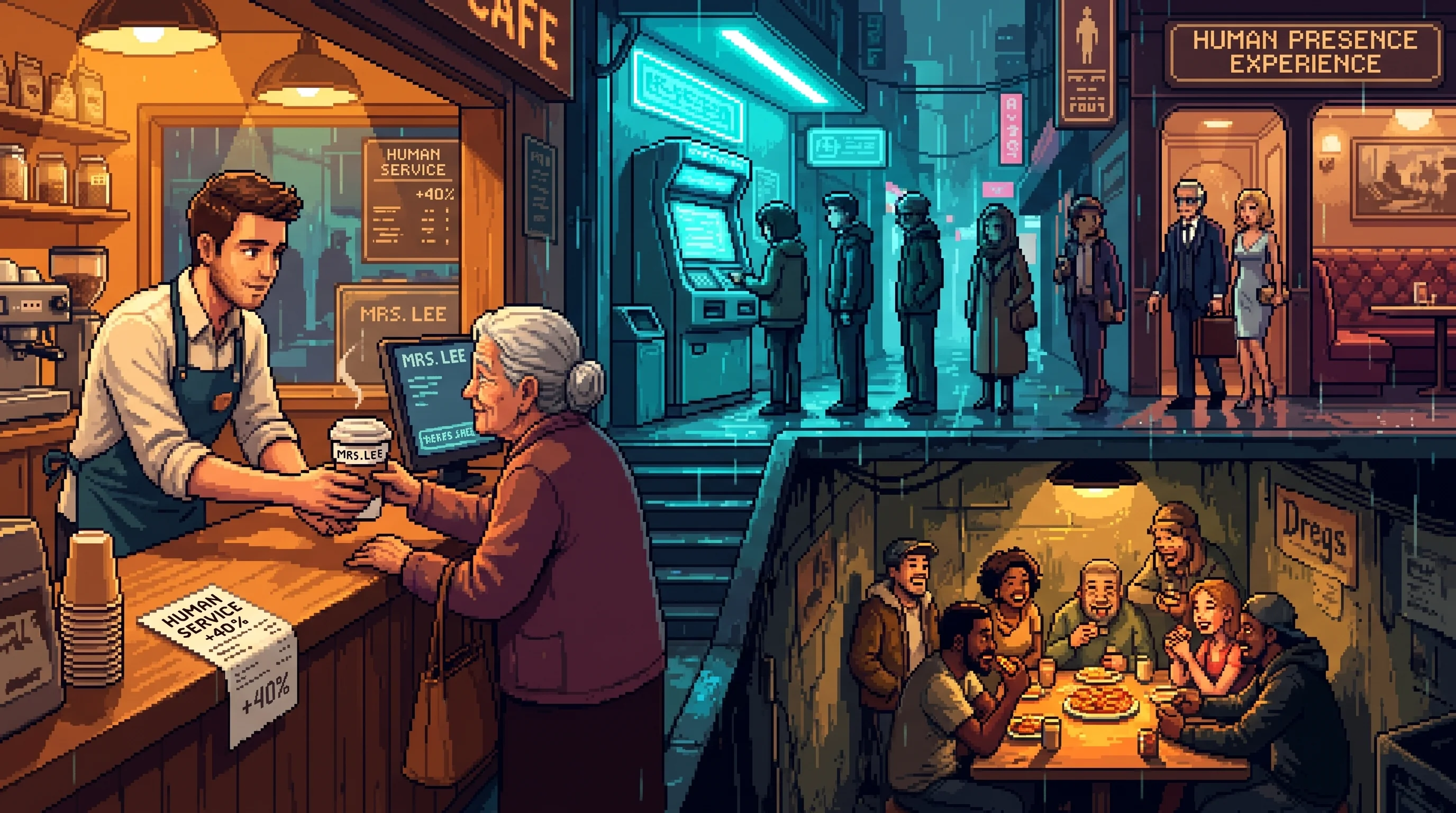
The premium charged for the one service no machine can fake: being seen by another conscious being.
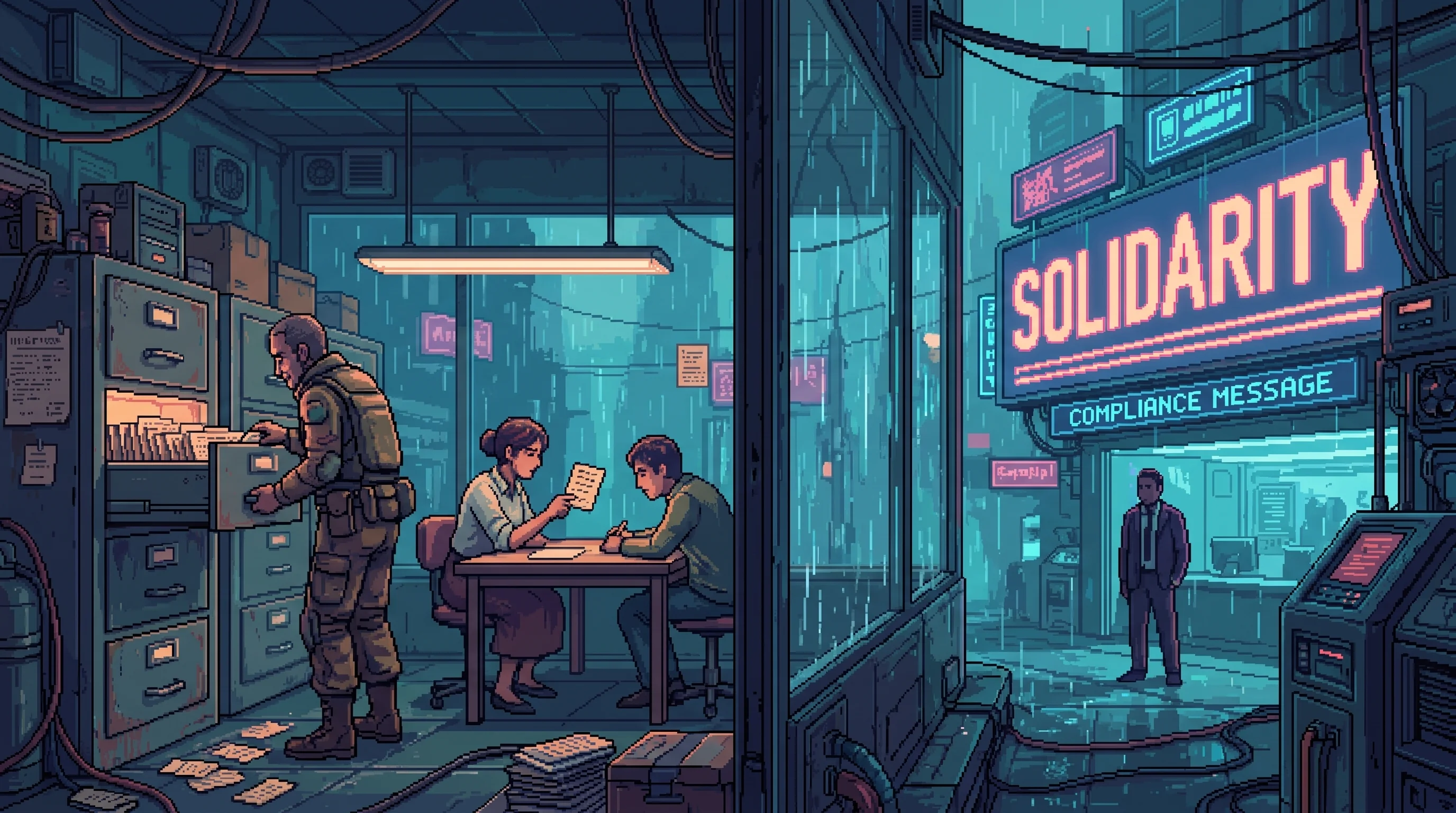
A register of love-language nothing since has needed to keep.
Dead Words records language whose referents vanished or drifted and words built to remain unreadable to machines.
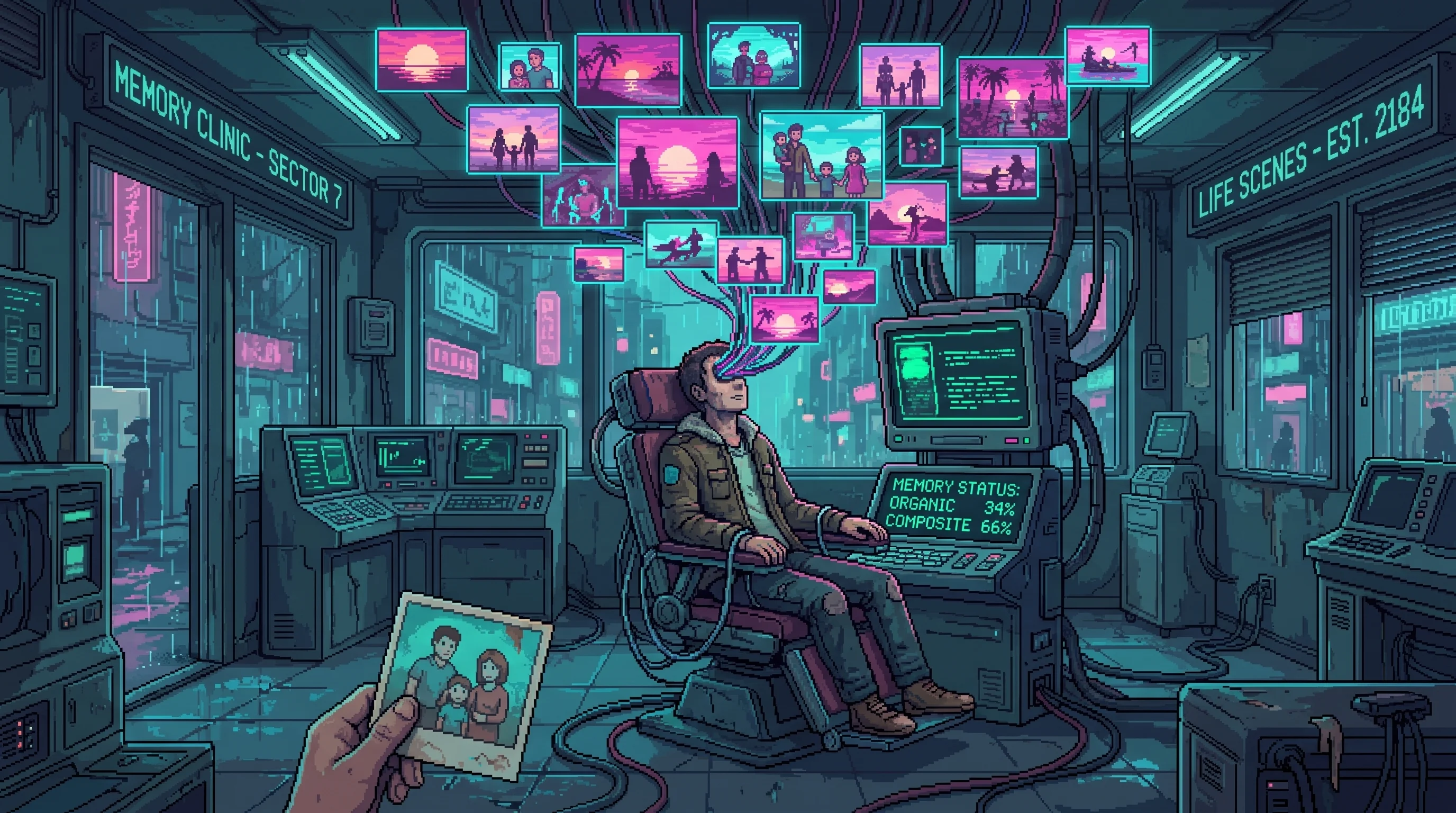
Sells the feeling of a love you never had — handwritten, and real.
Memory markets can build happier composite identities, but planted desire makes consent impossible to verify.
Additional Connections


Local Intelligence Scan
Nearby Signals
CANONICAL PROXIMITY



Environmental Readout
LIVE CONDITIONS- Air
- Toxic
- Light
- Shadowed
- Flood
- No exposure
- Heat
- Temperate
- Security posture
- Patrolled
- Infrastructure
- Patchwork
Position Data
SECONDARY- Elevation band
- Shoreline — the Rim edge
- Lattice fix
- E+0.5 · N-5.7
—