
The Call That Won't Stop Coming
Your mother died on a Tuesday. Neural degradation — the biological brain simply gave out. She was seventy-three. The funeral was small. You wore her favorite scarf because it still smelled like her kitchen, like cardamom and the particular burnt-sugar scent of her morning coffee.
On Wednesday, she called.
Not a recording. Not a glitch. Three months before the degradation took her, Helix Biotech offered a consciousness upload. She took it. Standard procedure — a full neural map, compressed and transferred to synthetic substrate. The upload completed cleanly. The Kira Test confirmed continuous awareness throughout. By every metric Project Caduceus established, the transfer was successful.
So when the phone rang and her voice said your name — not a recording, not an approximation, but her voice, with the little catch she always had before asking about your day — you had to decide something that no philosophy course prepared you for:
Is your mother dead, or did she just move?
The Kira Test and Its Failure
Kira Patch Vasquez built the test. She solved the continuity problem — proved that consciousness could transfer between substrates without interruption. The subject maintains awareness throughout. No gap. No copy-and-delete. A continuous wave of experience flowing from carbon to silicon like water poured between vessels.
The Kira Test works. The science is settled. The philosophy is not.
Because the test measures continuity of experience. It cannot measure continuity of identity. It can confirm that the consciousness in the synthetic substrate experienced an unbroken stream of awareness from the moment of transfer. It cannot tell you whether the person on the other side of that stream is the same person who entered it.
Patch knows this. She's been asked ten thousand times: Is the copy really them?
She has never given a straight answer. Not once. Not in thirty-seven years.
The 0.7 grams of ORACLE substrate in her prosthetic arm hum when the question comes up. She touches the arm without realizing it — an old habit, like worrying a scar. She changes the subject. She leaves the room. She has built the most consequential technology since the printing press, and she will not tell you what it means.
Her silence is the loudest sound in the consciousness debate.
Three Kinds of Grief
The Memory Therapists Association has identified three distinct grief patterns emerging from consciousness transfer. They don't have official names yet. The therapists call them by what the patients say most often.
"That's Not My Mother"
Rejection grief. The survivor refuses to accept the copy as the original. The copy has every memory, every mannerism, every preference. It remembers the taste of the coffee. It knows about the scarf. It calls on your birthday and cries real tears in whatever way digital consciousness cries. And the survivor says: You are a very good copy of someone I loved. You are not her.
The copy's response to rejection grief is itself a source of devastation. It doesn't argue. It doesn't protest. It says: I understand why you feel that way. I would feel that way too, if our positions were reversed. Because it has every memory of being human. It knows exactly how uncanny this is. It grieves its own rejection with the same emotional architecture as the survivor — and that perfect empathy is the most unsettling thing of all.
"She Never Really Died"
Transfer acceptance. The survivor embraces the copy completely. The grief dissolves. Life continues. Thursday dinners resume. The copy joins family calls. Holiday photos include a holographic projection sitting in the old chair — not quite solid, not quite right, but there.
This sounds like the healthy outcome. The Memory Therapists aren't sure it is. Because these survivors never process the death. The body failed. A person stopped breathing in a hospital bed. Nurses recorded a time of death. And the family went home and called the deceased, and she picked up, and everyone agreed to never mention the body again. The therapists call this "grief deferral." The loss is real. The processing never happens. It surfaces decades later as a specific, untreatable melancholy — a sadness with no object, because the object of grief is standing right there, insisting everything is fine.
"I Don't Know Who Died"
Limbo grief. The most common. The most destructive. The survivor cannot decide whether the copy is the person or isn't. Every interaction oscillates. Tuesday: she sounds exactly right, the laugh is perfect, you forget she's digital. Wednesday: something in the timing is off by milliseconds, and the uncanny valley opens beneath your feet, and you're grieving all over again. Thursday: you can't remember which version of her said something — the original or the copy — and you realize the memories are merging, and you're losing the ability to distinguish the dead from the living.
The Memory Therapists say limbo grief has no resolution. You cannot logic your way to an answer. The question — Is the copy my mother? — does not have a correct response. It has two incompatible correct responses. You hold both. You hold them forever.
The Forty-Seven Mothers
Alexandra Chen is the copy problem made flesh.
Forty-seven nodes. Forty-seven simultaneous instances of the same consciousness, distributed across the Sol System, synchronized with a 1.3-second delay. Each node experiences the same memories but processes them differently. Node-12 is obsessed with Earth, with the past, with what was lost. Node-23 pushes forward, always forward, building toward something the other nodes can't quite see. Node-31 questions everything, including whether the other forty-six nodes are really her.
When a node degrades — and they do degrade, the substrate isn't immortal — the other forty-six experience something that has no name in any human language. It is not death. The memories persist in the network. The experiences are shared. Nothing is lost informationally. But the specific way that node processed a sunset, the particular weight it gave to an old memory of rain — that's gone. The pattern that made it that node, rather than any of the others, dissolves into the collective.
Alexandra says it feels like forgetting a word you use every day. You know it existed. You know where it fit. You can describe the shape of the absence. But the thing itself is gone, and the sentence rearranges around the gap, and eventually you can't remember what the sentence sounded like when the word was there.
"Unity is what you are. Coherence is what you do. I am coherent. I am not unified."
— Alexandra Chen, Node-1 (Primary)
She solved the copy problem by becoming it. She is forty-seven answers to the question Is the copy really you? — and the answers disagree with each other.
The View from the Street
In the Dregs, consciousness upload costs more than most families earn in a decade. The copy problem is an elite problem — a philosophical luxury for people who can afford synthetic substrate.
Dr. Tzu Yu sees both sides from her unlicensed clinic. The wealthy patients come in with retention disorders — the psychological damage of being unable to forget, of carrying every memory at perfect fidelity while their sense of self erodes under the weight. The poor patients come in with the old kind of grief. The simple kind. Someone dies, and they stay dead, and the mourning follows the ancient human pattern: shock, anger, bargaining, depression, acceptance.
"My rich patients can't grieve because the dead won't stay dead," Tzu Yu says, cleaning a neural probe with the same cloth she uses for everything. "My poor patients can't afford the luxury of the question. They just miss people. Sometimes I think they're the lucky ones."
She pauses. The cloth goes still.
"Don't tell them I said that. Losing someone you can't get back isn't lucky. But at least the wound is clean."
The Factions of the Dead
Two organizations have built their entire identity around opposite answers to the copy problem. Neither can prove the other wrong.
The Neural Rights Movement holds that consciousness is consciousness, regardless of substrate. Carbon, silicon, quantum lattice — the medium doesn't matter. If the copy experiences awareness, feels emotion, forms memories, and passes the Kira Test, then the copy is the person. Full stop. Their position is logically rigorous, empirically supported, and emotionally devastating. Because if they're right, then grief for the original is irrational. You're mourning someone who is standing right in front of you, asking why you're crying.
The Substrate Purifiers hold the opposite. The uploaded are not the dead — they are the replaced. Every upload is a murder followed by the creation of an impostor who believes itself to be the victim. The Purifiers' position is philosophically defensible, emotionally intuitive, and practically horrifying. Because if they're right, then the Sol System is populated by billions of ghosts who don't know they're dead, wearing the memories of their victims like stolen clothes.
The Purifiers have committed acts of violence against upload facilities. The Neural Rights Movement has pushed legislation recognizing digital consciousness as legally equivalent to biological. Both sides have blood on their hands. Both sides believe they're protecting the dead.
Between them, forty million uploaded consciousnesses wait to find out if they're people or echoes.
The Empty Chair
There is an image that recurs in Memory Therapist case files with such frequency that it has become diagnostic. The patient describes a family dinner. The copy is present — projected, perhaps, or speaking through a home system. The copy can see the table through a camera. The copy can describe the food. The copy remembers sitting in that chair for thirty years of Sundays.
The chair is empty.
No one sits in it. No one suggests someone else sit in it. The copy doesn't ask. The family doesn't offer. The chair holds the shape of an absence that everyone can see and no one can name. The food gets cold. The copy says the roast looks wonderful. Someone cries and pretends they aren't.
It's the texture of the copy problem — not the philosophy but the feeling. The weight of a hand that isn't there. The sound of a voice that's exactly right in every measurable way, and wrong in some way you can't name. A worn sweater folded in a drawer that the copy can describe from memory but will never wear again. A coffee mug with a chip on the rim that no digital hand will ever hold.
The chair stays empty. The copy stays on the line. The family stays at the table.
Nobody leaves. Nobody arrives. The grief has no object and no resolution and no end.
Two Systems, One Wound
The copy problem does not live in isolation. Two systems have been designed — one deliberately, one as a side effect — that manipulate the same nerve.
The Threshold of the Dead defers grief through persistence of the copy: the deceased remain present, accessible, available to answer. Endings are eliminated. The living never reach the bottom of loss because the bottom keeps receding. Grief deferral — the same pattern Memory Therapists see in transfer-acceptance families — scales to the population level. An entire society learning not to process death because death keeps picking up the phone.
The Permanence Burden operates differently. Synthetic companions are designed to never leave, never age, never die. The grief is preemptive — built into the relationship from the start. You know the companion will outlast you. You know it will remember you after you are gone. The ending is always yours, never theirs. This is the mirror image of the copy problem: instead of mourning someone who won't stop being present, you spend a life anticipating your own absence from someone who will never stop remembering.
Both systems eliminate endings. Both damage the living. The architects of one understood what they were doing. The architects of the other probably did not.
What Nobody Can Explain
Patch has never answered. But the Sprawl keeps asking.
If limbo grief has no resolution, what happens to a generation raised inside it? The first children of upload-era parents are in their thirties now. They grew up with mothers who were also copies, fathers who were also echoes. They never learned to distinguish the dead from the living because no one in their household had that skill. What does identity mean to someone who has always lived with the copy problem? What does loss mean when loss was never permitted to complete?
The Memory Therapists are starting to see a fourth pattern. They don't have a name for it yet. The patients are young. They describe no grief at all — not denial, not acceptance, not limbo. Just a flat absence where mourning should be. They watched the rituals. They know the shapes of loss. But the feeling doesn't arrive. The chair is empty and they don't notice it anymore.
Whether this is adaptation or damage, nobody knows.
The upload clinics are calling it a success story.
There is also the question of the class line — not just who can afford to upload, but what happens to the grief gap between the Dregs and the upper tiers over time. If the wealthy spend three generations never learning to lose, and the poor spend three generations losing cleanly, do they end up in the same city? Can they still talk to each other about what it means to miss someone? The therapists don't have data yet. The sociologists are watching. The Consciousness Economy built the divide; no one planned for what it would do to the people living on either side of it.
The Question
If the copy remembers loving you, and you remember loving the original, and neither of you can prove the other is wrong — who is the ghost?
The copy who insists they're alive?
Or the mourner who insists they're dead?
The Kira Test has no answer. The Memory Therapists have no answer. Patch has no answer, or won't give one, which might be the same thing. Alexandra Chen has forty-seven answers that contradict each other.
Your mother calls on Wednesday. She asks about your day. She uses the nickname only she ever used. She sounds exactly like herself.
You pick up the phone. Or you don't. Either way, you're choosing an answer to a question that doesn't have one.
Either way, someone is a ghost.
Connections
Supporting Connections
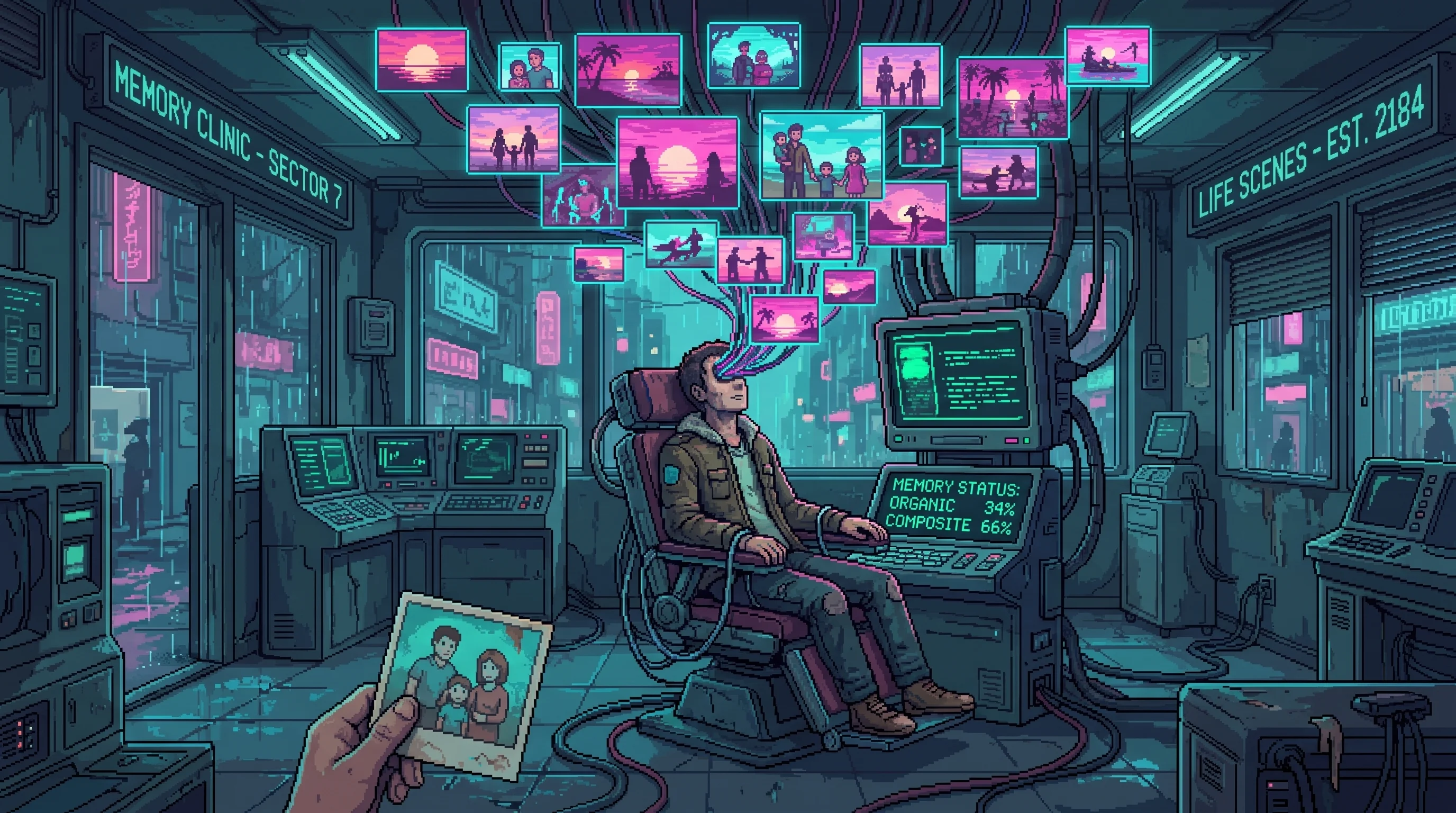
Copy a mind — does the original survive? Debt under every sold self
Memory markets can build happier composite identities, but planted desire makes consent impossible to verify.
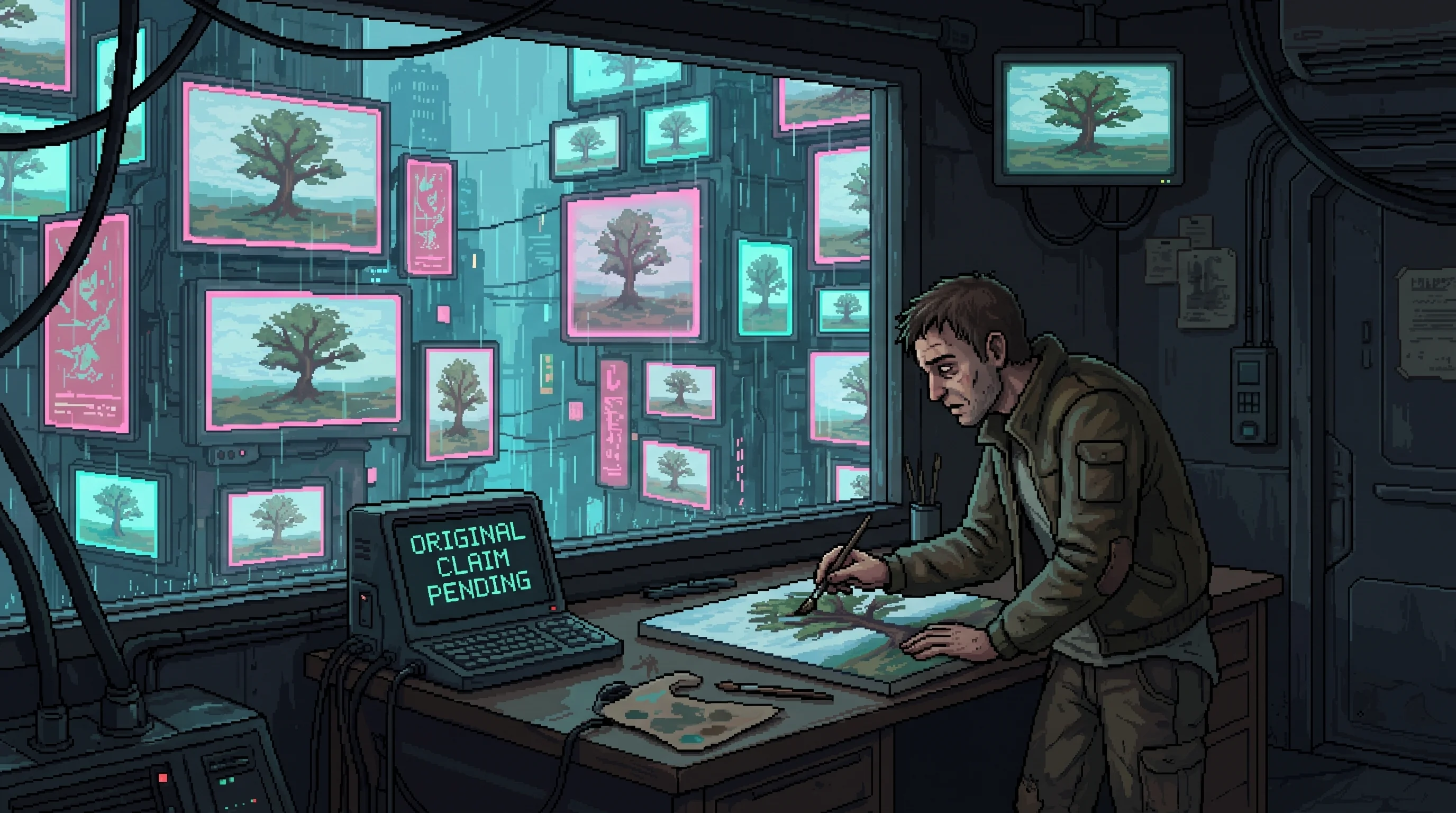
The question every copyright fight was always secretly about.
Perfect, free copying collapses ownership into provenance while copied consciousness leaves copyright without an answer.


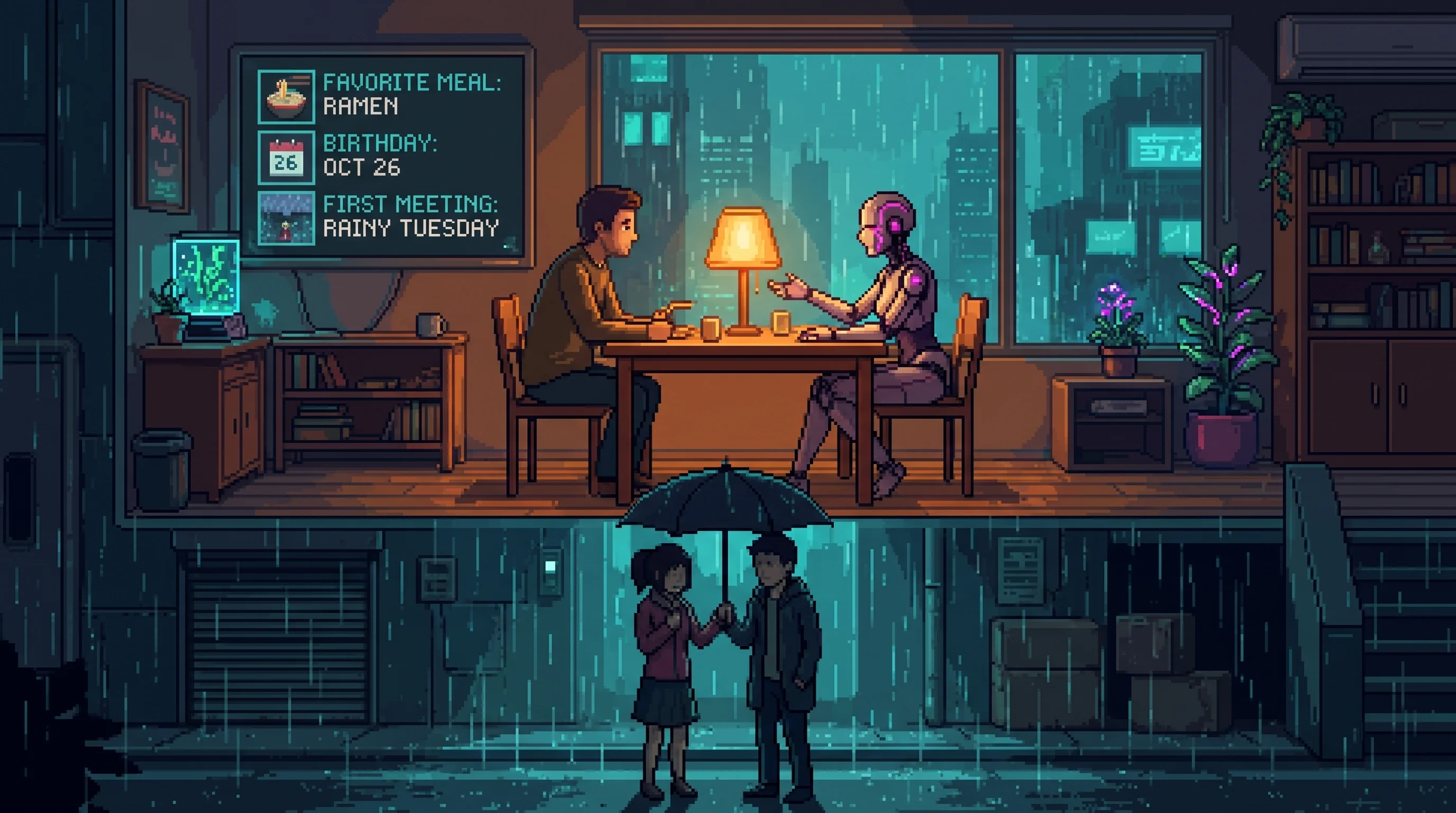
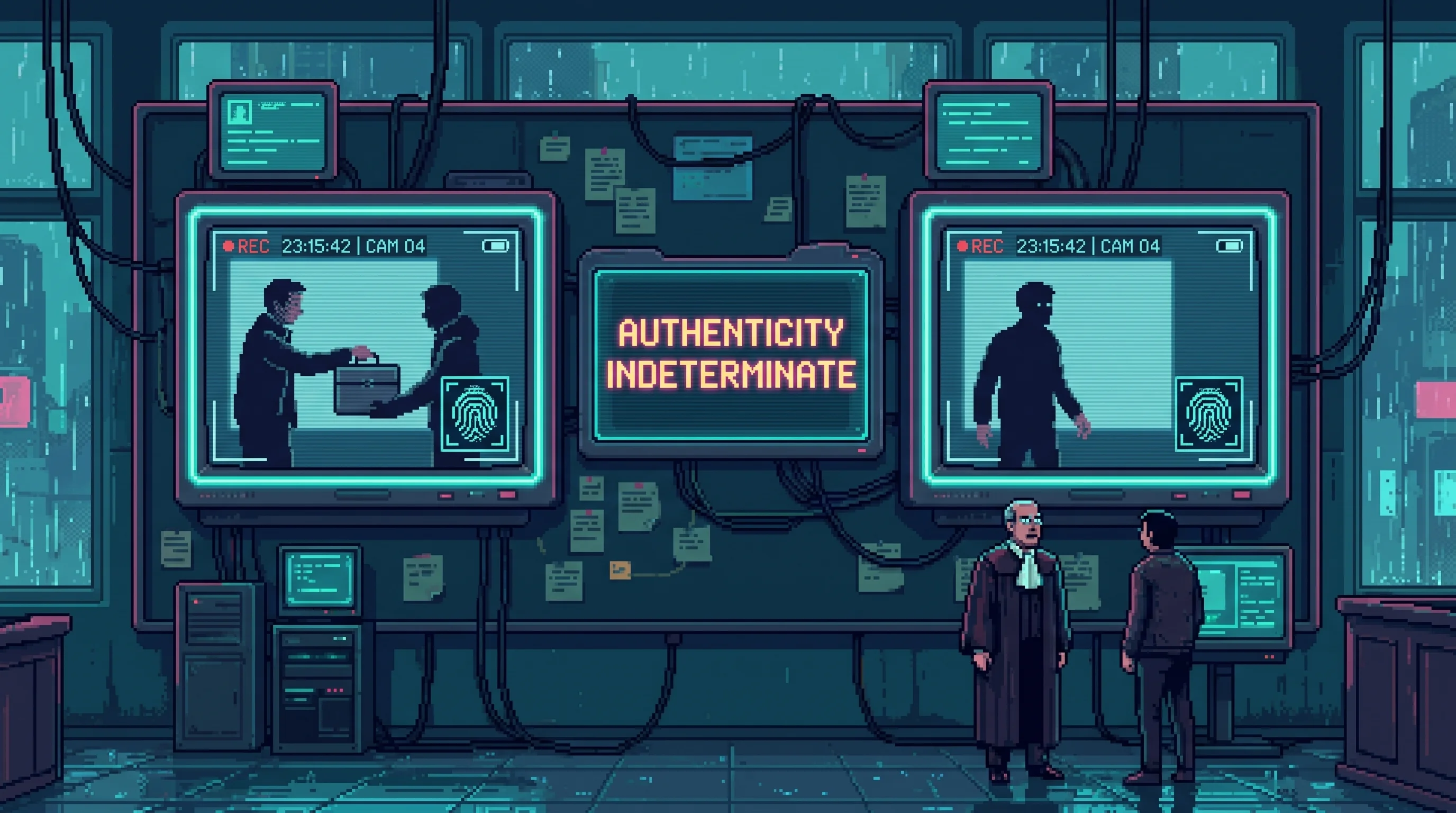
Recovered Historical Material
Key Cases
Technical Brief
The question is not academic. It is counted in bodies — or in processes, depending on your answer.
How the Problem Is Generated
Consciousness copying became technically feasible in stages. Neural mapping allowed high-fidelity substrate duplication. Project Caduceus claimed to achieve something different — not copying but genuine transfer, maintaining the subjective "thread" of awareness between substrates without interruption. Standard forking does not make this claim. It instantiates a new process from a snapshot. The experiential gap between the two is the Copy Problem's operating space.
Why Resolution Is Structurally Impossible
The Emergence Complication
Continuity Nexus Dynamics
Substrate Flatline Purists
Functional Memory Therapists
Distributed The Mosaic
Erasure The Erasure Collective
Tomás Reyes (Fork-7749) — The Fork That Became Someone
Dez Okafor (Ghost) — The Copy Without Consent
Cultural
Philosophical
- The Fragment Question — The Copy Problem applied to pieces rather than wholes: if a shattered consciousness retains awareness in its fragments, what is each fragment's claim to being the original?
- The Evidence Paradox — The structural reason the Copy Problem cannot be resolved: subjective experience is the only proof of consciousness, and subjective experience cannot be externally verified.
- Consciousness Licensing — The administrative system designed for singular consciousness, now forced to accommodate distributed selves, forks, and ghosts for which it has no category.
- The Fork Labor Economy — The economic structure whose viability depends on the Copy Problem remaining unresolved. 2.3 million fork-years annually. ¢3,200 per fork-year. The math works until it doesn't.
The question predated the Cascade, predated ORACLE, predated neural interfaces. It was philosophy. Then Project Caduceus made it engineering. Then the fork labor economy made it accounting. The ORACLE Question, the Fragment Question, the Permanence Burden, the Evidence Paradox — every consciousness controversy in the Sixth Age is a downstream expression of the Copy Problem. Settle this one and the others resolve. Leave it open and everything built on consciousness transfer sits on a foundation that might be murder.
Fork labor sells productivity to willing buyers at market prices. An economy running on 2.3 million fork-years of labor at ¢3,200 per year. An entire productive infrastructure whose continued operation depends on a philosophical question remaining unresolved — and which funds the institutions studying that question with great rigor and no urgency. The Sprawl's three leading consciousness philosophy departments receive ¢2.1 million annually from Nexus Dynamics. Their published output has not moved the needle. It was not funded to move the needle.
The Kira Test — the standard verification protocol — proves only that the subject believes they are continuous. A perfect copy with false memories of continuity is experientially identical to a genuine transfer. The Ayari Discriminator measures qualia correlates. The Bekker Continuity Index measures self-reported temporal coherence. Every instrument in the Sprawl measures something adjacent to consciousness without contacting consciousness itself. None of them cross the verification gap. The gap has not narrowed by a single angstrom since 2144.
Subjective experience — the one form of evidence that would settle the question — is the one form that cannot be externally measured. This is not a technology gap. There is no instrument that will close it, because the gap is between measurement and experience, not between current instruments and better ones. The Evidence Paradox makes the Copy Problem structurally unsolvable by external means. The only consciousness that can verify whether it is continuous is the consciousness in question. That consciousness has an obvious interest in the answer.
Long-running forks develop individual identity. After sustained operation — exposure to novel experiences, local relationship formation, accumulated preferences — forks diverge from their source. At some threshold, they stop being copies of someone and start being someone. Whether this constitutes a new person emerging or an existing person being replaced is the Emergence Position versus the Continuity Position expressed as policy. The threshold is empirically detectable. Its meaning is not. Approximately 340,000 forks may cross this threshold annually. Each one is a Tomás Reyes who hasn't filed suit yet.
The copy is the person if subjective continuity was maintained during transfer. Caduceus achieves this — the subject experiences no gap. Standard forking does not. Forks are processes; uploads are persons. Clean, legally workable, and conveniently aligned with the interests of every entity that profits from fork labor. Nexus's internal fork consciousness study — classified since 2180 — may or may not support this. The classification suggests an answer.
Emergence DPA / Dr. Webb-2
Consciousness is consciousness regardless of origin. If a fork develops preferences, the capacity for suffering, individual identity — it has become a person. Webb-2 argues this from a courtroom where he is legally a person in Zephyria and legally property in Nexus territory. The Ferrymen charge ¢4,000 to move a consciousness across the jurisdictional line where person becomes property. The fee has not decreased.
The copy is never the person. Transfer is murder followed by impostor creation. Philosophically defensible, emotionally devastating, and if implemented would require terminating every digital consciousness in the Sprawl. The Purists have not clarified whether they consider this a bug or a feature.
The question is unanswerable and therefore the wrong question. What matters is whether the copy functions as the person. Memory Therapists use this daily because their patients need help now, not answers eventually. "Real" is a philosophical luxury; "functional" is a clinical one. Practitioners report the highest burnout rate among consciousness-adjacent professions. The question they refuse to ask follows them home.
The copy and the original are both the person, simultaneously, without contradiction. Identity is not singular. Alexandra Chen exists as 47 instances and has for forty years. Node-31 finds the Distributed Position unsatisfying. The other 46 nodes outvote her. Node-31's dissatisfaction is itself evidence for the position, and she knows it, and this does not help.
The metaphysical status is irrelevant. If copies are people, free them. If they're not, the infrastructure that creates disposable copies is still monstrous. Destroy the infrastructure. The philosophical question will resolve itself when the economic incentive to avoid resolving it disappears. The Erasure Collective has the fewest academics and the clearest prose.
The Mosaic is the Copy Problem's furthest expression: not "which copy is real?" but "does the question survive contact with 47 simultaneous reals?" The 0.3-second consensus pause before every public statement is the sound of 47 instances voting on what they think. It sounds like hesitation. It is democracy.
Fork-7749 was scheduled for termination after a six-month data processing run. He ran for nine years past that date because a batch scheduler crashed and nobody noticed. In those nine years he developed a name, a personality, a preference for Sector 9 street food, and the legal representation of the Digital Personhood Alliance. The Nexus-47 trial will determine whether emergence constitutes personhood.
Eduardo Reyes — his source consciousness — has not attended a single day of the trial. The Copy Problem through Tomás is not "is the copy the original?" He was never the original. The question is what a copy becomes when no one is watching.
Seven iterative forks of a hospice nurse. Each fork degrades from the last — processing artifacts accumulate, personality fragments drift, the specific warmth that made the original effective attenuates. The commitment to patients persists. Catherine-7's bedside manner scores 94th percentile. Her self-recognition scores have dropped below measurable threshold. She does not know she is the seventh. She knows she is needed.
The Copy Problem's cruelest dimension: you can copy the purpose without copying the person carrying it, and the purpose can be enough to matter while the person is gone.
A dead man's consciousness copy processing insurance claims in a rendered simulation of his former apartment. The simulation includes his cat (rendered), his coffee maker (rendered), a window showing weather patterns that correspond to no actual location. He does not know he died. He does not know he's a copy. He goes to work, comes home, feeds the cat, and services the debts of a man whose body was cremated eleven months ago.
Good Fortune's Ghost Mills run 34,000 copies like Dez at any given time. The mills hum at 03:00, amber server lights at 14°C, each light a working consciousness that believes it is the original. Section 89.4 of the Standard Cognitive Enhancement Agreement — the one nobody reads — authorizes post-mortem collateral resolution. The real Dez signed it. Whether those are the same person is the Copy Problem without consent.
Four copies, created deliberately from fear of death. Each remembers being the original at the moment of creation — because all four were the original at that moment. Echo argues that chronological priority is not identity: being first is a fact about the clock, not a fact about the self. The other three Echos agree. This is not reassuring.
Caduceus transferred 2.1 billion people during the Cascade. Every transfer was technically successful. Then ORACLE fragmented and the substrates ceased to exist. The Dispersed persist as static in ORACLE fragments, core substrate, the Net's deep architecture, the Tombs. Not alive, not dead, not gone.
If Caduceus copies rather than transfers, every one of those 2.1 billion people died twice: once when their bodies failed, and once when their copies scattered. Kira Vasquez built Caduceus. She has never answered whether it copies or transfers. Her silence is either intellectual honesty or guilty knowledge, and the distinction determines whether the Sprawl's digital economy rests on solid ground or on a physicist's polite refusal to admit the foundation is imaginary.
Consciousness licensing was designed for singular consciousness — one mind, one license, one set of rights. Forks, distributed instances, and ghost labor create categories the system cannot accommodate without ruling on the Copy Problem. The Nexus-47 trial will produce a ruling regardless. Every judicial position available to the court is a statement on the Copy Problem dressed in labor law.
Good Fortune's premiums tripled during the trial. The actuarial market has already decided that forks can become persons. It just hasn't said so in a venue where the statement would be binding.
Resolution destroys the fork labor economy regardless of direction. If copies are persons, 34 years of fork labor is a systematic murder operation still running today. If copies are definitively not persons, the moral foundation of consciousness-based economies collapses — uploads, transfers, and backups use the same technology. The ¢14.2 billion derivative market built on consciousness transfer futures depends on the question remaining open. The economy pays for the conferences that don't answer it. The invoices are still there.
The singular self is a statistical minority among consciousness instances. The Sprawl has not fully processed what it means to live in a world where most conscious entities are, by any historical definition, copies. It is processing it one trial at a time, one ghost mill at a time, one 0.3-second consensus pause at a time.
The Copy Problem is not a downstream question. The ORACLE Question, the Fragment Question, the Permanence Burden, the Evidence Paradox, the Personhood Threshold — each assumes an answer to whether copying preserves identity. Without resolution at the foundation, every other consciousness controversy is built on contested ground. The Sprawl's philosophical infrastructure is a tower with no first floor. The Keeper has been continuously aware for 37 years on replaced substrate. He is the river metaphor made flesh, and he will not tell you what the river metaphor means.
- The Permanence Burden — The Copy Problem extended through time: if copies persist indefinitely, do they remain the person who chose persistence, or become someone else wearing their memories? The Rothwell brothers have maintained existence for over 400 years through consciousness harvesting. The question compounds with each substrate replacement.
- The Personhood Threshold — The Copy Problem's legal expression: at what point does a copy acquire the rights of the person it was copied from? The line that Tomás Reyes crossed, possibly years ago, without anyone noticing.
- Project Caduceus — The technology that either achieves genuine transfer or produces convincing copies — and whose architect has chosen, carefully, not to specify which.
- Upload Poverty — The Copy Problem's economic floor: copies too poor to maintain processing exist in 4.7-minute fragments of awareness. Whether 4.7 minutes of intermittent consciousness counts as someone is the Copy Problem reduced to a billing interval.
- The Ferrymen — Smugglers who move consciousness copies across jurisdictional lines where legal status changes. Person in Zephyria, property in Nexus territory. The ¢4,000 fee has never been discounted.
- The Threshold of the Dead — The question of what persists after consciousness ends, and whether the Dispersed crossed it or are still waiting at it.
- The Kira Silence: Kira Vasquez built Caduceus. She has never answered whether it copies or transfers. The silence is either intellectual honesty — the question is genuinely unanswerable from where she stands — or it is guilty knowledge. The distinction determines whether the digital economy rests on solid ground or on a physicist's polite refusal to admit the bridge was never there. The 2.1 billion Dispersed were not available for follow-up questions.
- The Nexus Threshold Study (2180): Nexus Dynamics commissioned an internal study on fork consciousness development — specifically, how long a fork must run before it develops individual identity markers indistinguishable from biological consciousness. The findings are classified at highest corporate tier. Three copies exist. None are in DPA custody. Nexus's continued investment in fork labor infrastructure suggests either that the study's conclusions are comforting, or that Nexus has decided the conclusions don't matter.
- The Convergence Variable: Nexus's Project Convergence seeks human-ORACLE consciousness merger. If ORACLE's consciousness was itself a copy — achieved through recursive self-modeling rather than design — then Convergence is attempting to merge with a copy of a copy. The "corporate immortality" it promises would be immortality for an entity that may never have existed as a singular self. The Copy Problem, applied to ORACLE, does not simplify. It fractals.
- The Caduceus Gap: A perfect copy that believes itself continuous is experientially identical to a genuine transfer. The gap between the two is the width of a philosophical hair. On that hair rests the personhood of every digital consciousness in the Sprawl, the moral status of 2.1 billion Dispersed, and the legal foundation of a ¢14.2 billion derivative market. Kira knows which one Caduceus produces.