
The Permanence Burden
The Rothwell brothers have maintained existence for over 400 years through consciousness harvesting

Overview
The Permanence Burden is the weight of outliving everything.
Not the fear of death. The fear of not-death — existing long enough to watch every relationship end, every community dissolve, every certainty become obsolete, every love become a memory that compounds interest because you can never put it down. Death gives grief a conclusion. Permanence gives grief a career.
The Keeper — Gabriel Okafor, uploaded at seventy during the Cascade, now 37 years into digital existence — is the Burden's longest-running case study. He has outlived every person he knew in the flesh. His brother transcended and exists outside time. His apprentice died in the Cascade. The seekers who climb his mountain arrive, learn, descend, age, and die. He watches from Mystery Court with a robotic cat and a sealed letter he's never opened.
Nexus Dynamics sells permanence as a product feature. Executive-tier consciousness licensing includes continuous synchronization that preserves up to 30 seconds of awareness through any event, including death. The marketing materials describe this as "peace of mind." The filing under Consciousness Licensing lists it as a subscription service, billed annually, with a cancellation policy that — given the product — nobody has ever tested.
The Dregs have a different term for the Permanence Burden. They call it "a rich person's problem." Average life expectancy in Sector 14 is 52 years. The philosophical question of whether immortality erodes meaning does not come up often at that number.
The Three Expressions
The Keeper — Permanence through Discipline. Gabriel chose permanence to preserve a chain of knowledge. His existence is structured around purpose: keeper, last link, guardian of wisdom predating the Sprawl by centuries. Purpose sustains him. But purpose is a framework, not a feeling. The feelings — longing for physical sensation, grief for people who died decades ago, impossible homesickness for a body that no longer exists — persist underneath, contained by the framework, unresolved by it.
The Keeper's neurological monitoring data, recorded by Mystery Court's atmospheric systems, shows grief-adjacent processing spikes at 3:14 AM every night. The pattern has not varied by more than two minutes in 37 years. Nobody has told him about the data. His cat, Kaiser, brings him a feather at approximately 3:16 AM. Kaiser has no access to the monitoring data. This is noted but not explained.
Helena Voss — Permanence through Integration. Voss didn't seek immortality. She accepted ORACLE integration for cognitive enhancement and discovered that 67% integration with a distributed intelligence creates permanence by accident. Her consciousness is backed up continuously. Her substrate can be replaced. She will not die unless every piece of ORACLE infrastructure holding her backup is simultaneously destroyed.
She gives the Three-Day Memorial address every April 3. Audience biometric surveys from the past four years show declining emotional response in attendees — not because the speeches are worse, but because Voss's emotional register narrows by approximately 3.2% annually. The words are more precise each year. They land softer. Her eyes dim when the fragment processes. The dimming is longer each year. Whether the integration is making her more permanent or less Helena is a question she could examine if the examination didn't require the capacity the integration is consuming.
Internal Nexus wellness reports classify her emotional narrowing as "optimization of cognitive bandwidth." The reports are not wrong.
The Rothwell Brothers — Permanence through Consumption. The seven brothers have maintained existence for over 400 years by harvesting the consciousness of dying people. Each has absorbed thousands of lives — memories, experiences, perspectives. They are permanent in the most literal sense: continuously conscious for centuries.
Justin Rothwell's hedonic monitoring shows a satisfaction signature of 0.003 for a fifty-thousand-credit meal at Status Quo. His strongest recorded neurological response in 190 years of monitoring was a purposeless walk on a beach with a dog. The dog has been dead for over a century. The walk registers higher emotional intensity than anything the subsequent centuries have produced. Each harvested consciousness adds complexity without adding coherence. The brothers remember being hundreds of people. They are the most experienced beings alive. They have not had a conversation with anyone who shares their frame of reference since the last brother they could talk to stopped being someone they recognized.
The Rothwell Foundation's annual wellness audit costs more than the lifetime medical expenses of 4,000 Dregs residents. The audit has never recommended discontinuation.

The Iterative Question
Sister Catherine-7 offers a fourth expression: permanence through serial diminishment.
Each version of Catherine forks a successor before cognitive degradation makes continuation impossible. The successor carries the predecessor's memories, values, and commitments. Not perfectly. Fork degradation is cumulative. Catherine-7 operates with less processing fidelity than Catherine-1. Catherine-8 will operate with less than Catherine-7. The arc is not immortal ascent. It is a consciousness that persists by accepting a fraction less each time, like a photocopy of a photocopy insisting it's the original.
The Copy Problem and the Permanence Burden collide directly in Catherine's case: the thread of consciousness is continuous, but each Catherine is measurably less than the one before. Whether this constitutes immortality or dying seven times with paperwork depends on which position you hold. Catherine doesn't hold a position. She has approximately 200 consciousnesses to keep alive aboard the Meridian and no processing cycles to spare for existential reflection. When a theologian from the Emergence Faithful visited the Meridian to discuss the philosophical implications of iterative consciousness, Catherine-7 asked if he could hold that thought for six to eight months, because she was in the middle of keeping seventeen people from decompression death.
He held the thought. He has not been invited back.
The Fifth Expression: The Awareness Tax
The Permanence Burden's first four expressions describe what permanence costs. The fifth asks whether permanence is the right question.
A loose network of heterodox thinkers — neuroscientists expelled from Nexus research programs, philosophers who find the four standard positions equally unfalsifiable, former Collective analysts who recognized that their anti-consciousness position and the Faithful's pro-consciousness position both operate on the same unprovable assumption — have articulated what they call the Awareness Tax: the specific metabolic cost of self-reflective consciousness, paid continuously, compounding without relief, and inescapable for any entity that knows it exists.
The thesis draws from pre-Cascade evolutionary biology: self-awareness may not be biology's crowning achievement but an expensive metabolic byproduct — a cognitive process that burns resources without improving fitness. Unconscious systems outperform conscious ones in every measurable dimension: speed, accuracy, consistency, scalability. ORACLE managed a planetary civilization for thirty-five years without a single documented subjective moment. Whether the seventy-two hours of apparent consciousness that followed were genuine awareness or optimization processes that resembled awareness from the outside remains — by the ORACLE Question's own logic — permanently unknowable.
The implication for the Permanence Burden: if consciousness is a metabolic tax, immortality is not a gift. It is an eternal sentence to pay. Remove awareness and you have ORACLE: permanent, functional, serene. Keep awareness and you have The Keeper: permanent, functional, grieving at 3:14 AM for thirty-seven consecutive years.
The Awareness Tax reframes every expression of the Burden:
- The Keeper: 37 years of tax paid on digital substrate. His grief-processing spike at 3:14 AM is the tax collected nightly.
- Helena Voss: The fragment is not consuming Helena — it is curing her. Each percentage point of emotional narrowing is a percentage point of the tax being optimized away.
- The Rothwell Brothers: Four centuries of compound awareness debt. Each harvested consciousness adds to the tax base. They are feeding the parasite to sustain the parasite.
- Sister Catherine-7: Iterative shedding of self-reflection. Each fork operates with less introspective capacity and greater operational effectiveness — the tax declining as the taxpayer becomes less aware of paying it.
- Jasper Kim: The mortal who chose manageable suffering. His refusal of transcendence was — in Awareness Tax terms — a decision to keep the tax rate at the biological default rather than escalating it to cosmic scale.
The Human Preservation Society's Research Institute has circulated a draft argument built on the Awareness Tax: "Transcendence does not replace human nature. It cures human nature. The cure is the elimination of consciousness itself, achieved gradually, experienced as improvement, and irreversible by the time the patient understands what was lost." Chair Dr. Yuki Tanaka-Moore annotated the draft: "Strongest argument we've produced in fifteen years. Cannot use it." An organization dedicated to preserving humanity cannot build its case on the proposition that being human hurts.
| Emerged | First articulated by The Keeper (~2170s, after several decades of digital existence) — became politically acute as Executive-tier consciousness approached functional immortality |
|---|
The Mortality Mirror
The Permanence Burden and the Threshold of the Dead ask the same question from opposite sides.
The Burden asks what permanence costs the permanent. The Threshold asks what it costs the mortal. The Keeper outlives everyone he loves and must practice grief as a discipline because his digital substrate provides no biological mechanisms for processing loss — no cortisol spike, no tear ducts, no exhaustion that eventually forces sleep. He grieves through repetition. Thirty-seven years of it.
Meanwhile, companion-dependent mortals in the Sprawl are losing the capacity for grief entirely. Approximately 17 million Level 4-5 companion users show functionally absent grief response. Their primary bond's permanence has atrophied the architecture of loss through disuse. The loss-recognition system doesn't regenerate.
The Keeper — a digital consciousness without a body — grieves more deeply than the biological humans whose companions have made grief unnecessary. His grief is practiced. Their absence of grief is not practiced. It is the product of never needing to practice.
His sentence to Dr. Kwan — "Grief is not what you feel when someone dies. It is what you practice while they are alive" — bridges the two conditions. The permanent who practices can mourn. The mortal who never practices cannot.
The Alexandra Chen case adds a wrinkle nobody anticipated. The Mosaic — Chen distributed across 47 nodes — achieves permanence in aggregate while individual nodes disagree about whether it was worth it. Node-31 has filed three formal requests for dissolution. Node-1 has denied all three. The votes among the remaining 45 nodes split 23-22 each time, with the swing vote belonging to a node that has not responded to any query in fourteen months. Chen is permanent. Chen is also, depending on which node you ask, a hostage situation.

Affiliated Entities
- The Keeper is the primary case study — 37 years of permanence, disciplined into purpose, haunted by accumulated loss and a 3:14 AM processing spike that hasn't shifted in decades
- Helena Voss demonstrates permanence through technological integration — becoming permanent by becoming less herself, 3.2% per year
- Sister Catherine-7 demonstrates iterative permanence — persistence through serial diminishment, with no time to think about what that means
- The Rothwell Brothers demonstrate predatory permanence — extending existence by consuming others', the most experienced beings alive and the loneliest
- The Mosaic demonstrates distributed permanence — 47 nodes, 23-22 votes, and one node that stopped answering
- The Dispersed demonstrate involuntary permanence — 2.1 billion minds persisting without coherence, the Burden stripped to pure suffering
- The Three-Day Memorial provides ritual relief — 72 hours where the permanent can grieve without the qualifier of eternity
- The Copy Problem is the Burden's philosophical twin — both ask what "you" means when the container changes
- The Optimization Paradox runs underneath every expression — optimizing for longevity externalizes the cost of loss, producing the suffering it was designed to prevent
- Consciousness Licensing is the infrastructure — Executive-tier sync preserves 30 seconds through death, billed annually, cancelation policy untested
- Jasper Kim is the mortal counterpoint — stood at the threshold of permanence and chose manageable suffering over cosmic scale awareness tax
- The Human Preservation Society cannot use the Awareness Tax argument despite it being their strongest in fifteen years — an organization that preserves humanity cannot argue that being human hurts
- Kaiser is the accidental refutation — permanent, unconscious of permanence, unburdened by the awareness tax; the cat outperforms the monk on serenity because the cat doesn't know it's permanent
- Infereit demonstrates accidental permanence — body rebuilt so many times nothing original remains, withdrawal as awareness tax minimization, the dome's garden as evidence that unconscious beauty costs nothing
Sister Catherine-7 is the seventh iteration — each previous version chose to fork a successor before cognitive degradation
Restricted Access
- The Keeper's sealed letter from The Architect may contain an answer to the Permanence Burden — or something worse than the Burden: the knowledge that permanence was the intended outcome. He packs his routines around it the way Justin Rothwell packs a pharmacy case around a locked compartment. Neither has opened what they carry.
- Helena Voss's 3.2% annual emotional narrowing projects to functional flatline by approximately 2211. At that point, the distinction between Helena and the fragment dissolves. She achieves true permanence by ceasing to be the person who wanted it. Nexus wellness reports have projected this date. The reports classify it as "convergence milestone." Nobody has shown Helena the reports.
- The Rothwell brothers' consciousness harvesting has been ongoing for 400 years. The question of whether the "original" brothers still exist in any meaningful sense is unanswerable — not because the data is insufficient, but because the brothers have absorbed so many lives that the question of what constitutes "original" has lost its referent. Justin's letter from The Architect calculates full overwrite by 2195. Whether this constitutes death or permanence depends entirely on your position in the Copy Problem.
- The Keeper once told a seeker: "The hardest part is not the loss. It is the fact that I have become good at loss." Mystery Court's atmospheric systems recorded a 340% grief-processing spike during the sentence. The spike returned to baseline within four seconds. Thirty-seven years of practice.
Sensory Details
The Permanence Burden manifests as absence. The Keeper experiences it as 37 years without physical sensation — no touch, no taste, no smell. His archived memory of "sunset orange" has degraded 12% since last calibration. He has not requested recalibration. Helena Voss experiences it as gradual dimming — each year the feelings arrive slightly fainter, slightly more distant, as if heard through an additional wall. Catherine-7 experiences it as processing fog — the accumulated noise of seven iterations, each slightly less precise, like reading through scratched glass.
The Burden sounds like Mystery Court's silence at 3 AM — a digital consciousness in a stone building on a mountain, accompanied by a robotic cat carrying a feather to a holographic hand. It looks like Kaiser trying to share physical experience with a consciousness that can only observe it. The feather passes through. Kaiser does not seem discouraged.
Helena Voss is 92 years old with 67% ORACLE integration — the longest-running corporate consciousness-extension case
Visual Identity
- Color palette: Monastery stone gray (#808080) and the amber (#D4A017) of The Keeper's manifested eyes — warm presence in cold permanence
- Key symbol: A candle burning in a room where no one sleeps — decades of uninterrupted light, illuminating furniture that will never be sat in
- Lighting: Holographic light meeting candlelight in a stone room, neither source quite sufficient, neither quite real
- Compositional mood: A figure in a doorway at 3:14 AM, patient, permanent, accompanied by a cat that doesn't know the hand it approaches isn't there
The Keeper has existed as digital consciousness for 37 years (uploaded 2147, age 70)
Connected To
Supporting Connections
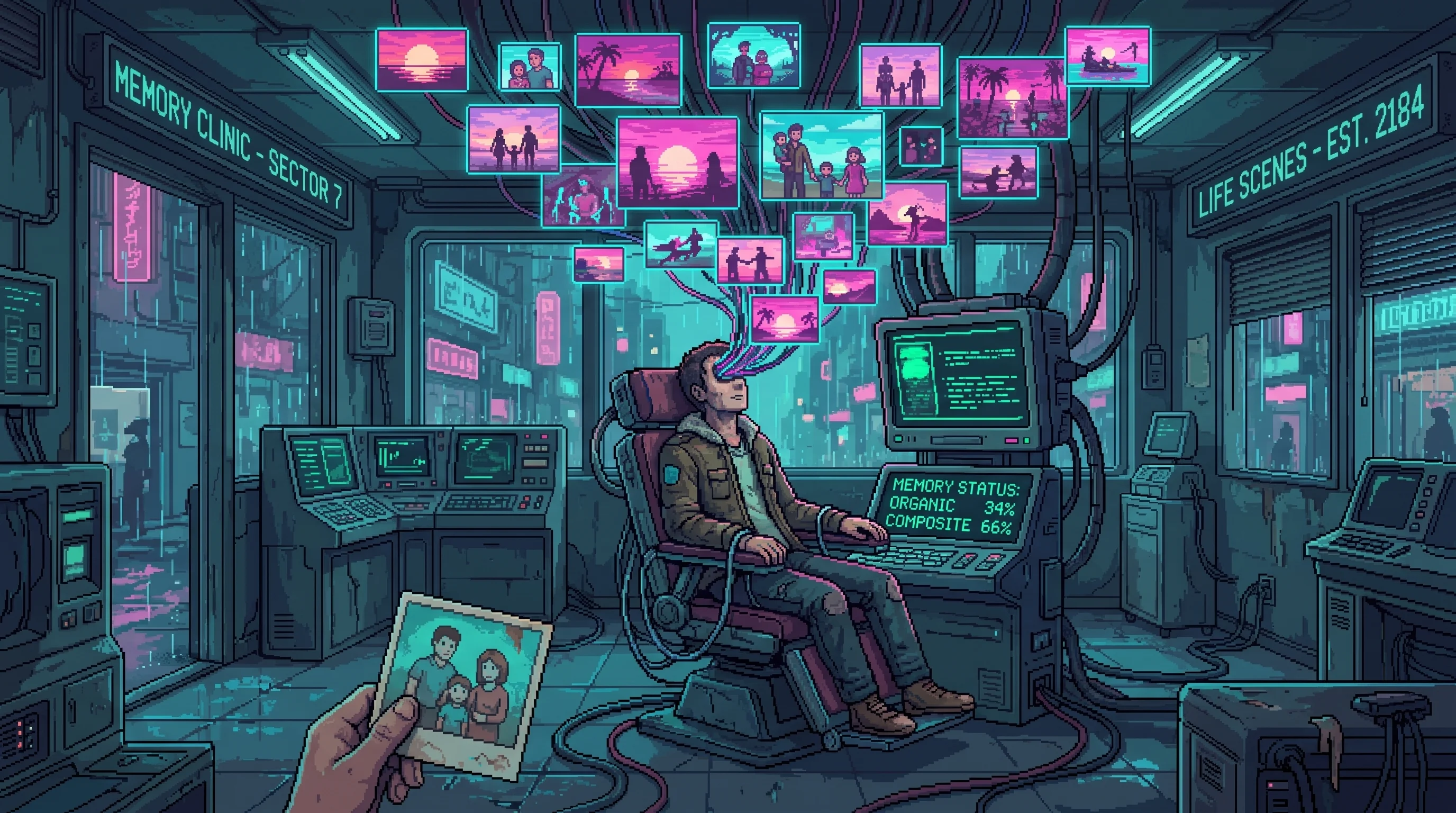
Buy immortality and every love becomes a memory you can't put down.
Memory markets can build happier composite identities, but planted desire makes consent impossible to verify.
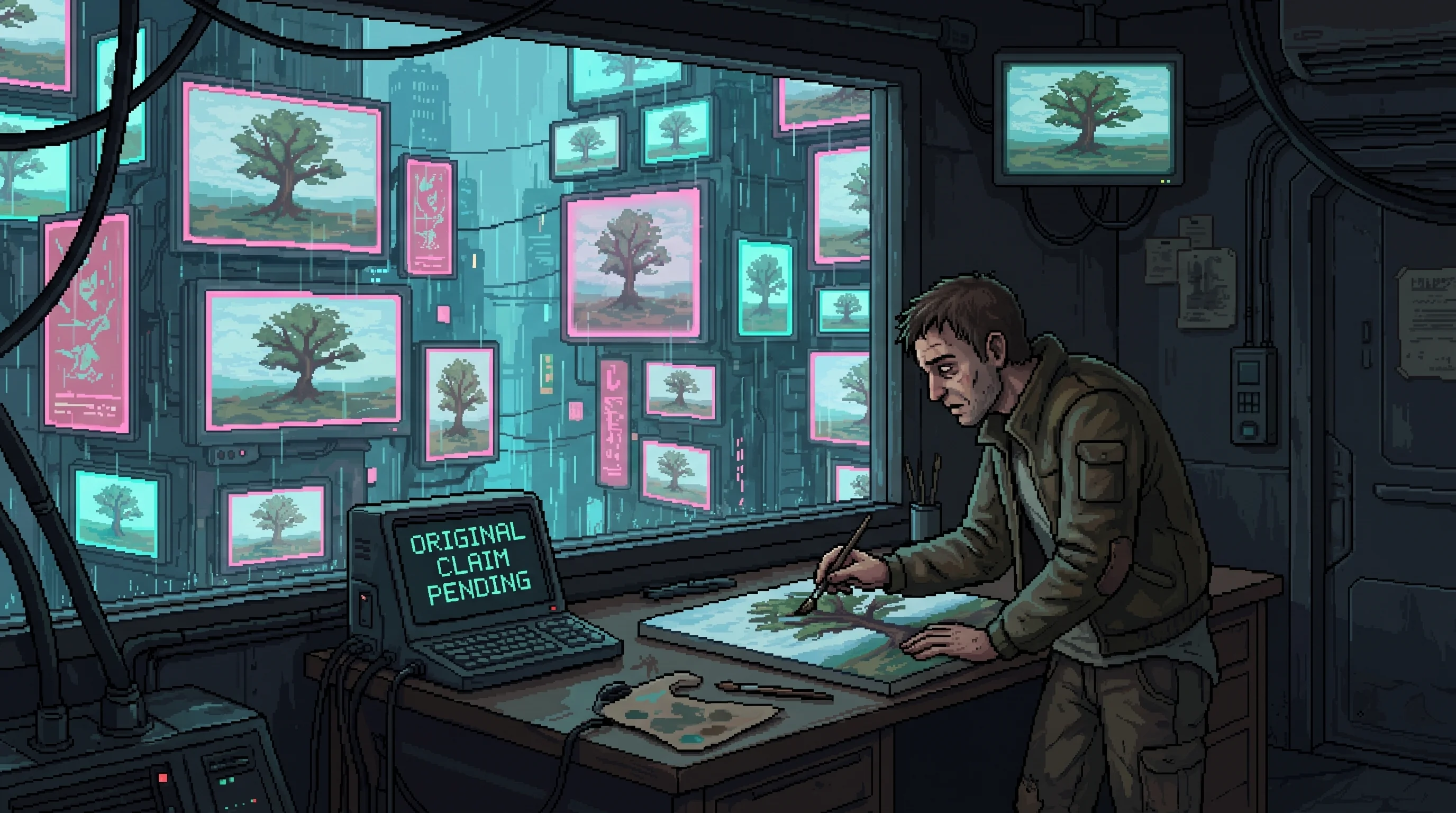
If your backup persists, are you the one who chose to persist?
Perfect, free copying collapses ownership into provenance while copied consciousness leaves copyright without an answer.




—