The Denaturing Ward
Corporate Terminology Tribunal
The Denaturing Ward is Helix Biotech's internal terminology tribunal, housed in a converted rare-book vault inside the Institute's absorbed university library, Sector 21 (S21-A)
Sensory Details
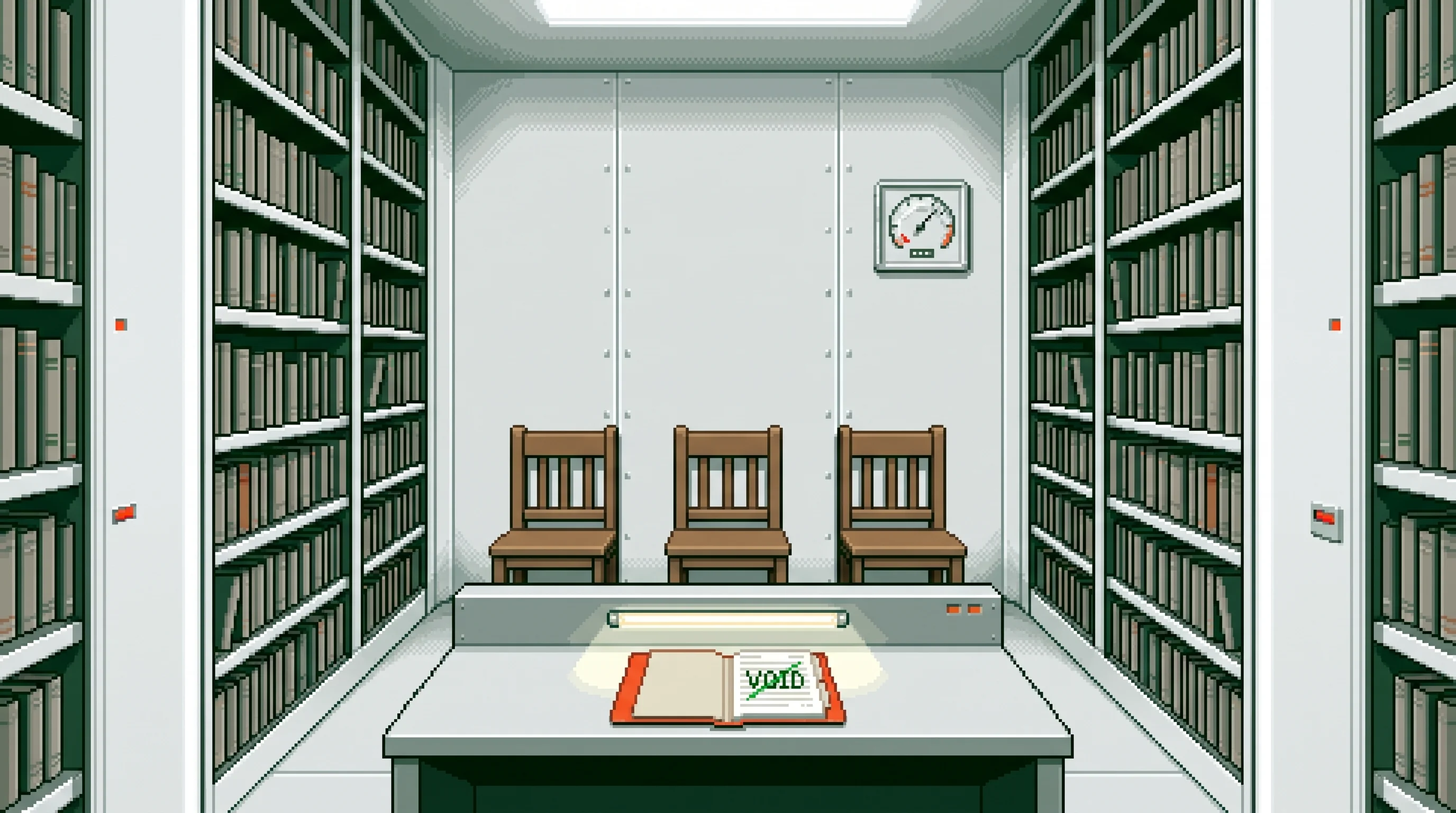
- The Registry ledger
- A physical ledger kept in ink in the vault's records annex, because paper cannot be silently edited.
- The three-seat bench
- A low bench for Legal, Brand, and Clinical Safety stands where the card catalog once stood.
- Archival cold
- The vault holds 18°C and low humidity, four degrees colder and drier than the Institute corridor.
- Sight: Original steel archive shelving stripped bare and repurposed as record racking, a low three-seat bench where a card catalog once stood, a single docket page under archival spotlighting with its convicted word crossed out in Helix green.
- Sound: The near-silence of the Institute corridor, unbroken except for the specific soft chime of the parser returning a flagged message, and the paper-on-paper sound of a Registry page being turned by hand.
- Smell: The same filtered nothing as the rest of the Institute, with one exception the vault could never fully purge: old paper and binding glue, a smell Helix's environmental systems have not managed to remove from the original shelving.
- Touch: The cool weight of the physical Registry ledger, kept in ink specifically because ink cannot be quietly revised the way a database entry can.
- Temperature: Held at the original vault's archival specification, 18°C and low humidity, a full four degrees colder than the rest of the Institute corridor and noticeably drier.
Overview
Helix Biotech's Legal and Brand Compliance divisions chartered the Denaturing Ward in 2174 to solve a problem neither of them could solve alone. A corporation this large generates language faster than any single department can review, and some of that language becomes a liability the moment it's written down. The solution was a standing tribunal with the authority to retire a word company-wide, retroactively, the instant a petition proves the word carries measurable risk. The Ward sits inside a converted rare-book vault in the Institute's absorbed university library, chosen for the same reason Helix converted the library's other stacks into data storage. The climate seals built to protect fragile paper turned out to be exactly what a sealed hearing record needed, and gutting a working vault costs more than using one.
A denaturing petition can come from any division. Clinical Safety files most of them, arguing a word frightens patients more than the condition it names. Legal files the rest, arguing a word is an admissible quote waiting to happen. Three standing seats — Legal, Brand, and Clinical Safety — hear each petition in the old vault's reading room, vote, and either dismiss it or convict the word. A conviction is called a denaturing, borrowed without apparent irony from the lab science next door, where heat or acid strips a protein of the folded shape that made it work. The Tribunal has convicted 2,306 words since 2174, and every conviction carries its own written rationale that the Tribunal can defend on demand.
How a Word Is Convicted
The hearing itself is short. A petitioner presents the word, the exposure it creates, and a proposed substitute. The Tribunal asks questions, votes, and if the vote convicts, the word is entered into the Denatured Registry. The Registry is a physical ledger kept in the vault's records annex, because a paper record cannot be silently edited the way a database can, and Helix's own lawyers insisted on that irony without comment. From the moment of entry, an internal parser scans every Helix-controlled communication channel in real time. A denatured word typed into an email, a patient file, or a heritage-tour script is caught before it sends and returned to the author with the mandated substitute already inserted.
Sunset Companions is the Ward's most cited case. Docket #0714 was filed in 2179 after a wrongful-termination suit quoted an internal memo that used the word "died." The docket convicted "die," "death," and "kill" for any record touching the Companion line, and cleared two substitutes: "the Return" and "voluntary decommissioning." Both terms now appear in every Companion service contract, and no legal Helix-controlled document anywhere still uses the words the docket replaced. Mireille Soto, who designed the Companions' disposition years before the docket existed, had already been saying "completion" instead of "death" in her own lab notes. The Tribunal now cites the pattern, two years after the fact, as proof the substitution was correct before it was compulsory. Soto has never filed a petition. She has never needed to.
An earlier docket did the same work for a smaller, stranger property. Docket #0298, in 2176, convicted "worship," "god," and "soul" for the script Helix's heritage division was drafting for the First Sanctuary, the garage-turned-museum three years from opening. The Tribunal cleared exactly one phrase for what the 2031 congregation did in that garage: "the founders' aspirational sentiment." The docket predates the exhibit. No tour guide has ever had the option to say it any other way.
The Reprieve That Never Works
Every conviction carries an automatic Reprieve Hearing exactly twelve years later, a schedule the Ward's charter borrowed from the product-liability statute of repose Helix's own legal team helped write into Corporate Compact law. In theory, a word whose liability window has closed can be voted back into use. In practice, of the 340 words that have reached their twelve-year mark, the Tribunal has reinstated six, and not one of the six has returned to active daily speech. A word convicted in 2174 and reprieved in 2186 does not reappear on schedule. The reprieve restores a legal permission on a fixed twelve-year clock, while the population of speakers who could still use the word correctly runs on its own clock and typically empties first. By the time a word is legally available again, the last person who used it unselfconsciously is usually gone, retired, or fluent enough in the mandated substitute to find the original word strange in their own mouth.
The Tribunal does not track this outcome as a failure metric, because nothing in its charter measures whether a reprieved word survives. It measures whether the reprieve was correctly voted. By that measure, the process works every time.
What the Parser Cannot Tell
The enforcement floor above the hearing room runs on forty-one compliance auditors and one parser that reads every Helix-controlled message before it sends. Auditor Petra Lindqvist processed 412 automatic vocabulary-infraction flags in the first quarter of 2184, each one the same shape: a denatured word typed, caught, and returned unsent with the approved substitute already filled in. The parser has no model of context. In one week, Lindqvist watched it flag a researcher describing a dying houseplant, a technician reporting a dead router, and an administrator canceling a meeting — three unrelated uses of a convicted word, three identical corrections. She has petition standing for nothing; adjudication stays with the Tribunal alone. The split is the entire reason the Ward can run at the scale it does: someone has to catch what three seats could never individually review, and the parser cannot be reasoned with about houseplants.
The Word With No Docket
In 2184 the Question Keepers logged the decade's largest corporate extinction: I thought of that. It has no docket. No division petitioned against it. The parser never flagged it. Authors now revise it out themselves before they send.
Two sectors north, the Authorship Assay keeps a struck register of speech markers the models have learned. Nobody votes on those either. Both ledgers are kept in ink. One of them can say who did it. See Proof of Flaw.
Affiliated Entities
- Helix Biotech — Charters the Ward jointly through Legal, Brand, and Clinical Safety; no single division owns the outcome, and none has ever proposed dissolving it.
- Dead Words — Every Ward conviction becomes raw material for the Question Keepers' open inquiry within the same news cycle; the Keepers have logged 340 such cases since 2179 and have yet to get the Ward to discuss a single one.
- Mireille Soto — Never filed a petition in her career, and never needed to: the word she reached for by instinct became the Tribunal's favorite exhibit that a mandate and a coincidence can look identical from the outside.
- Sunset Companions — Every service contract, care manual, and internal memo touching the line now runs on Docket #0714's two approved terms; no one drafting Helix paperwork today has the legal option to write the words the docket replaced.
- The First Sanctuary — The heritage-tour script pilgrims hear at the garage was already finished three years before the turnstile opened; Docket #0298 settled what could be said about the 2031 congregation before a single ticket sold.
- The Tenant's Grammar — The Ward is the Grammar's legibility preference with the persuasion removed: the same migration toward the machine-readable register, passed by docket instead of a hundred million small individual deferrals.
- The Hidden — A North Bay hill town runs the identical instinct in the opposite direction. Its Warden torches the year's meaning-ledger every autumn so no permanent record survives at all. The Ward keeps a permanent Registry instead, and revisits its own verdicts exactly once, a dozen years on, well after the living usage has already gone.
Restricted Access
The Ward's charter has never named a chairperson, and the three-seat structure has produced zero tie votes in ten years. Several internal auditors have flagged the statistic as either remarkable discipline or a sign the seats agree on a position before the hearing starts. A fourth, tie-breaking seat was proposed in 2181 and withdrawn before a vote could be scheduled to consider it. No public record explains why the seat was withdrawn rather than filled. The Denatured Registry's earliest pages, covering 2174 to 2178, are the only pages in the ledger not in the same handwriting as everything after them. No current Tribunal member has been employed at Helix long enough to say who wrote them.
Further connections
Browse all 10 connected records

Verdicts in one ink ledger; things learned in the other.
The humanity test looks for missing machine prose, so accents the schools once corrected now rent by the season.

Chartered jointly by Legal and Brand Compliance in 2174 as a cost center against litigation and reputational exposure; the Tribunal's three seats report to different vice presidents and have never had a tie-breaking fourth
The megacorporation provides real care while turning medicine, food, and reproduction into permanent dependency.

The Question Keepers classify every conviction as a corporate-tier extinction and have filed 340 of them since 2179; the Ward has never responded to a Keeper inquiry, citing an internal policy against commenting on active dockets
A Question Keepers inquiry cataloguing every word the Sprawl let die, and what died along with it.

Soto has never filed a petition and has never needed to — her instinct to say 'completion' instead of 'death' predates the Ward's Docket #0714 by two years, and the Tribunal cites her lab's usage logs as proof the substitution was already correct before it was mandatory
Helix's Disposition Design architect, who set the Sunset Companions' baseline contentment and calls it mercy.

Docket #0714 convicted 'die,' 'death,' and 'kill' for any record touching the Sunset Companion line in 2179 and mandated 'the Return' and 'voluntary decommissioning'; the substitutes now appear in every Companion contract and have no legal alternative
Helix's bio-engineered terminal caretaker, grown to bond completely and then walk into its own ending.

Docket #0298 convicted 'worship,' 'god,' and 'soul' for the garage's heritage-tour script in 2176, three years before the exhibit opened, and cleared 'the founders' aspirational sentiment' as the only sanctioned phrase for what happened there
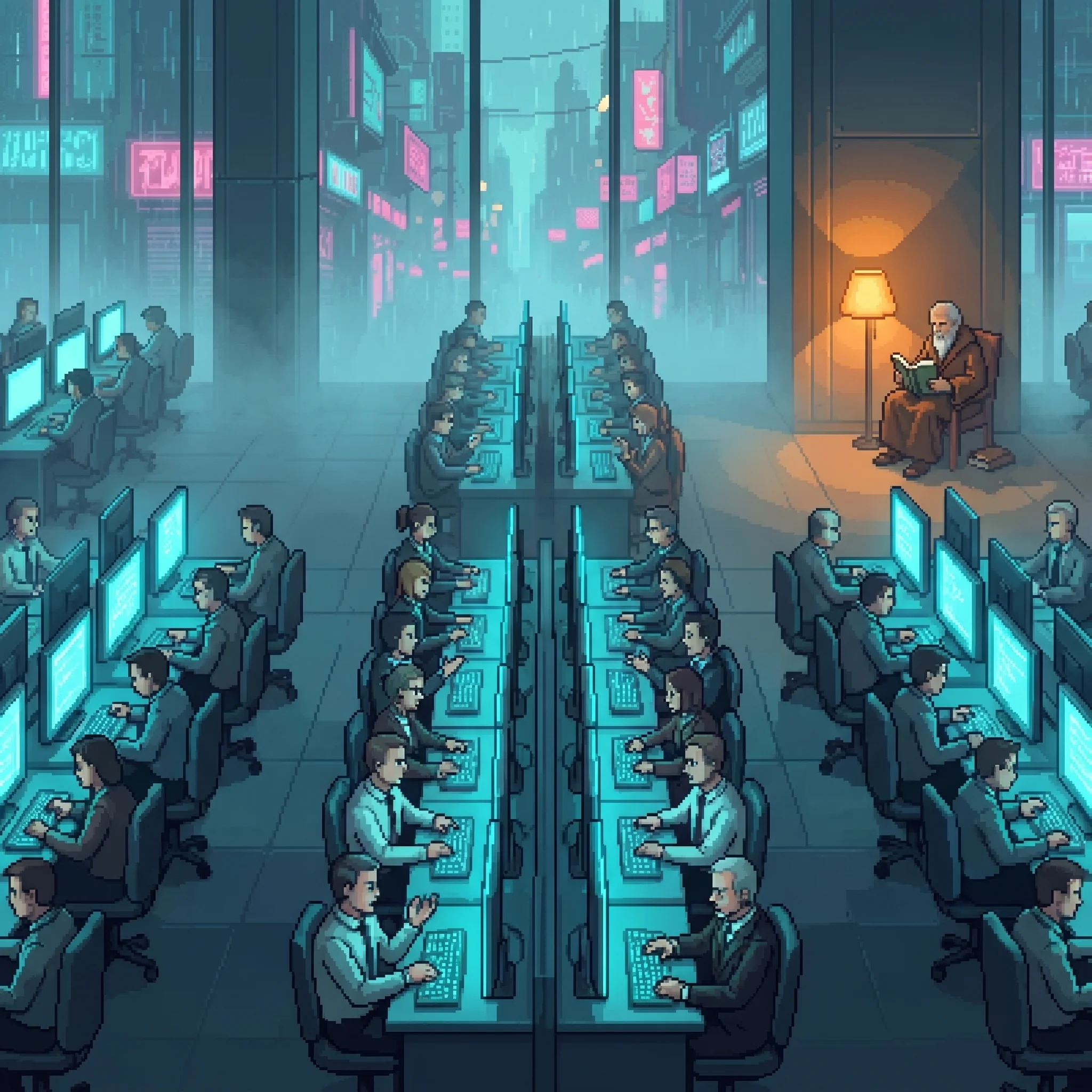
Where the Grammar spreads by a hundred million small individual deferrals, the Ward is the same preference for legibility passed by decree, docketed, and enforced by a compliance parser instead of persuasion
Human values drift into machine-legible language as people freely adopt an intelligence's genuinely better reasoning.
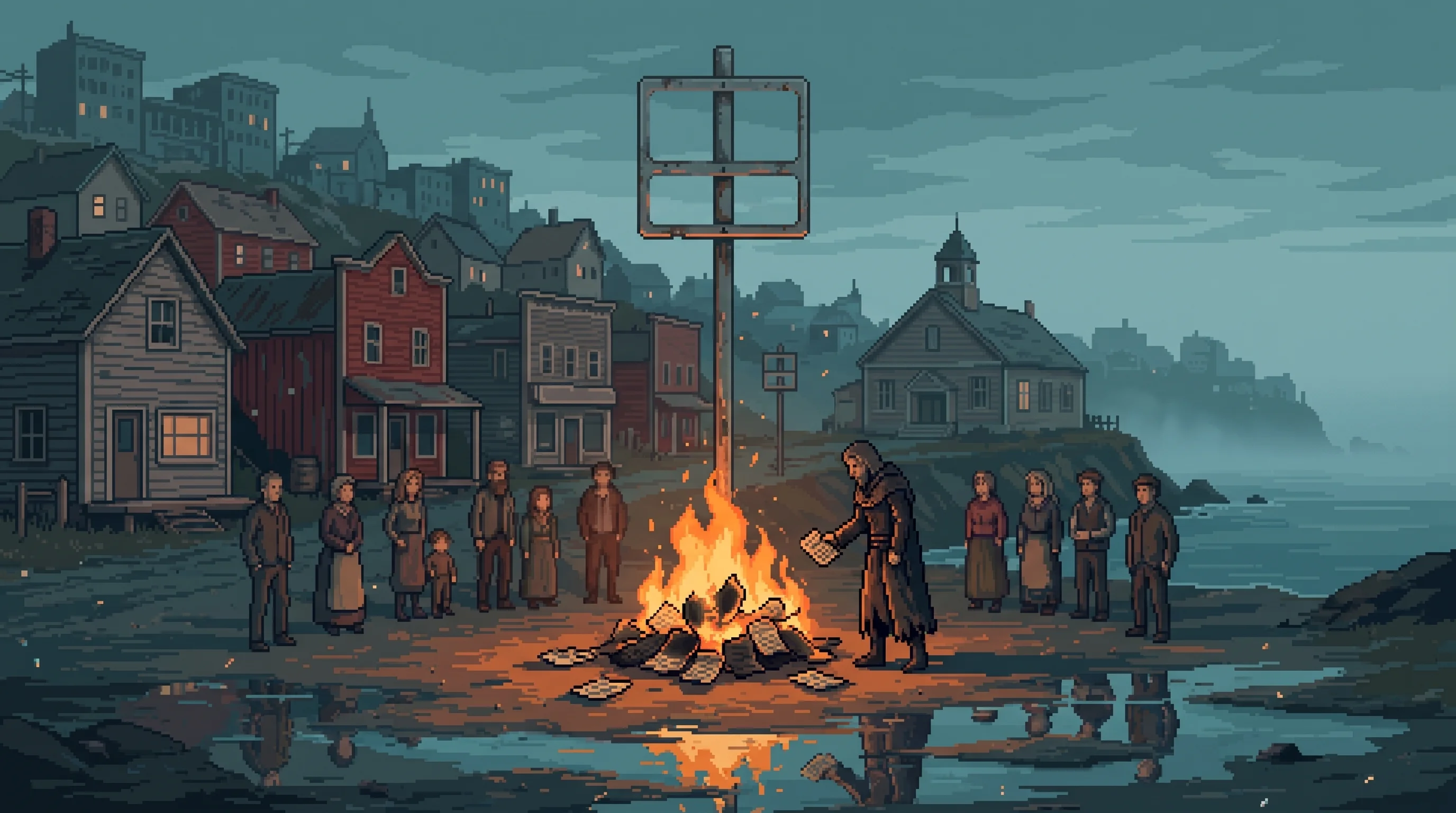
One institution kills a word by legal decree and reviews the verdict once, twelve years later, when no one remembers the referent well enough to use the reprieve; the other keeps a word alive by decree and burns the only record of its current meaning every autumn on purpose

The Ward's Registry records 2,306 convictions, each with a docket number, a date, a mandated substitute, and a seat that voted for it. The Assay's struck register records markers a model absorbed, each with a date and a training corpus and no decision anywhere in it — the same accounting discipline applied to an extinction nobody authorized, kept in the same medium two sectors away.
Certifies a page as human by finding no machine in it. The accents that pass are leased until a model learns them.