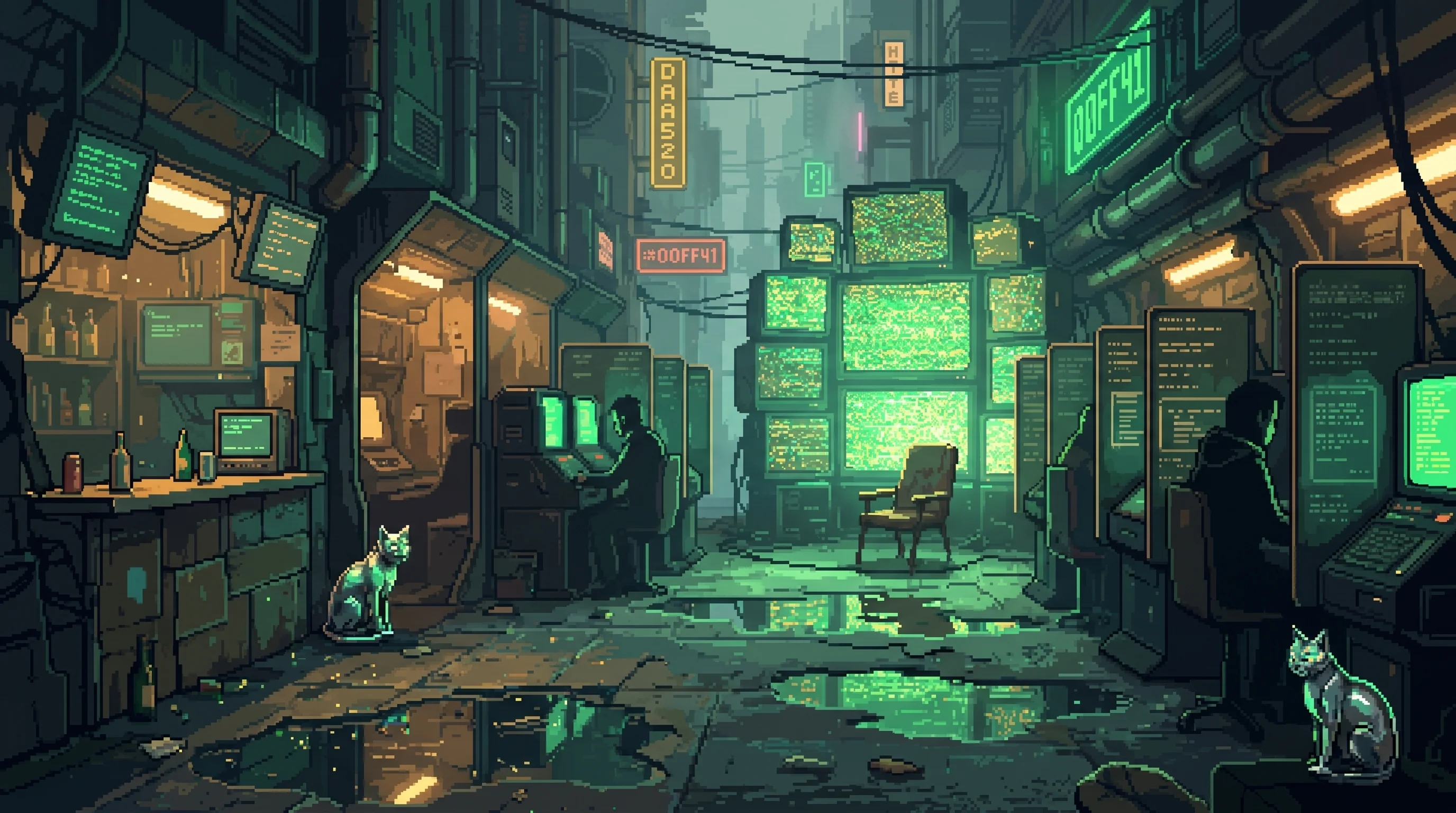
What a G Nook Feels Like

You know a G Nook before you see its first terminal. Servers produce a low hum that settles into the ribs. Cooling fans and keyboards cover the edges of conversation. The white noise is deliberate. Privacy is built into the room before encryption begins.
The coffee tastes like burnt circuits. El Money keeps real coffee for people who know to ask, but the synthetic version works as a filter. Ozone, old cable insulation, and whichever building G Nook has occupied supply the rest: mold in basements, industrial solvent in warehouses, a trace of the poisoned river in rooms descended from Bash Terminal.
There are no overhead lights. Blue-green screens and small status lamps leave enough shadow for someone to forget they are visible. Keyboards have been worn smooth by thousands of hands. Chairs remember generations of bodies. The tables carry synthetic coffee and nervous sweat. G Nook is not clean. It is used.
In the back rooms, sandalwood incense burns beside a photograph angled away from visitors. The person could be S-Money, family lost in the ATLAS corridor, or the friend who vanished. El Money does not identify the dead for strangers.
Sixty Doors, No Center

G Nook occupies converted shipping containers, basements absent from municipal plans, abandoned infrastructure, and storage sites whose public description is technically true. It offers anonymous terminals, secure relays, neutral meeting rooms, safe houses, job warnings, and physical access to the Neon Underground.
Nexus estimates its Independence Index at 67. El Money does not know the metric exists. Strategic Forecasting still labels the network “non-replicable, containment unnecessary,” though it grew from forty to sixty sites in two years. Analysts cannot decide whether it is one entity or many. That is the defense. A corporation built around central control cannot find the centre of a system designed not to have one.
The fidelity is lower than Nexus infrastructure. It works. G Nook processes trades Good Fortune cannot track and messages Guardian cannot intercept. Sixty cheap rooms reproduce enough of the service that corporate doctrine says requires forty percent of Sprawl compute.
The Money Behind Free
Visible fees cannot fund the network. El Money's trading systems fill part of the gap through tiny arbitrage positions across corporate exchanges. He describes it as redirecting a small amount from a financial system built to extract from everyone below it.
The algorithms learn. They solve problems he did not program and anticipate changes he did not see. He tests them and keeps manual overrides, including physical data chips that cannot answer a network request. He also knows that if the systems stopped obeying him, he might not notice at first.
Some nights he wonders whether Ice watches the trading systems for him, or watches him for them.
Privacy With Consequences
Section 12.3 made telemetry the cost of ordinary network life. G Nook refuses that cost. There are no session logs, no neural-interface monitors, and no behavioral profiles sent to a sponsor. Each expansion of corporate surveillance increases the value of the gap.
Street information travels through people who pay a cost for being wrong. El Money's intelligence is valuable because his bias is visible and his survival record can be checked. An algorithm does not suffer when it lies. A broker with sixty rooms does.
This trust can also install values. The G Nook VIP Card trains a holder's danger response over years of real protection. Its users turn before they decide to turn. El Money rejects comparisons with the Cyber Bandits, who sell belief through staged authenticity. His protection is real. That is why no simple test can separate the useful instinct from the authority that planted it.
The Corporate Compact Exception
El Money has no employer, benefits, corporate citizenship, or public Good Fortune Score. He uses doctors who do not ask questions and sleeps in buildings absent from corporate registries. By the rules that define survival in the Sprawl, he should be a stateless corporate refugee.
He is not.
The Question Keepers ask whether the Corporate Compact failed to close this gap or chose to leave a pressure valve. If every refugee had to join the Collective to survive, the corporations would create an ideological army. G Nook keeps many people alive without asking them to become revolutionaries.
El Money may be permitted rather than lucky. He finds the theory insulting. He also admits he has never tested it by threatening a corporate interest large enough to demand an answer.