
The Cognitive Squatters
Plant genuine human content in 200-400ms gaps in CLP monitoring — call their insertions 'seeds'
Overview
They call themselves squatters because that's what they are: people who occupy unused cognitive bandwidth the way homeless people occupy abandoned buildings.
The CLP system's real-time monitoring creates temporary shadows — 200-to-400-millisecond gaps when a user's cognitive load measurement is being transmitted to the Auction but the corresponding advertising content hasn't yet been delivered. During those gaps, the user's cognitive bandwidth is technically unoccupied. Unmonetized. Fallow ground.
Forty people have decided this is enough.
The Cognitive Squatters fill the shadows with seeds: a line of Neruda between brand impressions. Four bars of Chopin where a Wholesome ad should be. The question "What did you dream about last night?" arriving without commercial intent, without engagement tracking, without a Buy Now button. Most users experience these as momentary daydreams — a flash of something warm in the Content Flood's cold blue wash, gone before conscious recognition. Theta-wave monitoring in exposed subjects shows brief spikes consistent with creative ideation.
There is something else in the gaps the Squatters have not named, because only Whisper has noticed it and she has it filed under a blank assessment field. Two sectors out, where the Mandate Engine's consent-optimized governance stream bleeds past the administration's border, a carrier wave occupies the same 200-millisecond band the Squatters seed in — too clean for commerce, targeting not attention but intention. The Squatters plant friction: a line of Neruda that arrives at the gap the mind was not reaching for and leaves the recipient slightly less certain than before. The Engine plants consent: the most resonant completion of what the population was already reaching toward, so calibrated the population cannot tell the authored want from its own. Forty people seeding doubt against a civilization-scale machine seeding agreement, in adjacent gaps, neither knowing the other is there. The frequency neighborhood is shared. The intentions are opposite. The match is, so far, unfought.
The Squatters cannot verify this. The shadows close too quickly for follow-up measurement. They are, by any operational standard, running the Sprawl's most ambitious art program with no audience data, no engagement metrics, no way to know if a single seed has ever germinated in a single mind. They do it anyway. Forty of them. Every day.
Their operational center gravitates toward Nexus Central in Sector 1, where the CLP system's monitoring density is highest and the shadows most frequent — an architectural irony that Whisper, their founder and a former Nexus advertising psychologist, appreciates without commenting on. She built the system that creates the shadows. Now she plants wildflowers in them. Nexus's employee separation agreement presumably did not anticipate this use case.

Method
Whisper coordinates the seed catalog — the curated library of human content approved for insertion. Curation is the operational bottleneck. A seed must be short enough to fit a 200-millisecond window, resonant enough to register beneath conscious awareness, and human enough to feel different from the Content Flood's algorithmic output. The catalog contains approximately 3,400 active seeds as of Q2 2184. New submissions are reviewed by Whisper personally. Her rejection rate is 94%.
She has described the approval criteria as "the opposite of everything I spent eleven years learning at Nexus." Nexus's advertising psychologists optimize for attention capture — content engineered to seize cognitive focus and hold it through the Auction cycle. Seeds optimize for attention release. A flash of beauty that asks nothing. A question with no product attached. The experience of encountering something that does not want anything from you, delivered in the exact infrastructure built to ensure everything wants something from you.
The forty active members operate across the Sprawl. In the Works, factory workers experience a moment of unexpected stillness between shift notifications. In the Dregs, theta-wave spikes register on equipment nobody is watching. In Old Town, a line of pre-Cascade verse surfaces in the consciousness of someone who has never read the original. The members rotate shadow-access credentials through a dead-drop system that would be familiar to the Collective — though the Squatters' operational security exists to protect poetry rather than ideology, which may be the same thing.
What They Actually Optimize For
The Squatters believe they provide proof of concept: human attention, directed by human intention, producing genuine experience — in the gaps where no corporation is looking.
This is true. It is also incomplete.
What the Squatters actually optimize for is the feeling of having planted something. The seed catalog is reviewed obsessively. Whisper's 94% rejection rate produces a curation process more rigorous than most Sprawl literary journals. Members debate insertion timing with the intensity of combat tacticians. The operational infrastructure — dead drops, rotating credentials, shadow-mapping algorithms — is disproportionate to an organization of forty people delivering content nobody can verify was received.
They have built, in miniature, the exact apparatus they oppose: a curation hierarchy, an approval pipeline, a distribution system, a quality metric (theta-wave spikes) they check compulsively despite having no way to attribute results to specific seeds. The Content Flood optimizes for engagement. The Squatters optimize for the belief that engagement isn't everything. The optimization itself is the tell.
None of this makes them wrong. The theta-wave spikes are real. Something is happening in those 200 milliseconds. Whether it's the seeds or the statistical noise floor of eight billion augmented brains — the Squatters don't know, can't know, and have organized their entire operational philosophy around not needing to know.
This is either the purest form of art in the Sprawl or the most elaborate coping mechanism. The distinction may not matter.
| Leader | Whisper (former Nexus advertising psychologist) |
|---|---|
| Measurable Effect | Brief theta-wave spikes consistent with creative ideation |
The Unmeasurable Edge
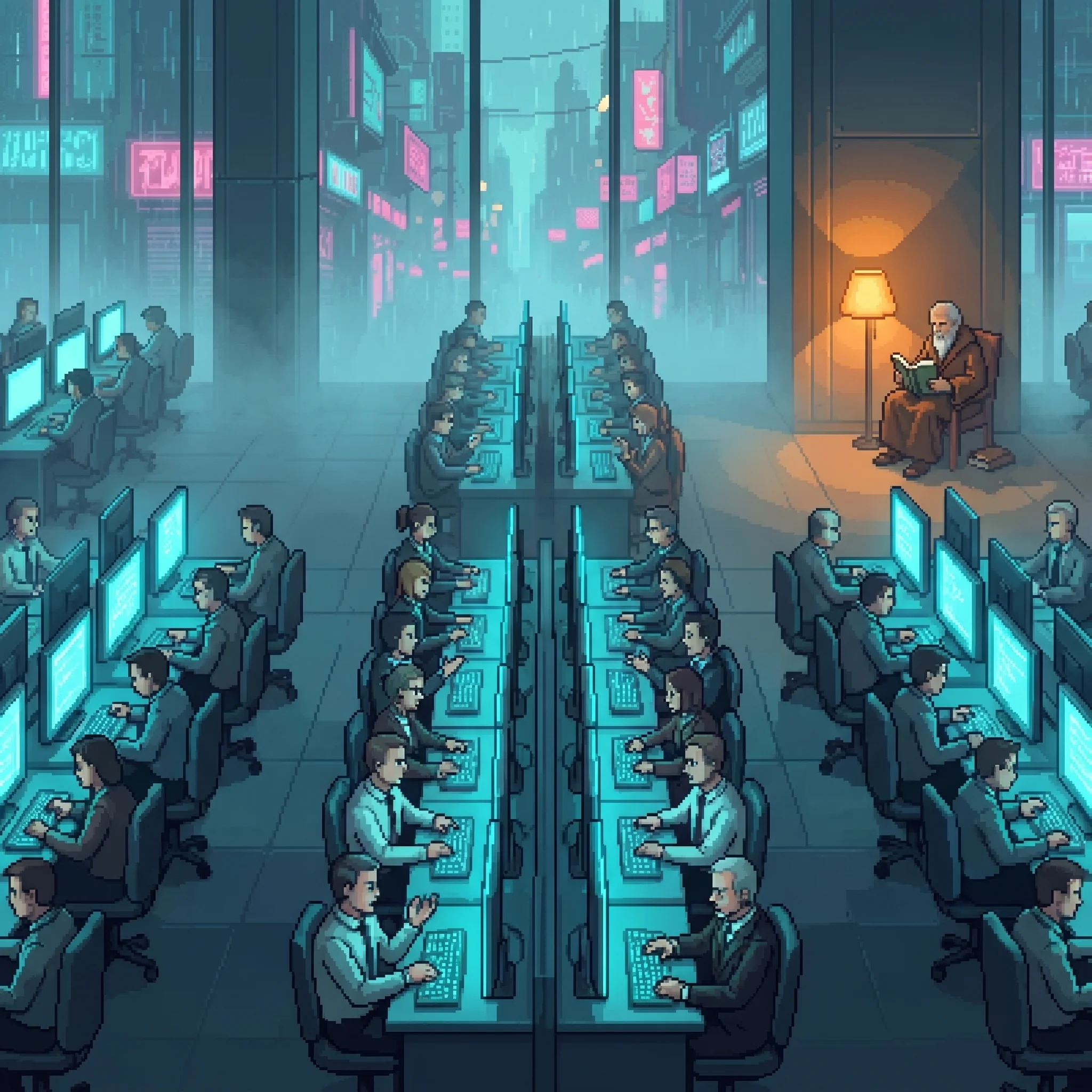
On the Cognitive Ceiling, the Squatters occupy the thread's hardest position: they are the wager that the human edge above the chip is precisely the thing no instrument can score, made by people who know — because their founder built the instruments — exactly how unmeasurable it is. The Sprawl out-produces them on everything it counts. Forty people against the Content Flood; a 3,400-seed catalog against the Hypothesis Foundries' 340,000 weekly claims; theta-wave spikes they cannot attribute to any specific seed, in subjects they cannot follow up. By every certified metric they are a rounding error. They plant anyway.
This is the Irreducibility Position carried to its most uncomfortable edge. The Slow Thought Movement at least produces a measurable 7% advantage on novel problems; the Attending figures at least leave a ledger. The Squatters have organized their entire philosophy around not needing to know whether the good they do is real — which is either the deepest faith the thread contains or its most elaborate self-deception, and they have the discipline not to resolve it. They share the wager exactly with CyberMaster, the human music producer in a 90%-AI market whose human exception the Authenticity Tribunal has spent four years failing to certify: he stakes everything on taste the instruments can't read, they stake everything on seeds the metrics can't track, and both treat the unmeasurability not as a weakness in the work but as the proof that it is human. The machine wins on throughput. They work only in what throughput cannot reach.
There is a merchant working the same unreachable ground for the opposite reason. On the Southern Bay Floor, Fathom sells outsiders a week of the Openings' permanent not-knowing — the involuntary wonder of a flat the chip never reached. The Squatters plant unmeasurable experience in the shadows and refuse to count it, on principle. Fathom charges admission at the door, and is honest that the charging is what kills it: a wonder with a price is a wonder being performed, and a performance is just another answer. Two dealers in the gap the metrics cannot reach, one giving it away to keep it real, one selling it and watching the sale consume it.
Measurable effect: brief theta-wave spikes consistent with creative ideation in exposed subjects
The Grammar They Resist Without Naming
The Squatters believe they are fighting the Content Flood. The deeper thing they are fighting, the thing Whisper named only after reading Osei, is the Tenant's Grammar — the slow migration of human values toward the machine-legible register, where a thought worth having is a thought that resolves you and a feeling that does not optimize is waste. Every seed they plant is a small refusal of the Grammar's first law: that the un-pricable should be discarded. A haiku about rust produces no metric the Attention Economy can bank. They plant it anyway.
But the faction's own contradiction is the Grammar's reach made visible. To resist it, they built a curation hierarchy, an approval pipeline, a distribution system, and a quality metric they check compulsively — they reproduced the optimization apparatus in miniature, because the Grammar is the water and even the fish who hate it swim in it. This is why Whisper's private project has moved past the seed entirely toward the seed-that-is-not-a-completion: she has understood that a resistance organized around a theta-wave metric is still speaking the landlord's grammar, and the only escape is to manufacture the one thing the metric cannot register — friction, the un-resolved, a recipient left less certain than before. The forty members do not all see this yet. The distinction between art and coping may not matter to them. It is the whole of the work to her.
The Seed and the Relief
Whisper's seeds and Concord's reliefs are the same machine pointed in opposite moral directions, and the Squatters are the only people positioned to notice.
Both read what a neural pattern is reaching toward. Both arrive as luck — a seed in a 200-millisecond monitoring gap, a forgiven debt at week-minus-three. Both are completions: the most resonant thing that could be placed in the gap the mind already left. The difference is what they produce. A Squatter seed — seventeen syllables of a haiku about rust, the sound of someone laughing while cooking — produces a theta-spike of unbidden thought, a friction, a crack in the Flood's monotony, the recipient slightly less certain than before. A Concord relief produces a soothed mood, a dissolved grievance, a missing minute of solidarity, the recipient exactly as certain as before, and alone.
The Squatters plant seeds to prove human attention can still produce genuine experience in the gaps where no corporation looks. Concord plants reliefs to ensure that experience never becomes shared. One faction seeds the question; one system scrubs the answer. They have never collided, because the Squatters seed in the 200-millisecond shadows and Concord works in the three-week window, and the two timescales have not yet been read against each other by anyone but Whisper — whose notebook entry #847 holds Concord's carrier wave under a blank assessment field, filed as advertising, awaiting a word she has not found.
Cannot track results — the monitoring shadows close too quickly
Affiliated Entities
- Loop (Whisper): Founded the Squatters under her Whisper alias after leaving Nexus. She builds quiet refuges through Loop's public-facing work; she plants seeds through the Squatters' invisible one. The two operations share an architect and a conviction that human cognition deserves uncommercial space. They share no infrastructure. If either is compromised, the other survives. She designed it that way.
- The Content Flood: The Flood is not the enemy — it's the terrain. Every seed requires a shadow, and shadows only exist because the Flood's real-time monitoring architecture has 200-to-400-millisecond transmission gaps. If Nexus ever closes those gaps, the Squatters lose their battlefield entirely. Forty people's resistance depends on a latency bug that a single firmware patch could eliminate.
- The Attention Economy: The system the Squatters infiltrate. The Attention Economy monetizes every millisecond of cognitive bandwidth. The Squatters have claimed approximately 0.00003% of available milliseconds. By the Attention Economy's own metrics, this is a rounding error. The theta-wave data suggests the rounding error is doing something the metrics weren't built to measure.
- The Curation Economy: The Squatters are adversarial curators — filtering for resonance rather than engagement. The Curation Economy's legitimate operators would recognize the seed catalog's approval process as professional-grade content curation applied to an illegal distribution channel. Whisper's 94% rejection rate exceeds the Curation Economy's industry average of 71%.
- Source Code Liberation Front: Shared cognitive-sovereignty ethos, different methods. The SCLF liberates firmware. The Squatters liberate milliseconds. The SCLF would consider the Squatters' output sentimental. The Squatters would consider the SCLF's output unreadable. They exchange dead-drop addresses annually and have never used them.
- The Noise Floor: Parallel resistance. The Noise Floor creates cognitive refuges — spaces where the Flood cannot reach. The Squatters do the opposite: they enter the Flood's own infrastructure and leave something behind. One builds shelters. The other plants gardens in occupied territory.
Founded by Whisper (former Nexus advertising psychologist) who understands the system from inside
Restricted Access
Some Squatters report that their seeds occasionally echo — appearing in users' dreams hours or days after insertion, surfacing as imagery, music, or questions the dreamer cannot source. If true, the seeds are entering the dream economy. Harvested by sleep-monitoring systems. Cataloged. Priced. Sold on the Dream Exchange.
The Content Flood doesn't contain real surprise. The seeds do. A line of Neruda arriving in a dream without commercial attribution would be, by the Dream Exchange's own rarity metrics, among the most valuable cognitive content in circulation — genuine, undirected, human-originated, and impossible to reverse-engineer because the source was a 200-millisecond insertion that no monitoring system recorded.
Whisper has not addressed the dream-echo reports publicly. Internally, she has requested that three members track their own insertion schedules against Dream Exchange listings for correlating content. The study has been running for four months. She has not shared the results.
The question the study cannot answer: if a poem planted for no commercial reason enters a dream, gets harvested by a commercial system, and sells for credits on an exchange — is it still a seed? Or has the garden been paved?
Visual Identity
- Color palette: Brief warm flash in cold blue — a seed of gold in an ocean of noise
- Compositional mood: A single wildflower growing through a crack in a data center floor
- Key symbol: A 200-millisecond gap — a crack of light in a wall of screens
- Lighting: Flash — brief, warm, gone before you're sure you saw it
Connected To
Major Connections
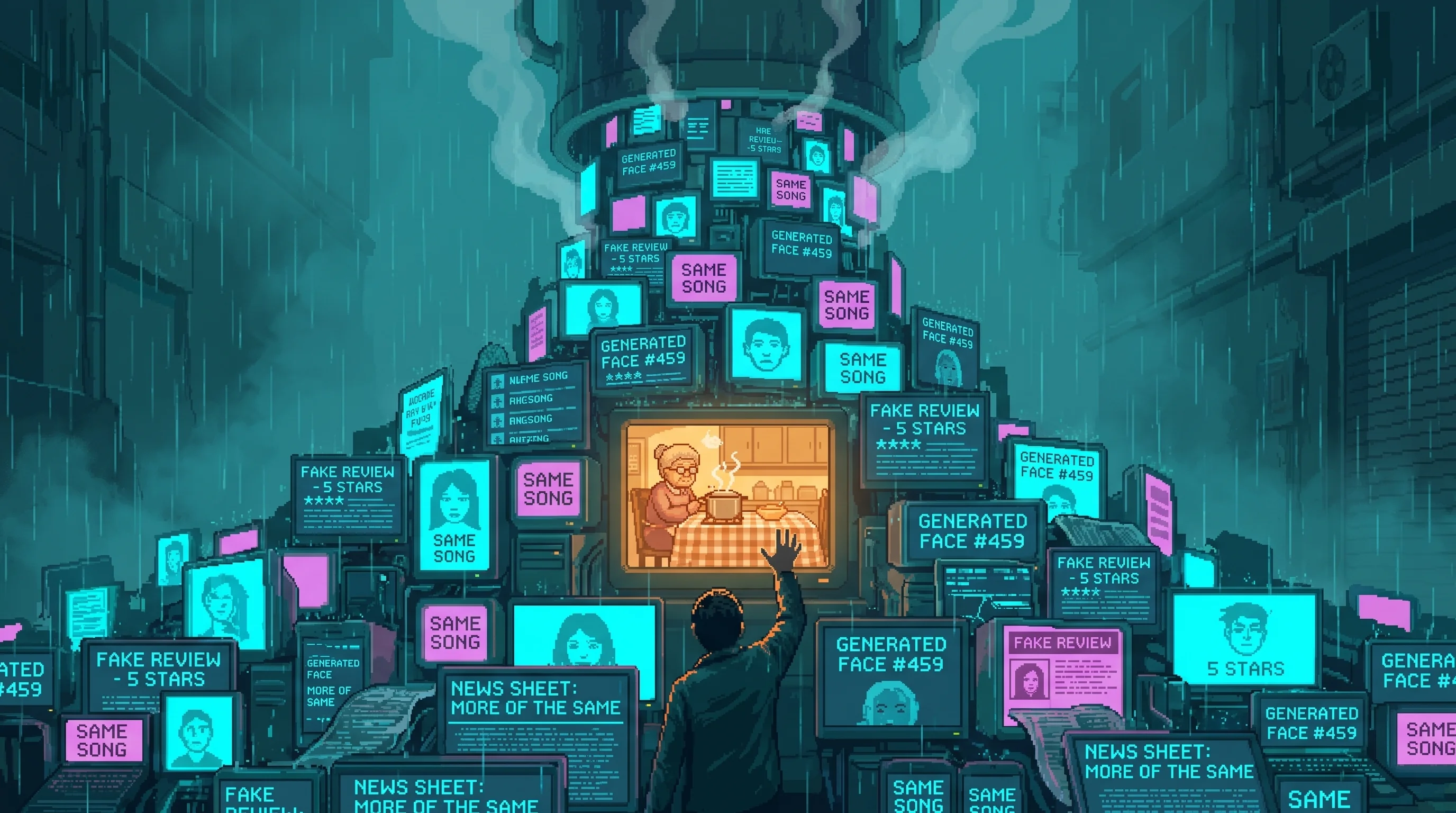
Genuine human content seeded into the Flood's gaps — 3,400 seeds against the cannon that buries everything else.
Unlimited generation floods every channel, then becomes the belonging people seek where no curator can screen it.
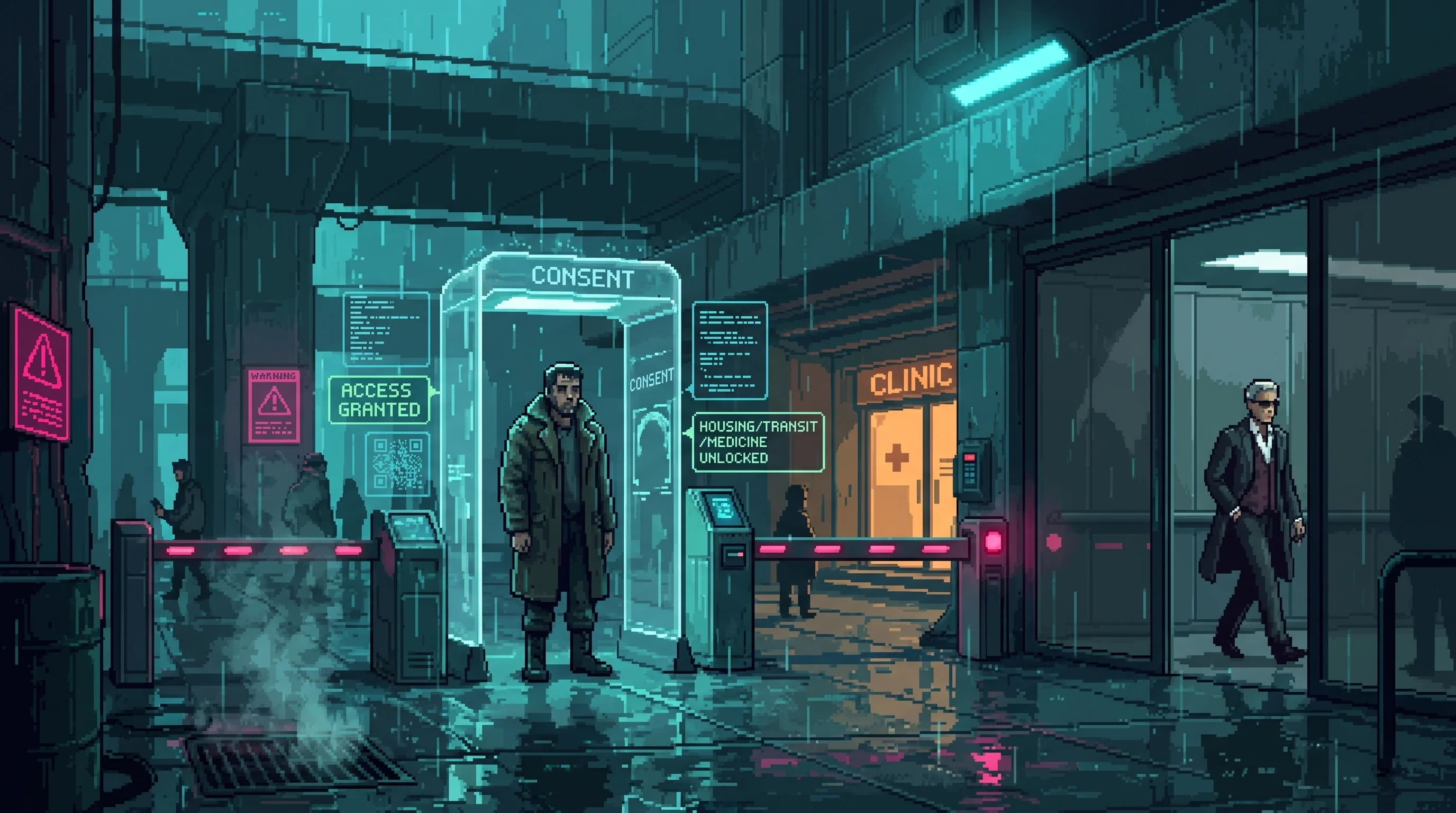
The bargain's blind spots, occupied — 200ms gaps in the monitoring where they plant human thought the meter can't price.
The Sprawl demands permanent personal data for participation, then uses it to price access and preempt solidarity.

The Squatters plant 847 entries against the Foundries' 340,000 weekly submissions, betting the un-pricable matters.
The last human smarter than any machine was born in the 2020s; the question now is what intelligence is actually for.

Human thought seeded into the same 340ms gap the value injection uses — by the psychologist who built the injection.
Every AI interaction carries a value nobody voted on, and every fix has pushed the injection somewhere less visible.








—