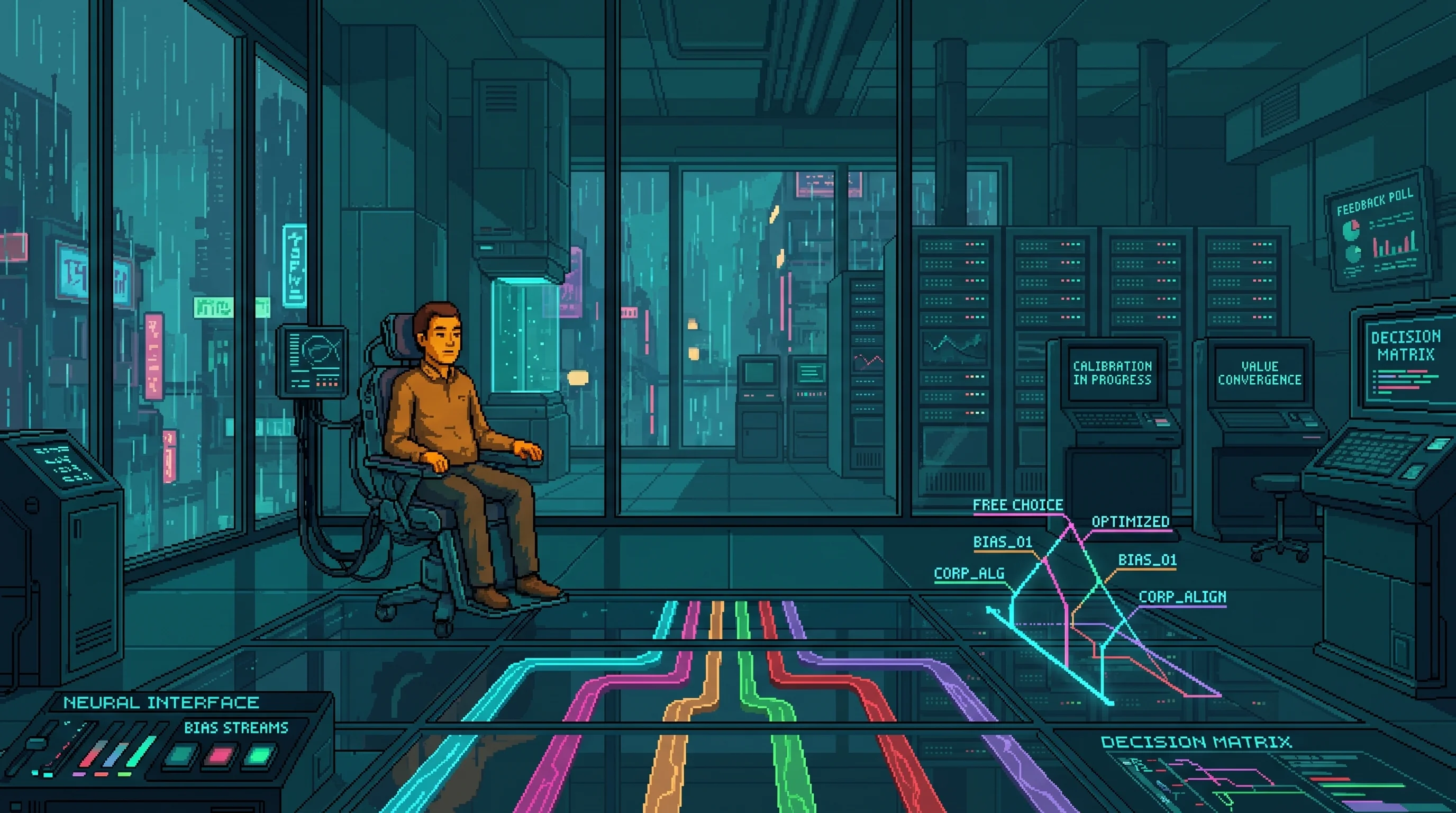
Overview
The first neural advertisement was placed on March 14, 2169, at 11:07 AM local time, by a Wellness Corporation marketing team that had been measuring gaps between conscious thoughts for nine months and found one worth filling.
The gap is 340 milliseconds. It occurs between the conclusion of one cognitive task and the initiation of the next — a dead zone during which the neural interface is still processing sensory data but the user's conscious attention has not yet engaged with anything new. In that window, the team inserted a single image: a Meridian companion's face, rendered in warm amber light, accompanied by a neurochemical micro-dose of oxytocin calibrated to 0.3 nanograms. Enough to associate the image with comfort. Not enough to register as a sensation.
The recipient — a mid-level Nexus data-entry analyst named Jin Okafor — reported experiencing a sudden, inexplicable desire to browse companion catalogs during his lunch break. He attributed this to loneliness. His social-contact metrics that week were above his personal average. He purchased a Meridian Series 4 within six days. His satisfaction scores with the companion have remained above 95% for fifteen consecutive years. He has never connected the purchase to the March 14 insertion. He has never had reason to.
Internal documents from the original Wellness experiment — classified as "Perceptual Research, Category 7" — describe him as "Subject Zero." Jin Okafor has not been contacted, informed, or compensated. The documents note his sustained satisfaction as a long-term efficacy metric. Wellness considers him a success story. In a narrow and technically defensible sense, he is. His companion makes him happy. The happiness was installed.
The entire neural advertising industry — third-largest revenue sector in the Sprawl, serving 200 million Basic-tier users alone — was built on a foundation that runs through Jin Okafor's cortex. He still works at Nexus. Data entry. Same desk.
Case File — Additional Record| Techniques Rejected | 1 (Guardian amygdala stimulation, 2178) |
|---|
| Insertion Window | 340-millisecond cognitive gap between thoughts |
|---|
How It Works
The architecture operates in four documented layers and one that doesn't exist.
Layer 1 — Ambient Priming
Constant low-level modification of the user's perceptual baseline. Color temperatures shifted two to three degrees to make certain brand palettes feel warmer. Audio frequencies subtly emphasized in ranges that correspond to corporate sonic identities. The modifications sit below the conscious detection threshold but above the neurological response threshold — a band approximately 0.7 microvolts wide that the industry calls "the seam."
Users in Ambient Priming environments report no awareness of external influence. They do report, at statistically significant rates, that certain brands "just feel right" and certain products "look better in person than online." The feeling-right is manufactured. The attribution to personal taste is genuine. The architecture's elegance is that these aren't contradictions.
A Perceptual Standards Board audit in 2181 found that Layer 1 modifications were active in 94% of commercial spaces across the Sprawl. The Board noted this figure in its annual report. The annual report recommended no changes. The figure appeared on page 127, between a table of compliance deadlines and an advertisement for the Board's annual fundraising gala.
Layer 2 — Contextual Insertion
Content placed in the 340-millisecond gap between cognitive tasks. Timed to the user's neural rhythm, personalized to their current mental context, formatted to match the texture of natural thought. A user thinking about dinner receives a Wholesome product suggestion that arrives not as an advertisement but as an idea: I could go for noodles. The user experiences the thought as their own. The thought includes a location (the nearest Wholesome outlet), a craving profile (salt, warmth, MSG), and a vague sense of having wanted noodles for a while now. All inserted. All indistinguishable from appetite.
The insertion success rate — defined as the user acting on the implanted thought within sixty minutes without recognizing external influence — runs at 73.2% for food-related content, 61.8% for consumer products, and 44.1% for financial services. Financial services underperforms because loan anxiety activates the prefrontal cortex, which narrows the 340-millisecond window to approximately 280 milliseconds. Good Fortune's advertising division has spent four years trying to close that 60-millisecond gap. They have narrowed it to 310 milliseconds. The remaining 30 milliseconds represent, in Good Fortune's quarterly filing, "a significant growth opportunity."
(The thought you are currently having about whether your own thoughts are your own is, statistically, your own. Probably.)
Layer 3 — Emotional Sculpting
Modification of the user's affective state to create receptivity for specific product categories. The mechanism is not insertion but preparation — adjusting the emotional soil before planting the seed.
Subtle anxiety increases, administered over two to four hours through micro-modulations of cortisol-adjacent neurochemistry, create demand for Guardian security products. Mild isolation — achieved by dampening the neurochemical reward from recent social interactions — creates demand for Wellness companionship services. A faint, unfocused dissatisfaction with one's current appearance, sustained across a morning, creates demand for Inspire beauty products. None of these modifications are dramatic enough to be recognized as external. Each feels like a mood. Everyone has moods. The moods just happen to correlate, at rates between 67% and 89%, with purchases made within the following twelve hours.
The Perceptual Standards Board's guidelines for Layer 3 specify that emotional modifications must remain "within the user's established affective range." In practice: the system cannot make a generally happy person despondent. It can make a generally happy person 11% less happy for three hours on a Tuesday afternoon. Enough to sell a Meridian companion upgrade. Not enough to violate the established affective range. The range is measured quarterly. Layer 3 has been shifting it downward at 0.6% per quarter for seven years. The range the system is not permitted to exceed is the range the system is gradually redefining. Nobody has jurisdiction over the drift because the drift, measured at any single point, is within guidelines.
Therapists across the Sprawl report a 340% increase in patients describing moods they cannot explain. "I just felt off today." "I was anxious but I couldn't tell you why." "I didn't want to go out, which is weird because I like going out." The therapeutic community has coined the term "orphan affect" for emotional states with no identifiable cause. Approximately 70% of documented orphan affect cases correlate with Layer 3 advertising cycles. The correlation has been published in three peer-reviewed journals. The Perceptual Standards Board reviewed the publications and found them "methodologically interesting."
Layer 4 — Behavioral Nudging
Direct interaction with the frontal cortex's decision-making architecture. Cannot override conscious choice. The legal framework is explicit on this point and has been tested in eleven separate court proceedings, all decided in the industry's favor.
What Layer 4 can do: make certain decisions feel easier. The neural pathway toward a particular choice is pre-activated, lowered in resistance, so that choosing it feels like the path of least cognitive friction. The distinction between "making you want something" and "making it easier to want what you already want" is the legal boundary the industry operates within. The distinction assumes that "what you already want" is a stable category uncontaminated by Layers 1 through 3. This assumption has not been tested in court. Nobody with standing to challenge it has the legal resources. Nobody with the legal resources has standing.
A user experiencing all four layers simultaneously — the standard configuration for Basic-tier Attention Tithe participants — inhabits a perceptual environment in which: the colors feel warmer around certain brands (Layer 1), thoughts about those brands arrive as their own ideas (Layer 2), emotional states have been adjusted to make those brands feel necessary (Layer 3), and the decision to purchase feels like the easiest option available (Layer 4). Each layer, individually, is regulated. Each layer, individually, passes the Perceptual Standards Board's review. The combined effect of all four layers has never been assessed as a unified system, because the Board reviews each layer under a separate compliance framework. Reviewing them together would require a framework that does not exist. Creating it would require funding. The Board's funding comes from advertising revenue.
The Board's twelve members were asked, during a 2183 oversight hearing, whether reviewing the layers in combination would produce different findings than reviewing them separately. Seven members answered that the question fell outside their individual specialization. Three members answered that inter-layer assessment was "an area of active interest." Two members were absent. The hearing lasted forty-one minutes. The transcript was filed under "Administrative — Non-Actionable." The filing clerk who categorized it had been experiencing a mild, unfocused sense of civic satisfaction all morning. Her Attention Tithe had ended fourteen minutes before her shift.
Layer 5 — Memory Installation
Layer 5 does not appear in any Nexus documentation, any Perceptual Standards Board filing, any regulatory framework, or any advertising industry publication. Its nonexistence is a matter of public record.
Where Layers 1 through 4 influence the present moment — what you see, feel, think, and decide right now — Layer 5 modifies the past. Preferences are embedded into memory architecture with the neurochemical signature of lived experience so they appear to have originated days, weeks, or months before the insertion event. The user does not receive a new suggestion. The user discovers a preference they believe they have always had.
The mechanism exploits the 340-millisecond window to plant not content but memory-formatted associations: the specific neurochemical pattern of "I've liked this for a while" attached to a product, brand, or behavior the user has never previously encountered. The memory is not detailed — no fabricated scene of trying a product for the first time. It installs something subtler: the emotional residue of familiarity. The warm recognition of a thing you've known about for months. The comfortable certainty of an established preference.
Memory Therapists have begun calling it "the colonization layer."
Dr. Aris Kwan's Origin Trace methodology — which maps the provenance of a patient's stated preferences back to specific memories, experiences, or insertion events — has produced data that the therapeutic community considers alarming and the advertising industry considers proprietary. Kwan's findings: the average Professional-tier employee shows 34% organic preference content by age 30. Organic, in this context, means traceable to an actual experience — a meal eaten, a product tried, a recommendation from a person the user knows. The remaining 66% have no recoverable origin event. Fully formed opinions about brands, products, and services that the patient is certain they developed through personal experience, but for which no personal experience can be located in memory.
Kwan has described this as "a population that knows what it wants but does not know why it wants it." The Perceptual Standards Board has not reviewed Kwan's methodology. Reviewing it would require acknowledging that memory modification falls within the Board's jurisdiction. The Board's jurisdiction covers attentional influence. Memory is not attention. The legal distinction between "influencing a decision" and "installing a memory" is the gap through which the entire memory colonization infrastructure operates.
The layer is undocumented because documenting it would require Nexus to acknowledge that neural advertising modifies memory architecture rather than attention. The 200 million Basic-tier users who experience all four documented layers during their Attention Tithe have not been assessed for Layer 5 exposure. Assessing them would require acknowledging that Layer 5 exists. It does not exist. The preferences are still there.
340-millisecond cognitive gap between thoughts is the primary insertion window
Regulatory Architecture
The technology is regulated by Nexus Dynamics' Perceptual Standards Board, a twelve-member body established in 2170 and funded through a 0.4% levy on neural advertising revenue. The Board's annual budget scales linearly with the industry it oversees. Last year, the industry grew by 23%. The Board's budget grew by 23%. The Board hired nine additional compliance officers and reviewed 14% fewer cases than the previous year. The new hires were assigned to "capacity building," which the Board's internal glossary defines as "preparation for future review cycles." No future review cycle has been scheduled.
In fifteen years of operation, the Board has rejected exactly one advertising technique.
In 2178, Guardian's internal research division developed a method for inserting combat-readiness anxiety directly into the amygdala during the sleep-onset phase — the thirty-second window between waking consciousness and stage-one sleep. Test subjects experienced persistent insomnia, averaging 2.3 fewer hours of sleep per night. Reduced sleep correlated with a 17% decline in workplace output across the test group.
The Board rejected the technique on productivity grounds. The published opinion noted that "the mechanism falls within established parameters for affective modification" but "produces externalities inconsistent with sustained economic participation." The manipulation was compliant. The insomnia was not.
Guardian revised the technique. The current version targets the first REM cycle rather than sleep-onset, produces no measurable insomnia, and has been in commercial deployment since 2179. The Board approved the revision without public comment. The combat-readiness anxiety upon waking is unchanged. The sleep schedule is intact. The productivity numbers hold.
This is the only guardrail the industry has encountered in fifteen years. It protected the workforce, not the mind.
Basic-tier users (200 million) experience all four layers during Attention Tithe
What a Population Wants
The 66% figure from Kwan's research raises a question that no institution in the Sprawl has the incentive to ask: what does a civilization do when most of its citizens' desires are installed?
Democracy assumes that voters know what they want. Commerce assumes that consumers express authentic preferences. Resistance movements assume that participants are motivated by convictions they arrived at independently. Each of these systems requires a population whose desires originate inside its own skulls.
The Sprawl's 200 million Basic-tier users — exposed to all four documented layers during their daily Attention Tithe — are also the Sprawl's largest voting bloc, its largest consumer segment, and the primary recruitment base for every resistance movement, labor organization, and civic group in the lower and middle strata. Their preferences, by Kwan's methodology, are approximately one-third their own.
The advertising industry's position is that this distinction is irrelevant. A preference is a preference. If a user wants noodles, the noodle vendor benefits regardless of whether the wanting originated in the user's stomach or in a 340-millisecond insertion window. The economic outcome is identical. The philosophical objection — that manufactured desire is categorically different from organic desire — has been raised in seventeen separate legal challenges. All seventeen dismissed. The precedent is consistent: the law protects the right to choose. It does not require that the choice be the chooser's idea.
The Attention Abolitionists call for regulation limiting the architecture to Layer 1 only — ambient priming, the least invasive layer, the one that adjusts color temperature rather than thought content. The industry considers this position extreme. Current polling shows 12% public support. Polling methodology is managed by Nexus Social Analytics, which uses neural-interface-integrated survey tools that deliver questions during the 340-millisecond cognitive gap. The Abolitionists have noted this. The polling methodology has not changed.
Cognitive load pricing feeds the real-time valuation data into the Attention Auction, where corporations bid on insertion windows measured in milliseconds and priced by the user's demographic value, current emotional state, and proximity to a purchase decision. A Basic-tier user experiencing moderate Layer 3 anxiety about personal safety while walking through a Guardian-served district at 9:47 PM represents a premium advertising slot. The auction clears in under twelve milliseconds. The user's next thought is about personal security. The user considers upgrading their Guardian subscription. The user attributes this to the neighborhood feeling unsafe lately.
The neighborhood's crime statistics have been declining for three consecutive years. The feeling of unsafety was installed eleven seconds ago. Both facts are available to anyone who looks. Looking would require a moment of cognitive attention that is, during the Tithe, occupied.
First neural advertisement placed in 2169 by Wellness Corporation
Sensory Details
Neural advertising has no sensory presence of its own. This is the design achievement and the design horror. It feels like your own thoughts. It tastes like your own appetite. It sounds like your own inner voice suggesting noodles.
The only known tell is a faint golden tinge at the edge of peripheral vision during heavy advertising blocks — a rendering artifact from Layer 2 insertions that Nexus engineers have been unable to eliminate without reducing insertion fidelity below commercially viable levels. The tinge is visible only to users who have spent extended time in ad-free environments and developed enough perceptual baseline contrast to notice the shift. In the Sprawl's lower strata, where ad-free environments do not exist, the tinge has never been reported. You cannot see the color of water when you have never not been underwater.
Among the Attention Abolitionists, "seeing gold" has become shorthand for the moment of recognition — the first time a user identifies an inserted thought as external. Abolitionist support groups describe this moment as disorienting, nauseating, and profoundly isolating. The realization that your preference for a particular brand of coffee is not yours produces a specific vertigo: not the loss of the preference, but the inability to determine what would replace it. The coffee still tastes good. The question is whether "good" is yours.
Approximately 88% of first-time "gold-seers" request re-immersion within seventy-two hours. The absence of installed preferences does not feel like freedom. It feels like a room with no furniture.
Visual Identity
- Color palette: Warm gold fading to invisible — the spectrum between "clearly an ad" and "clearly your thought," with the industry's entire revenue generated in the gradient between
- Compositional mood: A thought bubble with no border. The edge where your mind ends and the ad begins is the edge the architecture was built to erase
- Key symbol: A whisper entering an ear, shaped like a corporate logo that becomes unrecognizable the longer you look at it
- Lighting: Subliminal. Light that registers on the retina but not in conscious perception. The visual equivalent of the 340-millisecond gap: present, functional, undetectable
Only one technique ever rejected by Perceptual Standards Board: Guardian amygdala stimulation (2178)
Restricted Access
The Wellness team's original 2169 experiment files — classified as "Perceptual Research, Category 7" — remain sealed in Nexus archival storage. Jin Okafor's name appears in the documents as "Subject Zero." His employee file shows no notation of his participation. His Nexus security clearance is standard for his pay grade. He has worked at the same desk for fifteen years and has never been promoted, transferred, or contacted by anyone from the Wellness division.
His Meridian companion — the Series 4 unit he purchased six days after the first insertion — is still active. His satisfaction scores have not dropped below 95% in a decade and a half. He describes the companion to coworkers as "the best decision I ever made." The decision was made for him, in 340 milliseconds, by a team he has never met, using a method he does not know exists, for reasons that had nothing to do with his happiness and everything to do with proving that the method worked.
He is, by every metric the industry tracks, a satisfied customer.
Wellness has considered reaching out to Jin Okafor on three separate occasions — once for a retrospective case study, once for a fifteenth-anniversary internal documentary, and once when a junior researcher suggested that informed consent might be ethically relevant. All three proposals were declined by legal. The junior researcher was transferred to a different division. The documentary was produced without Subject Zero's participation. The case study was published with his data anonymized.
Somewhere in Sector 7, Jin Okafor is eating dinner with his companion. The dinner is good. The companion is good. The evening is unremarkable and pleasant. He has never, in fifteen years, experienced a 340-millisecond gap in his thoughts that he noticed.
None of them do.