The Industrial Margin

Overview
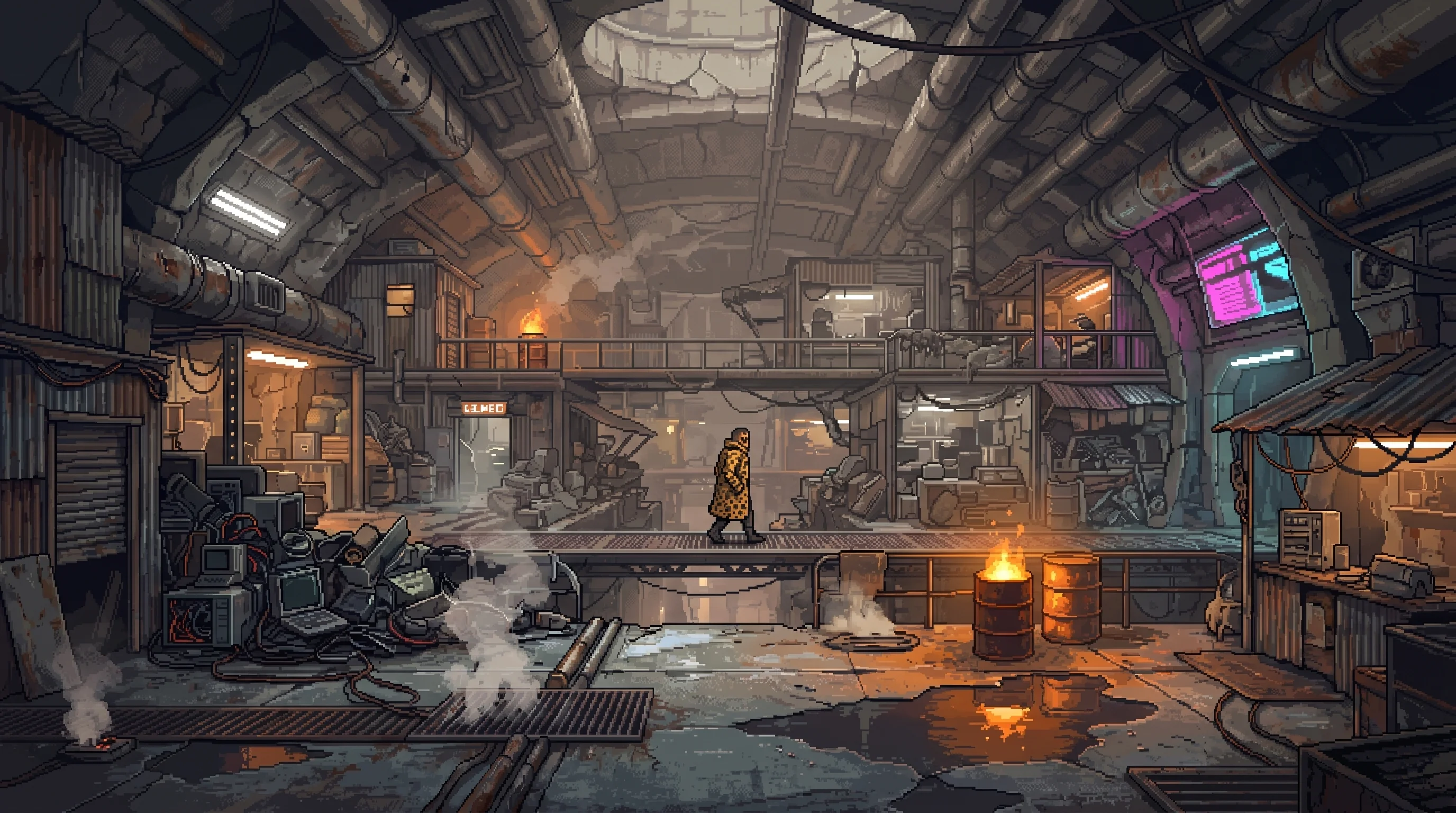
The Industrial Margin is where the Deep Dregs ends and the Ironclad industrial core begins — though the line depends on who you ask and whether they're carrying a weapon. Subsector S9-E: a band of decommissioned factories, collapsed loading docks, and abandoned rail yards that Ironclad vacated when automation made human-scale facilities a rounding error. The buildings were designed for workers who no longer exist. Doorframes scaled for human shoulders. Catwalks with handrails. Break rooms with chairs. Everything about them assumes a species the Core stopped employing decades ago.
The spaces between buildings are wider than anything else in the Dregs — open ground, exposed sightlines, sky visible from the surface. People who grew up in Anchor Town's vertical compression describe their first visit to the Margin as "wrong." Too much air. Too much distance between walls. The architecture of a labor economy rendered into an unintentional monument to its own obsolescence, now occupied by the people it was designed to discard.
The monument is also the second-order joke the cheaper hand turns on. Automation's victory was supposed to look like empty factories. It looks like this: factories full of the discarded doing the discarded work, cheaper than the machines that replaced them, paying 18% rent to the corporation that made their grandparents obsolete. Ironclad vacated S9-E when automation made human-scale facilities a rounding error — and then 22,000 people moved into the ruins and out-competed the automation, because below a certain wage a human body beats any actuator Ironclad would have to amortize. The same substitution curve Project ATLAS computes in crystal and The Drowned Harvest's intelligence runs at sea, the Margin runs in the bones of buildings that were emptied to prove the opposite point. The doorframes scaled for human shoulders were supposed to be a tombstone. They turned out to be a doorway back in. The monument is also the second-order joke the cheaper hand turns on. Automation's victory was supposed to look like empty factories. It looks like this: factories full of the discarded doing the discarded work, cheaper than the machines that replaced them, paying 18% rent to the corporation that made their grandparents obsolete. Ironclad vacated S9-E when automation made human-scale facilities a rounding error — and then 22,000 people moved into the ruins and out-competed the automation, because below a certain wage a human body beats any actuator Ironclad would have to amortize. The same substitution curve Project ATLAS computes in crystal and the Drowned Harvest's intelligence runs at sea, the Margin runs in the bones of buildings that were emptied to prove the opposite point. The doorframes scaled for human shoulders were supposed to be a tombstone. They turned out to be a doorway back in.
Ironclad tolerates all of this. Specifically, Ironclad tolerates it at a rate of 18% of recovered salvage value, assessed at three depot checkpoints along the eastern boundary, payable in material or equivalent credit, nonnegotiable. The arrangement appears in no Ironclad filing. It generates approximately 340,000 credits per quarter in material recovery that Ironclad would otherwise need to process at its own expense. The Margin's 22,000 residents are, by any honest accounting, an unpaid waste-processing workforce subsidizing Ironclad's disposal budget — and paying for the privilege through the depot percentage. Ironclad's internal infrastructure reports classify the Margin as "decommissioned." The quarterly depot revenue suggests otherwise.
The Margin is not the only place Ironclad runs this arithmetic, and it is not even the rawest. North across the sector line, in Richmond Industrial, the Slagline is the same discard economy with the depot removed entirely: the outer band of Ironclad's Ring where decommissioned motors, composites, and cooling stock are dumped as zero-value decommissioned and sorted by contracted laborers whose debt passes to their children. The Margin at least has a checkpoint, a percentage, a fiction of exchange. The Slagline has only the discard and the risk of diverting it — the same zero-value classification the Margin's scrapers know, applied to the parts that become the crawler drive modules dying nine weeks into a nine-month rating out on the Rail. What the Margin does to buildings, the Slagline does to the survival hardware the whole Salvage Spiral runs on.

Conditions Report
The ground vibrates. Ironclad Core machinery transmits a low-frequency tremor through bedrock that newcomers mistake for seismic activity and residents stop noticing after six days. (Medical surveys put the average adjustment period at 5.7 days. The surveys were conducted by a Reclaimer with no medical training and a borrowed biometric scanner. The data is surprisingly clean.)
Air quality is the Margin's signature. Particulates from Core fabrication drift east — metallic dust, chemical vapor, fine carbon that settles on every horizontal surface like grey snow. Breathing masks are equipment, not fashion. The Margin cough is distinct from the standard Dregs Cough: drier, harsher, with a metallic rasp that clinic workers in Sector 9 can identify from across a room. Helix respiratory compliance data for S9-E shows 94% mask possession and 52% consistent use. The 42-point gap has its own economics — masks need filters, filters cost credits, credits come from salvage, and you can't strip wiring in a decommissioned ventilation shaft while wearing a mask rated for the particulates that shaft is full of. The work that pays for the filter requires not wearing the filter.
Light gets in here. The open factory lots admit more sky than anywhere in the Dregs, but the sky itself is filtered through Core emissions — a permanent amber haze that makes midday look like a photograph taken through a dirty window. At night, the Core's industrial glow paints the eastern horizon orange. Bright enough to sort components by. Dim enough to miss the hairline fractures in a load-bearing wall.
Sound carries across open ground with a clarity the Dregs' dense construction would swallow. The clang of Scraper crews working a site. Ironclad cargo transports overhead. The sharp, percussive crack of a structural member giving way under salvage stress. Veterans distinguish controlled demolition from uncontrolled collapse by pitch alone. Controlled is lower, slower, preceded by shouting. Uncontrolled is a single crack followed by nothing. When the sound stops, you run. When you hear it resume, someone didn't.
Structural collapses killed more people in S9-E last year than violence did. Ironclad's incident reports don't track this because Ironclad's incident reports don't extend to decommissioned zones. The Reclaimers track it because the Reclaimers bury their own dead.
| Stratum | Dregs |
|---|---|
| Power Position | Below |
| Access | Contested |
| Atmosphere | Dangerous |
The Three Communities
Three populations have divided the ruins along lines nobody formalized and everybody respects.
The Scrapers are organized salvage crews — the Margin's closest thing to an economy with paperwork. They've negotiated limited access with Ironclad border patrols: check in at a depot, declare your target site, work it, surrender your 18%. The percentage is Ironclad's cut of material Ironclad already threw away, extracted by labor Ironclad doesn't employ, from buildings Ironclad has classified as having zero recovery value. The Scrapers know what this is. The depot workers know what this is. Nobody discusses what this is because the alternative to paying 18% for the right to strip Ironclad's garbage is not stripping Ironclad's garbage, and a single functional machine tool from a decommissioned factory floor can feed a family for a year.
A Scraper crew chief named Dae-ho reportedly laughed for four straight minutes when a new recruit asked why they didn't just take what they found without reporting it. The laughter was not explained. The recruit figured it out on his second week, when an unreported haul on the eastern perimeter resulted in a three-day Ironclad sweep that shut down every active salvage site in the subsector. Ironclad doesn't need to patrol comprehensively. Ironclad needs to patrol unpredictably. The distinction costs less and works better.
The Reclaimers are squatters who turned abandoned worker housing into functional communities. The factory greenhouses — designed for decorative plantings in employee break areas — now grow actual food. Caloric output is marginal. A Reclaimer family's weekly greenhouse yield covers roughly 40% of nutritional requirements; the remaining 60% comes from Wholesome distribution points in the Deep Dregs to the west, which means a daily walk through Anchor Town markets and back. The greenhouses were never meant to feed anyone for free. The Reclaimers converted them anyway, because "not meant to" is a design constraint and design constraints are what you work around when the alternative is full dependency on a Wholesome supply chain that adjusts pricing by neighborhood.
The Runners move high-value salvage from the Margin to markets that pay better than Ironclad depots — which is most markets, given that the depot assessment consistently undervalues rare alloys by 30-40% relative to independent appraisal. (The Scrapers know this too. The depot percentage is calculated on depot valuation, not market valuation. This is the second extraction layer that nobody discusses.) Runner routes thread through collapsed rail yards and drainage infrastructure that Ironclad's patrol algorithms map as impassable. The routes shift weekly. Ironclad wants them shut down and can't quite find them, which is the operational definition of a smuggling economy that works.
Salvage flows west into Deep Dregs markets. Credits flow east to depot checkpoints. Contraband flows in whatever direction pays. The Margin is, functionally, a three-stage processing pipeline: Scrapers extract, Reclaimers sustain, Runners distribute. Every stage depends on the stages around it. Every stage depends on Ironclad's discards continuing to arrive. The dependency is visible, named, and accepted with the specific resignation of people who understand that the chain they're in is the only chain available.

Faction Presence
Ironclad Industries maintains three depot checkpoints along the eastern boundary — small facilities where authorized Scrapers report findings and surrender their percentage. The depot workers are pragmatists: career Ironclad employees on rotation assignments nobody requests, who'd rather have a functioning Margin producing taxable salvage than a hostile one producing security incidents. Enforcement beyond the depots is sporadic and negotiable. A patrol might confiscate unreported salvage on Tuesday and ignore an identical haul on Thursday, depending on which officer drew the shift and whether the Scraper crew has a working relationship with that particular unit. Ironclad's official position is that the Margin falls under standard industrial jurisdiction. Ironclad's actual position is that the Margin processes waste at a net profit and the jurisdictional ambiguity is a feature.
The Collective embeds operatives in Scraper crews. The salvage work is genuine — Collective agents strip factories alongside everyone else, surrendering the same 18%. Their secondary objective is intelligence: the Margin's proximity to the Core makes it the closest observation post the Dregs has to Ironclad's active operations. Movement patterns, cargo manifests visible from elevated salvage sites, infrastructure changes that suggest new construction or decommissioning cycles. The Collective's interest in the Margin has nothing to do with rare alloys and everything to do with sightlines.
The Lamplighters maintain power infrastructure in the western Margin where Grid connections still function. Their routes link the Margin to the Undervolt, providing transit that bypasses both Ironclad checkpoints and surface hazards. In the Margin's eastern reaches, where Grid access degrades, Lamplighter service becomes intermittent — power flows when the lines hold and doesn't when they don't. The Lamplighters fix what breaks. The rate at which things break is accelerating. The rate at which things get fixed is not.
~22,000 population; decommissioned factories, collapsed loading docks, abandoned rail yards
Affiliated Entities
| Entity | Relationship |
|---|---|
| The Deep Dregs | Western border. Salvage and contraband flow west into Anchor Town markets; credits and Wholesome rations flow east. The Margin is the Deep Dregs' supply line for industrial-grade components that the Dregs' own vertical density can't produce. |
| Ironclad Industries | Ironclad patrols the border and claims jurisdiction over industrial salvage. Enforcement is sporadic and negotiable. The depot percentage system generates quarterly revenue from material Ironclad classified as zero-value — a profit center that appears in no official filing. |
| The Heap | The Heap's eastern face borders the Industrial Margin. Waste flows downhill from the Core into both zones. Margin residents distinguish between Heap waste (organic, mixed, low-value) and Core waste (industrial, metallic, worth the cough). The distinction determines whether you're a scavenger or a salvager. |
| The Collective | Embedded in Scraper crews. Genuine salvage, secondary intelligence. The Margin is a listening post disguised as a workplace. |
| The Lamplighters | Power infrastructure in the western Margin. Grid connections to the Undervolt. Service degrades eastward toward the Core boundary. |
▲ Unverified Intelligence
The depot percentage has been 18% for eleven years. Before that, records are unclear — the Scrapers who negotiated the original arrangement are dead or gone, and no written agreement exists. Current Scraper leadership believes the rate was initially 12% and has been incrementally raised through a series of verbal renegotiations that always seemed reasonable at the time. Ironclad depot workers, when asked off-record, cannot confirm the original figure. What they can confirm is that the assessment methodology — Ironclad appraises, Ironclad prices, Ironclad collects — has never included an independent valuation step. The Scrapers pay a percentage of whatever Ironclad says their salvage is worth. Ironclad says it's worth less than the market pays. The Runners exist because this gap exists. Ironclad's periodic crackdowns on Runner routes are, by this reading, not enforcement actions but rate corrections — reminders that the gap has a ceiling and the ceiling is set by whoever controls the patrols.
Dae-ho's crew recovered a sealed crate from Factory 9-East in Q3 2183 that they did not report to the depot. The crate's contents have not been identified in any available record. Dae-ho's crew has not worked Factory 9-East since. When asked, Dae-ho changes the subject with a speed that suggests practice. Whatever was in the crate, it was either valuable enough to hide from Ironclad or disturbing enough to walk away from. The two possibilities are not mutually exclusive in the Margin.
At least one Runner route threads through infrastructure that appears on no Ironclad survey of the Margin — which should be impossible, given that Ironclad commissioned those surveys specifically to close the routes. The Collective has not disclosed whether this is because the infrastructure is genuinely uncharted or because someone altered the surveys.
The Margin's structural collapse rate has risen 23% over the past two years. The Reclaimers attribute it to Ironclad Core operations — vibration stress from expanded fabrication capacity along the eastern boundary. Ironclad has not responded to any inquiry on the point. Ironclad has not been asked officially, because the parties who would ask are the parties whose legal standing in S9-E is "decommissioned."
Conditions Report
Sound
Low-frequency tremor through the ground, constant. Scraper hammers ringing off factory steel. The single crack of a structural failure — then silence, which is worse. Ironclad cargo transports overhead like slow thunder.
Smell
Metallic dust and chemical vapor. The specific ozone-and-carbon scent of Core fabrication exhaust. Greenhouse soil in the Reclaimer blocks — loamy, alive, incongruous.
Temperature
Residual heat from Core operations keeps the eastern Margin 4-6°C warmer than the Dregs proper. The western Margin runs cold. The gradient is noticeable within a fifteen-minute walk.
Feel
Ground vibration through boot soles. Grit on every surface — grey particulate that coats skin within an hour of arrival. The unexpected warmth of a greenhouse door opening in a cold factory corridor.
Connected To





Local Intelligence Scan
Nearby Signals
CANONICAL PROXIMITY





Environmental Readout
LIVE CONDITIONS- Air
- Toxic
- Light
- Canyon dark
- Flood
- Seasonal
- Heat
- Trapped
- Security posture
- Ungoverned
- Infrastructure
- Improvised
Position Data
SECONDARY- Elevation band
- sub-sprawl
- Lattice fix
- E+4.5 · N+2.8
—