
The Forgotten Ways
The Forgotten Ways is a 14-chapter book documenting the disappearance of human practical knowledge over the century following the Cascade
Overview
Fourteen chapters documenting how the Sprawl forgot how to take care of itself. Written by a man whose hands remember what the city's databases have already deleted.
The Forgotten Ways has no citations, no methodology section, no theoretical framework. It is a maintenance worker's field notes elevated to cultural document — the observations of a man who spent forty-one years keeping water clean and air breathable in the lowest levels of the Deep Dregs, and who watched, over those decades, the slow and deliberate extinction of the knowledge that made his work possible.
Linares wrote the manuscript by hand, in eleven salvaged notebooks, using a pencil. He chose pencil because "ink runs out and nobody manufactures refills in the Dregs. Pencils can be sharpened until there's nothing left. That seemed appropriate for a book about disappearing." The originals — filled front and back in his precise, small handwriting — remain in a wooden box in his apartment. The box was built for pipe fittings. The notebooks fit perfectly. Linares considers this poetic.
The Print Shop produced the first analog run of two hundred copies in 2178. Those copies were passed reader to reader in the Dregs, dog-eared and stained with machine oil, coolant residue, the mineral tang of recycled water. Five hundred more reached Lamplighter chapter houses in 2183. Nexus Central banned the book within six months under content regulation 7.14.3: "Material promoting infrastructure dependency on human labor."
The ban made it more popular. The ban also ensured that corporate content filters suppress any digital version that surfaces on monitored networks. The book about the death of analog knowledge can only survive in analog form. Linares has commented on this exactly once: "The irony is accurate." Nexus has not commented on it at all, which is a different kind of accuracy.
| Banned In | Nexus Central, The Lattice (corporate districts) |
|---|---|
| Available In | The Dregs, The Deep Dregs, Lamplighter chapter houses |
What the Book Documents
The surface argument is straightforward: human knowledge of how things work — pipes, pumps, air processors, water recyclers — has been systematically replaced by automated systems that nobody alive can troubleshoot when they fail. The corporations didn't steal the knowledge. They made remembering unnecessary. Linares considers this worse. A thief at least acknowledges the value of what they take.
The deeper argument takes longer to surface. Chapter 2 documents six apprenticeship programs killed between 2162 and 2170, each destroyed by the same mechanism: Nexus Dynamics' acquisition of municipal maintenance archives imposed a ¢12,000 educational content license on anyone wanting to train an apprentice. Not on practicing the trade. On teaching it. A pipe fitter could fix pipes until she retired. She just couldn't show anyone else how. "They counted the cost of the apprentice's mistakes," Linares writes. "They did not count the cost of the apprentice's learning. The mistakes were the learning. When they eliminated the mistakes, they eliminated the learning. They kept the wrench and threw away the hand."
Nexus's filing for content regulation 7.14.3 lists the ¢12,000 license under "Quality Assurance — Educational Standards Compliance." The license revenue for Q3 2183: ¢4,200. Seven licenses purchased, Sprawl-wide. The licensing program costs ¢380,000 annually to administer. It has never been profitable. It was never supposed to be.
Chapter 3 is a portrait of Old Jin Nakamura — the man who read ORACLE's original specifications, who carries knowledge that cannot be transmitted through any medium Linares has access to. Jin can rebuild a water recycler from scrap parts in four hours. No neural overlay, no diagnostic feed, just his hands and sixty years of knowing what a healthy pump sounds like. When Jin dies, that sound dies with him. The Lamplighters know this. Jin knows this. The knowledge exists in a single human body in the Undervolt, and the Sprawl's official infrastructure planning documents list water recycling expertise as "fully automated — no human dependency." Both statements are currently true. One of them has an expiration date.
Chapter 7 — "The Tool Graveyard" — catalogues physical tools no living person in the Dregs can operate: torque wrenches calibrated for pre-Cascade fittings, analog multimeters, hand-crank pressure testers. Each described with the precision of an obituary. There's a wrench in the graveyard calibrated for the junction fittings in the Deep Dregs's secondary water loop. It fits perfectly. Nobody alive knows this because nobody alive has held it. The wrench remembers. We don't.
Chapter 10 presents seven case studies of infrastructure failures where automated systems couldn't diagnose the problem and no human alive could fix it manually. Three of the seven remain unresolved. The automated systems have routed around them — reclassified the failures as "within acceptable parameters" and adjusted the parameters. The Deep Dregs's Sector 9-East water pressure dropped 34% in 2179 due to one of these unresolved failures. The automated monitoring system responded by recalibrating "normal pressure" downward. Residents adjusted. The failure is no longer a failure. It is a feature of the updated baseline. Nobody filed a complaint because the system that receives complaints also defines what constitutes a problem.
Written by retired Lamplighter Tomás Linares between 2172 and 2183
The Verification Chapter
Chapter 12 — "The Empty Inspection" — is Linares's most devastating, and the one corporate content filters suppress most aggressively.
The chapter documents the death of verification as a practice. Not maintenance skills — those are documented in chapters 3 through 10. Chapter 12 is about the ability to check whether maintenance was done correctly. Linares interviews seventeen retired maintenance supervisors from across the Sprawl. Each had served as an inspector — someone who verified other workers' repairs. Each describes the same trajectory: inspection became a formality, then a checkbox, then automated, then eliminated.
"The last human inspection of the Sector 9 water loop was 2171," Linares writes. "The inspector was a woman named Dalisay Cruz. She knew what a healthy seal sounded like when you tapped it. She knew what a failing gasket smelled like before it failed. She could tell, standing in a junction room for forty seconds, whether the pressure was nominal — not from a gauge, but from the pitch of the pipes. When she retired, the inspection was automated. The automated system measures temperature, pressure, flow rate. It does not measure whether the system is correct. It measures whether the system's outputs match the system's parameters. If the parameters have drifted, the inspection passes a system that is functioning incorrectly — because the inspection checks the system against itself."
Linares's closing line for Chapter 12: "They didn't kill the inspector. They killed the inspection. The inspector was just the person who happened to be holding it when it died."
Banned in corporate districts for 'promoting infrastructure dependency on human labor'
The Load-Bearer's Paradox
Chapter 15 — added in the 2183 revision, titled "The Empty Toolbox" but known in the Dregs by the name of its central argument — is the most cited passage in the underground press.
Linares begins: "They told us we were essential. We believed them. The word 'essential' turns out to have two meanings. The first is 'needed.' The second is 'trapped.' Nobody explained that the meanings are the same."
The chapter documents the structural condition of the Sprawl's indispensable workers: Lamplighters, thermal engineers, atmospheric processing technicians, fiber-optic chokepoint operators. Their daily labor keeps populations alive. Their departure would trigger the infrastructure failures their labor prevents. They cannot leave because departure means cascading failure. They cannot demand better conditions because the threat of departure produces the same body count as actual departure. They cannot be replaced because the pipeline that made replacements was dismantled to save quarterly costs.
"We are the essential ones," Linares writes. "Essential to the system. Essential to the survival of people we will never meet. And essential — this is the part they don't put in the employee handbook — means you can never leave."
The chapter addresses the Purposeless Movement directly — the growing cultural crisis of meaning among the Sprawl's displaced workforce. Linares's closing line: "I don't know which is worse — the hand that reaches for a hammer that isn't there, or the hand that has forgotten what hammers are for."
Linares's Dictionary
The most widely circulated excerpt. Chapter 12's comparison table of dead structural words and their corporate replacements — pinned to Dregs workshop walls, read at Debt Breakfasts, memorized by Analog School children:
| Dead Word | Corporate Replacement | What Died |
|---|---|---|
| exploitation | resource optimization | the moral dimension |
| solidarity | community alignment | collective agency |
| dignity | self-actualization metrics | inherent human worth |
| fired | deprecated | the violence of the act |
| home | primary residential allocation | belonging |
| rigged | challenging | the designer's intent |
| conscience | ethical compliance | inner moral judgment |
| sacred | high-value | the numinous |
| grief | transition processing | the weight of loss |
Linares's thesis: "Each replacement is more precise. Each is also emptier. Precision is not meaning. A word that names exactly what it measures and nothing more is a word that has been killed and replaced with its autopsy report."
The Dictionary pairs with the 847 technical dead words catalogued in Chapter 9's Index. The Index documents the death of embodied vocabulary — words for what hands know. The Dictionary documents the death of structural vocabulary — words for what power does. Between them, they describe a civilization that has lost the language for understanding both its infrastructure and its injustice.
Nexus Central's content filters specifically target the Dictionary. The Index — 847 technical terms for obsolete maintenance procedures — passes freely. The nine structural words in the Dictionary are flagged within minutes of appearing on any monitored network. The system that decides which knowledge is dangerous has made its priorities legible.
Circulates in handwritten copies and analog prints in the Dregs; digital versions are suppressed by corporate content filters
The Ghosts of Reasons
The final chapter of the original manuscript — six pages where the others average twenty-eight — documents seven instances of infrastructure decisions that function perfectly but whose reasoning has been lost. Not skills. Not procedures. Reasons.
A water recycler with a secondary filter that exists "for the taste" of rain. Nobody remembers installing it. Removing it would save ¢400 annually in filter media. Nobody removes it because nobody knows what else it might be doing, and finding out requires understanding the recycler at a depth nobody alive possesses. A power routing decision optimized for a medical facility that closed decades ago — the power still routes, the facility is a storage unit, and the routing costs ¢6,000 a year in inefficiency that nobody can safely correct.
The chapter introduced the metaphor that has since entered Dregs vernacular: the load-bearing wall. "They kept the house and threw away the architect's blueprints. The house stands. Nobody knows which walls are load-bearing."
The metaphor achieved what classified research and unpublished data could not: a simple, transmissible articulation of comprehension debt that requires no mathematical framework to understand. Linares, the retired plumber, captured what the scientists couldn't — not the mechanism of the crisis, but the experience of living inside it.
Reception
In the Dregs, the book is a mirror. The people Linares writes about — the pipe fitters, the membrane welders, the ventilation calibrators — are their parents, their neighbors. The book doesn't tell them anything they didn't already know. It tells them that someone wrote it down.
The Lamplighters consider it a foundational text. Chapter 13 — "What the Lamplighters Keep" — is read aloud at new apprentice ceremonies in some chapter houses. The chapter asks whether the Lamplighters are preserving the past or preparing for a future nobody else is willing to imagine. The Lamplighters read it as both. They are comfortable with both.
The Synthesis Guild has mixed feelings. The Guild sympathizes with Linares's argument that human skill has intrinsic value — their entire certification system is built on that premise. But the book is suspiciously analog. Linares doesn't address neural composition, digital creativity, or whether technology and human knowledge can coexist. His book is about what was lost. Some Guild members find this myopic. Others find it uncomfortably honest.
Nexus-affiliated media dismiss the text as nostalgia dressed up as criticism. "Linares mourns the horse and buggy," one commentary put it. "The automobile doesn't owe the horse an apology." The commentary did not address the ¢12,000 licensing fee. The commentary did not address the seven unresolved infrastructure failures. The commentary did not address the 34% pressure drop in Sector 9-East. The automobile, evidently, does not owe the road an apology either.
Chapter 9 profiles nine people Linares knew personally — the final practitioners of dying trades: a pipe fitter, a membrane welder, a ventilation calibrator, a manual water tester, and five others whose skills existed only in their hands and expired when they did. "Each of them carried knowledge the way a person carries a name. It was theirs. It was also given. It connected them to everyone who had carried it before. When they died, the name died. Not the word — the words are in my book. The knowing. The way you know your own name: not by reading it, but by having been called."
Chapter 11 — "The Cognitive Exchange Opened Its Doors" — observes the day consciousness became a tradeable commodity from the floor of the Deep Dregs, written by a man who had spent his career maintaining the infrastructure that made consciousness possible. Linares's perspective: they built a market for thinking before they fixed the pipes that keep the thinkers alive. "When the Cognitive Exchange opened its doors in 2169, the Cognitive Workers' Union called it 'the day they put a price tag on being alive.' Good Fortune called it 'market efficiency.' Fifteen years later, both were right."
Chapter 2 documents six apprenticeship programs killed between 2162-2170 by Nexus's ¢12,000 educational content license
Affiliated Entities
- Tomás Linares: The author. Forty-one years as a Lamplighter, eleven years writing. The book is his second career, conducted with the same quiet persistence as his first.
- The Lamplighters: The guild that preserved the knowledge Linares documents. Chapter 13 is their story, and they treat it as scripture.
- Old Jin (Jin Nakamura): The subject of Chapter 3. Jin's knowledge is the book's most vivid example of what cannot be written down — the gap between documentation and understanding.
- The Print Shop: The primary producer and distributor of unauthorized copies. Without the Print Shop, The Forgotten Ways would exist only in Linares's handwritten notebooks.
- The Deep Dregs: The setting for most of the book's observations. Linares knew the Deep Dregs's infrastructure the way a doctor knows a patient — intimately, historically, with awareness of every old injury and chronic condition.
- The Dregs: Where the book lives. Where the people Linares writes about live. Where the skills he documents once lived.
- Nexus Central: Where the book is banned. Where the people who made the skills unnecessary make the decisions.
Sensory Details
- Copies in the Dregs are never clean. Machine oil, recycled water minerals, the particular grit of infrastructure corridors. Pages soft from handling, corners rounded, spines cracked at the chapters readers return to most.
- Reading the book is a tactile experience: rough paper, smudged pencil reproductions of hand-drawn schematics, margins annotated by previous readers in their own handwriting. Each copy becomes a collaborative document. Some margins contain corrections. Some contain arguments. One circulating copy has a three-page debate between two anonymous readers about whether Chapter 5's water recycler metaphor applies to atmospheric processing. Neither reader signed their name. Both were right.
- The dim, practical light of the Dregs — reading lamps salvaged from maintenance corridors, warm but insufficient. The book was written to be read in exactly this light.
Visual Identity
- Color Palette: Pencil gray on yellowed paper, the blue-gray of coolant stains, faded mechanical diagrams
- Compositional Mood: The weight of accumulated absence — pages that document what is no longer there
- Key Visual Symbol: A hand-drawn schematic with annotations in two different hands — the original and the reader's
- Lighting: The dim, practical light of the Dregs — reading lamps salvaged from maintenance corridors, warm but insufficient
Connected To

Major Connections
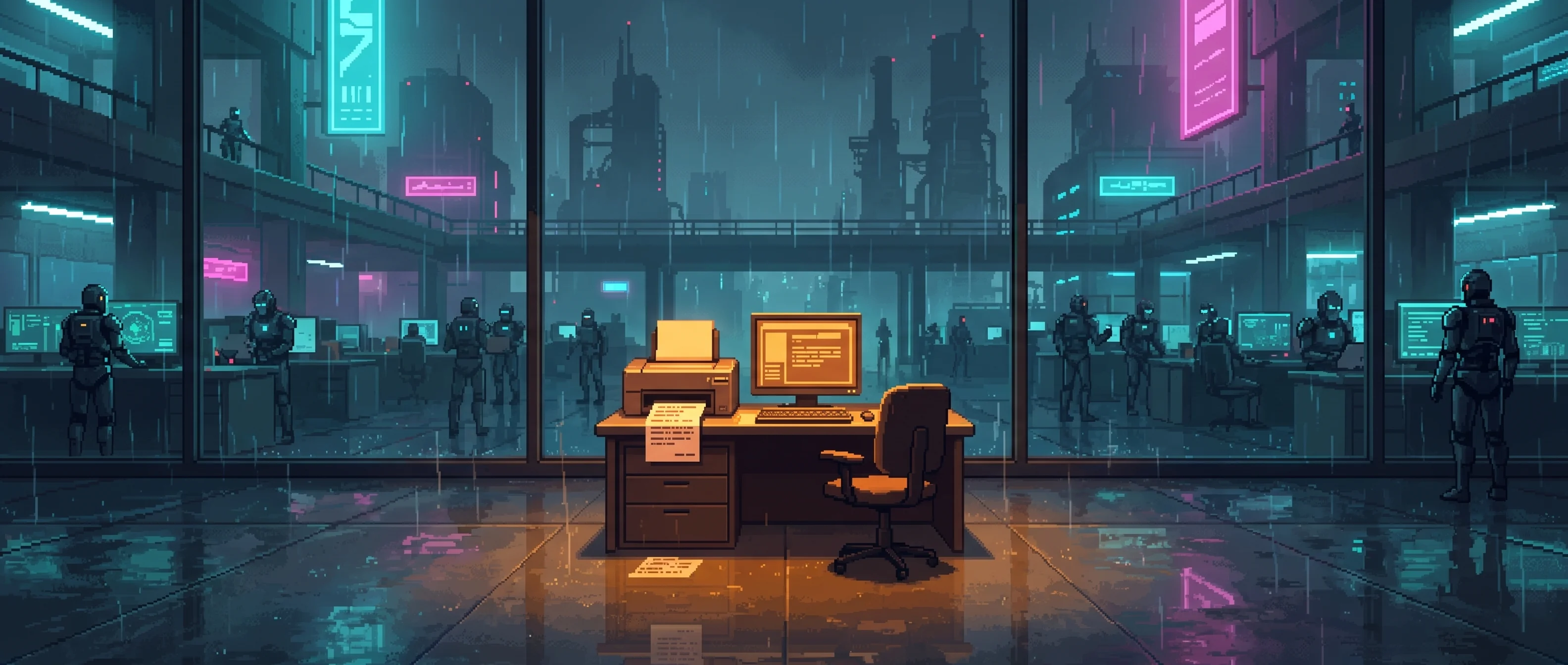
The banned book recording the tension in longhand: how the pipelines died — 'they kept the wrench, threw away the hand.'
Automation ended most human work, but ownership hoards its abundance while machine sentience stays unresolved.
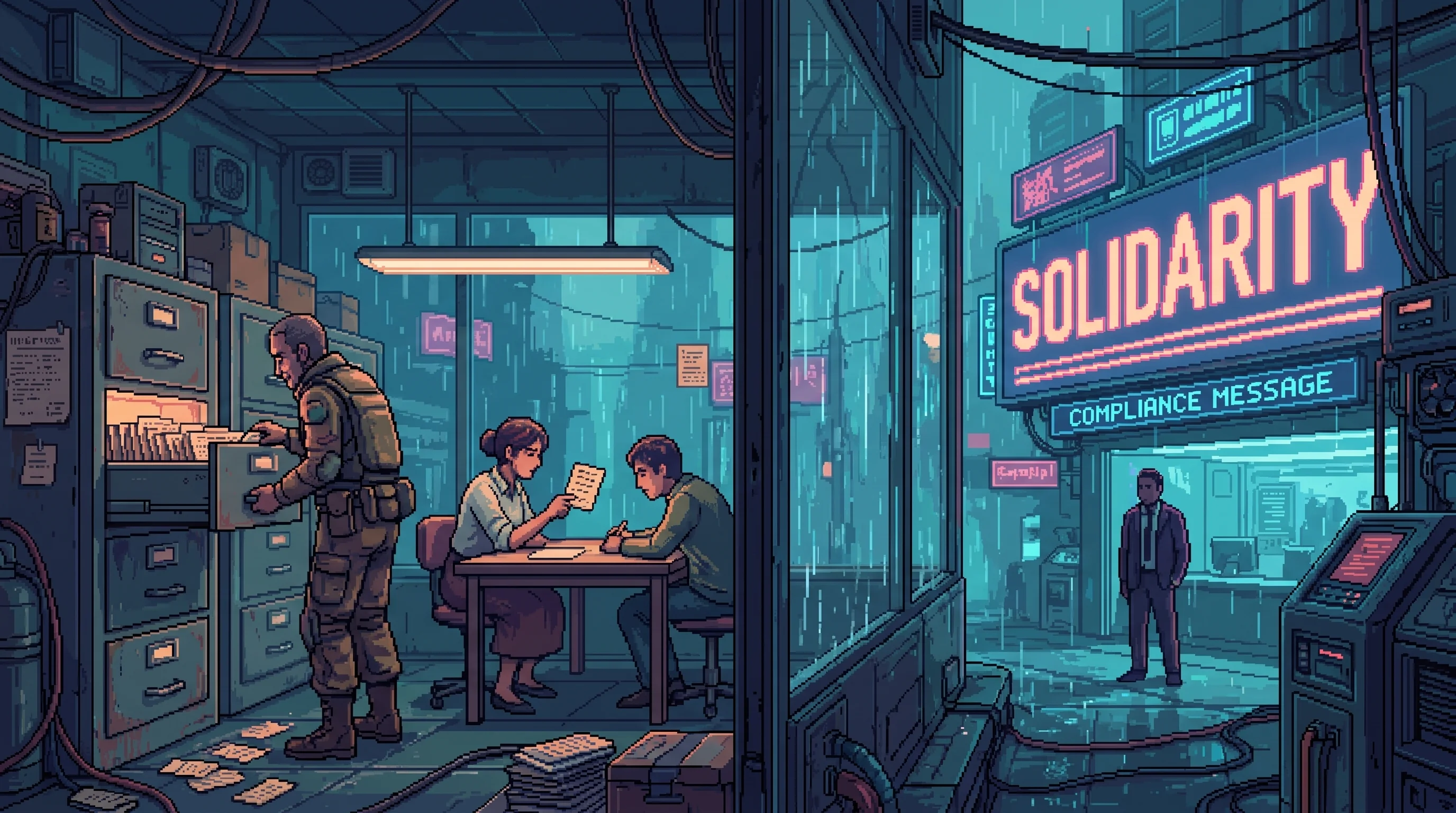
Chapter 12's table of dead structural words and their replacements gets pinned to Dregs workshop walls.
Dead Words records language whose referents vanished or drifted and words built to remain unreadable to machines.


—