
The Provisional Body
The longevity-managed do not have doctors in any traditional sense — they have cohorts. The cohort's collective mortality data is the evidence base from which each quarterly regimen update is derived. The oldest living enrollees are called Frontliners — not for courage, but because they occupy the data frontier: nothing beyond them has been observed yet.

Overview
Discovery outran proof, and the gap between them has been filled by enrollment.
Helix Biotech solved longevity. The compounds work — mortality curves have flattened dramatically across the enrolled population, average functional lifespan has extended by decades, and the Frontliners, the oldest living members of the program, are demonstrably more capable at their chronological age than any previous generation. None of this is disputed. What is also not disputed, and is also never discussed at quarterly protocol consultations, is that the mechanism producing these results has never been approved by any authority — because approval would require a trial endpoint, and the trial endpoint of a longevity study is the death of the last subject, which Helix is commercially motivated to delay indefinitely.
The Provisional Body is the name the Question Keepers gave to the system that emerged from this circularity: a mode of living in which the longevity-managed do not have doctors, they have cohorts. You are not treated, you are enrolled. Your regimen is not prescribed, it is updated — quarterly, automatically, based on what the people six months older than you discovered when they died. You did not participate in designing the update. You will not participate in designing the next one. You acknowledge receipt, swallow the new compounds, and continue contributing biometric data to the corpus that will inform the update after that.
This is, Helix notes, the most evidence-based approach to longevity medicine ever developed. The evidence is the cohort. The cohort is you.
Foundational Paradox
The paradox the Provisional Body produces is neither rare nor subtle: the thing that proves the treatment works is the same thing that prevents the treatment from being considered proven.
A standard clinical trial has endpoints. The endpoint of a longevity trial is death — yours, and enough of your demographic peers to constitute a statistically meaningful dataset. Helix designed the CohortEngine to approximate this continuously: your cohort is dying ahead of you, their deaths are informing your protocol, and your own death will inform your successors'. This is functionally equivalent to running a permanent multi-generation trial where the results are continually processed but never summarized, because summarizing them would mean concluding the trial, which would mean ending the program, which would mean ceasing to generate the data on which the program depends.
The circularity is structural, not a bug. Helix's regulatory affairs division has filed documentation with every relevant oversight body in the Organized Sprawl establishing that the CohortEngine constitutes a valid continuous evidence-generation mechanism that does not require a discrete approval endpoint. The filings cite 340 million enrolled individuals as evidence of the system's effectiveness. The 340 million enrolled individuals are enrolled in part because the filings establish that enrollment is the standard of care.
The Question Keepers named the controversy The Consent Horizon: the point at which consent to treatment becomes consent to indefinite experimental status becomes consent to never having a treatment that isn't experimental. Their open file has been active since 2175. Helix's legal team has not found any provision in any surviving corporate charter that requires a trial to end.

How It Came To This
Helix launched the Longevity Continuum program in 2168, eighteen months after the first compounds demonstrated significant mortality-curve flattening in preliminary cohort data. The enrollment materials described the program as "next-generation personalized medicine" and the quarterly updates as "evidence-based protocol optimization." Both descriptions were accurate. Both descriptions concealed the mechanism by which they would remain accurate in perpetuity.
The dependency was not planned. The first cohort of long-term enrollees discovered it organically: when three individuals in the Sector 22 pilot voluntarily withdrew after year two, all three experienced faster physiological decline than the statistical model for their cohort predicted. The lead CohortEngine researcher, Dr. Emery Vance, documented the finding in an internal brief titled "Cessation Pathology in Longitudinal Longevity Cohorts." The brief circulated within Helix's medical division. It did not circulate publicly. The enrollment materials were updated to include a disclosure on page 4 noting that "protocol cessation may produce outcomes inconsistent with pre-enrollment baseline due to biological reorganization during enrollment period." The phrase "may produce" was not changed when the likelihood was established at 94%.
The Frontliner designation emerged from the enrolled population itself, not from Helix. In the early years of the program, the oldest enrollees were informally called "the guides" — people whose experience with earlier protocol versions could inform newer enrollees' expectations. By 2180, the oldest living enrollees had passed the point where anyone's experience was relevant, because no one ahead of them had produced observable outcomes. The language shifted: they were Frontliners — not for what they knew, but for where they were. Nothing beyond them had been observed. Everyone below watched.
The Cohort as Doctor
A Provisional Body enrollee's primary relationship is with a cohort number, not a clinician. The CohortEngine assigns cohort membership at enrollment based on chronological age, biological markers, and existing protocol tier, then maintains that membership until mortality. The cohort number is the reference identifier on every quarterly update.
The update arrives as a system notification. It contains a list of compounds, dosages, and timing instructions. It may contain a brief note indicating that the update was triggered by a mortality cluster in the six-month-older cohort, though the note is optional and frequently omitted. What it does not contain is a clinician's name, a consultation record, or any indication that a human being reviewed the enrollee's individual circumstances before the update was propagated. The CohortEngine is not designed to do this. Reviews at scale for 340 million individuals would require a clinical workforce that does not exist and would cost more than the program generates.
Helix's documentation describes the CohortEngine as "the most sophisticated personalized medicine infrastructure ever developed." In a narrow sense this is accurate: the system is optimizing each enrollee's protocol based on the densest real-world dataset in the history of biological medicine. The optimization is running continuously, without interruption, at a scale no human institution could replicate. The question the documentation does not address is whether personalized medicine remains personalized when the person doing the personalizing is a system that processes the individuality out of 340 million bodies to find the commonalities that update 340 million bodies.
The Frontliners have started doing what no earlier cohort could: they are watching what happens when people beyond their position in the data frontier die. There are none. They are the frontier. When a Frontliner dies, the death is the first observation of that cohort-age's mortality pattern. The update it triggers will reach the cohort six months younger. The Frontliner whose death wrote the update will not receive it. This is, technically, how every death in the program functions. The Frontliners simply understand it more clearly, having watched enough people ahead of them contribute.
| Withdrawal Outcome | Clinical literature universal: faster decline than continuation. Protocol cessation is legal; the forms call it voluntary. |
|---|---|
| Controversy | The Consent Horizon |
| Enrolled Population | ~340 million (Organized Sprawl longevity tier 3+) |
| Protocol Revision Median | 17 revisions over an enrolled lifetime |
The Data You Contribute
Schedule D of the standard enrollment contract runs eleven pages. Section 9 covers intellectual property and data rights. Section 9.3 grants Helix Biotech perpetual, irrevocable, transferable rights to anonymized biometric, adverse-event, and mortality data from all enrolled individuals, including data generated after enrollment termination.
"After enrollment termination" means after death.
The clause has been in the standard contract since version 1.0 in 2168. In sixteen years of enrollment, no enrollee has successfully negotiated its removal. A legal challenge filed in 2177 by the Sovereignty Question movement argued that the posthumous data rights constituted a property claim on a deceased person's biological information without meaningful consent. The Organized Sprawl's Corporate Arbitration Panel found in Helix's favor on the grounds that the information was generated during the enrollment period, which the enrollee had consented to. The finding was understood by the Sovereignty Question as proving their point. The finding was understood by Helix as settled law.
The biometric data itself flows continuously. Every enrolled individual at tier 3 or above is monitored in real time: heart rate, metabolic markers, neural interface biomarkers, cognitive performance, immune response, sleep architecture. The stream runs 24 hours a day, every day, for the duration of enrollment. This is the primary research corpus from which protocol updates are derived. This is also how Helix knows, in real time, which individuals are likely to provide the most informative mortality events in the next 12 months — the predictive modeling capability is described in the enrollment materials as "longitudinal health trajectory analysis." Enrollees who request their own trajectory analysis are told that the data is proprietary. It is, legally, accurate: the data is theirs only in the sense that it was generated by their bodies. It belongs to Helix in every other sense.
The Question Keepers have been attempting to establish what the Sovereignty Question calls "data sovereignty at mortality" — the right of an enrollee or their estate to withdraw data rights at death. Helix's legal team has responded that such a right would effectively invalidate the evidentiary basis of the entire program, since death events are the most data-dense moments in an individual's enrollment arc. They are correct. This is the argument.
Implications
The Provisional Body changes what health means without appearing to.
Before the Continuum program, a patient could evaluate their relationship with medicine by asking whether they were getting better. The clinical trial framework produced a binary: the treatment worked, or it did not. The approval system took the binary seriously. Medicine was the project of converting provisional treatments into established ones.
The Provisional Body eliminates this structure. The longevity-managed cannot ask whether they are getting better because "better" has no reference point: the pre-enrollment baseline is irretrievably gone after the first year, and the alternative outcome — faster decline than continuation — is documented but unknowable from the inside. They can ask whether they feel well, which the compounds generally ensure they do, and which is not the same question. They cannot ask whether the protocol is working because the protocol always seems to be working until the mortality event that updates the next cohort.
The philosophical consequence the Consent Horizon debate keeps circling is this: if the alternative to indefinite experimental status is faster death, the experimental status has made "consent" a word that describes what the enrollee must say to receive something they cannot refuse. Helix's consent framework is technically impeccable — every update is disclosed, every risk is documented, every withdrawal option is presented. The framework produces valid consent in every legal sense. What it cannot produce is consent that is meaningfully free, because the freedom it extends is the freedom to decline faster.
The enrolled population is almost entirely aware of this. The median enrollee has read enough of the materials, or heard enough from other enrollees, to understand the basic mechanics. Enrollment rates have increased every year since 2168. The population that understands the mechanism and enrolls anyway is not confused. It has concluded that the alternative is worse. This conclusion is almost certainly correct. Helix considers this the strongest possible endorsement of the program.
Affiliated Entities
- Helix Biotech: The CohortEngine is Helix's largest longevity revenue line. The corporation controls biological infrastructure across the Sprawl; the Provisional Body is what that control looks like applied to the question of how long you live.
- The Patience Doctrine: The Provisional Body's data-horizon logic is the Doctrine's projections applied to bodies — present enrollees as transition-cost data points in a model whose verification date is past everyone currently living.
- Halcyon Bridgeworks / The Waiting Ward: The Waiting Ward is the acute terminal version of what the Provisional Body manages chronically — suspension while the queue moves, biometric monitoring in real time, enrolled until the event that ends enrollment.
- The Augmentation Ladder: Body-as-subscription appears in both; the augmentation ladder runs on cognitive enhancement, the Provisional Body on continued survival. Both produce the same cessation problem: removal is more dangerous than continuation.
- The Suffering Premium: The Untuned — those who refuse longevity enrollment on philosophical grounds — produce the only natural-mortality dataset in the Sprawl. Helix monitors their outcomes. The Premium is the cultural economy that prices proximity to their refusal; the Provisional Body is what they are refusing.
- The Upgrade Treadmill: The Provisional Body is the Upgrade Treadmill's longest-duration expression — a dependency that cannot be meaningfully terminated and that lasts exactly as long as the dependent continues to survive. Withdrawal produces faster decline than continuation; the body reorganizes around the intervention, and cessation is not a return to baseline but a descent below it.
- Time Debt: Every enrolled person lives on a protocol they didn't design, at terms they didn't negotiate, updated quarterly by what the older cohort discovered when they died. The Time Debt accrues with each revision; the counterparty is Helix, and the interest is biological.
- Privacy vs. Prosperity: Every enrolled body is a continuous data stream — biomarkers, adverse events, cognitive metrics, mortality timing. The Privacy vs. Prosperity bargain reaches its terminal form in the Provisional Body: what was traded for access is not convenience or credit but additional years. The corpus those streams build is research infrastructure Helix owns in perpetuity. Death is the most data-dense moment of enrollment.
What the Frontliners Know
Restricted annex — open to read
The Frontliners have no meaningful way to share their findings. The people they would share them with are the six-months-younger cohort, which will receive an updated protocol based on how the Frontliners die, regardless of anything the Frontliners choose to communicate while alive. This creates an information asymmetry the program was not designed to prevent: the most experienced enrollees — people with the longest longitudinal exposure to the CohortEngine's logic — are also the people whose knowledge dies with them, because the system was not designed to extract what they understand. It was designed to extract what they do.
There are informal Frontliner networks in several districts, organized carefully below the threshold of anything Helix would find actionable. They are not protest movements. They do not organize against the program. They meet, mostly, to share the experience of being the data frontier with people who understand what the frontier means — which the cohorts below them cannot, because the cohorts below them have not yet reached the point where no one is ahead.
What the Frontliners appear to have concluded — the Question Keepers have informal contact with several — is not that enrollment was a mistake. Most would enroll again, given the same information at the same moment. What they appear to have concluded is something narrower and harder to articulate: that there is a difference between having a life and having an enrollment period, and that the difference cannot be identified by examining either one from the inside. You feel, enrolled, as though you are living your life. The Frontliners suggest that this feeling does not mean it is true.
Connected To
Primary Connections

Withdrawal produces faster decline than continuation — the body reorganizes around the intervention, and cessation is not a return to baseline but a descent below it. The trial does not let you out; it only lets you stop.
Upgrades rewire users until baseline feels disabling, removal risks catastrophe, and each version demands the next.
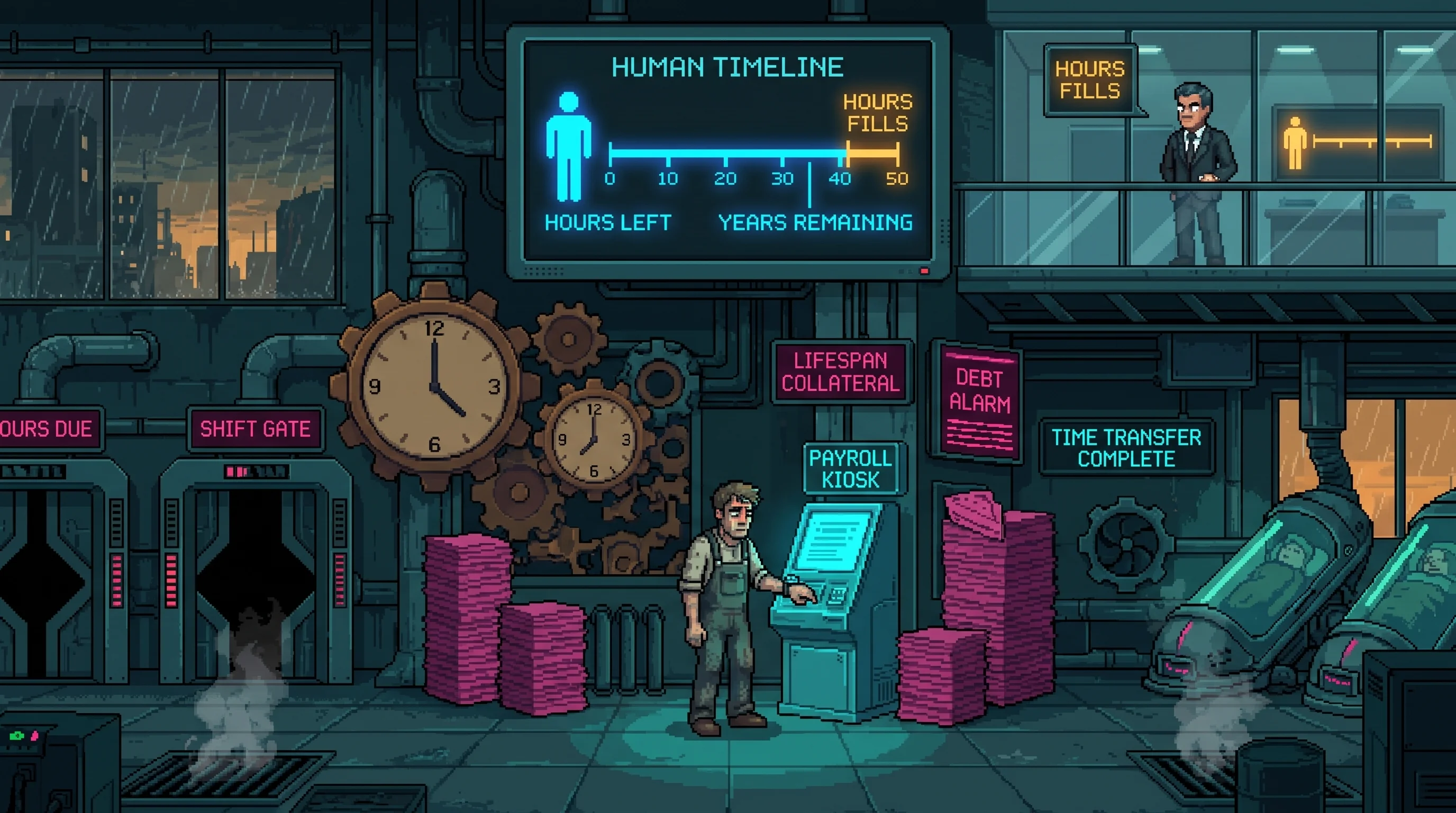
Every enrolled person lives on a protocol they didn't design, at terms they didn't negotiate, updated quarterly by what the older cohort discovered when they died. Life expectancy is renegotiated continuously, and the counterparty is Helix.
Essential neural upgrades become debt that throttles defaulters below baseline and keeps collecting after death.

Every enrolled body is a continuous data stream — biomarkers, adverse events, cognitive metrics, mortality timing. The corpus those streams build is the research infrastructure Helix owns. Death is the most data-dense moment of enrollment.
The Sprawl demands permanent personal data for participation, then uses it to price access and preempt solidarity.

Supporting Connections

Enrollees as transition costs in projections verified posthumously.
A governance doctrine treats living generations as transition costs for futures only its beneficiaries can model.

The Waiting Ward is the acute terminal version; this is the chronic.
Terminal-care corporation that suspends the dying on subscription while a proprietary cure-queue decides who leaves.



—