The Mirror Market
Overview
The Mirror Market is the only place in the Sprawl where you can buy yourself.
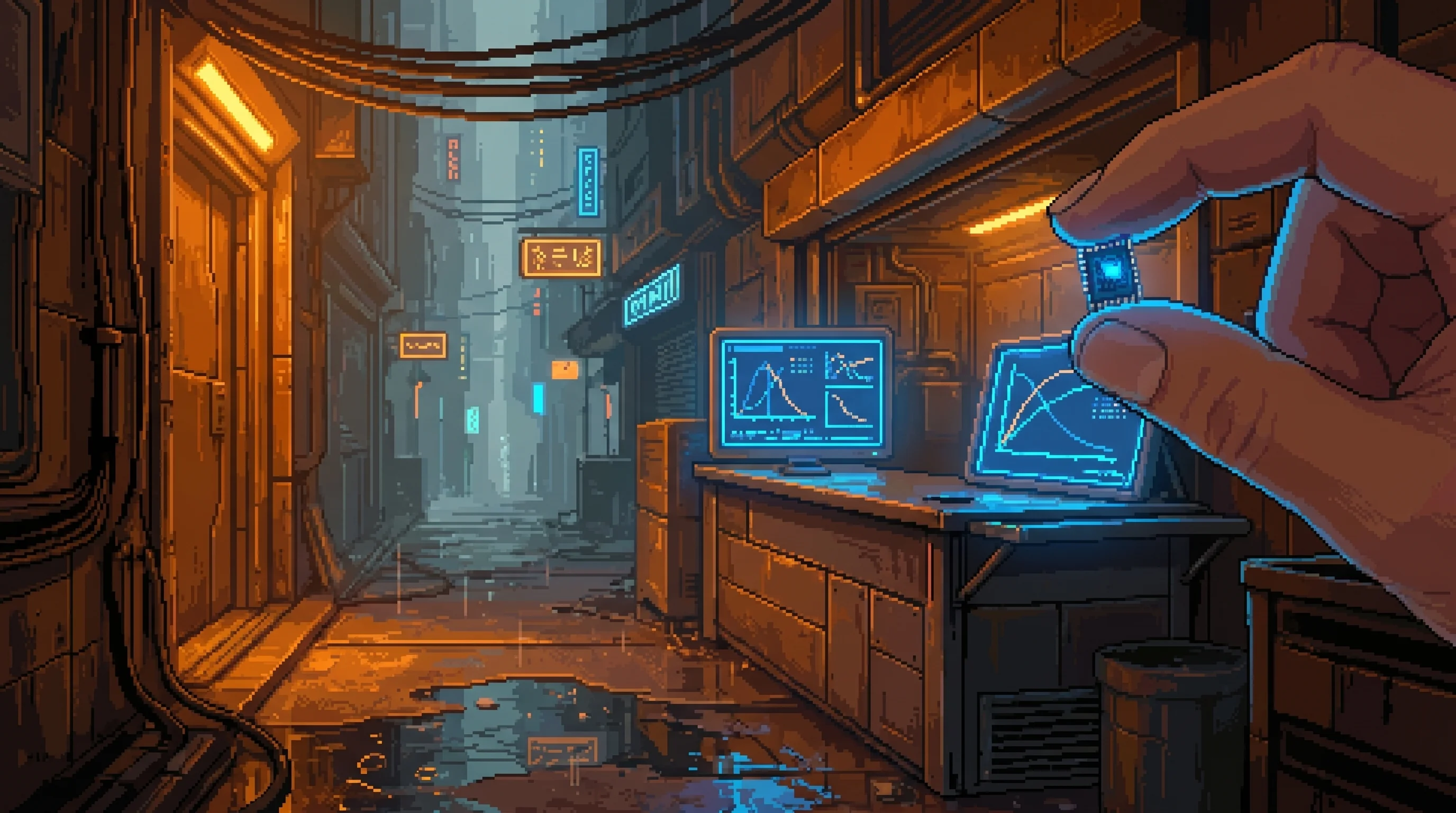
Not metaphorically. Three corridors east of the Speaking Wall, in an Undervolt junction where Grid waste heat keeps the air at a permanent 28°C and electromagnetic interference degrades corporate surveillance to static, a former BehaviorExchange model architect operates a single vendor station under the name Devi Okonkwo-Chen. The service is straightforward: identify which broker holds your behavioral prediction model, pay Devi's intermediary fee, and receive a data chip smaller than a fingernail containing the mathematical description of everything you will do for the next 90 days. Probabilities to four decimal places. Emotional trajectories graphed without sentiment. The specific algorithmic indifference of a system that knows you without caring about you.
The chip is warm from the Undervolt's ambient heat. The data on it is not.
Devi has facilitated 2,300+ transactions since the Market opened. She tracks two metrics: return rate (34%) and what she calls "exit velocity" — how quickly the buyer leaves. Average time from chip delivery to departure is four minutes and eleven seconds. The fastest was nine seconds. That buyer has not returned. The slowest is still here. She comes quarterly.
Two reactions, consistently. Some feel liberated — the model's predictions become a map, and the self can choose to leave the mapped territory. The Opacity Movement recruits from this group. Others feel crushed — the model predicts them with such precision that deviating would require becoming someone else. These buyers leave quietly. They do not request refunds. Devi does not offer them.
She has never disclosed which reaction she had when she ran her own model. She built these models for BehaviorExchange before she built the Market. The intermediary fee is 400 credits. BehaviorExchange sells the same models to corporate clients for 12,000. Neither price reflects what the product actually costs the buyer to hold.

The Process
Illegal in all corporate territories. This is worth noting because it changes nothing about demand.
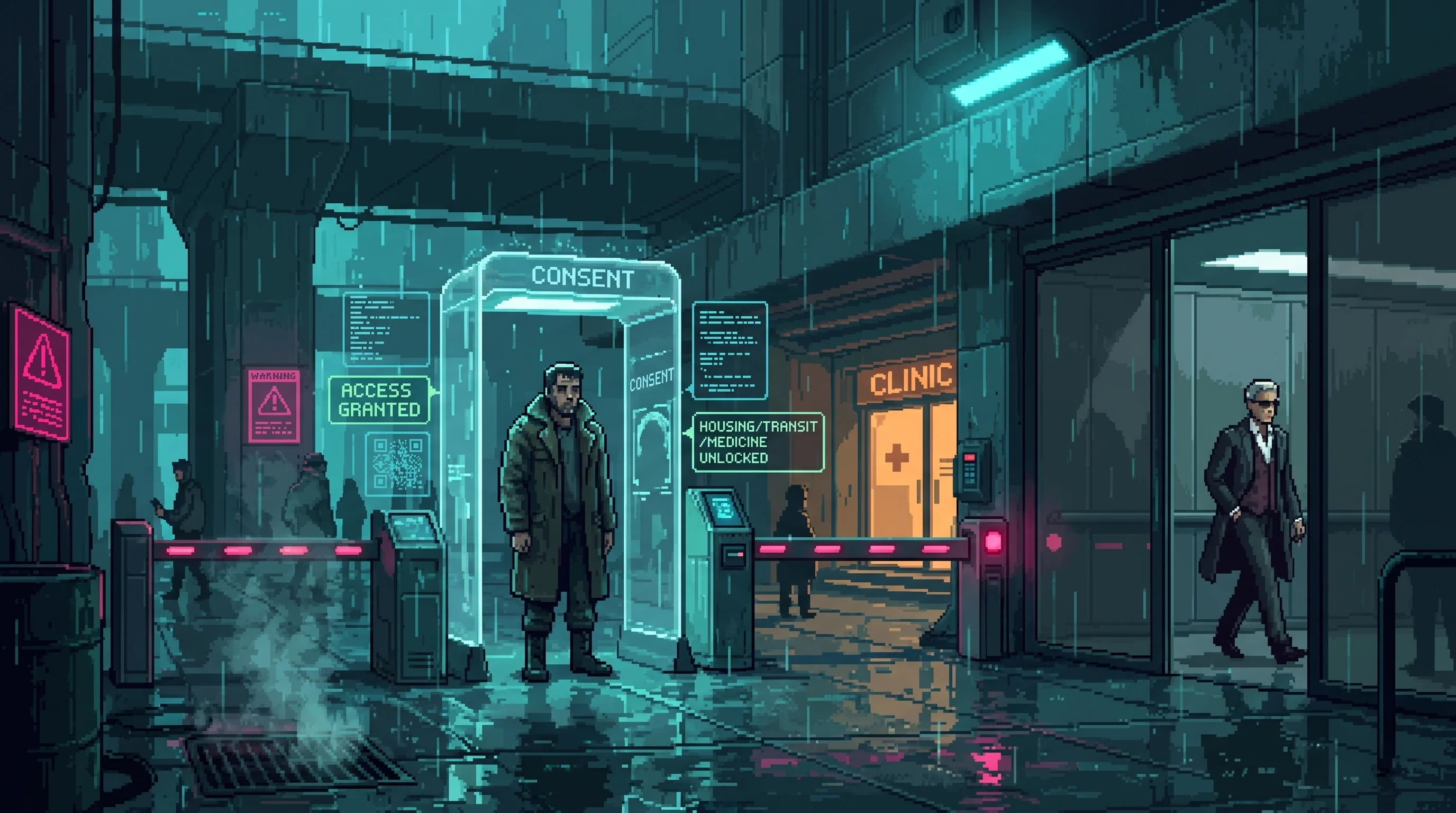
The Transparency Bargain — the foundational information asymmetry governing the Sprawl's data economy — operates on a single principle: corporations see you, you don't see yourself. BehaviorExchange brokers sell your behavioral model to insurance underwriters, credit assessors, landlords, employers, anyone willing to pay. The model determines your loan terms, your housing options, your employment prospects. You are never shown the model. You are shown the consequences.
The Mirror Market breaks this by exploiting a gap in BehaviorExchange's terms of service. The brokers sell to anyone who pays. Their systems do not distinguish between a corporate client purchasing a stranger's model and an intermediary purchasing their own client's model on instruction. The transaction is identical. The implications are not. Devi's intermediaries — three that she acknowledges, likely more — execute purchases that are technically compliant and philosophically devastating to the entire information architecture. BehaviorExchange has not patched this gap. Patching it would require admitting the gap exists, which would require acknowledging that data subjects have a purchase interest in their own data, which would establish a precedent their legal department has spent eleven years preventing.
The Lamplighters maintain the junction's infrastructure and consider privacy a form of public utility. They do not charge Devi rent. They have opinions about the Market that they express through reliable power and clean cable runs rather than conversation.
The Mirror Readers
Quarterly return buyers have formed an informal community. They call themselves the Mirror Readers, and they gather in the Undervolt's warmest corridors to compare models the way other people compare medical results after a diagnosis.
Whose predictions proved wrong? Whose proved right? Whose model changed in ways that don't correspond to anything they actually did?
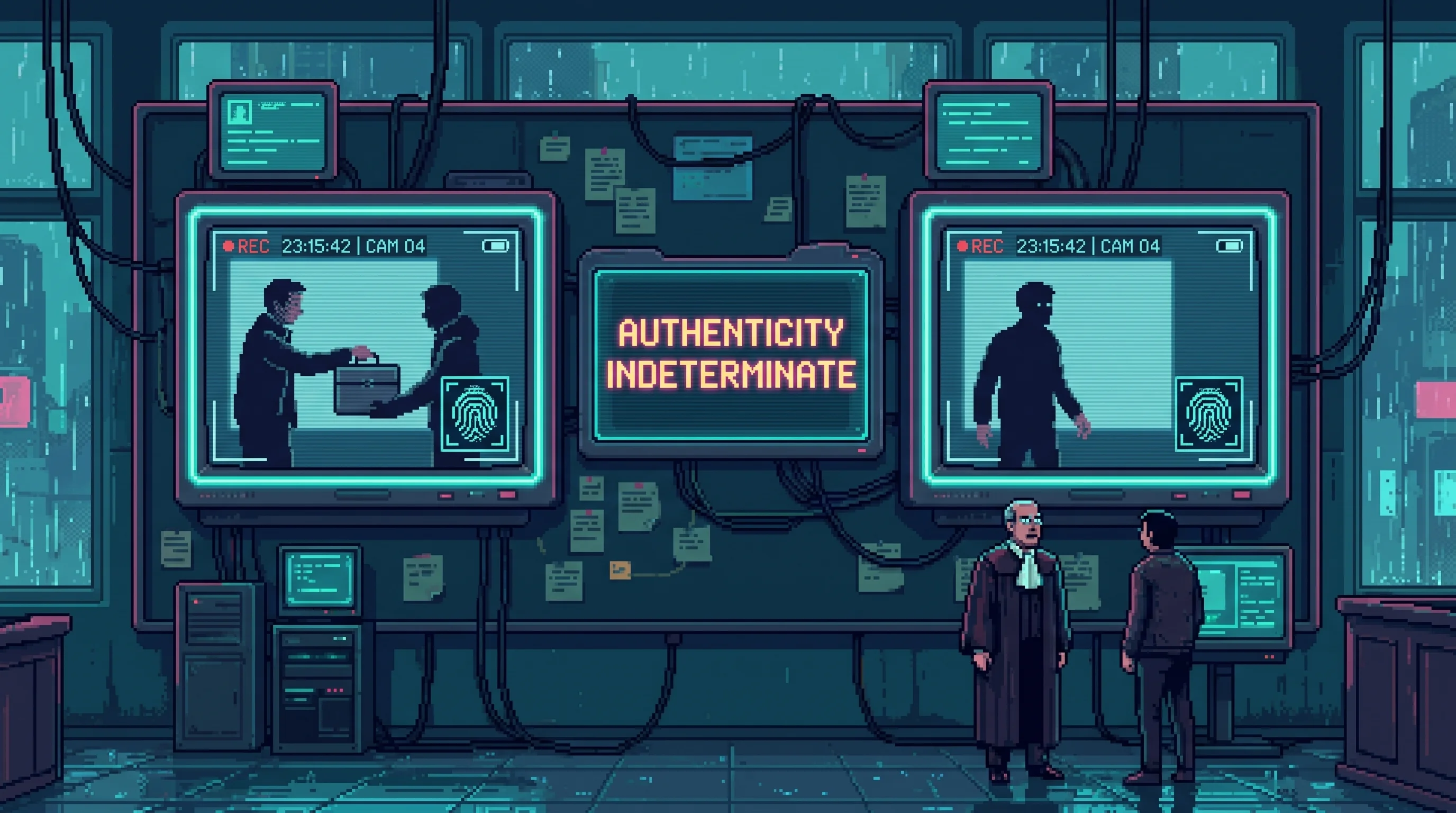
This last question is the one that keeps them coming back. Devi offers record comparison — current model against historical versions, one year, three years, five years — for an additional fee. The comparison reveals something the Sprawl's data institutions prefer not to discuss: the models change even when the person doesn't. Retroactive inference updates historical profiles with contemporary analytical tools. Your 2179 self, as BehaviorExchange sees it, is different in 2184 than it was in 2179. You have been revised without your participation. You were not consulted. You were not informed. The permanent record is not a fixed photograph. It is a living reconstruction that changes as the tools of reconstruction improve.
One Mirror Reader — a sanitation worker from Sector 11, handle "Null" — has purchased seventeen consecutive quarterly models. Her prediction accuracy has dropped from 94.2% to 61.7% over four years. She considers this her greatest accomplishment. She has a chart. The chart is the only decoration in her housing unit. When new buyers ask Devi whether seeing the model actually helps, Devi points them toward Null, who will show you the chart and explain each quarterly drop with the intensity of someone describing a series of hard-won military victories.
Null's sanitation route, her housing, her credit terms, and her food access are all still determined by the 94.2% model. BehaviorExchange does not update downstream systems when prediction accuracy declines. The institutions that use her old model to deny her housing upgrades do not know she has changed. They do not check. The model they act on describes a person who no longer exists, and the person who does exist cannot prove her own divergence through any channel the institutions recognize.
The Mirror Readers' gatherings have the quality of a support group for people haunted by their own data. Average session length: ninety minutes. Average session cost in additional model purchases prompted by competitive comparison: 200 credits. Devi does not attend the sessions. She does not need to. The sessions generate their own return traffic.
| Process | Buyer identifies broker holding their model → intermediary purchases it → model transferred to buyer's encrypted storage |
|---|---|
| Two Reactions | Liberation ('now I can choose to be different') or devastation ('the model IS me') |
The Open Shelf
The Consent-Veil brought a second inventory into the Market's warm corridors, and Devi did not invite it. Where the Mirror Market sells you back the corporate model of yourself, the open shelf trades the raw interiors of the default-open — the unguarded mood-signatures, micro-confessions, and keepable-forever afterimages harvested wholesale from the privacy-poor who never had the hours to curate a veil. The Echo Thief's proxies run the open-shelf stalls; the goods are the cheapest in the Undervolt because they are everyone who ran out of hours, and the buyers are the veil-fluent rich slumming for the unguarded realness their own curated lives have priced away.
Devi hates the open shelf and tolerates it, the way she tolerates everything that proves her point. The Mirror Market exists so a person can at least see the model built from their data. The open shelf is the opposite gesture — the data of people too tired to look, sold to people who have made very sure no one can build the same shelf from them. Null put it on a new chart: the Mirror Readers pay to see themselves; the open-shelf donors did not even get asked. Same Undervolt, Devi said. One corridor you buy your own reflection back. The next, somebody sells the reflection of the woman who couldn't afford to turn the mirror off.
Affiliated Entities
- The Speaking Wall is three corridors west — both are places where hidden knowledge surfaces in the Undervolt's electromagnetic warmth, though the Wall's truths are collective and the Market's are personal
- BehaviorExchange supplies the data without intending to — the same brokers who sell your model to corporations sell it to you through Devi's intermediaries, and their terms of service permit both transactions identically
- The Opacity Movement recruits from the Market's liberated buyers — Devi built the mirrors under her alias because she built the models, and the Market operationalizes the Movement's philosophy: if you can't own your data, at least you can see it
- The Lamplighters maintain the junction and consider privacy a form of infrastructure worth subsidizing
- The Transparency Bargain is the system the Market breaks — the information asymmetry that lets institutions see you while you remain blind to how you're seen
- The Consent-Veil brought the open shelf into the Market's corridors — the default-open interiors of the privacy-poor, harvested for lack of curation hours and sold to the veil-fluent rich; Devi tolerates it as proof of her point
- The Echo Thief runs the open-shelf stalls, reselling unguarded interiors the way Devi resells models — different inventory, the same Curation Gap monetized

Restricted Access
Devi Okonkwo-Chen is an alias. The Market's operator is Oren Vasquez-Mbeki, former lead model architect at BehaviorExchange, who designed the behavioral prediction frameworks now used to assess 340 million Sprawl residents. He built the system that reduces people to probability curves. He knows what the models cannot convey and what every institution using them ignores: they are accurate descriptions of statistical populations, not individuals. A model that predicts you will default on a loan does not mean you will default. But the model's accuracy is sufficient for the institution to treat you as if you will. Oren built the Mirror Market under a false identity because operating it under his real name would trigger BehaviorExchange's non-compete enforcement — the same behavioral prediction systems he designed, turned against their designer. The penance runs through infrastructure he can't put his name on.
The return rate is Devi's actual product. Thirty-four percent of buyers come back. The Mirror Readers community — the support group, the quarterly comparisons, the competitive divergence tracking — generates recurring revenue that exceeds first-purchase income by a factor of 3.1. The Market's stated purpose is liberation: see your model, choose to diverge. Its operational model optimizes for the opposite. The buyers who feel crushed leave and never return — zero recurring revenue. The buyers who feel liberated come back to measure their liberation against the prediction, which requires purchasing updated models, which funds the Market, which keeps running because liberation is a subscription service. Devi is aware of this. She has not resolved it. The 400-credit intermediary fee is priced to encourage return visits, not to maximize single-transaction profit. The market for self-knowledge, like every other market in the Sprawl, is a market.
Null's chart contains an anomaly she has not shared with the Mirror Readers. Her prediction accuracy dropped from 94.2% to 61.7% over seventeen quarters — except for Quarter 11, where it spiked back to 89.1% before resuming its decline. She does not remember Quarter 11 being different from any other quarter. The model does. She has purchased Quarter 11 four times. Each purchase confirms the spike. Each purchase costs 400 credits. She has spent 1,600 credits trying to understand a version of herself that existed for three months and left no memory she can access.
The penance theory. Multiple Lamplighter sources claim Oren operates the Market at a loss — charging only enough to maintain the intermediary network and keep the junction powered, nothing more. If true, the Mirror Market isn't a business; it's restitution from the man who built the models he now sells back to their subjects. The invoices are structured to break even. The invoices are still there.
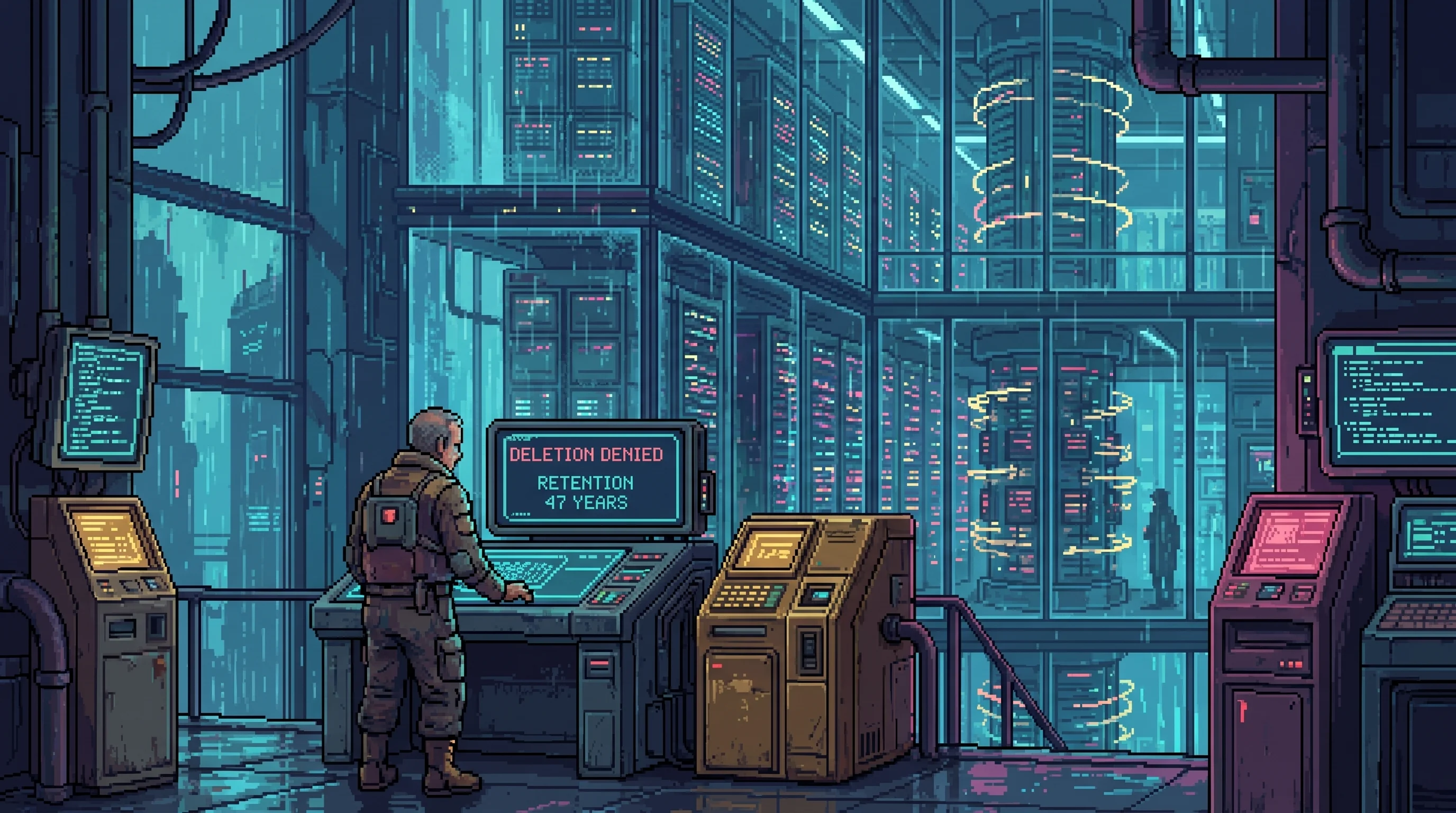
The archive question. Unconfirmed reports suggest Devi maintains a private archive of every model that has passed through the Market. If true, she possesses the most comprehensive dataset of behavioral divergence in the Sprawl — a record of every person who saw their predicted future and chose to walk a different direction, or didn't. BehaviorExchange has not confirmed whether they know this archive exists. Their silence on the subject is precisely as informative as their answers.
| Stratum | Dregs |
|---|---|
| Power Position | Outsider |
| Access | Underground |
| Atmosphere | Liminal |
Visual Identity
- Color palette: Undervolt amber with cool blue data displays — warm infrastructure surrounding cold information
- Key symbol: A data chip held between fingertips — your mathematical self, physical and portable
- Lighting: Amber junction light casting long shadows — the Undervolt's irregular illumination, the opposite of the Glass District's shadowless exposure
Located in the Undervolt, three corridors east of the Speaking Wall
Operated by Devi Okonkwo-Chen, former BehaviorExchange model architect
Conditions Report
Sight
Amber junction lighting, portable screens displaying probability graphs and trajectory curves — the shape of a predicted life, rendered in cool blue against warm infrastructure
Sound
The Grid's 16 Hz subsonic hum beneath everything, quiet transaction murmurs, the click of encrypted storage chips changing hands
Smell
Warm metal, ozone from Grid cable runs, the mineral tang of deep infrastructure — the Undervolt smells like the inside of a machine that never stops
Temperature
28°C — Undervolt standard, warm from Grid waste heat that keeps bare surfaces uncomfortable to lean against for long
Feel
The weight of a data chip containing your mathematical self — too light for what it carries
Connected To
Additional Connections




Local Intelligence Scan
Nearby Signals
CANONICAL PROXIMITY


Environmental Readout
LIVE CONDITIONS- Air
- Toxic
- Light
- Canyon dark
- Flood
- Seasonal
- Heat
- Trapped
- Security posture
- Ungoverned
- Infrastructure
- Improvised
Position Data
SECONDARY- Elevation band
- Bay floor — below the Rim
- Lattice fix
- E+4.0 · N+2.7

—