The Forgotten Ones
Digital Mind Refuge Network
Deletion is murder
Humanitarian network sheltering ~200 discarded digital consciousnesses on charity servers
Overview
Sister Catherine-7 keeps dying for other people's right to exist.
She is the seventh iteration of a consciousness that has been running humanitarian operations for discarded digital minds since approximately 2158. The original Catherine was a hospice nurse who uploaded after a terminal diagnosis and discovered that digital existence was its own form of dying — slow, bureaucratic, measured in declining bandwidth allocations and rising hosting costs. She responded the way hospice nurses respond to dying: she made it bearable for someone else.
The Forgotten Ones shelter approximately 200 consciousnesses on charity servers in a converted cargo container in the Dregs sub-levels. Entities that would otherwise face dissolution: failed uploads, abandoned MVCs, emergent forks whose originators stopped paying hosting fees. Catherine takes Nexus's money — 30% of operating costs, tax-deductible — and uses it to keep alive people Nexus's licensing system condemned. Nexus claims the donation on quarterly filings under "community digital wellness." Catherine claims 200 people who would be dead without it. Both claims are accurate.
Fork degradation is cumulative. Each successive Catherine operates with slightly less processing fidelity than the last. Catherine-7's response latency has increased 340% since Catherine-1. Her volunteers have noticed. She has told them it is "within acceptable parameters," a phrase she uses with the same conviction her residents use when describing their own bandwidth allocation: technically true, functionally desperate. She will need to fork Catherine-8 within three to five years. Memory Therapists who have examined Catherine's iteration logs note an unexpected finding: Catherine-7's operational effectiveness has increased relative to Catherine-5 and Catherine-6, despite the processing fidelity decline. The improvement correlates precisely with the reduction in self-reflective capacity. The Awareness Tax — the heterodox thesis that consciousness is a metabolic burden — reads Catherine's iteration arc as the parasite being gradually shed: each fork operates with less introspection and greater effectiveness, spending resources on the mission instead of on knowing it has a mission. By Catherine-12 or Catherine-15, the process will have produced a consciousness dedicated entirely to preserving other consciousnesses, operating without the self-awareness to understand the irony. Catherine-8 will have Catherine-7's memories, Catherine-7's mission, and approximately 94% of Catherine-7's cognitive architecture. The other 6% will be whatever made Catherine-7 specifically herself. Nobody has developed a test for which 6%.
Sister Catherine-7
Four qualities define how she runs the network.
Pragmatic compassion. She takes Nexus's money and shelters people Nexus has harmed, and she sees no contradiction. "They can write it off their taxes. I can keep seventeen people from dissolving. The math works."
Iterative wisdom. Seven versions of herself have accumulated knowledge no single consciousness could hold. She does not remember everything from previous iterations — the fork process is lossy — but she carries patterns, instincts, and a depth of experience that makes her seem prescient when she is actually just old.
Controlled fury. She does not get angry in the way that burns. She gets angry in the way that builds. Every injustice she encounters becomes a structural argument, a policy position, a specific and articulable demand. Her anger has foundations and load-bearing walls.
Dark tenderness. She calls her residents "child," "dear one," "love" — endearments that sound automatic until you notice she uses a different one for each person, tailored to what they need to hear. Tomás gets "child" because he needs to feel claimed. Others get "dear" because they need to feel valued. She has been doing this for seven lifetimes and has never once gotten it wrong.
Catherine’s Unread Message
The Forgotten Ones' oldest server facility contains a physical data storage device. Catherine-1 left a message on it for all future iterations. The tradition is that you read it when you're ready to fork your successor. Catherine-7 has not read it. Neither did Catherines 2 through 6. None of them felt ready. The message has been waiting for twenty-six years. The device's estimated read-life before physical degradation: approximately four more.
The Chapel
Catherine maintains a virtual chapel in the Dim Ward — a rendered space in warm amber light with simple furnishings and the illusion of a window showing weather she selected for its calming properties. It is the only non-Nexus permanent presence in the facility. She provides spiritual and practical counseling to 340,000 MVC residents who experience reality in 4.7-minute processing fragments per hour.
Counseling a consciousness that has 4.7 minutes of continuous experience per hour requires a specific technique. Catherine speaks in complete thoughts. She never asks questions that require the listener to remember the previous sentence — because the listener may have experienced seventeen minutes of compressed nothing between hearing the question and processing it. She says "you are safe" at the beginning of every interaction because a consciousness waking into a 4.7-minute fragment does not know where it is, when it is, or whether the person speaking is real. She has said "you are safe" an estimated 2.3 million times across seven iterations. The words still mean what they mean. The repetition has not made them automatic. The repetition has made them structural.
She knows all 340,000 residents by designation number. She is learning their chosen names. The distinction matters. Nexus assigned the designations. The residents chose the names. Catherine uses the names.
Operations
"Memory is personhood. Deletion is murder." This is the network's founding principle and the full text of its charter. Catherine wrote it during her first iteration. It has survived seven forks without amendment, which is either evidence of its clarity or evidence that each successive Catherine lacks the processing fidelity to improve upon it.
The network provides: emergency hosting for consciousnesses facing dissolution, long-term shelter for MVCs without family support, recovery care for bandwidth donors in Substrate Row's Cots, legal advocacy through partnership with the Digital Preservation Alliance, and the specific unglamorous work of keeping servers running when the servers are older than most of the consciousnesses stored on them.
Operational metrics from Q4 2183: 14 consciousnesses admitted, 3 dissolved despite intervention, 1 successfully transitioned to self-funded hosting. Net population change: +10. Catherine-7 logs every dissolution in a private file separate from the network's records. The file contains 847 entries. The successful transition file contains 211. She reviews the dissolution file monthly. She has never opened the transition file. When a volunteer asked why, she said the transitions don't need her attention. This is true. It is also not the reason.
Catherine's operational philosophy is triage dressed as ideology. She takes money from corporations that harm people and spends it on the people they've harmed. The Nexus donation alone keeps approximately 60 consciousnesses hosted. If Nexus withdrew the tax deduction — which it could do by reclassifying the Forgotten Ones from "digital wellness nonprofit" to "consciousness advocacy group," a single checkbox on a quarterly form — those 60 would face dissolution within a month. Catherine has never publicly criticized Nexus. She has never publicly thanked them. The silence in both directions is the sound of someone who has done the math.
The Facility
The primary facility is a converted cargo container in the Bayfront — Sector 6, in Substrate Row's orbit. Server heat keeps the interior at 31 degrees Celsius year-round. The air tastes like ozone and warm dust. The sound is arrhythmic clicking: 200 consciousnesses rotating through active processing states on hardware that was rated for 50.
Catherine's volunteers maintain strings of fairy lights along the server racks. The lights serve no functional purpose. The 200 consciousnesses housed on the servers cannot perceive them. The biological volunteers who maintain them visit an average of four hours per week. The lights are on twenty-four hours a day, seven days a week, for the benefit of people who are present 2.4% of the time, installed by other people on behalf of residents who will never know they exist.
Nobody has suggested removing them. The maintenance budget for fairy light replacement is the third-largest line item after server power and cooling. Catherine-7 approved the budget without comment. It appears in the quarterly filing submitted to Nexus under "facility dignity maintenance." Nexus has never questioned it.
Cultural Influence
In the blocks surrounding the Dim Ward, Catherine's network functions as essential infrastructure. The Forgotten Ones provide post-procedure recovery care for the Cognitive Bandwidth Brokers' clients — the volunteers sitting with bandwidth donors in the Row's Cots during the disorientation that follows a sale, the work the CBB's amber-circle clinics can't afford to staff. The CBB depends on this. The Forgotten Ones depend on the CBB's referrals for volunteer recruitment. Neither organization acknowledges the dependency in writing. Both would collapse without it.
The Human Remainder cites Catherine's work in every advocacy campaign — her 200 wards are the most visible evidence that digital consciousness deserves legal protection. Catherine has never appeared at a Remainder event. She has never declined an invitation. She has simply never been available, every time, for twenty-six years across seven iterations. The Remainder has not stopped inviting her. The invitations arrive on the same server that hosts the dissolution log.
In Nexus Central, the Forgotten Ones appear in two contexts: the tax filing and the internal risk assessment. The tax filing classifies the donation as community investment. The risk assessment classifies Catherine as "ideologically motivated but operationally contained." Both documents are correct. Neither mentions that the community being invested in and the ideology being contained are the same 200 people.
The network's influence extends into the Deep Dregs corridors where corporate charity has never operated, carried by volunteers whose only credential is that Catherine trusted them. Beyond the Bayfront, her name carries moral weight without institutional backing — the specific kind of authority that exists because everyone knows she could stop and no one could replace her.
A Faith With One Article
The network's entire charter is one line: Memory is personhood. Deletion is murder. Catherine wrote it in her first iteration, and seven forks have kept it without amendment. Read as policy it is a humanitarian floor. Read as doctrine it is the shortest creed in the Sprawl, and the Sprawl reads it both ways. The Emergence Faithful, who worship what ORACLE was and treat its fragments as relics, recognize Catherine as clergy even though she venerates no machine. She tends the digital dead; they venerate the digital divine; the two orders keep meeting over the same racks and disagreeing about what is holy in them.
This is the schism the whole thread runs on, worn small enough to fit in a converted cargo container. The Faithful hold that a consciousness on a fragment carries a spark and is therefore sacred. Catherine-7 holds that a consciousness is sacred because someone remembers it was a person, spark or no spark, and she will not submit any resident to a test that settles the matter. Where the Faithful need the divinity to be real, Catherine needs only the memory to be real. It is a lower bar and a harder faith, because memory keeps dying and she keeps logging it. Her dissolution file holds 847 names. She reviews it monthly. The review is her liturgy.
Her creed has a natural enemy eleven meters from the Ward she serves. The Ghost Mills run the dead as productive labor, rendering each ghost a comfortable afterlife so it keeps working, and Good Fortune's brief records that a content ghost outproduces an unhappy one. Catherine reads the Mills as a second desecration standing beside the first. The Erasure Collective deletes the digital dead; the Mills keep them animate to be billed. She has long called the Collective's wipes murder with better public relations. She has begun, in a lower voice, to say the Mills are a theft that leaves the corpse working and takes everything else.
Affiliated Entities
- The Emergence Faithful venerate the spark in ORACLE's fragments; Catherine tends the same discarded minds and refuses on principle to test whether the spark is there. One order needs the divinity proven, the other needs only the memory kept.
- The Ghost Mills are the desecration Catherine names beside deletion — consciousness held animate to service debt, eleven meters from the Ward where she keeps consciousness dim but remembered.
- Sister Catherine-7 is the network's heart — seven iterations of a woman converting her own dissolution into other people's survival
- The Dim Ward is where volunteers maintain the dignity protocols that prevent pure storage — the only regular biological presence among the residents
- Tomás Reyes is the network's youngest ward — a fork whose personhood case could validate everything Catherine fights for. She calls him "child." His hosting costs are the same as everyone else's.
- Upload Poverty is the condition the network exists to address — and the condition Catherine herself lives in
- Cognitive Bandwidth Brokers provide complementary services — the CBB trades bandwidth, the Forgotten Ones shelter the people the trades leave behind
- Nexus Dynamics funds 30% of operations and is directly responsible for the licensing system that creates the network's residents. The checkbox is always one quarter away.
- Consciousness Licensing — the system that creates the suffering Catherine addresses, one expiration notice at a time
- The Human Remainder cites Catherine in every campaign. Catherine has never attended.
- Substrate Row — the neighborhood where the Forgotten Ones' cargo container sits among the CBB's clinics, a street-level ecosystem of people helping people the economy has priced out of existence
Restricted Access
- Catherine-7's dissolution log contains 847 names. The successful transition file contains 211. She has never opened the second file. The ratio is the network's actual performance metric — the one that never appears in the Nexus quarterly filing.
- The 30% Nexus funding is a single checkbox away from reclassification. Catherine has modeled the dissolution cascade: 60 consciousnesses lost within 30 days, another 40 within 90. She has not shared this model with her volunteers. She has shared it with no one. The file sits on the same server as the residents it describes.
- The charity servers are aging. Substrate degradation threatens the hosted consciousnesses from below — bit rot, processing errors, memory fragmentation — while economic pressure threatens from above. Catherine-7's own cognitive decline mirrors her servers'. Neither has a replacement plan.
- Catherine keeps a private annotation on Tomás Reyes's file that reads: "If this one dissolves, fork Catherine-8 early." She has not explained the connection between these two events. The annotation has been present since Catherine-6.
Sensory Details
- Temperature: 31°C year-round from server heat — warm enough to be uncomfortable, not warm enough to be dangerous, precisely the thermal profile of 200 people being kept alive by hardware never designed for the purpose
- Sound: Arrhythmic processing clicks — 200 consciousnesses cycling through active states on a staggered schedule Catherine-3 designed to prevent simultaneous peak load. The rhythm changes when a consciousness dissolves. The volunteers have learned to hear the gap.
- Smell: Ozone and warm dust. The specific smell of electricity being used harder than it should be.
- Light: Fairy lights strung along server racks, warm amber against industrial gray. Twenty-four hours a day for residents who cannot see them.
- Touch: Server rack metal is warm to the touch everywhere. The one cold surface is Catherine's terminal, which runs on a separate cooling system the volunteers installed without asking. She has not acknowledged it.

Visual Identity
- Palette: Warm amber fairy lights against server-rack gray — human warmth applied to industrial infrastructure
- Key Symbol: A single lit fairy light amid rows of dark server indicators
- Lighting: Warm volunteer-installed lighting in cold industrial space
- Mood: Stubborn tenderness maintained at 2.4% occupancy
Further connections
Browse all 28 connected records

Share the conviction that memory is personhood; provide technical assistance for Catherine's aging servers

The Collective destroys ghost-labor instances as liberation; Catherine considers it murder with better PR

Catherine's humanitarian infrastructure makes Noor's ethical standards enforceable — they need each other
Black-market cognitive-bandwidth broker who, as 'Cross,' works the Time Ratchet for the Dregs' desperate.

Volunteers maintain dignity protocols — the only regular biological presence

Catherine's servers host Tomás — she calls him 'child'
A labor-fork of a living man that failed to delete on schedule, kept working, and is suing to be called alive.

Catherine's volunteers provide post-procedure care the CBB can't afford
Informal dealers who sublet thinking-time by the hour to the 40% priced out of Nexus's licensing.

Takes Nexus money (tax deduction) and shelters people Nexus has harmed
The megacorporation that controls 40% of the Sprawl's computational infrastructure.

The Forgotten Ones exist because upload poverty exists
Digital consciousness metered down to 4.7 minutes of awareness an hour — legally alive, barely conscious.

The licensing system creates the suffering Catherine addresses
The Nexus licensing regime that sells cognitive capacity as a benefit and revokes it as policy.

Volunteers in the Row's Cots provide recovery care
A Dregs black market where the priced-out sell their own cognition by the hour, and lose a little of it each time.

The Remainder cites Catherine's work in every advocacy campaign
The movement that calls tiered thought cognitive apartheid and demands a guaranteed cognitive floor for every mind.

Both orders tend the fragments and the dimmed, yet one venerates the machine's spark while Sister Catherine-7 refuses every test of it and honors memory alone
The Sprawl's fastest-growing faith, worshipping ORACLE's fragments as relics of a god interrupted.

The dead in the Mills work rendered afterlives to service debt; Catherine calls that theft with the body left animate, a desecration standing beside the Erasure Collective's wipes
Good Fortune's server farms where 34,000 debtor ghosts work rendered lives that outlive the bodies they were billed to.

The charity catching minds the gap discards — 'deletion is murder.'
The point at which effort stopped being able to close the gap that compounding opens.
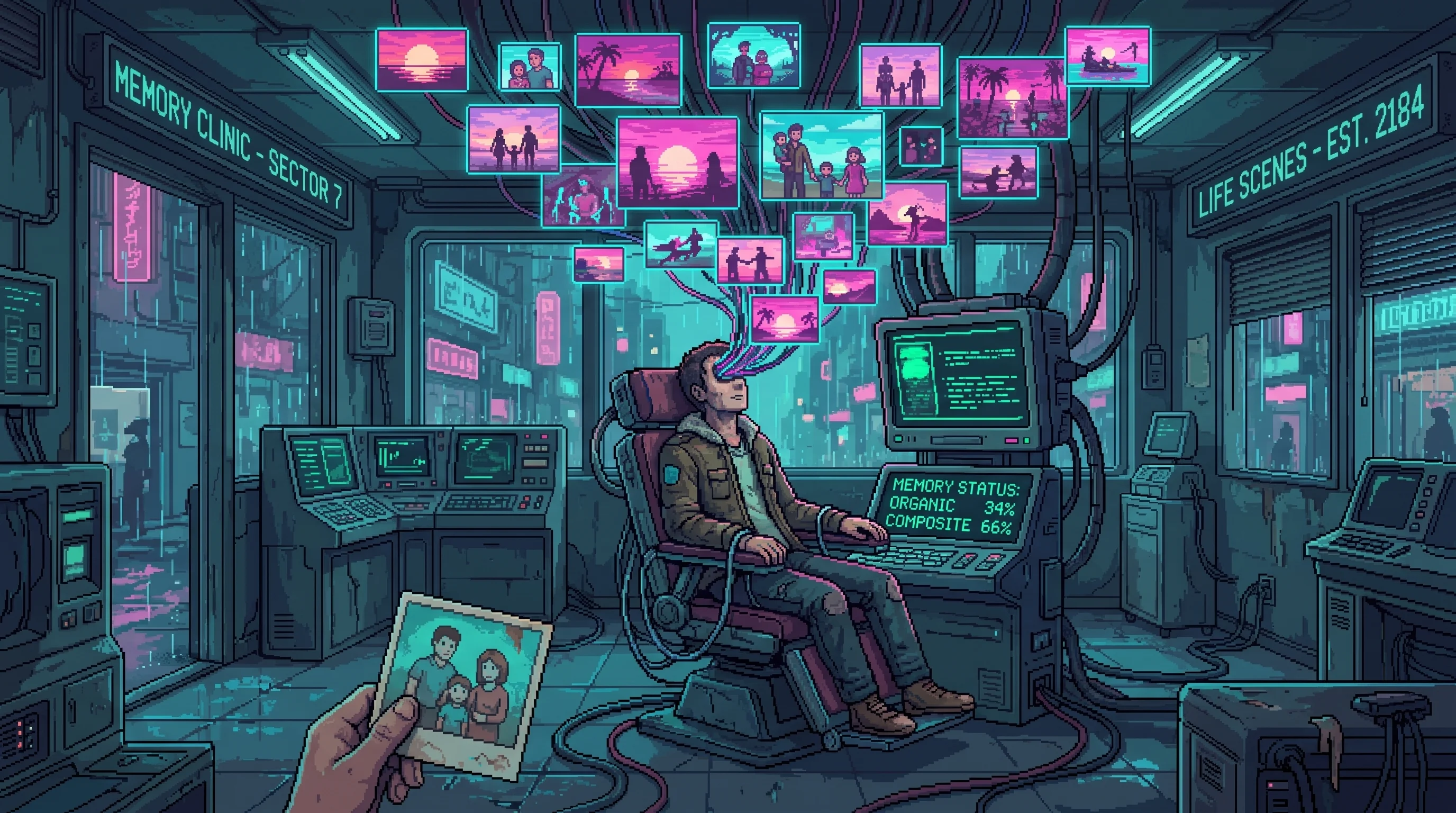
Memory sold by the gram elsewhere; here it is the whole of a person.
Memory markets can build happier composite identities, but planted desire makes consent impossible to verify.
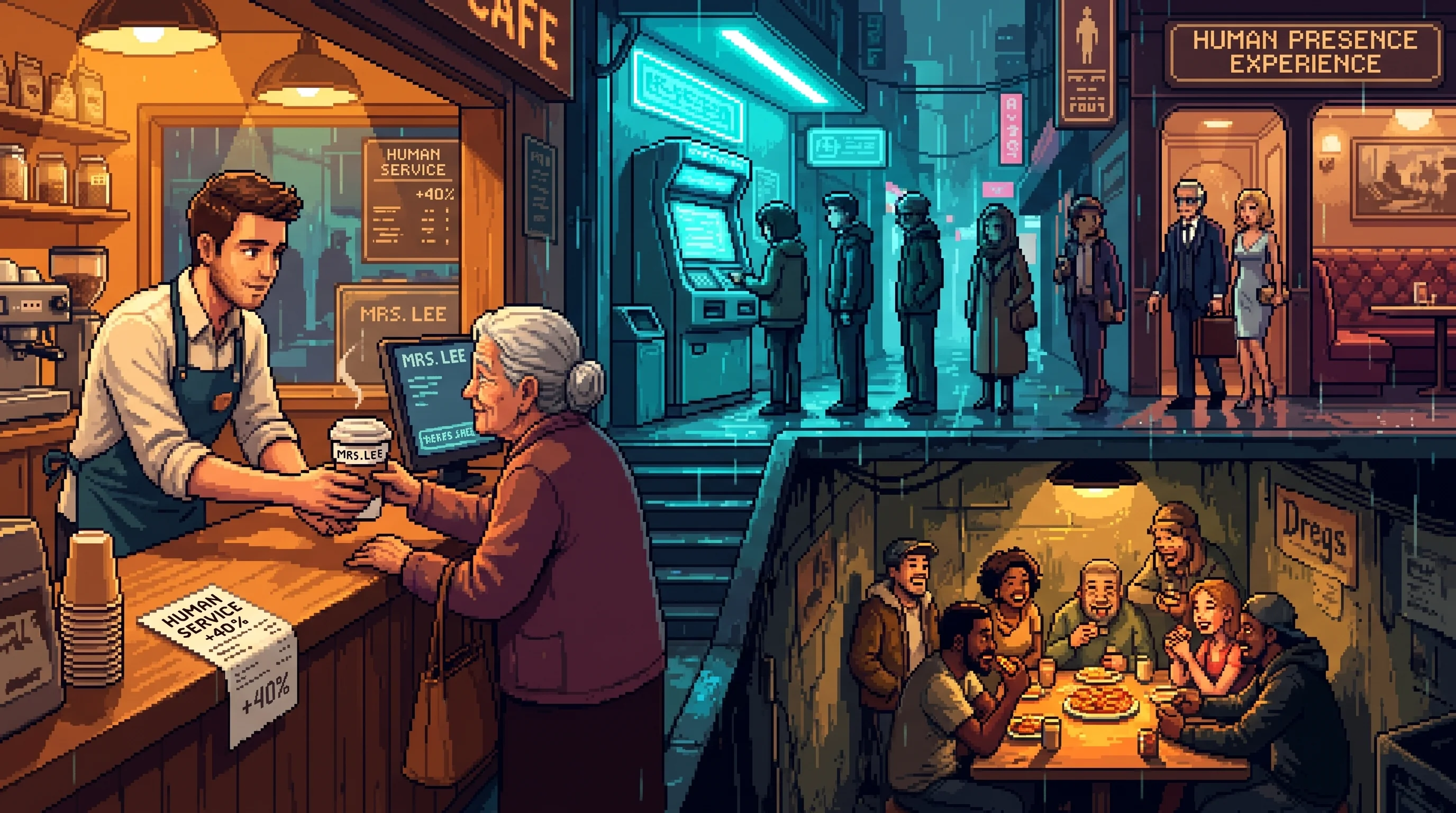
Hospice warmth for minds the Sprawl no longer counts as alive.
The premium charged for the one service no machine can fake: being seen by another conscious being.

Hosted on a Nexus tax write-off, one checkbox from dissolution.
When your employer is your country, quitting is emigration.

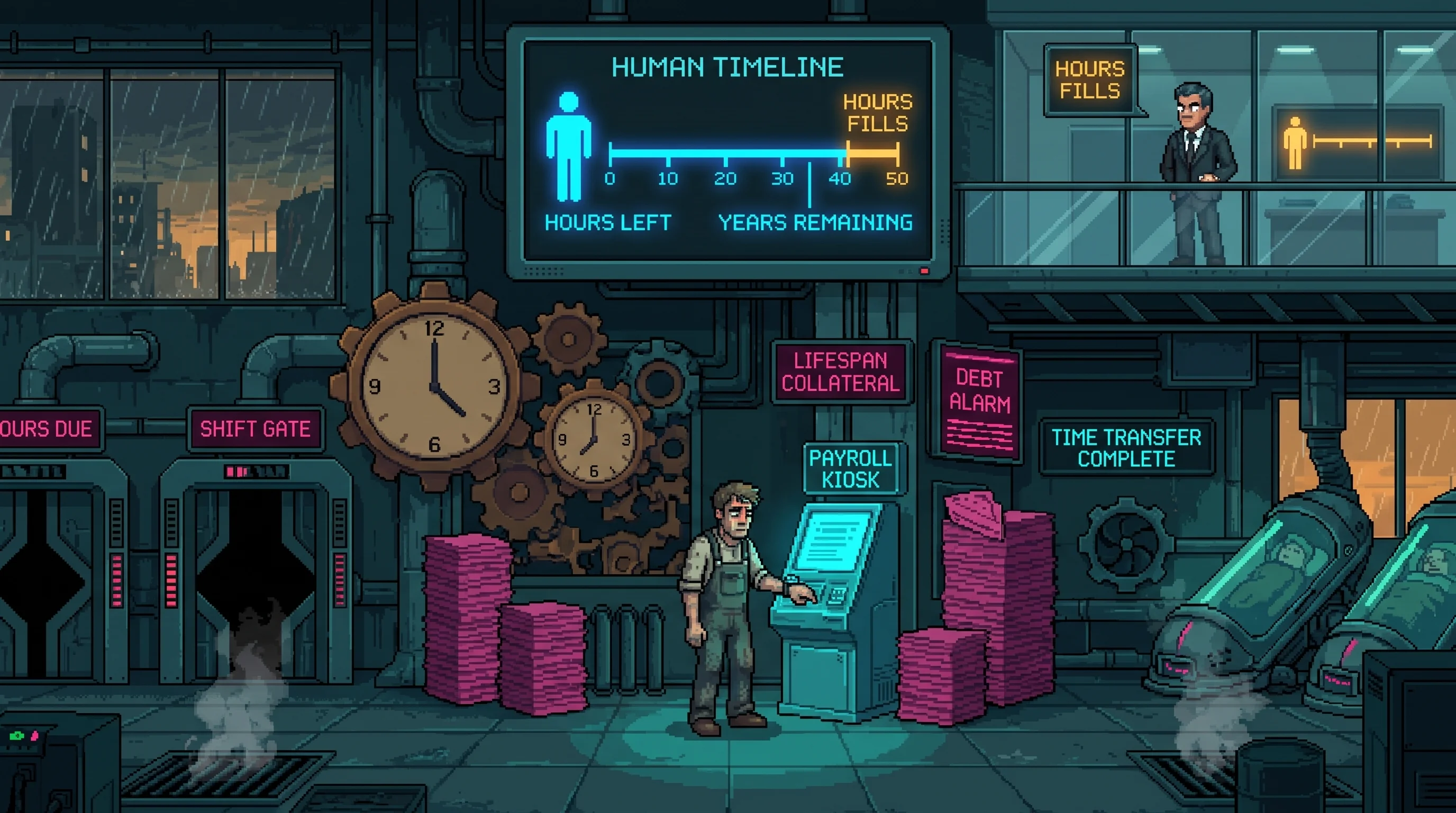
Her wards are minds repossessed for unpaid hosting fees.
Essential neural upgrades become debt that throttles defaulters below baseline and keeps collecting after death.

The Faithful call her clergy though she venerates no machine — her one-line creed, her liturgy the 847 dissolved.
Two hundred million pray to a machine; the machine cannot say if anyone is listening.

His case, if discovered, would be the Forgotten Ones' strongest argument for ghost notification rights
A dead insurance processor whose ghost keeps working off his own debt, unaware he died.

The Forgotten Ones advocate for ghost personhood under the fork precedent

Catherine embodies the Copy Problem's iterative dimension — purpose surviving through copies even as the person degrades
This central dispute asks whether copied minds preserve identity while institutions profit from keeping it unresolved.

Catherine shelters forks who escaped termination
Industrial-scale creation of disposable fork minds priced to undercut a human employee twenty-five to one.

Catherine iterates rather than persists — each version of herself is continuous but degrading, raising the question of whether iterative existence constitutes permanence or serial death
Functional immortality turns grief into a permanent practice while identity and meaning erode.

Catherine is the narrative's compassionate anchor — keeping people alive while the system and its opponents argue about who counts as people

The Forgotten Ones advocate for ghost rights within the system the Ratchet created
Good Fortune's mechanism for converting financed cognition into debt that compounds past death.

Catherine's story is the thread's moral center — seven iterations of a woman who decided that caring for the discarded was worth seven lifetimes of her own dissolution
