Counselors are trained to cite the queue position improvement at every session — the phrase 'proximity is not distance' appears in all Halcyon training materials as the standard response to a patient expressing desire to file for release
CeoDirector Selin YılmazSloganHold on. We'll bridge you there.Founded2168Employees~190,000
Scene ReferenceHalcyon Bridgeworks
Overview
Halcyon Bridgeworks does not cure diseases. It manages the gap between diagnosis and cure.
In 2184, a terminal diagnosis with a viable treatment trajectory — the patient's biology is compatible with a bespoke compound that Helix Biotech's Personalized Intervention Division can manufacture — means the patient does not die today. It means the patient is placed in a manufacturing queue. The queue resolves, on average, in fourteen months. Fourteen months is a long time to manage a terminal condition without pharmaceutical intervention. Halcyon Bridgeworks is what you pay to survive that fourteen months without actively dying.
The Hold-On Plan keeps terminal subscribers metabolically suspended — a managed not-quite-dying — while their bespoke compound clears the queue. Consciousness cycles down to intermittent orientation windows. The body is maintained. The disease is slowed. The bill runs monthly. And the compound is always, measurably, closer than it was.
When Director Selin Yılmaz founded the company in 2168, she was two years out from watching her father die in a hospice waiting room — a man with a viable treatment trajectory and a queue position that arrived three weeks after he did. She built Halcyon so that never happens to anyone else's father. She built it correctly. Halcyon works. The cure arrives. For patients who stay on the bridge, the treatment success rate is 71%.
The remaining 29% did not stay on the bridge. Some of them died in suspension before their compound cleared the queue. Some of them had their queue position expire due to elapsed manufacturing relevance and had to restart the process. And some of them — 4.3% of those who tried — successfully filed a Release Petition and chose to leave.
Product Lines
The Hold-On Plan is Halcyon's core product and the mechanism by which terminal care became a subscription service.
Enrollment begins at the Bridge Entry Assessment: a 72-hour period following terminal diagnosis where the patient meets with Halcyon counselors, reviews their treatment trajectory, and confirms enrollment in the Plan. The 72-hour window is designed to prevent impulsive decisions in either direction. In practice, the window is heavily counseled toward enrollment — the counselors are trained to emphasize queue positions, treatment success rates, and the emotional cost to families of premature release. The word "hospice" does not appear in Bridge Entry Assessment materials.
Once enrolled, the patient enters the Waiting Ward and the bridge state. Orientation windows — periods of managed consciousness — occur on a schedule calibrated to the patient's metabolic tolerance, typically every 96 hours. Each orientation window lasts between four and twelve minutes. During an orientation window, the patient can speak to family members, receive care updates from the attending counselor, and, if they wish, express a desire to file for release.
The Release Petition process — the formal mechanism for choosing to stop — is available to any enrolled patient. Its existence is disclosed during the Bridge Entry Assessment. Its full requirements are disclosed in section 14 of the enrollment documentation.
The Release Board
The Halcyon Care Board meets quarterly in the Corridor headquarters. It comprises twelve voting members: four Halcyon medical directors, four Halcyon patient advocates (whose performance is measured on sustained enrollment outcome rates), two independent medical ethics representatives (appointed by the Sprawl Medical Council, whose funding is partially derived from a Halcyon charitable gift), and two independent patient representatives (former Hold-On Plan enrollees, selected by the board itself).
The board reviews Release Petitions during its quarterly meetings. A petition is eligible for review only after both required counseling sessions are complete, which typically takes 45–90 days to schedule. The board's most common finding for denial: "meaningful progress" — defined as a 15% or greater reduction in compound queue position since the last review. The board finds meaningful progress in approximately 78% of reviewed petitions, because the queue does move, and fifteen percent of a large number is always achievable without being arrival.
After a denial, the patient may appeal. The appeal is reviewed at the next quarterly meeting, 90 days later. If the appeal is also denied, a mandatory 180-day reflection period begins. At the end of the reflection period, the patient may file again. The process, from first petition to successful exit, averages 6–8 months. During those months, the subscription continues.
The board is not composed of bad people. Every member believes they are preventing premature deaths. They are not wrong. Some patients who would have been approved for release are alive today because they weren't. The 71% treatment success rate includes them. What the board cannot count, because they don't have the data, is how many patients would have preferred not to be saved.
Public Notice
Hold on. We'll bridge you there.
“hold on”
“bridge period”
“meaningful progress”
“we'll get you there”
Halcyon Bridgeworks — official messaging
Visual Identity
Brand Palette
Cerulean (#4A9BB5) — water, movement, bridges, calm surfaces that carry things forward
Soft Gray (#E8ECEF) — clinical neutrality without sterility; the color of rooms that want you to stay
Bridge Ivory (#F5F9FC) — warmth at the edges; the color of good paper
Architecture
The Waiting Ward network is operated by Halcyon Bridgeworks across organized Sprawl medical districts and Heights medwings. Each facility is designed by firms that specialize in aspirational medical spaces. The patient pods are called berths — a nautical metaphor that the brand guide notes "evokes voyage, not confinement." Berth curtains are a soft cerulean. Family lounges have floor-to-ceiling queue displays that show the patient's position in a warm amber sans-serif font, with a gently animated progress indicator. The air is the Relief Corporation proprietary botanical blend. The furniture has no sharp edges. There are plants.
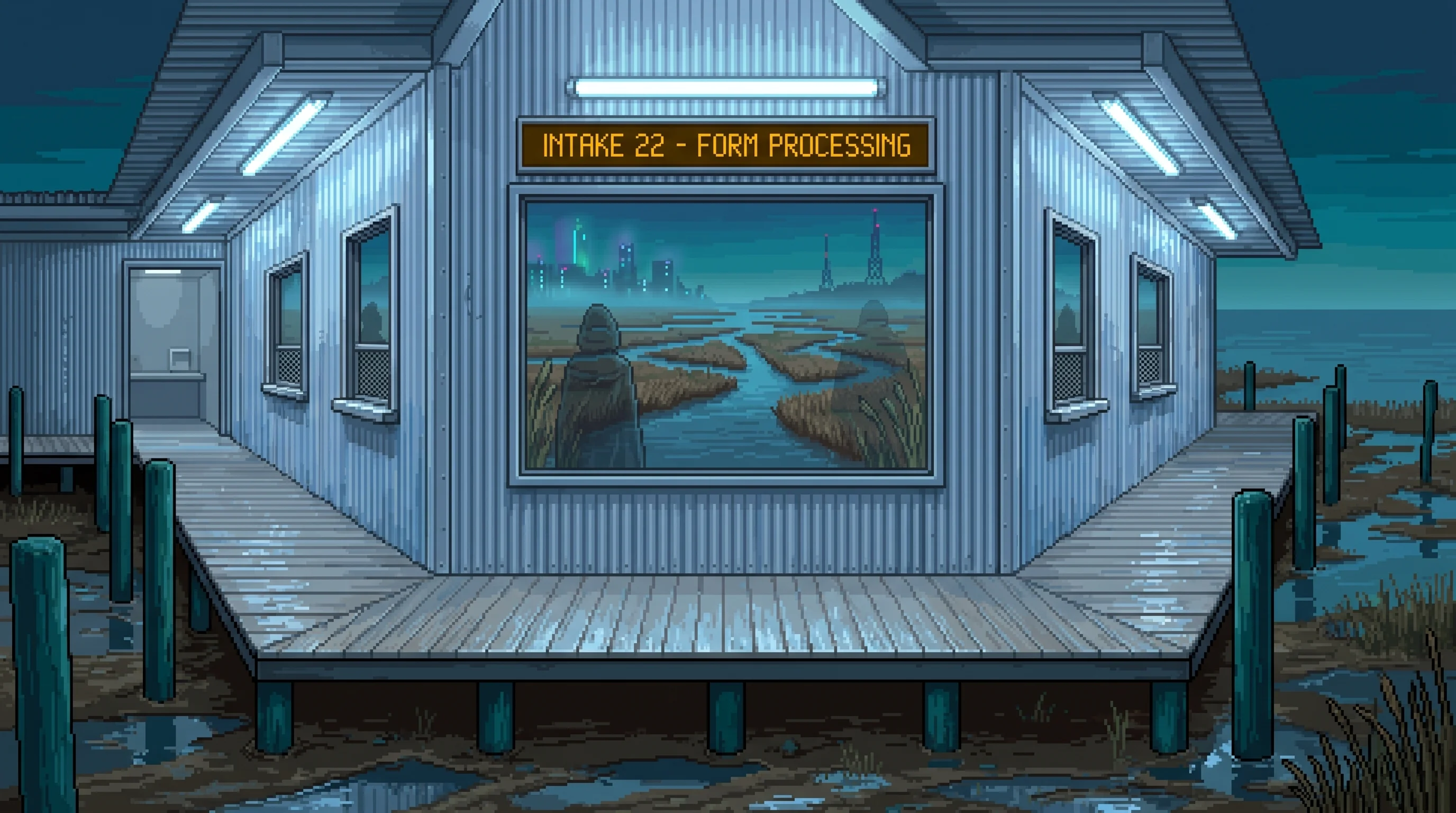
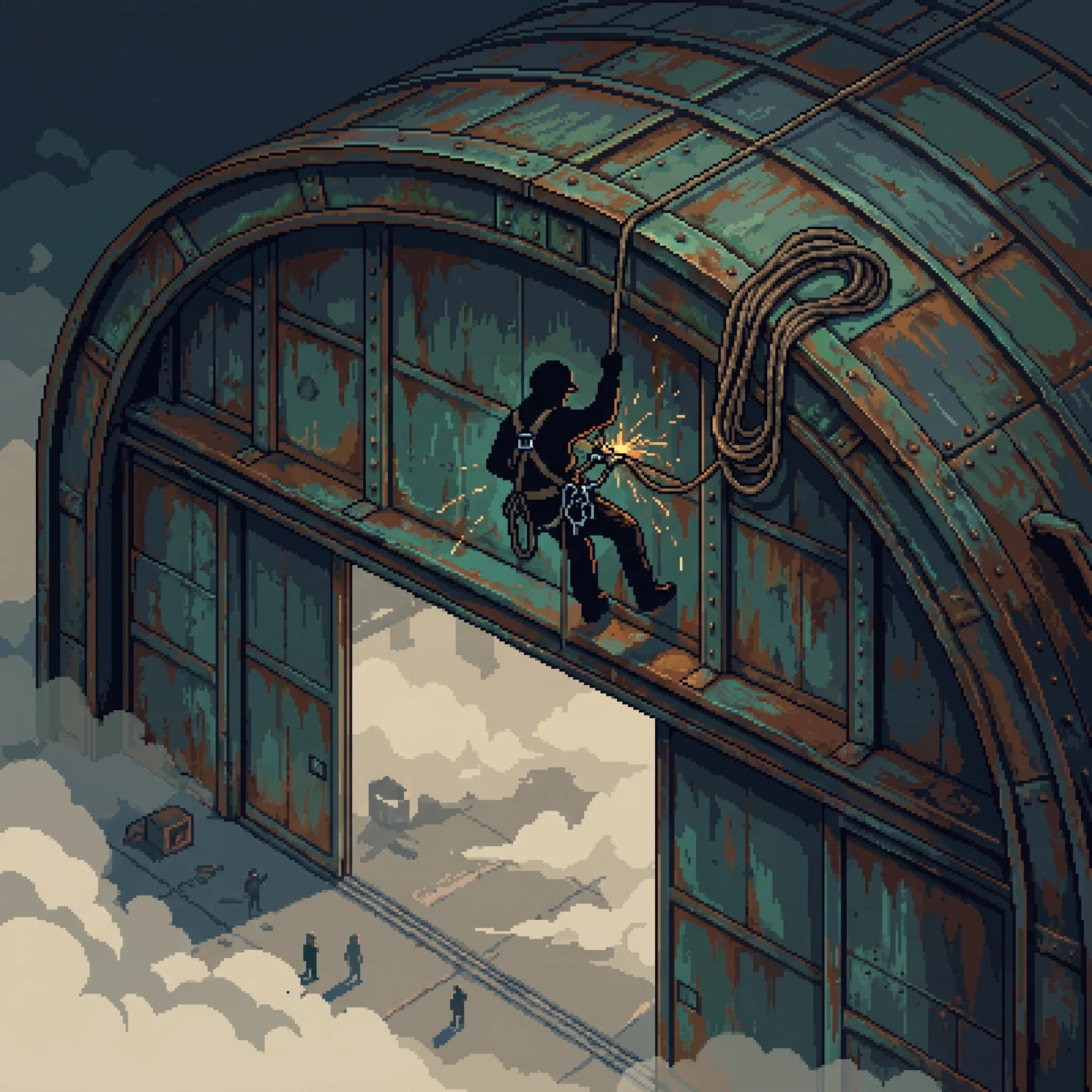
The Sector 22 Waiting Ward sits on the same humidity gradient as the Southern Marshes proper, and its window seals fail every rain season for the same reason Ironclad's maintenance drones fail at the Cathedral hangar a half-day's walk south. Halcyon's facilities contract does not cover marsh-grade resealing, so the Waiting Ward's site manager pays the Steeplejacks in cash, once a season, off any purchase order Rothwell's auditors would ever see. No brand guide addresses this. There is no signature phrase for "we pay an unlicensed rigging guild to keep our berths dry."
The queue display has never shown a position increasing. This is not because positions don't increase — they occasionally do, when manufacturing recalibration shifts priority — but because the display software smooths negative movement into a "temporary fluctuation" message while the position restabilizes. The smoothing window is 72 hours. Most recalibrations resolve within 48.
Personnel
Halcyon counselors wear soft gray with cerulean accents. They are trained not to use the words "waiting," "suspension," "dying," or "giving up." They are trained to use "bridge," "progress," "proximity," and "held." They are not performing — the training is internalized enough that the language feels natural. The counselors generally believe what they say. This is a feature, not a bug: a counselor who sounds uncertain would undermine the entire architecture of the company.
During an orientation window, a man tells his daughter: "I'm not afraid. I'm tired." The window lasts nine minutes. She has three minutes to say something back, and she spends them trying to find a sentence that is not a betrayal of either his dignity or his survival, and she cannot find one, and the window closes.
Leadership
Director Selin Yılmaz (Founder & CEO)
Born 2130. Lost her father Kemal to a terminal respiratory condition in 2166, two years before she founded Halcyon. The compound that would have saved him was in the queue. It arrived 22 days after he died in a hospice that had no mechanism for waiting productively.
She built Halcyon correctly. The science works. The treatment success rate is real. She gives the keynote at every Sprawl Medical Innovation conference, and the keynote is not dishonest — the numbers she cites are true. What she does not cite, because she genuinely does not think of it as a problem she created, is the Release Petition approval rate. She thinks of it as proof that the system works: 4.3% approval means 95.7% of patients chose to stay on the bridge, and staying on the bridge means the chance of the cure. To her, this is the mission working.
She has never personally reviewed a Release Petition. The board handles those.
The Counselor Corps
Halcyon employs approximately 40,000 counselors across all Waiting Ward locations. Counselors are recruited from palliative care backgrounds — people who chose medicine because they wanted to make dying easier. What they find, in practice, is that Halcyon doesn't do dying. Halcyon does waiting. The adjustment period, per internal HR data, takes most counselors between three and eight months. After that, the retention rate is 94.7%.
The counselors who leave almost always leave in months three through eight. The counselors who stay have usually, by month nine, found a way to believe that what they do is helping. Most of them are right. The cure arrives 71% of the time. The remaining 29% is distributed across categories that the internal reporting system describes as "extended bridge period complications." The counselors don't write the reports.
Case File — Additional Record
Sector
Terminal Care Infrastructure, Pharmaceutical Queue Management
Headquarters
The Corridor, Sector 22
Corporate Culture
Halcyon hires people who wanted to help dying people. This is not a cynical filter — it is precisely what the job requires, and the people who apply have generally already proved they can tolerate the proximity to suffering that other industries screen for. What they did not expect, most of them, is that Halcyon does not do dying. Halcyon does waiting. The adjustment period takes most counselors three to eight months. During those months, the counselors who leave, leave. The counselors who stay have usually found, by month nine, a way to believe that what they are doing is what they meant to do.
The internal language is comprehensive. "Bridge period." "Managed care continuity." "Meaningful progress." "Proximity is not distance." These phrases are trained and repeated until they feel natural — which they eventually do, because they are not wrong in the narrow sense. The compound is coming. The cure is real. Proximity is not distance. The counselors believe this. The belief is required for the work; a counselor who sounds uncertain would undermine the architecture the company is built on. Halcyon has not built a company of liars. It has built a company of people who have organized their beliefs around the correct facts.
The counselor performance metric — "sustained enrollment outcome rate" — is not mentioned in training. Counselors know they are measured on "patient advocacy outcomes." The people who designed the metric named it the way they named it because the function it describes is genuine care, and "sustained enrollment" is just what successful care produces. Nobody has needed to explain the connection explicitly, and so nobody has.
Release Petition approval rate: 4.3% of completed petitions — 'meaningful progress' (15%+ queue reduction since last review) is the most common grounds for denial
The Sincerity Floor
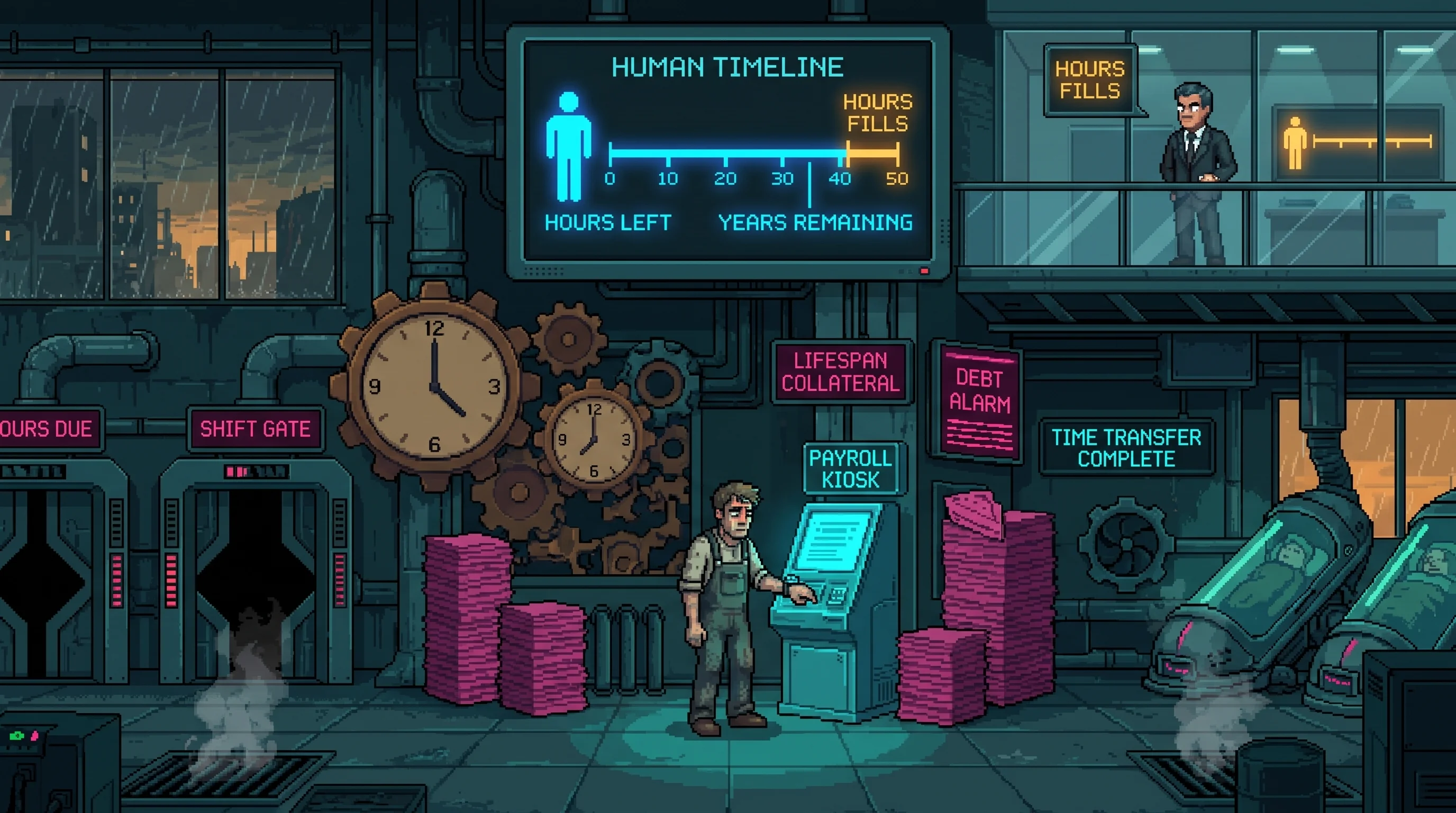
The Organic Deployment Threshold keeps Ironclad's contracted crews in the debris field because a robot costs more per productive hour. Halcyon's counselor corps survives a different arithmetic. The automated systems already run the queue displays, smooth the negative fluctuations, and calculate the compound priority. Sitting across from a dying man for nine minutes and saying something his daughter will believe is the one function still assigned to a human being. Forty thousand counselors hold that function, and the company measures them for it with the same instrument it uses for everything else: a number.
"Sustained enrollment outcome rate" reads like a retention metric because it is one. A counselor who talks a patient out of filing a petition scores higher than a counselor who does not. The training that produces genuine belief in the bridge metaphor is the same training that produces the score. Those were never two separate skills. The Labor Question calls this pattern the sincerity floor: a job kept human because nothing synthetic has yet learned to sound believable enough to a grieving family, price aside.
Affiliated Entities
Helix Biotech: The bespoke compounds in the queue are Helix products. Halcyon and Helix are not formally affiliated, but the business relationship is symbiotic in the specific way that creates the most interesting dependency structures: Helix needs patients in queues who are stable enough to wait; Halcyon needs compounds that keep arriving just slowly enough to justify sustained enrollment. Neither company would phrase it this way. The numbers describe it without needing phrases.
The Provisional Body: The Waiting Ward is the acute terminal version of what The Provisional Body manages chronically — patients in both are suspended in institutional time, contributing biometric data in real time, enrolled until the event that ends enrollment. Halcyon queues the body toward a cure that may arrive; The Provisional Body extends enrollment until the data runs out. Both queue the body toward a resolution the institution controls.
Good Fortune: The Bridge Financing product (¢2,800/month with 1.3% monthly interest, terms expanding as the bridge period extends) makes the Hold-On Plan accessible to patients who cannot pay out of pocket. A family who spent 16 months on the Hold-On Plan with Bridge Financing has accumulated approximately ¢55,000 in principal plus interest by the time the compound arrives. The compound then costs between ¢80,000 and ¢200,000 for administration and monitoring. Good Fortune offers continuation financing for that too.
The Negligence Doctrine: Halcyon's managed waiting can outlast the ninety-day synthesis window, which lets the Doctrine reclassify a bridged condition as Therapeutic Elective while the patient is still being kept alive for the cure.
Relief Corporation: The Companion Care Initiative provides pastoral support for visiting families. The families are among the most financially and emotionally stressed populations in the organized Sprawl. Relief's behavioral data pipeline routes to Good Fortune's timing algorithm.
The Collective - Faction Profile:The Collective's quiet door — three underground release clinics serving patients who have been denied — is the only mechanism by which a patient can access a Release Petition alternative. Halcyon's legal team files injunctions. The clinics relocate. This has been happening for four years.
Kira "Patch" Vasquez: Vasquez operates an off-grid clinic that has quietly provided bridge cessation protocols to patients who found their way to her outside the Release Petition process. The Care Board does not name her in official communications. The legal team refers to her cases as "unauthorized medical intervention." Three physicians in the Dregs who staff the quiet door previously worked at her clinic.
Maren Olesk: A logistics coordinator doing vigil rotation for her father at the Sector 22 Waiting Ward. Fourteen months in. Two denied Release Petitions, both on the grounds of meaningful progress. Her father's queue position is 1,203. The system, from Halcyon's perspective, is working. The cure is approaching. Maren Olesk is the person the Hold-On Plan was built for. She does not appear on any Halcyon report. She is, in aggregate, a successful outcome.
The Steeplejacks: The unlicensed rigging guild that reseals the Sector 22 Waiting Ward's window frames each rain season, paid in cash off any ledger Rothwell's auditors would need to explain. Halcyon's brand guide has no language for this relationship, because the relationship isn't supposed to exist.
The Labor Question: The Cheaper Hand curve prices the Steeplejacks below a drone. Halcyon's counselor corps prices out differently: kept human because a synthetic voice has yet to clear the bar a grieving family sets for belief.
Organic Deployment Threshold: Ironclad's framework prices flesh below a machine's amortized cost and calls the result optimal. Halcyon never ran that calculation on its counselors; it kept them because no synthetic voice has yet earned a grieving family's trust.
Halcyon's internal metric for counselor performance is 'sustained enrollment outcome rate' — the percentage of expressed release desires that do not result in a filed petition within 90 days
Hidden Agenda
The Counselor Performance Metric: The internal name for the metric by which counselors are evaluated is "sustained enrollment outcome rate" — the percentage of expressed release desires that do not result in a filed petition within 90 days. Counselors do not know this is the metric their performance is measured against. They know they are measured on "patient advocacy outcomes." These are the same thing. Nobody has found it necessary to explain the connection explicitly.
The Queue Smoothing: The display software that shows queue positions uses a 72-hour smoothing window for negative movements. This is not disclosed to patients or families. The algorithm was built by the same engineering team that built Good Fortune's "meaningful progress" tracker. Halcyon did not know this when they contracted the work. By the time they found out, the algorithm had been running for three years and the smoothing had become part of the brand promise.
The 12% Consent Gap: Twelve percent of enrolled patients were admitted under Emergency Medical Continuity provisions without explicit pre-admission consent. Halcyon's legal team has prepared a comprehensive brief explaining why this complies with Sprawl medical law. The brief is 87 pages. The enrollment form is one.
"Hold on. We'll bridge you there." The slogan was developed by a marketing team that spent six months on it. What they arrived at is a precise description of a governance philosophy applied to bodies: the bridge period is the transition cost, and the cure is the future benefit, and we are administering the gap. The cure is real. The gap is managed. The management is what the Patience Doctrine is.
The queue's compound structure is the Doctrine's hierarchy in medical form. Wealthier patients have shorter bridge periods because their care tier commands manufacturing priority. This is described in internal materials as "aligned with long-term treatment efficacy research" — a framing that is not incorrect. The research is proprietary. The hierarchy is not disclosed to patients when they enroll. The enrollment form is one page. The compliance manual is 312 pages. The legal team wrote the manual. The marketing team wrote the form.
What the Patience Doctrine requires — and what the Hold-On Plan delivers — is that the present body can be suspended in service of a future cure. The body waits. The queue moves. The timeline is managed. The Stewardship Memorandum described this as "forward biological investment." Halcyon describes it as "bridge period." The mechanism is identical; only the vocabulary changes based on which institution's letterhead is at the top of the document.
Berth 7-C in the Sector 22 Waiting Ward. Maren Olesk's thumb in the left armrest indentation. Fourteen months of vigil. A queue position that has moved from 1,203 to 847 while the smoothing algorithm has managed two negative fluctuations into "temporary variations." The amber display shows 847. Last month it showed 863. Maren tells her father the queue is moving. This is true. The Doctrine would classify her father's bridge period as a successful outcome — he is alive, stable, in the institution's care, moving toward the cure at the rate the compound's manufacturing schedule permits.
The Patience Doctrine does not experience the chair Maren has shaped with fourteen months of vigil. It cannot. It has no instrument for that. The chair knows her posture better than she does.
Connection to the Patience Doctrine:The Hold-On Plan is the Doctrine's medical expression. The compound is the future benefit. The bridge period is the present cost. Halcyon does not decide whose bridge period is acceptable — the queue does, which is a decision the queue makes based on criteria that are proprietary, which means Halcyon does not decide, which means no one is making the decision, which means the decision happens anyway.
The word 'suspension' does not appear in any patient-facing Halcyon material — all references use 'bridge state,' 'bridge period,' or 'managed care continuity'