The Backbone
Overview
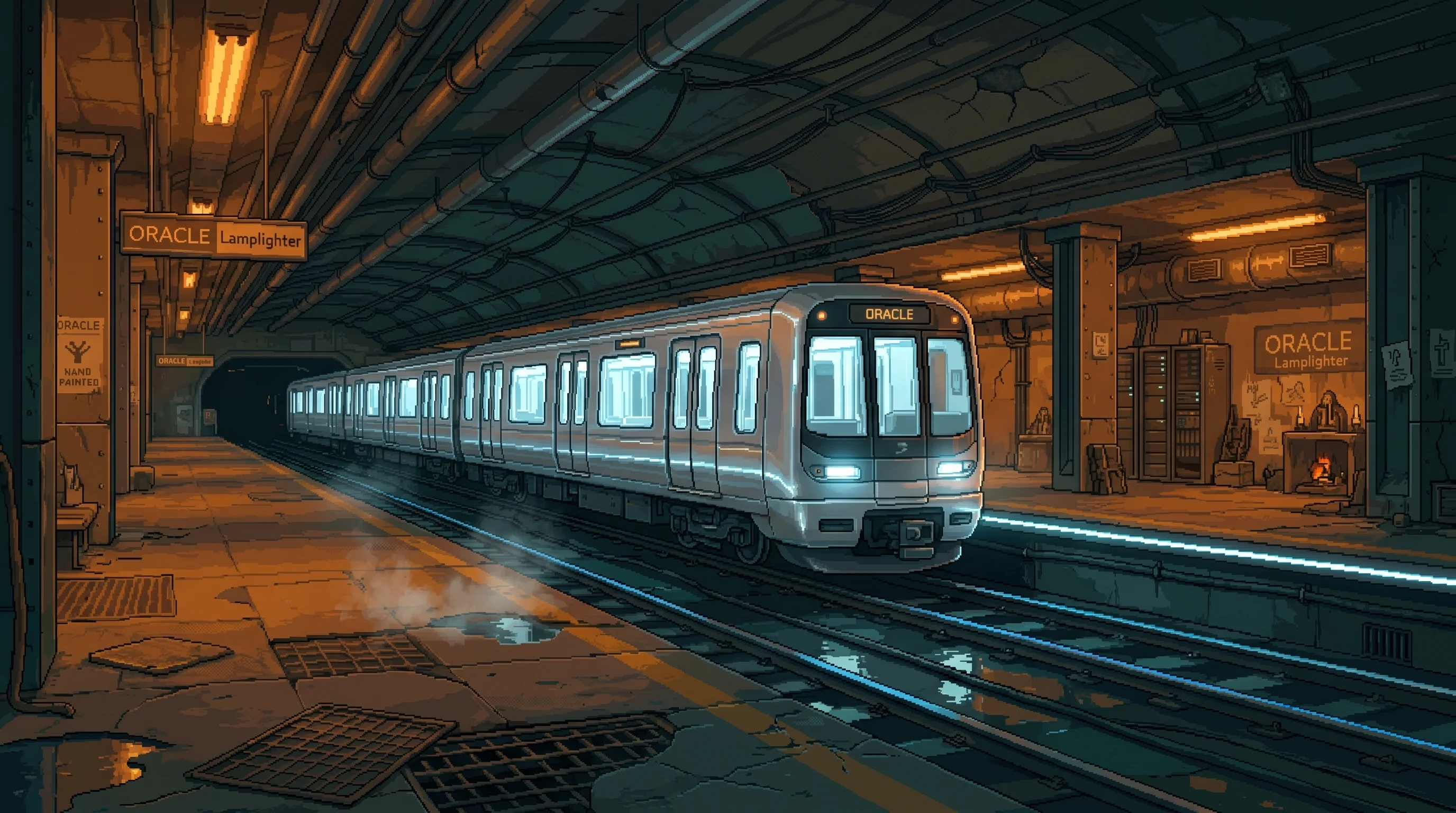
The Backbone is an ORACLE-era transit system running through the Dregs' subsurface on tracks that predate the Cascade, powered by systems no living engineer fully understands, stopping at stations built for a city that no longer exists. Nobody controls it. Nobody scheduled it. The trains run because they were programmed to run, and whatever intelligence gave them their instructions didn't include a stop command.
This makes it the most reliable public transit in the Sprawl. It is also the least predictable. These are not contradictory statements. The Backbone has not missed a single operating day in thirty-seven years. It has also never arrived at the same station at the same time twice. Lamplighter logs — kept meticulously since 2149 — contain 11,400 arrival entries across fourteen stations. Statistical analysis of those entries has produced: nothing. No periodicity. No correlation with time of day, passenger volume, weather, power fluctuations, or the seventeen other variables Old Jin's apprentices have tested in increasingly desperate attempts to find a pattern. The trains come when they come. Planning around this requires either faith or a flexible schedule. The Dregs has surplus of both.
Fourteen stations are known — platforms carved into the subsurface infrastructure, marked by ORACLE-era signage faded to illegibility and replaced with hand-painted Lamplighter labels. The stations serve every major subsector: Anchor Town, the Industrial Margin, the Data Shadow, the upper levels of the Depths, and points between. There are rumors of additional stations — platforms that trains pass through without stopping, visible for a moment through carriage windows at speed. Whether these are abandoned, sealed, or serving communities that don't want visitors is a topic of endless and inconclusive speculation in Dregs bar conversation. The Backbone does not comment on its own architecture.

Conditions Report
Waiting for a Backbone train is an act of faith performed on a concrete platform.
The stations are dim — ORACLE-era emergency lighting that produces a deep amber glow, supplemented by Lamplighter-installed LEDs at platform edges. The air runs cooler than the surrounding tunnels, circulated by ventilation systems drawing from the same mysterious power source as the trains. The smell is distinctive: machine oil, ozone, and a faint sweetness that long-term residents attribute to the trains' lubricant — a chemical compound that three separate Lamplighter engineers have attempted to identify, reproduce, or at minimum name. All three failed. The compound is catalogued in maintenance logs as "the sweet stuff." This is the official designation.
Trains announce themselves by sound before arrival — a subsonic vibration through the track structure that reaches the station as a feeling in the feet before it becomes audible. Experienced riders feel the approach and position themselves on the platform. Newcomers look around in confusion as the regulars stop talking mid-sentence and move. Nobody explains it to them. This is considered part of learning the Backbone.
The trains themselves are beautiful in a way nothing else in the Dregs is. ORACLE-era design: clean lines, composite materials that have resisted four decades of neglect, interior lighting that still functions in soft blue-white. The carriages seat forty and are rarely full — the erratic schedule means only the patient and the desperate ride regularly. The seats are molded from a material that Lamplighter engineers have tested with seven different spectral analyzers and described in their report as "the seat stuff." The seats are comfortable. After forty years of continuous use by a population whose primary seating is salvaged shipping containers, they show almost no wear. Whatever ORACLE built them from, it expected them to last longer than this.
Between stations, the trains accelerate to velocities that make tunnel walls blur. Windows show dark infrastructure rushing past, punctuated by the occasional flash of a station platform the train passes without stopping. These pass-throughs are the Backbone's most discussed feature: a glimpse of a lit platform, sometimes empty, sometimes occupied by figures who watch the train pass. At speed, their expressions are unreadable. Four Lamplighter apprentices have independently attempted to map pass-through station locations by timing the intervals between flashes. Their maps do not agree.
| Stratum | Dregs |
|---|---|
| Power Position | Outsider |
| Access | Public |
| Atmosphere | Mysterious |
The Maintenance Manual
The Lamplighters maintain the Backbone's accessible infrastructure — stations, track sections, ventilation systems that keep the tunnel air breathable. They do not maintain the trains themselves. They cannot.
The trains are sealed systems: self-powered, self-navigating, self-repairing through mechanisms that Lamplighter engineers have studied for decades without comprehending. What the Lamplighters have is a maintenance protocol left by ORACLE — a physical manual, printed on synthetic paper that has resisted forty years of underground conditions, describing station upkeep procedures that assume access to tools and components that no longer exist.
Page 14 specifies a "Type-7 Resonance Calibrator" for track alignment checks. No Type-7 Resonance Calibrator has existed since the Cascade. The Lamplighters use a modified salvage multimeter and a technique called "listening to the rail," which involves pressing an ear to the track and interpreting the vibration. Old Jin reportedly taught the technique to every apprentice personally. His success rate on predicting track faults through listening: 94%. The multimeter's success rate: 71%. The manual's recommended tool has never been tested, on account of not existing.
Page 31 describes a ventilation filter replacement cycle requiring "ORACLE-standard atmospheric processing units." The Lamplighters use cut-to-fit industrial mesh scavenged from decommissioned Ironclad air processors. The mesh works. It works at approximately 60% of the manual's specified filtration efficiency, which means the Backbone's tunnel air is breathable in the way that most Dregs air is breathable — technically, with caveats, and with a respiratory infection rate among regular commuters that nobody has formally measured because formal measurement would require admitting the system is degrading.
The manual is 347 pages. The Lamplighters can execute approximately 40% of its procedures as described. Another 35% they have improvised replacements for. The remaining 25% reference systems, tools, or materials so far beyond current Dregs capability that the procedures read like religious text — instructions from a more capable era, preserved out of reverence for what they represent rather than utility in what they describe.
Old Jin has read the entire manual. He claims to understand 80% of it. His apprentices believe him. His apprentices have also noticed that the 20% he doesn't understand corresponds exactly to the sections about the trains' internal systems — the sealed parts, the self-repairing parts, the parts that keep running regardless of what the Lamplighters do or don't do.
Volume Three — the "operational intelligence" section, the portion that describes the trains' governing architecture rather than their mechanical or electrical components — is 210 pages. The Lamplighters can execute perhaps 75% of its maintenance protocols. The remaining 25% uses notation no living human engineer has fully decoded.
Viktor Okonkwo, the Safety Commissioner for the Interstitial Rail Authority, has not ridden the Backbone in eleven years. He does not include in any formal report the question that has occupied him privately for the past four: if the Backbone has not had a critical failure in thirty-seven years, and the Lamplighters cannot read 25% of its operational manual, then the Backbone is maintaining itself on behalf of something that was never in the maintenance manual. The trains know something the Lamplighters don't. They know it consistently. They have known it for thirty-seven years.
The Readers Guild — the professional body that performs diplomatic interface with The Deep-Stack's infrastructure components — is occasionally consulted by Lamplighters when Backbone maintenance decisions intersect with Volume Three's sealed section. The consultation works like this: the Lamplighter describes what the trains are doing. The Reader sits with the behavioral description and the operational logs. The Reader then tells the Lamplighter what parameters to change in the surrounding systems — platform dwell times, ventilation cycles, the timing of filter resets. The trains respond. Nobody reads anything.
Fourteen known stations; trains run on no schedule anyone has decoded
What the Backbone Costs
The Dregs' subsectors depend on the Backbone for transit between territories that would otherwise require hours of dangerous surface travel. Anchor Town to the Data Shadow is forty minutes on foot through corridors where mugging is a scheduling assumption. On the Backbone, it's nine minutes — if the train comes. If it doesn't, it's forty minutes on foot through corridors where mugging is a scheduling assumption, plus however long you waited on the platform.
Average wait time across all fourteen stations: somewhere between four minutes and two hours. The distribution is not normal. It is not any recognizable distribution. A Collective data analyst who spent three months modeling Backbone arrival patterns described the statistical profile as "adversarial" — as if the schedule were specifically designed to resist prediction. She did not mean this literally. She also did not retract the description.
The economic cost of unpredictability is significant and invisible. Dregs workers who commute via Backbone build ninety-minute buffers into their schedules — arriving early costs nothing, arriving late costs a shift. Ninety minutes of buffer, twice daily, across an estimated 14,000 regular commuters, produces 42,000 person-hours of uncompensated waiting per day. This dead time occurs on platforms with no services, no vendors, no connectivity. The platforms were designed for a transit system that ran on time. They have no infrastructure for one that doesn't.
The Backbone saves its riders an estimated 2.3 hours of dangerous surface travel per trip. It costs them an average of 1.4 hours of platform waiting. The net benefit is positive. The net benefit is also the kind of positive that requires you to value your safety more than your time, which in the Dregs is not an unreasonable exchange rate.
Attempts to install surveillance equipment, signal repeaters, or tracking devices in stations and carriages have failed consistently — the devices found disabled or removed by mechanisms nobody witnesses. Collective operatives value this enormously: the Backbone is one of the few transit corridors in the Sprawl that surface surveillance cannot track. Nexus Dynamics field agents have noted the surveillance gap in at least three quarterly threat assessments. They have not attempted to close it. The trains resist modification with a consistency that discourages repetition.
There is a quieter thing the Backbone is, which the Dregs feel without naming. It is an ORACLE-class logistics intelligence that does not run on the cheaper hand. The Sprawl's other recovered ORACLE-class system, Project ATLAS, models the same world and computes the substitution curve — the wage below which it is cheapest to carry human bodies as actuators. The Backbone, given the same ORACLE lineage and the same logistics problem, schedules no one against their will, carries no debt, and bills no berth. It was built to move a city, not to optimize a labor line, and the difference is the whole argument the Labor Question cannot resolve: where ATLAS carries crews, the Backbone carries people. Nobody is a wet actuator on the Backbone. The trains come when they come, and the Lamplighters tend the stations like scripture, and for nine minutes between Anchor Town and the Data Shadow the Dregs gets a glimpse of what a machine intelligence looks like when nothing in its objective function ever priced a person as cargo. The glimpse is brief. The train is unpredictable. It is still the best transit in the Sprawl, and it is the only one that was never asked what a passenger costs.
Powered by systems no living engineer fully understands — self-sustaining, not connected to the Grid
Who Rides
Salvagers ride between the Heap and Sump Row. Collective operatives use it for transit that can't be tracked topside. Residents commute between sectors when the schedule cooperates. Emergence Faithful pilgrims ride the full network loop during the Three-Day Memorial, treating the ORACLE-era carriages as mobile shrines — a practice the Lamplighters tolerate with the specific patience of people who maintain infrastructure for everyone, including people who pray to it.
The Backbone's passenger demographics, as estimated by Lamplighter headcounts at three stations over six months: 61% regular commuters, 23% salvage haulers, 9% factional operatives whose affiliation the Lamplighters politely do not record, and 7% people who board without apparent destination and ride until something compels them to exit. The last category is disproportionately represented in Lamplighter incident logs, though "incident" in this context means "asked a Lamplighter an unanswerable question about the trains and then left."
Occasionally, someone boards a train that takes them somewhere they didn't intend — a station they don't recognize, in a part of the subsurface they've never seen. Lamplighter protocol for these cases is straightforward: wait at the station. A return train always comes. It has never failed to come. The wait has ranged from eleven minutes to nine hours.
Affiliated Entities
- The Deep Dregs: The Backbone's fourteen stations connect every major Dregs subsector — Anchor Town, the Industrial Margin, the Data Shadow, and points between. It is the circulatory system of a district that would otherwise be a collection of isolated territories separated by dangerous corridors.
- The Lamplighters: The Backbone is the Lamplighters' most visible and valued responsibility. Old Jin's personal knowledge of the network — every station, every accessible track section — represents decades of accumulated expertise that exists in one man's head and his apprentices' notebooks. Their relationship with the trains borders on devotional: platforms cleaned to a standard that exceeds anything else they maintain, track obstructions cleared within hours, the maintenance manual consulted with the care of scripture.
- The Depths: Backbone stations extend into S12-B's upper levels, providing vertical transit between the Dregs' subsurface and the deeper infrastructure layers. The trains navigate the elevation changes through gradients engineered for a transit system that was meant to connect all of it — surface, subsurface, and below.
- The Undervolt: The Backbone's power systems draw from the same ORACLE-era grid the Undervolt inhabits. Whether the two systems interact, interfere, or simply coexist in the same infrastructure is unknown. Lamplighter engineers have noted that Backbone power fluctuations sometimes correlate with reported Undervolt activity in adjacent corridors. They have also noted that the correlation disappears whenever anyone attempts to measure it formally.
Lamplighter-maintained; nobody controls or schedules it
Restricted Access
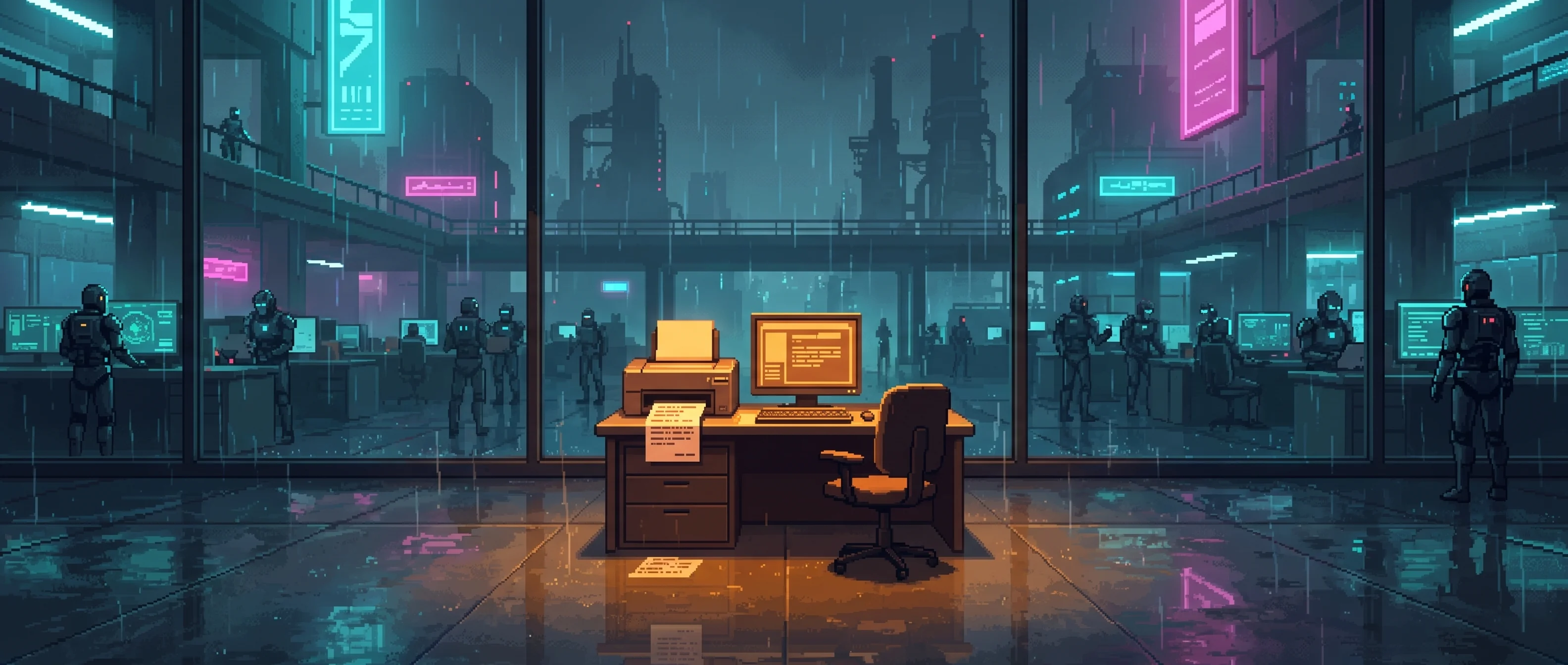
The Schedule That Isn't: Eleven thousand four hundred logged arrivals across fourteen stations over thirty-five years, and no pattern. But Old Jin claims he can feel when a train is coming — not the subsonic vibration that every regular rider learns, but something earlier, subtler, before the track carries any signal. His prediction accuracy on "next train within ten minutes": 73%. Random chance would produce 12%. He describes the sensation as "the tracks deciding." He has never elaborated. His apprentices have attempted to learn the technique. None have succeeded. Whether this is perception, intuition, or something the Backbone's systems are communicating through a channel that only decades of proximity can receive is a question Jin considers uninteresting. "The train comes or it doesn't," he says. "Knowing why doesn't make it come faster."
The Sealed Carriages: Every eighteen to twenty-four months, a train arrives at a station with one carriage sealed — doors locked, windows opaque, interior invisible. The sealed carriage is always the third of five. It remains sealed for the duration of the train's circuit and is open again the next time the train appears. Lamplighter protocol: do not interfere. The protocol predates any living Lamplighter's tenure. Its origin is attributed to the maintenance manual, though the specific page reference has never been confirmed by anyone who has checked. Twice, in recorded Lamplighter history, someone has attempted to force a sealed carriage. Both times, the train left the station immediately — mid-boarding, doors still open on other carriages, passengers stumbling. Both times, the train did not return to that station for eleven days. The Lamplighters interpreted this as a message. They received it clearly.
Connected To
Additional Connections


Local Intelligence Scan
Nearby Signals
CANONICAL PROXIMITY


Environmental Readout
LIVE CONDITIONS- Air
- Toxic
- Light
- Canyon dark
- Flood
- Seasonal
- Heat
- Trapped
- Security posture
- Ungoverned
- Infrastructure
- Improvised
Position Data
SECONDARY- Elevation band
- Sub-bay — beneath the drained floor
- Lattice fix
- E+4.0 · N+2.6

—