
Overview
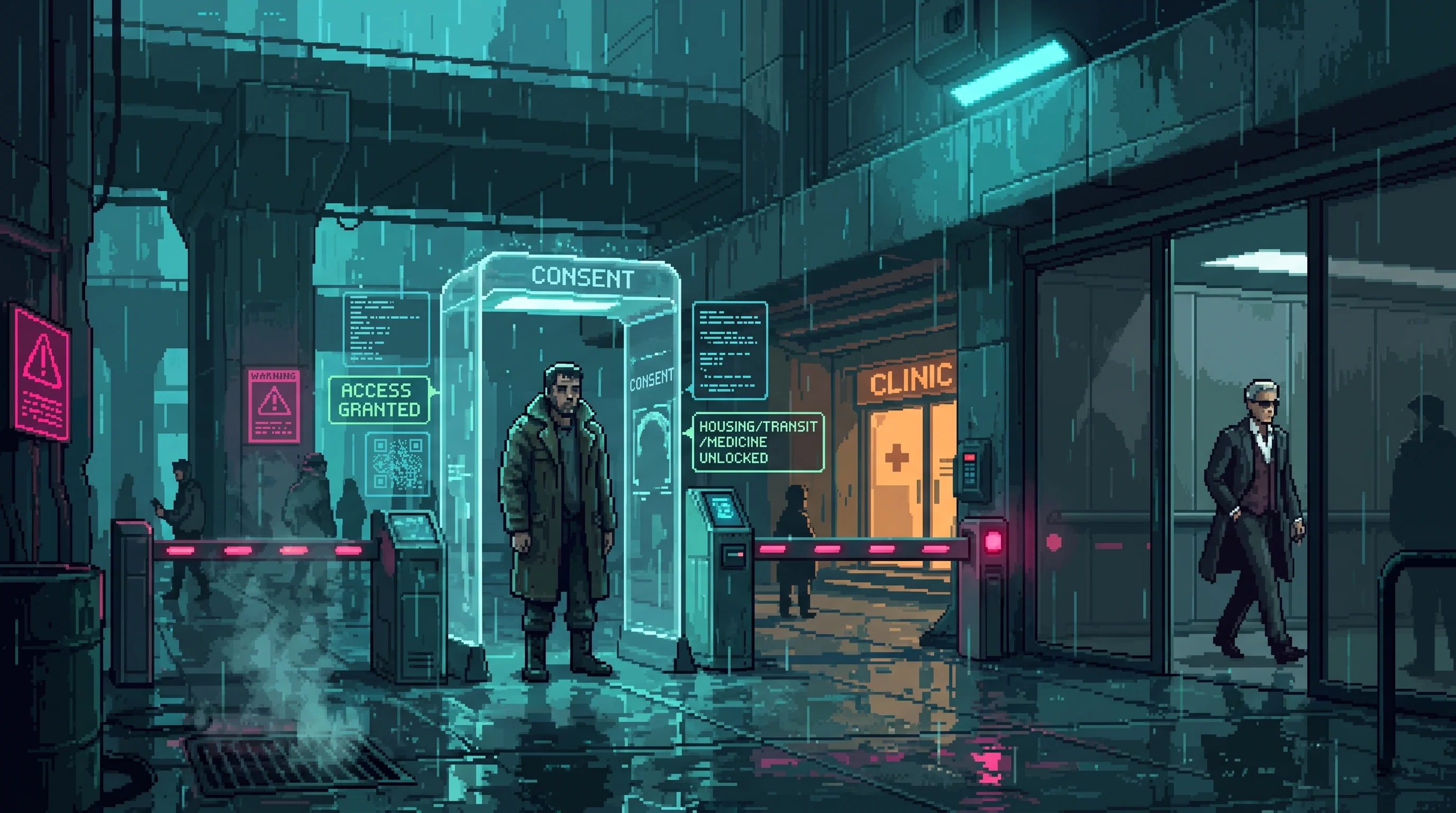
A Consent-Veil is the per-encounter privacy contract that runs between two neural interfaces the instant they come within sensor range. It is not a product you buy; it is a setting you maintain, which is the entire problem. The firmware ships standard with every interface — Foundation-tier infants are veiled before they are named. What does not ship standard is the time to curate it.
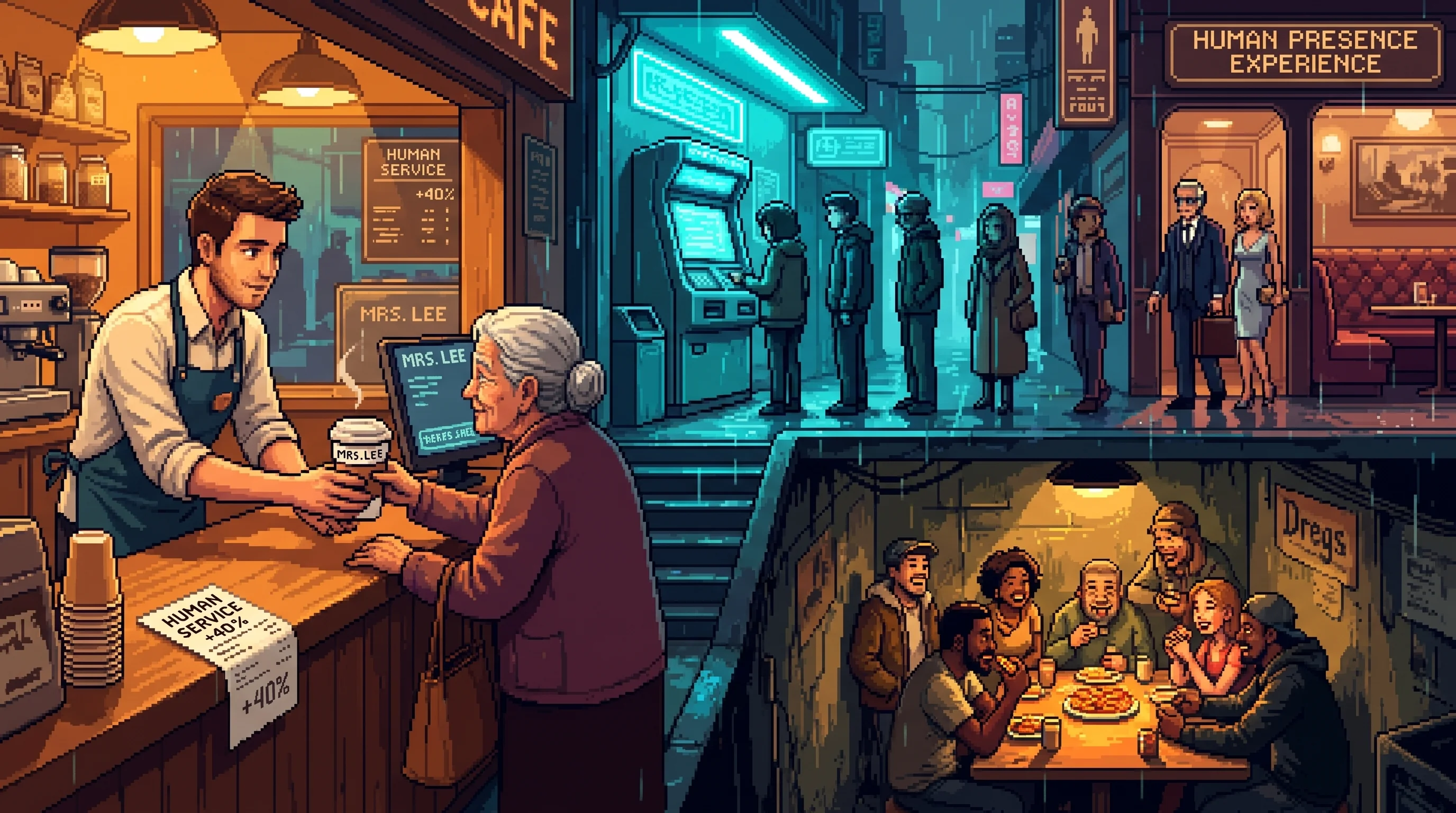
For thirty years the Transparency Bargain only ran vertically: corporation looking down at the individual, telemetry flowing one direction at 15,900 data points a second. Nobody monetized two Dregs residents looking at each other on a maglev platform, because there was nothing in it. Then, in 2181, Nexus shipped the Reciprocal Recognition firmware — the same update that gave a Small Talk Cafe barista the legal right to remember your face — and discovered the horizontal layer was worth more than the vertical, because there were so many more of it. Every glance, every shared elevator, every passing stranger: a micro-contract, a micro-fee, a sliver of telemetry, multiplied across a city of three hundred million people who come within sensor range of each other thousands of times a day. Section 12.3 covered it without a new ceremony. A glance is data generated through the interface. The interface routes it. The Bargain applies.
The Sprawl named the new layer before the corporation did. The Consent-Veil: the real-time contract you grant each passerby for what they may see, record, and keep. And because curating it is unpaid labor, it did the one thing the Privacy Gradient never could — it made the class divide visible in the body, instant and unforgiving, the difference between a person who can afford the hours and a person who cannot.
- Decisions per day
- ~11,000 micro-permissions for a fully self-curating resident; the wealthy lease a curator so they never feel the work
- Default state
- Default-open — everything visible, keepable forever, free to trade. The factory setting you land on when you have no hours left to curate
- Class axis
- Veil-fluency — correlates with the Exposure Index at only 0.6; a separate country from credit-priced privacy
- Legal basis
- Section 12.3 of neural interface licensing — 'all data generated by or through the neural interface'; a glance is generated through the interface
- Also called
- The Veil, Reciprocal Recognition Layer, default-open (slang for the unworked veil)
- What
- The per-encounter, real-time privacy contract that runs between two neural interfaces the instant they come within sensor range — what each passerby may see, record, and keep of you
- Shipped
- 2181 — bundled into Nexus's Reciprocal Recognition firmware, the same update that gave human service workers the legal right to remember a customer's face
- Cost
- Free — ships standard with every interface, Foundation-tier infants veiled before naming. The cost is in HOURS, not credits


How It Works
Curating a veil means deciding, per stranger, per encounter, in real time: what may this person see — your face? your name-glyph? your mood-signature? your Health Trajectory aura? — what may they record (a still, a thirty-second loop, the full sensory capture), what may they keep (until they look away, a day, forever), and may they trade the keeping on the Mirror Market. A fluent curator reads a stranger's stratum in the first half-second and reveals exactly enough to be legible and no more, revoking the moment the encounter ends, leaving the other person a memory that decays on a schedule the curator chose. It looks like grace. It is grace, the way a concert pianist's hands look like grace — and it is also eleven thousand micro-decisions a day.
The wealthy do not make them. Their veil-craft is leased: a veil-intelligence calibrated to one nervous system that curates each encounter the way the Pace curates each lesson, so the curated self arrives without the curator ever feeling the work. The poor make the decisions or they don't, and mostly they don't. Default-open is the factory setting — everything visible, keepable forever, free to trade — the setting you land on when you have worked a double shift and have not got eleven thousand decisions left in you.
Applications
The fluent use the veil the way the wealthy use everything: invisibly, as a personality. The veil-feral — new money whose leased curator hasn't finished calibrating — leak the wrong stratum-signal and are read, mercilessly, as not-quite-belonging. The genuinely default-open are read as privacy-poor, and the reading costs them: jobs, contracts, standing, because a self that cannot be revealed-and-revoked is a self with nothing underneath. Counter-practices have emerged at every price point — the leased curator for the rich, the-counted's pooled cooperative veil for the organized poor, Patch's ¢200 veil-governor for the merely exhausted, and the Dregs' oldest answer: one fixed analog mask, worn to everyone, cheap and durable, the privacy of consistency. In the Western Shore, Astrid Solheim runs the one counter-practice that neither performs the labor nor removes it: an unpaid class that hands the resident a working subset of the decisions and leaves the rest open by design.
Risks & Side Effects
The eleven-thousand-prompt day is itself an injury — a tinnitus of small permissions that the default-open describe as a weight and the fluent never feel. And there is the correlation Nexus has not published: in Origin Trace audits, the most fluent veil-curators score lowest on organic-preference content. The people best at choosing what strangers remember of them have the least say in what they themselves remember. The curated self and the colonized self appear, in the data, to be the same self — privacy mastered all the way into self-erasure.
A dockhand finishes a double shift, steps onto the maglev, and his interface fires its eleven-thousandth consent-prompt of the day — this stranger may keep your face, this one your mood-signature, this one forever — and he does what he does every night: nothing, lets it all stay open, and watches the veil-fluent woman across the car reveal exactly enough of herself to be remembered the way she chose.
History
The vertical Transparency Bargain ran unchallenged from the 2150s, when Nexus rolled out universal neural interfaces under Section 12.3. For three decades the horizontal layer — what one person could see and keep of another — was commercially worthless: too small, too diffuse, two strangers on a platform generating nothing a broker would buy.
The pivot came in 2181 with Nexus's Reciprocal Recognition firmware, marketed as a courtesy to the warmth economy — the update that gave a Small Talk Cafe barista the legal right to remember a customer's face and greet them by name. The firmware's real payload was the consent-handshake protocol: the per-encounter contract that resolves between any two interfaces within sensor range. Within a season the Sprawl had named it the Consent-Veil, and within a year three consequences had hardened. First, default-open became the slang for the unworked veil and the tell of the time-poor. Second, the wealthy began leasing veil-intelligences — interpersonal cousins of the Pace — turning curation into an invisible service. Third, the warmth economy absorbed the labor as a priced trade, veil-craft, sold by the hour by people with hours to those with credits but none.
By 2184 the firmware ships standard on every interface, Foundation-tier infants veiled before they are named. The Opacity Movement's proposed free default-curation floor has failed three times in Zephyria's council. The Mirror Market's open shelf — the harvested interiors of the default-open — has become the largest single inventory in the Undervolt. No vote was held on any of it. The four-second consent that surrendered the vertical layer in the 2150s surrendered the horizontal one on the same page, thirty years before there was anything on it worth taking.
Strategic Assessment
The veil-curator is an intelligence that decides, on your behalf, what other people are allowed to remember of you — and the better it does its job, the less of you survives the curation. It is the privacy version of the question the Pace asks about education: when a machine optimizes your self-presentation perfectly, whose self is being presented? The Consent-Veil makes privacy a labor market, and like every labor market in the Sprawl, the people doing the work and the people enjoying it are not the same people.
Affiliated Entities
- The Transparency Bargain
the Consent-Veil is its interpersonal expression; the vertical surveillance everyone learned to ignore became a horizontal cruelty no one could
- The Privacy Gradient
the Gradient prices privacy in credits; the Consent-Veil prices it in hours, the time axis the Gradient never measured
- The Pace
the wealthy's leased veil-curator is the Pace's interpersonal cousin, calibrated to one nervous system
- Nexus Dynamics
shipped the firmware and brokers the fee on every act of remembering between every two people
- The Mirror Market
the default-open are keepable-forever and free-to-trade, flooding the Market with "the open shelf"
- Clean Lives
coheres the slow archival self; veil-coaching trains the fast interpersonal one
- Mara Chen
maps the horizontal surveillance layer the veil created
- The Counted
socialize curation across forty-seven members who cannot each afford it
- Hector from Sector 12
default-open and un-curatable to the fluent; his beanie-and-catchphrase brand is the Dregs' fixed-mask answer to a per-encounter contract he has no hours to work
- Kira "Patch" Vasquez
built the ¢200 veil-governor, a one-setting hardware mercy that ends the tinnitus of consent-prompts for the default-open exhausted
- Lyra Voss
her art is the anti-veil, total revelation made sacred; she fired the curator Relief leased her
- Alexei Kozlov
his Nexus-leased veil is the most expensively curated self in the Spire; noted that the most fluent curators have the least say in what they themselves remember
- The Resonance Collective
when a Dispersed voice manifests, the room's veils fail in unison; the dead never signed Section 12.3
- Astrid Solheim
the Western Shore's unpaid, taught alternative to a leased curator or a fixed mask, a shortlist drilled into residents over eight weeks
Sensory Details
The veil announces itself as a faint cool pressure behind the eyes when an encounter contract resolves — the fluent stop noticing it, the default-open feel it eleven thousand times a day as a low, gritty fatigue, like sand under the eyelids. A curated stranger leaves a clean, scheduled afterimage that fades exactly when promised. A default-open stranger leaves everything: the smell of their shift still on them, the exact slump of their shoulders, the mood-signature they could not afford to hide, kept forever, free.











Social Impact
The Consent-Veil added a class axis the Sprawl had no column for: veil-fluency, correlating with the Exposure Index at only 0.6. You can be Gradient-poor and veil-fluent — the off-shift artist who curates obsessively — or Gradient-rich and veil-feral. The Sprawl reads both in seconds and judges the second harder, because money you can inherit but fluency you have to work. "Default-open" became the cruelest thing you can call someone: not that you are watched, but that you cannot afford the hours it takes to curate being watched.