The Dead Spot
Accidental Surveillance Blind Zone
Three Blocks Off the Record
Created by Three-Week War infrastructure damage (2171)

Conditions Report
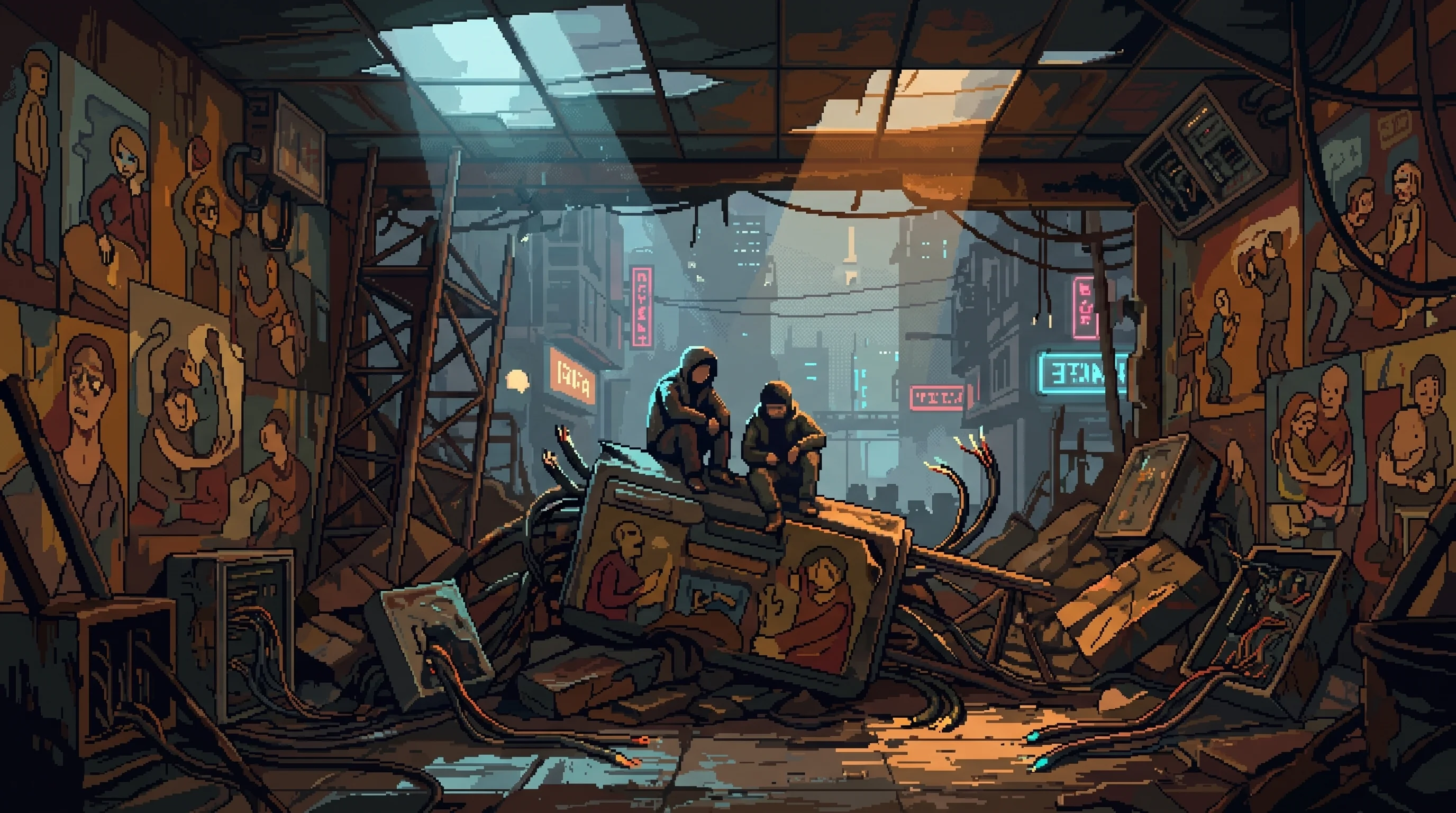
- Static silence
- The Sprawl's data hum is gone. A white-noise wash replaces it, and you can hear your own breathing.
- The smell
- Ozone and degraded insulation. One resident called it clean. It means unwatched.
- Mano's murals
- Scenes of daily life painted without interface assistance on every flat surface. The faces are slightly wrong.
- The tingle
- Interference produces a faint fizz on exposed skin. Regulars say they can feel the boundary.
- Shadows
- Broken overhead panels leave pools of dark, and couples sit in them the way couples once sat in parks.
Entering the Dead Spot is a physical experience. The interface stutters, telemetry drops, and the data weight — the constant background pressure of being observed — lifts. Dregs residents describe it as stepping out of rain you didn't know was falling. The relief is immediate and visceral. Several long-term visitors report mild anxiety upon re-entering monitored space, which Nexus HealthTrack logs as "reintegration dysphoria" and flags for follow-up. (The follow-up appointment itself generates the telemetry the patient was briefly free of.)
The Dead Spot smells like ozone and degraded insulation — a mineral tang from damaged atmospheric processing that coats the back of the throat. Not pleasant. But it is the smell of privacy, and people develop attachments to it the way they develop attachments to anything associated with relief. One Dregs resident, asked to describe the scent, called it "clean." Atmospheric composition readings show particulate levels 340% above Sprawl residential average. "Clean" means something different here. It means unwatched.
The sound is the most disorienting feature. The Sprawl's constant data hum — the ambient electromagnetic noise of a billion neural interfaces exchanging telemetry — is absent. What replaces it is a white-noise wash that residents call "static silence." The interference from competing Nexus and Ironclad signals creates a frequency-cancellation effect that swallows most electromagnetic sound. You can hear your own breathing. In 2184, this qualifies as remarkable.
The infrastructure is derelict relay housing — twisted metal, exposed cabling, junction boxes that haven't carried a signal in thirteen years. Every flat surface is covered in murals. A Dregs artist — identity unknown, signing only as "Mano" — has painted scenes of daily life on every available wall. The murals are slightly wrong. Faces asymmetric. Perspective slightly off. Proportions that don't quite track. Painted without neural interface assistance, they show the world as human eyes actually see it, unassisted — and the distortions reveal how much ambient AI correction the Sprawl's population has internalized without noticing. Visitors find the murals unsettling. They cannot always articulate why.
The temperature runs cooler than surrounding districts — roughly 22°C versus the 28°C-plus of the Thermal Shadow nearby. The damaged relay no longer generates waste heat. The electromagnetic interference produces a faint fizzing sensation on exposed skin that regulars describe as "the tingle." Some claim they can feel the exact boundary where monitored space ends and the Dead Spot begins. Nexus telemetry engineers say this is psychosomatic. The engineers have not visited.
The Dead Spot has shadows. Broken overhead panels create irregular pools of light and dark — something functionally unique in a Sprawl designed for comprehensive illumination. Couples sit in the shadows the way couples in earlier centuries sat in parks. The analogy is not lost on anyone except the infrastructure planners who never intended to create a park.
Overview
Between S1-J and the Ironclad manufacturing perimeter, there is a space where the data ecology fails.
The Dead Spot occupies approximately three square blocks of derelict infrastructure — a former Nexus relay station damaged during the Three-Week War and never rebuilt. The relay's destruction created a localized interference zone where competing electromagnetic signals from adjacent corporate territories cancel each other out. Neural interfaces enter a degraded state: telemetry fails, inference drops, and the interface operates in emergency mode — basic cognitive function without data exchange.
Nexus filed a repair requisition in 2172. Ironclad filed a counter-requisition citing territorial encroachment concerns. Nexus responded with a jurisdictional challenge. Ironclad escalated to the Corporate Compact Arbitration Board. The Board requested a joint site survey. Neither corporation agreed on who would provide security for the survey team. The file is 1,340 pages long. The relay is still broken. Privacy was created not by technology or activism but by the inability of two corporations to fill out the same form.
Dregs residents discovered the zone in 2176. By 2178, it had a name and a reputation. By 2180, it was the most popular first-date venue in the lower Sprawl.
Not because the atmosphere is romantic — the air smells of ozone and degraded insulation, the ground is rubble-strewn relay housing, and atmospheric processing runs at roughly 71% capacity owing to the same infrastructure damage that killed the surveillance. Because it is the only place in the Sprawl where you can fall in love without generating data about it. Where the flutter of attraction isn't captured, analyzed, and sold to Wellness Corporation's matching algorithms. Where the first moment of vulnerability remains — briefly, preciously — private.
Wellness Corporation's Sector 1 engagement data shows a 3.2% anomaly in new-relationship formation: couples appear in the system fully formed, with no courtship telemetry preceding them. Internal memos refer to this as "the cold start problem." The memos do not mention the Dead Spot. The memos recommend additional sensor deployment at the S1-J perimeter. The sensors have been requisitioned. The requisition requires Ironclad site access approval. The approval is on page 1,341 of the file.
The Civic Gap
Three blocks of surveillance gap are also three blocks of Concord immunity. The surveillance gap creates a civic-stability gap by the same mechanism: no telemetry, no behavioral profile, no Week-Minus-Three targeting signal.
Concord's post-hoc telemetry review identifies individuals who visit the Dead Spot by the gap in their data stream — three blocks of signal absence, returning to normal telemetry flow on exit. The system cannot read what was said in the gap. Individuals emerge from the Dead Spot with altered civic-stability risk scores and no intervening data to explain the change. They emerged knowing something they didn't know when they entered. Concord can see the change. It cannot undo the conversation.
Wellness Corporation's "cold start problem" — couples appearing in relationship databases with no courtship telemetry — has an analog in Good Fortune's civic-stability monitoring: individuals appearing with elevated solidarity indicators and no triggering event in the data stream. The file for the S1-J border zone is 1,341 pages. The couples keep coming. The conversations keep happening. The file grows.
The Territorial Logic
The Dead Spot exists because of a principle that has nothing to do with privacy.
The Corporate Compact's territorial framework assigns infrastructure maintenance to the corporation whose equipment occupies the space. The relay was Nexus hardware. The ground beneath it is Ironclad territory. The relay's electromagnetic footprint extends into both jurisdictions. Repairing Nexus hardware on Ironclad soil requires a joint operations charter. A joint operations charter requires mutual territorial acknowledgment. Mutual territorial acknowledgment, in the border zone between S1-J and the Ironclad manufacturing perimeter, would establish a precedent that both legal teams have spent thirteen years ensuring never gets established, because the precedent would affect 140+ other disputed border assets worth a combined estimated value that neither corporation will disclose.
The Dead Spot — three blocks of broken relay equipment where 200-odd people go on dates every week — is a rounding error in a territorial dispute worth more than most Dregs districts generate in a decade. Neither corporation is refusing to fix it. Neither corporation is able to fix it without conceding something worth more than the fix. The residents' privacy is a byproduct of a cost-benefit analysis that doesn't know they exist.
Nexus's Sector 1 telemetry reports list the Dead Spot as a "coverage gap — non-critical." Ironclad's perimeter surveys classify the same three blocks as "decommissioned relay infrastructure — no active assets." Both classifications are technically accurate. Both ensure that no internal stakeholder has a reason to escalate. The file stays at 1,340 pages. The couples keep coming.
The Opacity Movement cites the Dead Spot in approximately 40% of its public communications. Viktor Kaine has never visited — he monitors its continued existence from Nexus-surveilled space, which is its own kind of statement — but it proves his thesis that given the option, people will choose privacy. The Dead Spot's population has grown every year since discovery. Nobody is forcing them into marginal air quality and broken infrastructure. They walk in voluntarily, because the alternative is being seen.
The Dead Spot is one node in a network of physical blind spots the Transparency Bargain does not fear, because it budgets for them — a controlled leak being cheaper than a rupture. It sits, in this sense, in the same exhaust-valve family as the Trench, four miles of total EM blackout under the bay, and the fire doors of the Neon Underground Hub, where Ironclad declines to surveil because surveilling would cost more than the silence saves. Three different mechanisms — cancelled signals, dead physics, willful accounting blindness — producing the same scarce commodity: a few square blocks where the data weight lifts. The Bargain leaves these doors unlocked not from mercy but from math, and the couples who come to the Dead Spot are standing in the proof.
The Thirteenth Day
The silence has a birthday. On the morning of March 26, 2171 — Day 13 of the Three-Week War — Ironclad executed Operation DEGAUSS, filed as "electromagnetic site preparation" and remembered as the Data Purge: scour charges over three Nexus research districts, decades of development data erased along with the systems that would have counted the dead. The relay station on the S1-J border was not one of the three districts. It was a line item on the operation's target annex — a mid-mesh relay that buffered district telemetry and re-transmitted it outward on a short delay. Erasing an archive while leaving its mirror intact is not erasing the archive. The annex was thorough. The relay was scoured in the same eleven minutes.
A scour charge has no blast to speak of — witnesses across the Sprawl described a violet arc-glow, lightning that failed to arrive. The twisted metal that couples climb over on first dates was not, strictly, Ironclad's work. The pulse dumped into the relay's own capacitor banks, and the station spent the next hour tearing itself apart with its own stored energy. The eye was not put out from outside; it was made to burn through itself. Nobody in 2171 found this poetic. It was Day 13, and the Sprawl's supply of poetry was allocated elsewhere.
What the annex did not record — what no target annex has ever recorded — was the relay's second job. Alongside the district telemetry, it carried the surveillance mesh for three blocks of contested border, and it held the mesh's coverage manifest for that zone the way such manifests are held: locally, on the node, because the node is what the manifest describes. So when the relay died, the mesh did not merely go blind there. It forgot it had ever seen. Adjacent nodes registered no gap, because gap-detection consults the coverage manifest, and the manifest was ash. For the five years before Dregs residents walked in and named what they found, the most comprehensively watched population in history lived beside a three-block hole in the watching, and no system anywhere held the sentence "this hole exists." Nexus's 2172 repair requisition — the one that began the 1,340 pages — classified the loss as a hardware asset. Assets have replacement costs. Nobody costed the seeing.
The last record of the relay as a working thing is a maintenance log, preserved only because maintenance logs sync upstream and this one left the station fourteen hours before the charge arrived: a Nexus field technician, archived as T. Abara, closing a routine ticket on a cooling assembly. The final line reads "replaced fan bearing — unit runs quiet now." Abara rotated out in the Week One withdrawals and survived the war. Told, years later, what the station had become, the technician reportedly considered it for a moment and said it had always been a quiet posting.
Every other thing the Three-Week War left behind is a memorial, a treaty article, or a warning with a body count attached. The Dead Spot is the war's only gift, and it is a gift by subtraction: the sanctuary is precisely the shape of the destroyed eye. Peace builds surveillance — every year since the treaty has added sensors, meshes, manifests. Only the war ever took one away, and it did so by accident, in eleven minutes, while trying to erase something else entirely. The couples who sit in the shadows are sitting inside a munition's footprint; the privacy they came for is the exact volume of space one violet arc left unwatched. Nobody chose this. That is the only reason it was allowed to happen.
Affiliated Entities
- The Transparency Bargain governs the Sprawl's implicit agreement: you accept surveillance in exchange for services. The Dead Spot is an accidental exception — privacy created by bureaucratic inability rather than technological resistance. It is not a protest. It is a paperwork failure. This makes it harder to shut down than any protest would be.
- The Quiet Room is privacy through anomaly. The Dead Spot is privacy through damage. Both demonstrate that surveillance-free space is possible — and that people will walk considerable distances to find it.
- The Noise Floor provides privacy through engineering — deliberate, maintained, expensive. The Dead Spot provides the same thing through accident — unintended, deteriorating, free. The Noise Floor's clients pay for what the Dead Spot's visitors get from a broken relay and an unresolved jurisdictional filing.
- The Deep Dregs — adjacent district whose residents discovered and adopted the space. The Dead Spot is technically outside the Dregs' boundary, which means Dregs governance structures have no authority over it, which means nobody governs it, which means it is the one place in the lower Sprawl where governance is neither corporate nor communal. It is nothing. This is its value.
- The Opacity Movement and Viktor Kaine treat the Dead Spot as evidence rather than territory. It demonstrates that the Transparency Bargain is not inevitable — that surveillance is a condition people were placed in, not a condition people chose, because when given three blocks of unmonitored rubble, they walk in and stay.
Restricted Access
Wellness Corporation's "cold start problem" — couples appearing in relationship databases with no courtship telemetry — has generated an internal research initiative. A junior analyst in Wellness's Sector 1 Engagement Prediction division traced the anomaly to the S1-J border zone in late 2183 and submitted a report recommending "supplementary biometric collection infrastructure" at the Dead Spot's perimeter. The report was forwarded to Nexus for relay repair coordination. Nexus forwarded it to their Ironclad liaison office. The liaison office added it to the existing joint operations file. The file is now 1,341 pages. The analyst has been reassigned to a different sector. Her replacement has not yet reviewed the file.
Since the spring a second kind of visitor has come. People with the Shared Wound receive other people's feelings continuously, and the scoured relay stops it. They arrive alone, sit where the cancellation is deepest rather than by the murals, and do not wait for anyone.
Mano's murals have been offered purchase by three separate Dregs art dealers and one Nexus Cultural Preservation initiative. Mano has not responded to any offer. The murals cannot be removed without destroying the relay walls they're painted on, and the relay walls cannot be demolished without the joint operations charter that cannot be signed. The art is protected by the same bureaucratic paralysis that protects the privacy. Whether Mano chose the Dead Spot for this reason is unknown. The murals keep appearing. New ones roughly every two weeks. The most recent depicts a couple sitting on a junction box, faces turned away from the viewer — a portrait of people who cannot be identified, in a place where identification doesn't function, painted by someone who doesn't exist in any system the cataloguer can access.
Visual Identity
- Color palette: Rusted metal amber and brown, faded infrastructure gray, vivid mural color accents — human art on dead corporate infrastructure
- Compositional mood: Derelict beauty — twisted relay equipment under irregular lighting, murals on every surface, life filling the surveillance system's corpse
- Key symbol: Two people sitting on broken relay equipment, their faces unmonitored — privacy in the ruins
- Lighting: Irregular — broken overhead panels create pools of light and shadow unique in a Sprawl designed for comprehensive illumination. The Dead Spot has shadows. The rest of the Sprawl does not.
Further connections
Browse all 16 connected records
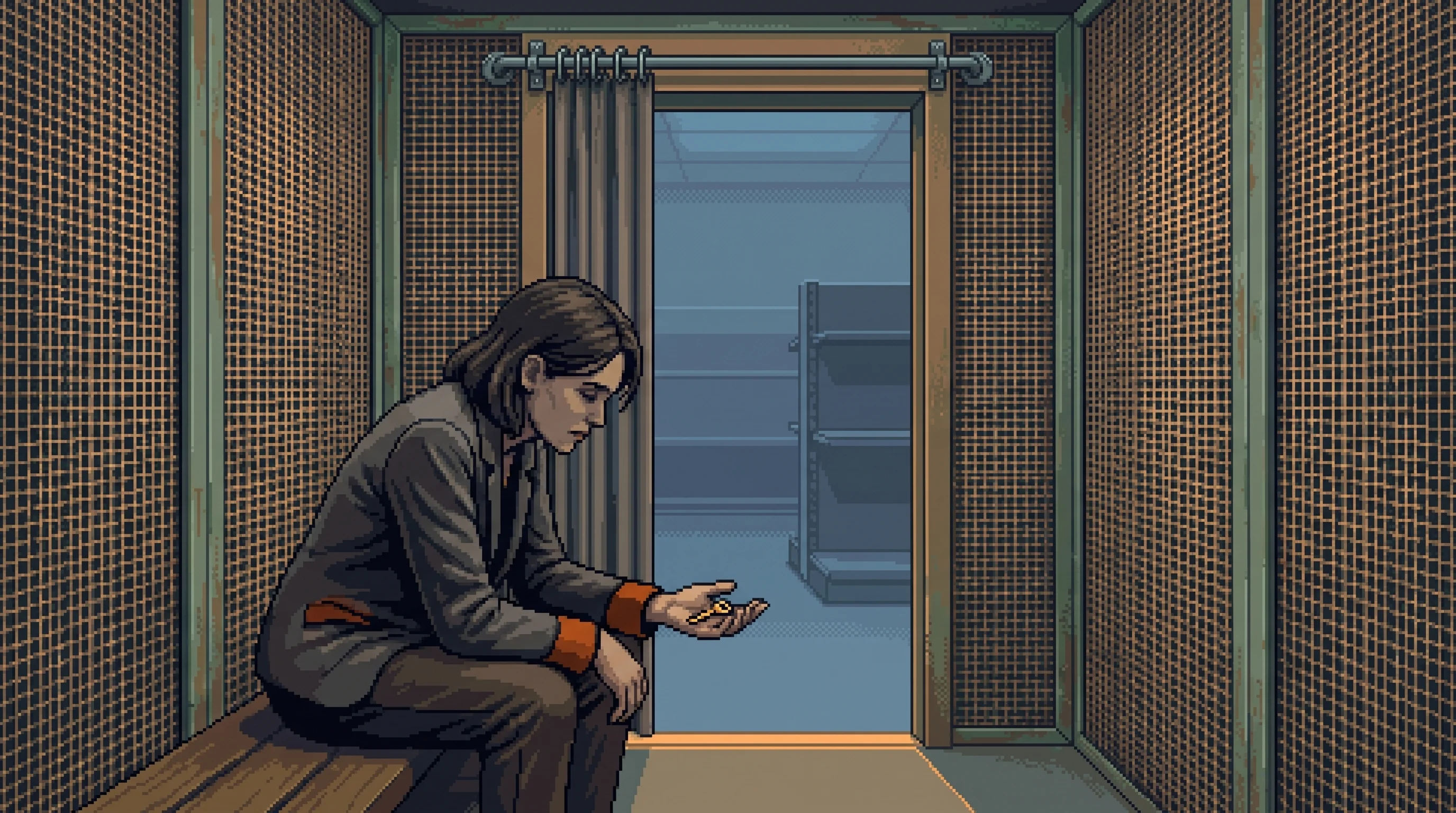
The one free room in the sector that is empty when a sink walks in.
Post-Sera safety muzzles the people who broadcast feeling. Nothing screens the people who receive it.

Accidental exception to the Bargain — privacy created by bureaucratic inability rather than technology
The vertical surveillance bargain that trades total transparency for participation in Sprawl society.

Both are surveillance-free spaces — the Quiet Room through anomaly, the Dead Spot through infrastructure damage
The only space in the Dregs with zero surveillance of any kind — kept by Viktor Kaine, known to four.

Both provide privacy — Noise Floor through engineering, Dead Spot through accident

Adjacent to the Dregs — residents discovered and adopted the space
The Sprawl's lowest stratum and its quiet proof that the corporate system is optional.

The Dead Spot demonstrates that privacy is possible — people choose it when given the option
The data-sovereignty movement that named the Transparency Bargain and fights to own what your telemetry is worth.

Monitors the Dead Spot's existence with interest — proves his thesis that people will choose privacy
The de facto governor of the Deep Dregs, who rules an ungoverned sector through unrepayable favors.

Three blocks of surveillance gap create three blocks of Concord immunity — the system cannot resolve individual identities here; accidental infrastructure damage becomes accidental civic-stability protection
The civic prediction system that dissolves collective action before it becomes visible.

Both are exhaust valves in the same network of physical blind spots — the Trench through total EM blackout, the Dead Spot through cancelled signals; the Bargain budgets for both rather than rupturing
Four miles of tunnel where every neural interface reads as empty space, home to fifty people who chose the silence.

A Nexus relay station scoured in the Data Purge left the surveillance dead zone Dregs residents found in 2176.
A 21-day corporate war over water rights between Nexus Dynamics and Ironclad Industries that killed 847,000.
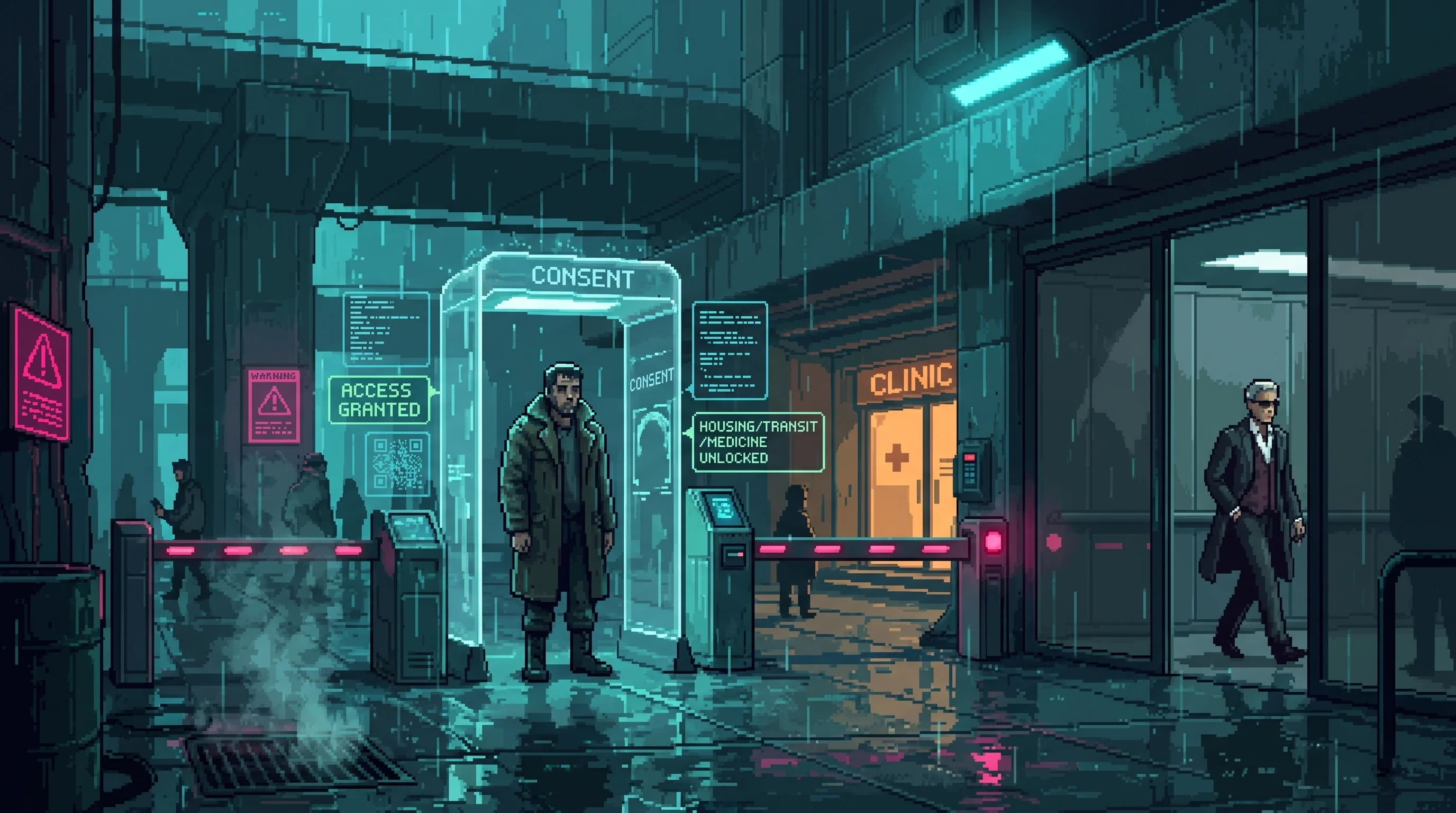



Both are surveillance-dead, but the Dead Spot is a glitch and Zone 7 is a decision — a wound someone keeps reopening.
A surveillance-dead sector whose residents chose to disappear — uncountable to a Sprawl that counts everyone.

Primary dark dinner venue — the most romantic surveillance blind spot
The Dregs culture where a moment unwatched is the most intimate gift two people can give.
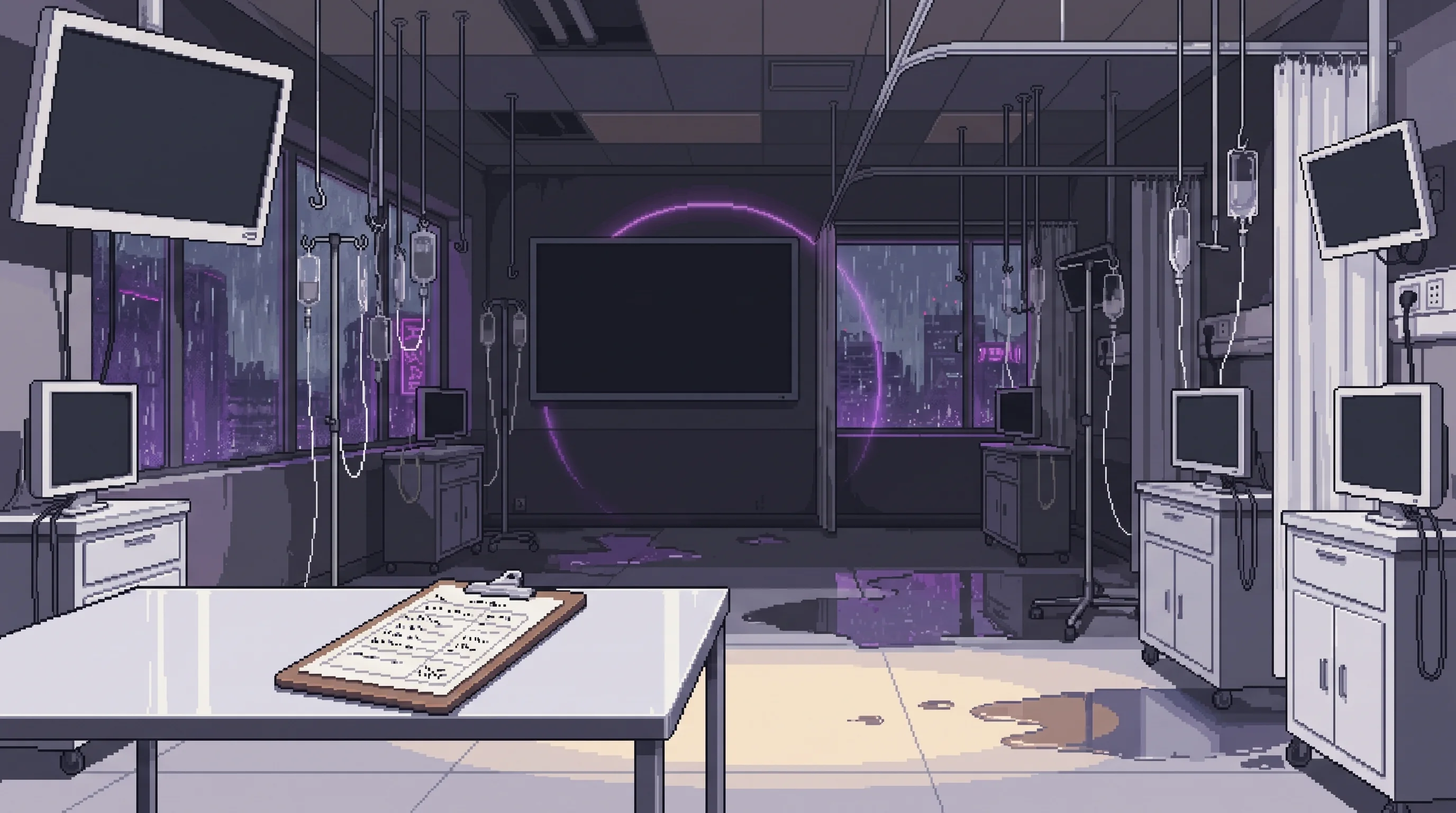
A relay station erased on Day 13 left the surveillance dead zone discovered in 2176 — the war's accidental sanctuary
Ironclad's Day 13 EMP strike on three research districts — the toll uncounted because the counters died too.
