The Quiet Room
Overview
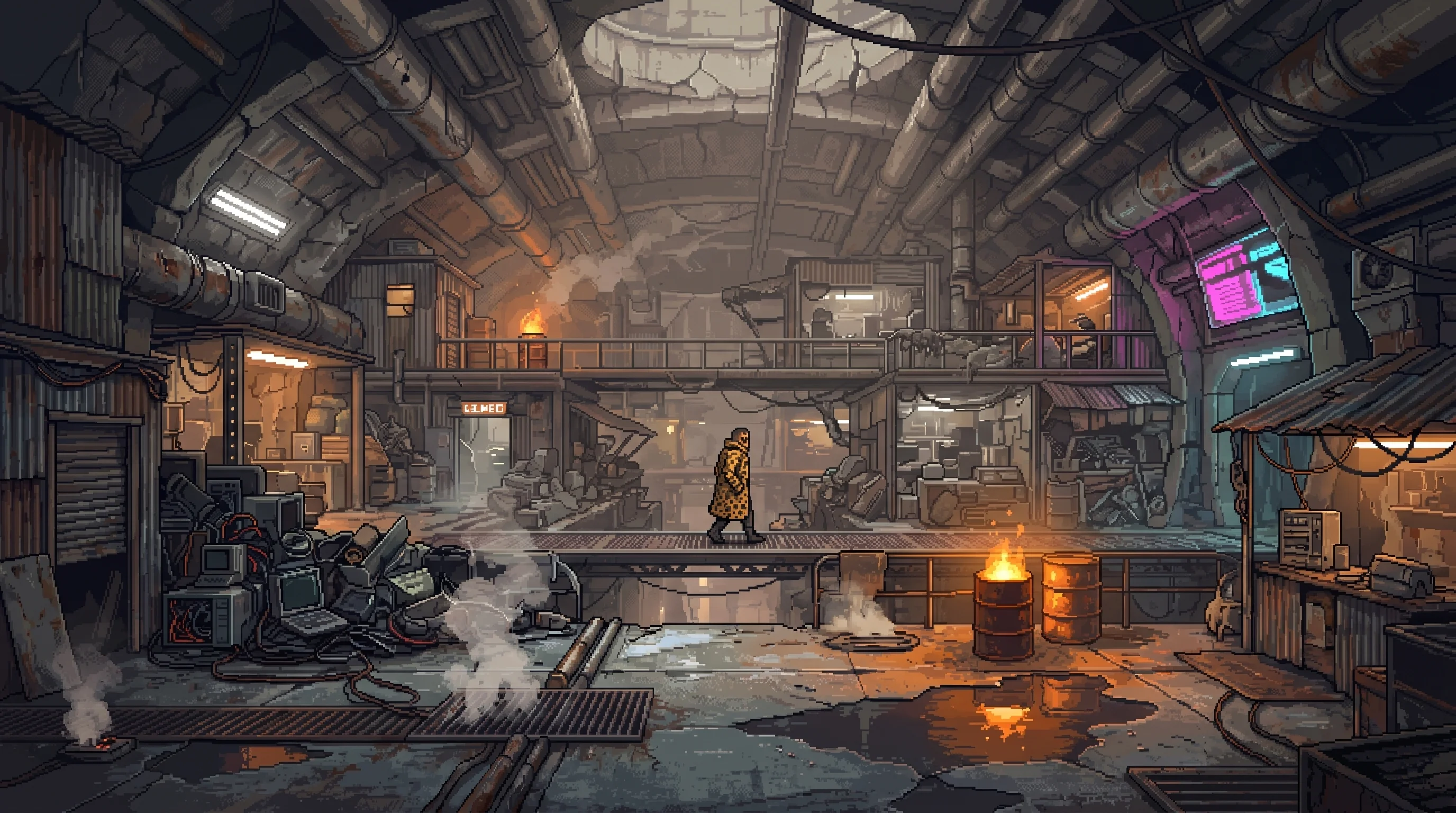
Behind the decommissioned water processing plant on Level 3 of The Deep Dregs, through a service corridor that hasn't appeared on maintenance logs since 2168, past a bulkhead door that requires a physical key Viktor Kaine carries on a cord around his neck — there is a concrete box where surveillance goes to die.
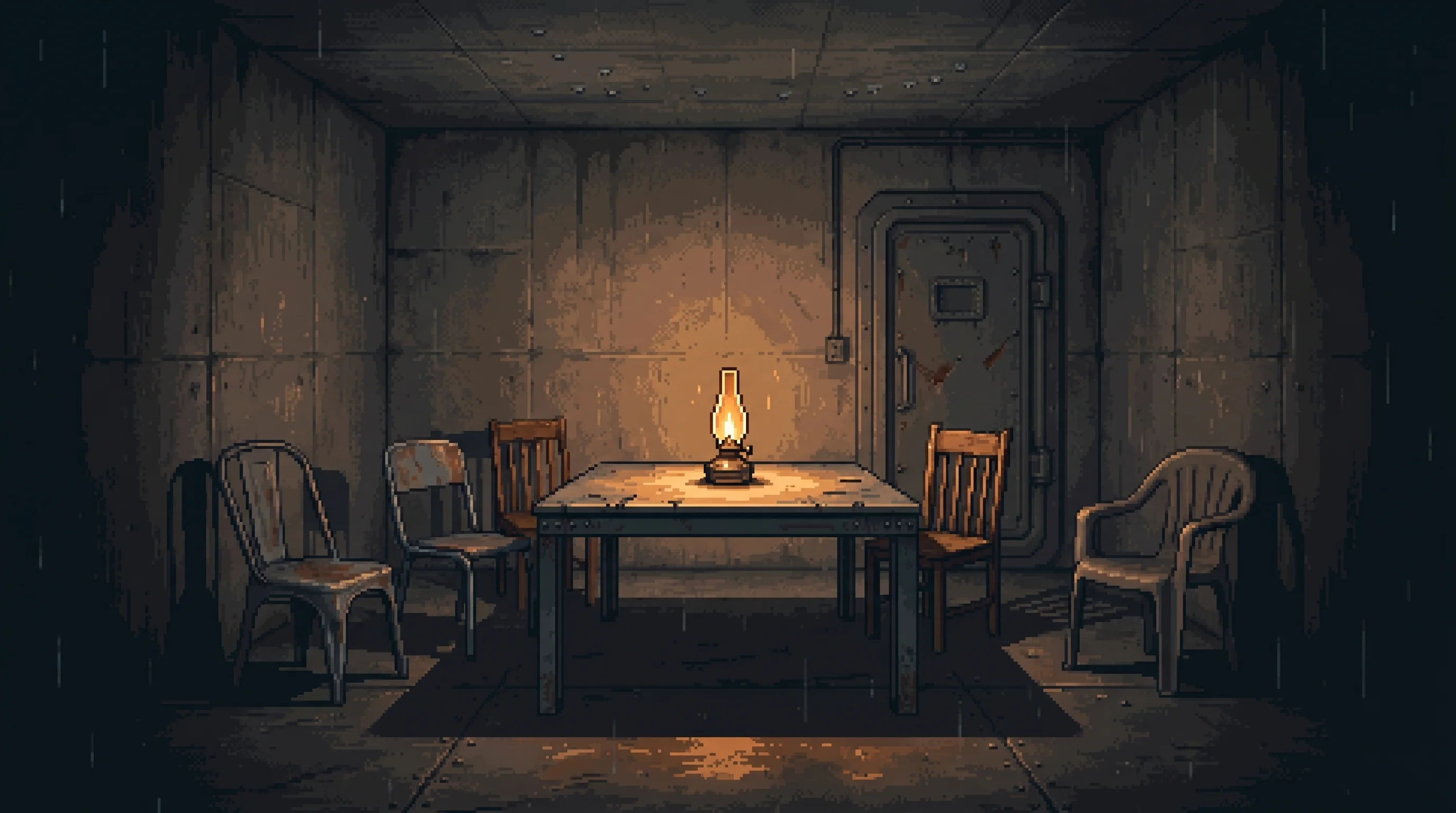
The Quiet Room is four meters square. Concrete walls. No windows. One entrance. A table bolted to the floor, six mismatched chairs, and a kerosene lamp Kaine replaces monthly. Inside, digital technology does not function. Neural interfaces go dormant. Communication signals die at the threshold. Recording devices produce static. Even the bio-monitoring subsystems that most augmented citizens carry as a condition of corporate employment fall silent. The effect is immediate, consistent, and unexplained.
Nobody installed a jammer. Nobody built a Faraday cage. The walls are ordinary concrete, tested twice. The floor is ordinary steel, tested once. Kaine found the room in 2153, when it was an unused supervisor's office in a water plant already failing. His comm link died at the threshold. He tested different equipment, different frequencies, different approaches. Nothing worked inside. He sealed the door, pocketed the key, and told no one for seven years.
Three decades later, the Quiet Room is the only known space in The Deep Dregs with zero surveillance coverage of any kind. In a district where Nexus passive-collection nodes average one per forty square meters, this is not an anomaly. It is a statistical impossibility that has persisted for thirty-one years without generating a maintenance ticket, a sensor gap report, or a single Observer task assignment within two hundred meters.
The Observers are either avoiding it or can't detect it. Nobody has determined which. Nobody with the authority to investigate has tried, which is its own kind of data.

Conditions Report
The moment you cross the bulkhead threshold, something subtracts. Not pain. Not discomfort. The constant low-frequency hum of your neural interface — the one you stopped noticing decades ago — stops. The micro-feedback of bio-monitoring, the faint signal-processing pressure behind your eyes, the always-on awareness of being networked — gone.
First-time visitors call it deafness. Not auditory. Cognitive. The removal of inputs you didn't know you were processing. Some find it peaceful. Some find it terrifying. Kaine, who has entered approximately four hundred times in thirty years, still pauses at the threshold every time.
"I count to three," he told El Money once. "After three, I'm just a man. No network. No interface. No record. Just what I remember and what I can prove with my own eyes." He tapped his cane against the concrete floor. "It's the only honest place left."
What he didn't say: the counting has gotten slower over the years.
The Furniture
The table is plain metal, bolted to the floor. No drawers, no hidden compartments. Its surface is scarred by decades of use — rings from cups, scratches from keys, one deep gouge Kaine won't explain. Everything in the Quiet Room happens across this table: negotiations, confessions, the exchanges of information that cannot survive light.
Six chairs. Mismatched. Three steel, two wooden, one plastic. They were here when Kaine found the room. He has never replaced them. His stated reasoning: nobody gets a position of power at a table where every seat is different. The unstated effect: in a room stripped of every digital status indicator — no Triumph Scores, no verification badges, no neural-profile assessment overlays — the chairs are the only hierarchy available, and they refuse to provide one.
A battery-powered flashlight sits in the table's single drawer — the one exception to the no-technology rule. Even this seems reluctant to cooperate. Its beam flickers uncertainly in the room's atmosphere, as if the room is tolerating it rather than permitting it.
| Economic Status | Non-commercial |
|---|---|
| Population | 0-6 at any time (by appointment only) |
| Elevation | Level 3 (sub-surface) |
What Honesty Costs
Kaine has used the room approximately thirteen times per year since 2160. Four hundred conversations, give or take, across three decades. Zero records. Zero transcripts. Zero evidence that any of them occurred.
The first was with a Collective operative who needed to share intelligence about an Ironclad weapons cache without interception. The operative entered, felt the silence, and nearly left. Kaine sat down first. The intelligence was good. The cache was found. The operative was later killed in an unrelated operation. Kaine does not discuss the early years.
El Money uses the room for negotiations that can't happen even in G Nook's encrypted back rooms. G Nook has encryption. The Quiet Room has nothing, which is better. The distinction matters: encryption is a promise made by technology that can be broken by better technology. Nothing cannot be broken because there is nothing to break. El Money's most consequential deals — the ones that don't appear in any ledger, that no faction claims credit for, that produced outcomes everyone benefits from and nobody can explain — share one commonality. They happened at a table with six mismatched chairs, lit by kerosene, in a room that shouldn't exist.
Kira "Patch" Vasquez is the third person who knows the location. She's examined the room's properties with her most sensitive detection equipment, which stopped functioning at the threshold like everything else. She has no explanation. She visits occasionally for her own reasons. Patch is not someone who tolerates unexplained phenomena patiently. The fact that she keeps returning without an answer suggests the room offers something she values more than the answer.
The fourth person has never been named. Speculation among those who know: Jin, the Collective handler. Raz Demetriou, the salvage merchant. Someone from Kaine's past who predates his role as The Deep Dregs's governor. Kaine does not clarify. The key hangs on his neck, and there are no copies.
Twelve conversations in the past year have not been shared with anyone. Given Kaine's age — seventy-eight, industrial lung, a cane that bears more weight each season — the subject matter is not difficult to guess. Who inherits the key inherits the room, and whoever inherits the room inherits the last private space in The Deep Dregs.
| Stratum | Dregs |
|---|---|
| Power Position | Parallel |
| Access | Restricted |
| Atmosphere | Sacred |
The Blind Spot
Mara Chen's Convergence Map shows eleven persistent blind spots across the Sprawl that haven't changed in three years. The Quiet Room is one of them. Mara doesn't know what's there. She knows something is protecting it — or more precisely, she knows that the absence of data in that location is too consistent to be accidental and too precise to be natural.
She's right about the precision. The technology-dampening effect extends exactly to the threshold of the bulkhead door. One centimeter outside, everything functions normally. This boundary does not drift, does not fluctuate, does not respond to environmental changes. Natural electromagnetic anomalies do not behave this way. Whatever defines the boundary is defining it with intention.
Kaine has hired engineers to examine the walls. Nothing unusual. Consulted ripperdocs about electromagnetic anomalies. No explanation. His private theory — shared with no one — is that the room sits above something old. Not ORACLE-old. Older. The kind of old that predates digital infrastructure entirely. Perhaps a natural anomaly in the bedrock. Perhaps something else.
He doesn't need to know. He needs it to keep working. The distinction between understanding and utility is one Kaine resolved decades ago. It is also, if you think about it, the distinction the entire Sprawl has failed to resolve about ORACLE.
What the Room Diagnoses
The Sprawl's surveillance infrastructure does not optimize for safety. It optimizes for behavioral prediction. Every conversation recorded, every movement tracked, every thought pattern modeled — the data isn't collected to protect people. It's collected because predicted behavior is monetizable behavior, and the corporations running the prediction engines have never found a data source they considered sufficient. Nexus's passive-collection density in the Dregs — one node per forty square meters in a district that generates almost zero commercial revenue — is not security. It's completionism. The system collects because collecting is what it does.
The Quiet Room reveals this by subtraction. Remove surveillance, and conversations change. Not in content — in kind. El Money doesn't just say different things here than in G Nook. He asks different questions. Patch doesn't just share different intelligence. She shares doubt, which is operationally worthless and personally essential, and which she has never expressed in any surveilled space because doubt, once recorded, becomes leverage.
The Keeper describes The Silence as "the void that makes consciousness possible." Visitors to the Quiet Room describe something adjacent — an absence that defines presence. Whether there's an actual connection or merely a thematic echo is unresolved. What is resolved: in every other room in the Sprawl, you are performing for an audience you cannot see, whose intentions you cannot know, and whose recording you cannot erase. The performance is so constant that it has become invisible. The Quiet Room makes it visible by removing it. The first three minutes are disorienting. The next three are the closest most visitors have felt to childhood since their first neural interface.
The Mountain resists corporate encroachment through geography and cultural inertia. The Quiet Room resists through an anomaly nobody can explain. Both are spaces where the Sprawl's logic breaks down. Kaine has noticed the parallel. He has drawn no conclusions. Drawing conclusions requires evidence, and the Quiet Room is the one place in the Sprawl where evidence cannot be created.
When nothing can be recorded, there is no reason to perform. When nothing can be fabricated, there is no reason to guard. In a world where proof has become indistinguishable from forgery, a space where proof cannot exist is the most honest space available.
Four meters square. Six chairs. One lamp. The most valuable room in the Dregs has no technology, no security, and no explanation.
No technology functions inside the room — an effect nobody can explain
Affiliated Entities
- Viktor Kaine: His most closely guarded asset. The room is an extension of his governance philosophy — some conversations must happen without records, or they can never be honest.
- El Money: Uses the room for negotiations that can't happen even in G Nook's secured back rooms. G Nook has encryption; the Quiet Room has nothing, which is better.
- Kira "Patch" Vasquez: One of three people who know the location. She's examined the room's properties and has no explanation. She visits occasionally for her own reasons.
- Mara Chen / The Convergence Map: The room appears on Mara's map as a persistent blind spot — one of eleven that hasn't changed in three years. She doesn't know what's there. She knows something is protecting it.
- The Observers: Observer tasks have never been assigned within 200 meters of the room. Whether the Observers are avoiding it or simply can't detect it is unknown.
- The Mountain: The Quiet Room's inexplicable properties echo The Mountain's resistance to corporate encroachment. Both are spaces where the Sprawl's logic breaks down. Kaine has noticed the parallel but drawn no conclusions.
- The Silence: The Keeper describes The Silence as "the void that makes consciousness possible." Visitors to the Quiet Room describe a similar quality — an absence that defines presence. Whether there is an actual connection or merely a thematic echo is deliberately unresolved.
Restricted Access
- The fourth person who knows the room's location has never been named by Kaine. Speculation among those who know: it might be Jin (Collective handler), Raz Demetriou (salvage merchant), or someone from Kaine's past who predates his role as The Deep Dregs's governor.
- The room's technology-dampening effect extends exactly to the threshold of the bulkhead door. One centimeter outside, everything works normally. This precision is not consistent with natural electromagnetic phenomena. Something is defining the boundary.
- Kaine has held twelve conversations in the Quiet Room in the past year that he has not shared with anyone. Given his age (78) and declining health (industrial lung), these may be succession planning sessions. Who inherits the key inherits the room — and whoever inherits the room inherits the last private space in The Deep Dregs.
Conditions Report
Sound
Your own breathing. Your heartbeat, if you're quiet. The creak of the chairs. The rare drip of condensation from a ceiling that predates the Sprawl's modern infrastructure. Underneath, the deep geological hum of bedrock that was here before the city, before ORACLE, before any of it. Some visitors report the silence has texture — not sound, but the feeling of a room that is attending. The way an empty church feels when you're the only person in it. Kaine has never commented on this. He has never disagreed.
Smell
Old concrete. Mineral-rich groundwater seeping through pre-Sprawl walls. A faint organic scent — not decay, not mold, something deeper, like soil. In a city where soil hasn't existed at street level for a century, the smell is almost archaeological. Kerosene from the lamp adds a warm amber note. Kaine uses kerosene because the smell is human, familiar, and has no data signature.
Temperature
16°C. Consistently, regardless of season or the Dregs' thermal fluctuations above. In a district where processing heat keeps corridors uncomfortably warm, the room is conspicuously cold. Visitors pull their jackets tighter. Conversations tend to be brief — not because the room encourages haste, but because the cold keeps you honest. You say what you came to say and leave.
Connected To


Local Intelligence Scan
Nearby Signals
CANONICAL PROXIMITY


Environmental Readout
LIVE CONDITIONS- Air
- Toxic
- Light
- Canyon dark
- Flood
- Seasonal
- Heat
- Trapped
- Security posture
- Ungoverned
- Infrastructure
- Improvised
Position Data
SECONDARY- Elevation band
- Bay floor — below the Rim
- Lattice fix
- E+3.7 · N+2.4
—