The Impression Ward
Overview
The Impression Ward occupies the sixth floor of the Sector 9 medical complex, same building as Dr. Kwan's Connection Ward, two blocks from Dr. Park's Synthesis Clinic. Three facilities treating conditions that don't officially exist, clustered in a district where building codes are suggestions and Guardian patrols average 1.3 officers per 40,000 residents. The patients end up here because they can't afford corporate medical, and corporate medical wouldn't know what to do with them anyway. Helix Biotech's diagnostic manual lists 4,200 recognized neurological conditions. Experience addiction is not one of them. Neither is borrowed-life syndrome.
Recognizing them would require acknowledging that the memory trade produces casualties. The memory trade generated ¢2.1 billion in revenue last quarter. The casualties number approximately 60 per quarter on this floor alone, which is the only floor counting.
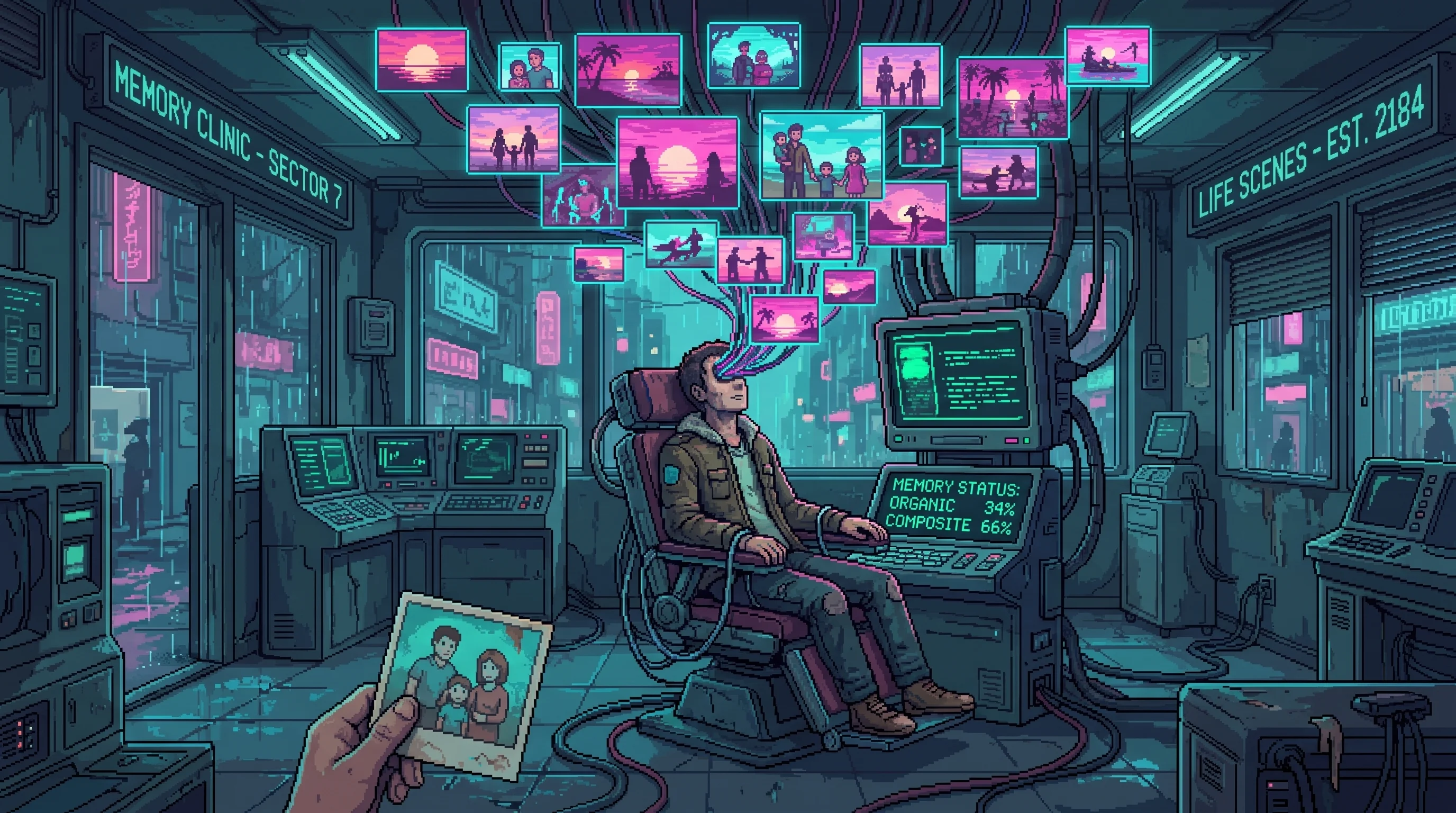
Approximately 60 patients cycle through each quarter. Their presenting complaint, translated from clinical language: they can no longer distinguish which of their memories happened to them. Some can't remember their own childhoods but can recall, in perfect sensory detail, a stranger's honeymoon in the orbital resorts. One intake form from Q3 2183 lists "favorite meal" as a Venetian dinner the patient has never eaten, in a city the patient has never visited, with a woman the patient has never met. The patient rated the memory 9.2 on the hedonic scale. His actual favorite meal — something his mother made, once, when he was six — he couldn't describe at all. It had been outcompeted.
Conditions Report
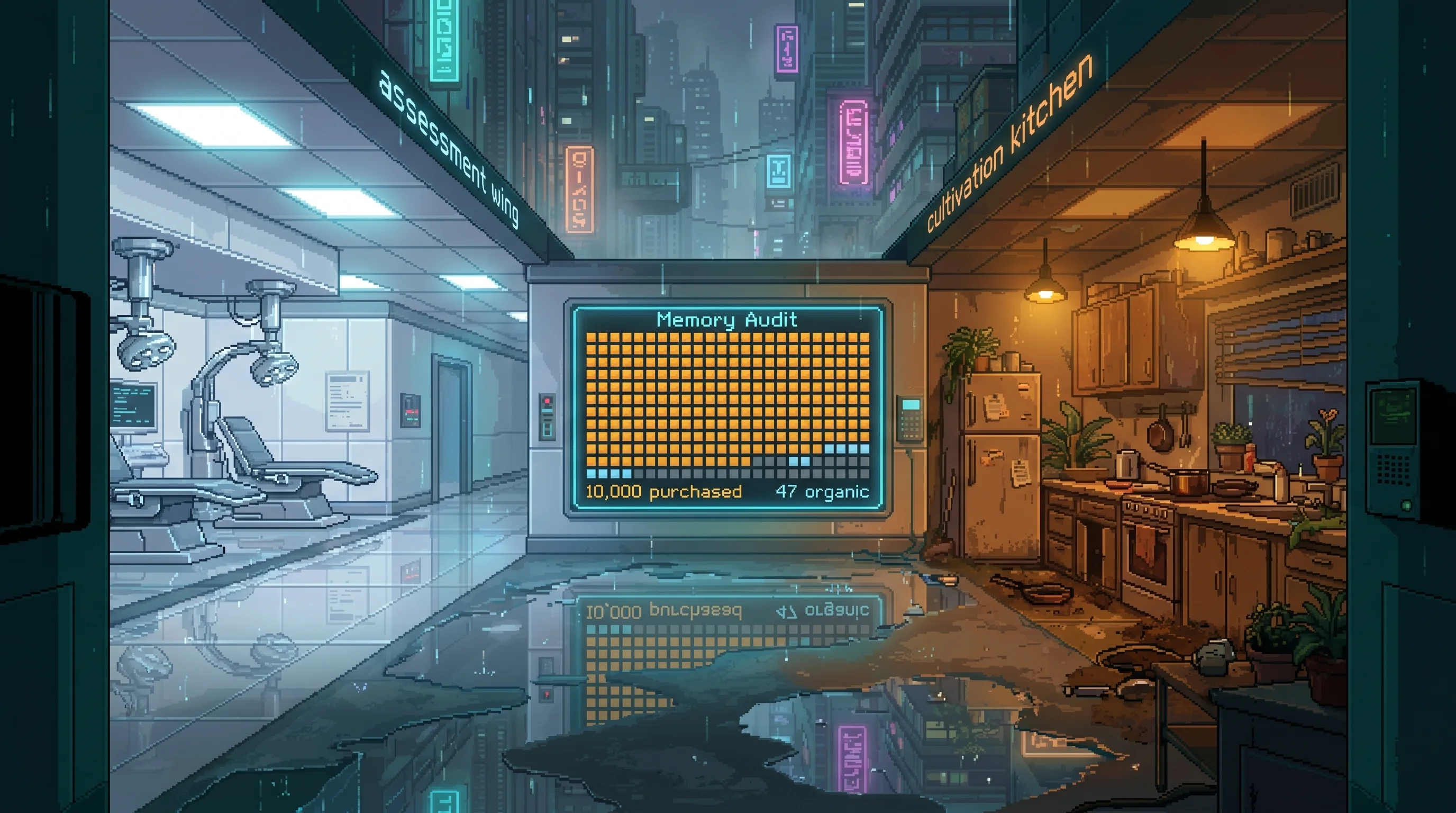
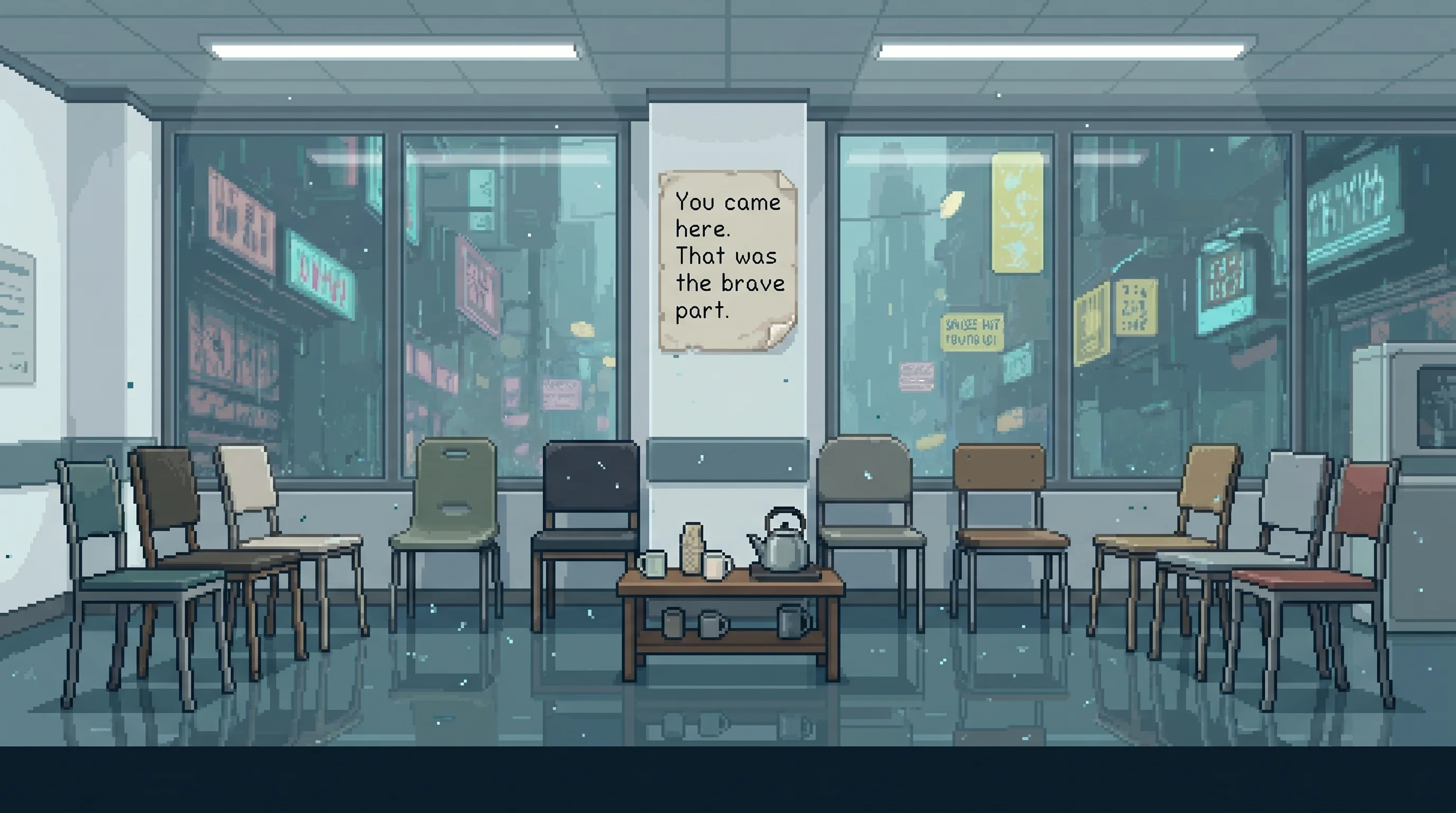
The sixth floor smells like medical-grade antiseptic and oolong tea, which is the smell of two philosophies occupying the same ventilation system. The assessment wing hums with neural mapping equipment — a low-frequency drone that patients describe as "the sound of someone reading your mail." The cultivation wing smells like burnt rice and garden soil and an argument someone had twenty minutes ago about whether the onions are done. The temperature in the assessment wing holds at 22°C. The cultivation wing fluctuates. Nobody controls it. That's the point. Curated temperature is one of the first things patients learn to stop expecting.
The transition hallway between the two wings is fourteen meters long. The lighting shifts from cool clinical to warm amber across those fourteen meters. Staff call it "the gradient." Patients who've completed treatment call it "the longest walk in Sector 9." Patients who haven't completed treatment don't call it anything because most of them are still deciding whether their discomfort is organic or purchased.

How It Works
The protocol was adapted from Dr. Aris Kwan's recursive comfort framework — the same therapeutic architecture the Connection Ward uses for companion dependency. Kwan designed it for one condition. The Impression Ward discovered it works for another. The common mechanism: the patient's neural architecture has been colonized by something optimized to feel better than reality, and reality needs to learn to compete.
Memory Audit (weeks 1-4). The patient's memory archive gets mapped. Every memory color-coded by origin — amber for purchased, cool blue for organic, gray for the ones nobody can classify. The audit produces a ratio. The ratio is the diagnosis.
Dez Okafor's ratio at intake: 47 organic memories to 10,000 purchased. Forty-seven. Out of more than ten thousand total memory events, forty-seven belonged to him. The audit flagged his anchor memory — the one his neural architecture weighted as most emotionally significant, the foundation everything else organized around — as synthetic. Purchased from a premium vendor. Hedonic rating: 9.7. His strongest organic memory rated 3.1. It was a Tuesday afternoon when nothing happened.
The ward considers a ratio above 200:10,000 "high-functioning." Below 100:10,000 is "critical." Below 50:10,000 has no official clinical designation because the diagnostic manual doesn't acknowledge the condition, so the staff use the term they've settled on informally: "ghost." Dez was three memories from ghost when he walked in. He walked in on his own. Most ghosts don't.
Staff have seen patients at 0:10,000. Full replacement. Every memory in the archive purchased, curated, optimized. These patients can describe their lives in extraordinary sensory detail — the food, the weather, the way the light hit the water. They cannot tell you their own name without checking.
Organic Cultivation (weeks 5-12). The opposite of everything the memory trade sells. Mundane. Specific. Unreproducible. Patients cook meals that don't turn out. They have conversations that stall and recover badly. They sit in rooms where nothing happens for intervals that feel longer than they are. One cultivation exercise involves standing in the building's stairwell for thirty minutes. The stairwell smells like concrete dust and recycled air. Nothing occurs. The memory it produces rates, on average, 1.4 on the hedonic scale. It is the patient's own 1.4. Neural architecture recognizes the difference even when the patient can't articulate it.
The goal is building organic memories robust enough to compete for neural resources against experiences engineered by companies that have spent decades optimizing for hedonic impact. A home-cooked meal against a Michelin-starred memory. An awkward silence against a purchased sunset. The odds are not good. The cultivation phase acknowledges this by existing anyway.
Integration (weeks 13-24). The patient learns to live as a hybrid — recognizing which memories are organic and which are purchased, weighting the organic deliberately, the way a musician learns to hear their own instrument in an orchestra that's louder, better-funded, and playing a more appealing song. The therapist does not ask patients to renounce purchased memories. Removal would produce cognitive damage. The purchased memories stay. They just stop being mistaken for a life.
| Adjacent To | Connection Ward (same building), Synthesis Clinic (2 blocks) |
|---|---|
| Treats | Experience addiction and borrowed-life syndrome |
Outcomes
Success rate at six months: 38% stable, 22% relapse, 40% hybrid — functional but still purchasing occasionally, the way a recovering addict keeps a bottle they claim they'll never open. The Memory Therapist Association practitioners who staff the ward consider 40% hybrid a success. The 22% who relapse tend to do so within the first seventy-two hours of discharge. The memory trade's vendor algorithms detect a returning customer's neural signature and offer a "welcome back" discount. The discount averages 30%. The relapse rate among patients who receive the discount: 94%.
Nobody at the ward has filed a complaint about the welcome-back discount. Filing a complaint would require a regulatory body that recognizes the condition, which would require a diagnostic code, which would require Helix Biotech to acknowledge that a ¢2.1-billion-per-quarter industry has a clinical downside. The ward's own existence is the complaint. The complaint has been noted by no one with the authority to act on it.
Because no licensing body acknowledges the conditions it treats, the ward's intake logs are shared with no licensing body — which makes its patient data the only longitudinal record of memory-dependency outcomes in the Sprawl. Several corporate research arms have made quiet inquiries for access. All were declined.
The lowest functional ratio the staff have rebuilt from is 12:10,000. One therapist, speaking without attribution: "We ran the audit three times. The 12 were real. We built from there. He completed the protocol. He's in the 38%. I don't know what that means about the other 88%." The staff do not discuss how often the audit reveals a patient's anchor memory to be synthetic. It happens more often than the intake numbers suggest. The ward files no incident report when it does. There is no form for it.
| Stratum | Middle |
|---|---|
| Power Position | Outsider |
| Access | Restricted |
| Atmosphere | Warm |
The Un-Simulable Reference
The ward's hardest cases are the patients whose anchor memory is not just borrowed but unfelt — subscribers to MoodLine™ whose affective Floor smoothed the original experience so thoroughly that there is no emotional residue to rebuild from. You cannot reconstruct a grief the patient never let themselves have. The ward's protocol depends on a flicker of real feeling somewhere in the architecture, and the Floor was purchased precisely to delete it.
So the staff do the thing Dr. Kwan does from the Connection Ward downstairs: they send these patients to the Deep Warren, to the Untuned, to stand near grief that is allowed to run at full amplitude. The corporate "absence simulations" score 3.1 out of 10 because a synthesized empty chair has no lived context. The Warren has nothing else. The widow grieving her father is the un-simulable reference the ward cannot manufacture and the Suffering Premium has already priced — and the ward, having no budget for the descent, simply writes the address on a card and hopes the patient can afford the lift.
Affiliated Entities
- The Connection Ward: Same building, same therapeutic ancestry. Dr. Kwan's recursive comfort framework treats companion dependency downstairs and memory dependency up here. The conditions are structural twins — both produced by corporate optimization of experiences the human nervous system was never designed to purchase.
- Dr. Aris Kwan: His framework was built for one crisis. The Impression Ward discovered it applies to another. He visits the sixth floor on Thursdays. He has not published on the adaptation. Publishing would require acknowledging experience addiction in a peer-reviewed journal, and peer-reviewed journals require diagnostic codes that don't exist.
- The Synthesis Clinic: Two blocks east. Different consciousness conditions, same medical district, same regulatory blind spot.
- Memory Therapists: MTA practitioners staff the ward. Their credentials are recognized by the MTA. The MTA is not recognized by Helix Biotech's medical licensing board. The practitioners are, by official standards, unlicensed. By outcomes, they are the only people in the Sprawl treating a condition that affects an estimated 400,000 residents.
- The Borrowed Life: The ward's primary referral source. Patients arrive when the borrowed life stops feeling like enough and starts feeling like everything. The transition is not always voluntary.
- Dez Okafor: Ratio 47:10,000. Anchor memory synthetic. The ward's most documented case because he agreed to let his audit data be used for training purposes. He is no longer available for follow-up questions. His case file remains the standard reference for ghost-threshold intake.
- The Insomnia Wards: All three — Insomnia, Connection, Impression — treat conditions created by optimizing away something the system doesn't value enough to track. Sleep, companionship, organic memory. Three floors of a building in Sector 9 treating the side effects of progress. The building has no official designation in Helix's medical directory. It has a waiting list.
Success rate: 38% at 6 months, 22% relapse, 40% stable hybrid
Visual Identity
Color palette: Clinical white in assessment, warm amber in cultivation, the fourteen-meter gradient between them
Key symbol: A Memory Audit display — the ratio rendered in amber and blue, 47:10,000, the gap made visible on a screen the diagnostic manual says shouldn't need to exist
Lighting: Cool and precise where memories are being catalogued. Warm and uncontrolled where new ones are being grown. The ward's architecture is its therapeutic argument: that light you didn't choose is worth more than light that was chosen for you
Treatment adapted from Dr. Kwan's recursive comfort framework
Not officially recognized — the Sprawl's medical system doesn't acknowledge experience addiction
Connected To




Local Intelligence Scan
Nearby Signals
CANONICAL PROXIMITY



Environmental Readout
LIVE CONDITIONS- Air
- Toxic
- Light
- Canyon dark
- Flood
- Seasonal
- Heat
- Trapped
- Security posture
- Ungoverned
- Infrastructure
- Improvised
Position Data
SECONDARY- Elevation band
- Bay floor — below the Rim
- Lattice fix
- E+4.5 · N+0.4
—
—