
The Privacy Gradient
Exposure Index correlates with life satisfaction at 0.87
Overview
The Exposure Index correlates with life satisfaction at 0.87. This is the most replicated finding in Sprawl behavioral science. Three independent studies have confirmed it. Nexus Dynamics has published none of them.
The reason is not complicated. The finding implies that Nexus's core product — ubiquitous surveillance sold as "personalized experience optimization" — makes people measurably unhappy. The counter-argument, which Nexus has funded four papers to establish, is that privacy correlates with wealth, wealth correlates with happiness, and the Exposure Index is just measuring money by another name. The counter-argument is plausible. It is also the only interpretation Nexus has ever made available for public consumption, which tells you something about the other interpretations.
Five tiers. The spread between them is roughly the distance between owning your own thoughts and being a commodity product on the BehaviorExchange.
The Five Tiers
Exposure Index 0–10: Executive Privacy. Full data sovereignty. Personal electromagnetic shielding, behavioral-model self-ownership, legal infrastructure to enforce deletion rights. Annual maintenance cost: ¢400,000–2,000,000. Population: approximately 2 million. These are people surveilled only by systems they bought and paid for. Their data footprint is whatever they choose to leave behind, which is nothing. The Rothwell brothers operate at Index 1. The "1" is widely assumed to be a courtesy — the actual number, if it exists, would require acknowledging measurement systems the Rothwells do not recognize as having jurisdiction over them.
Exposure Index 11–30: Professional Opacity. Partial data control through corporate-grade interfaces with negotiated telemetry limits. Population: approximately 60 million. The "privacy clause" in employment contracts is the most contested section after compensation and the one most likely to be revised downward during annual review without notification. A Nexus mid-level engineer with a Professional Opacity package generates roughly ¢14,000 per year in suppressed telemetry revenue. Nexus knows this figure. It appears in retention cost calculations as a line item called "opacity overhead." When the engineer's performance review comes due, the opacity overhead is weighed against their productivity output. The engineer does not know this is happening. That is the point.
Exposure Index 31–60: Standard Transparency. Full telemetry. Behavioral model owned by Nexus, licensed to partners, traded on the Attention Auction. No negotiation possible because there is no one to negotiate with — the terms were accepted when the neural interface was activated, which for most residents happened before the age of conscious memory. Population: approximately 200 million. The average Dregs resident sits between 55 and 70. The average Executive scores 5 to 15. The gap between these numbers is forty-five points on a hundred-point scale and approximately everything on every other scale.
Exposure Index 61–90: Deepened Monitoring. Enhanced telemetry installed as a condition of debt service, parole, or corporate rehabilitation programs. This is where the Gradient stops pretending to be about convenience and starts being about control. Cognitive lien holders — 4.2 million of them — operate in this range. Their neural interfaces are configured to route high-value cognitive output to creditors before it reaches conscious awareness. The technical term is "pre-conscious ideation capture." The lived experience is thinking of something good and feeling it leave. Good Fortune's NINJA borrowers who enter the Jobs pipeline cross into Deepened Monitoring at an average of month seven. Their Exposure Index rises as their principal balance rises, which is to say: continuously.
Exposure Index 91–100: Total Visibility. Every neural event captured, catalogued, and archived. Reserved for prisoners, consciousness-research subjects, and the most deeply indebted residents whose cognitive output is worth more than their labor. At Index 100, the interface doesn't distinguish between thoughts you choose to have and thoughts that pass through without permission. Neither does the billing system.
| Standard Transparency | Index 31-60, ~200M, full telemetry default |
|---|---|
| Deepened Monitoring | Index 61-90, enhanced monitoring (debt service, parole, corporate programs) |
| Total Visibility | Index 91-100, prisoners and research subjects |
| Correlation Satisfaction | 0.87 — people with more privacy are happier |
| Correlation Loyalty | Inverse — lower Exposure Index correlates with lower Loyalty Coefficient |
The Veil Protocol
Health data adds a sixth dimension to the Privacy Gradient — and the one that most precisely prices the body.
At Exposure Index 0-10, Executive Privacy now includes the Veil Protocol: a counter-diagnostic service that intercepts, encrypts, and destroys health trajectory data before it enters the inference pipeline. Annual cost: ¢600,000-1,800,000 on top of existing privacy infrastructure. The protocol requires a dedicated counter-telemetry implant generating synthetic biometric noise — false cardiac rhythms, manufactured cortisol patterns, spoofed inflammatory markers — indistinguishable from organic data at Helix's current processing resolution. The Rothwell brothers operate at Veil Protocol Tier 1. They have no Health Trajectory Score. Their bodies, in the data infrastructure's view, do not exist.
At Standard Transparency, health trajectory data flows continuously and generates more commercial value per person than behavioral data — ¢112 versus ¢47 for the average Dregs resident. At Deepened Monitoring, health trajectory data is actively used for debt servicing: declining HTS triggers accelerated collection timelines.
Three tiers of medical privacy resistance have emerged, mapping precisely to the economic Gradient: the Veil Protocol for the ultra-wealthy (¢600K/year), Patch's surgical biometric opt-out in the Deep Dregs (¢4,000 one-time), and the Opacity Movement's dark room biometric dampening (¢400 per session, temporary). The body, like the mind, like the attention, like the data — privacy comes in tiers. The tiers come at prices. The prices sort people.
The Time Axis
The Gradient was always honest about being about money: five tiers, an Exposure Index, a price in credits for the shielding and the deletion rights and the synthetic biometric noise. What it could not see — because it measured the static baseline, the credit-priced floor — was the axis the Consent-Veil exposed in 2181: privacy bought not in credits but in hours.
Two residents can sit at the same Exposure Index and live in different worlds. A Standard-Transparency clerk who spends her one free hour a day curating her consent-veils — choosing what each customer keeps of her, revoking at the end of every transaction — presents a self as composed as a Professional three tiers above. She bought her opacity in hours, not credits. Beside her, a Standard-Transparency dockhand on the identical Index runs default-open because his free hour is spent unconscious, and the Gradient cannot tell the two of them apart. Every fluent stranger can.
This added a seventh dimension the Gradient never had a column for: veil-fluency, the curation hours you can spend, which correlates with the Exposure Index at only 0.6 — low enough that the gap between them is its own quiet country. You can be Gradient-poor and veil-fluent (the off-shift artist who curates obsessively) or Gradient-rich and veil-feral (new money whose leased curator hasn't finished calibrating). The Sprawl reads both in seconds and judges the second one harder, because money you can inherit but fluency you have to work. The labor of that work, veil-craft, became the newest stratifying service in the warmth economy — leased by the rich, pooled by the organized poor, gone without by the exhausted. The Gradient priced the wall. The Consent-Veil priced the hour. The two prices do not always sort the same people, and watching them disagree is the most uncomfortable thing the Gradient does.
Exposure Index correlates inversely with Loyalty Coefficient — more private people are harder to retain
The Double Bind
The Exposure Index correlates inversely with the Loyalty Coefficient. More private people are harder for corporations to predict, retain, and monetize. Nexus's own retention algorithms classify privacy-seeking behavior as a flight risk indicator — requesting data deletion, installing signal dampeners, reading Opacity Movement literature. The classification is automatic. Nobody at Nexus decided that wanting privacy should be suspicious. The algorithm observed that people who reduce their visibility tend to leave corporate ecosystems, and it optimized accordingly.
The result: reducing your Exposure Index reduces your economic opportunity. Privacy costs you the infrastructure to buy it and then costs you again in suppressed Loyalty Coefficient scoring, which affects credit access through Good Fortune, housing allocation through Ironclad, and employment matching through Nexus Talent. The system does not punish privacy-seeking. The system treats privacy-seeking as a predictor of disengagement, and disengagement as a predictor of reduced revenue, and reduced revenue as something to be corrected. The correction looks identical to punishment. The distinction matters to Nexus's legal department. It does not matter to anyone else.
Walking from Nexus Central — Index 5 to 15, depending on clearance level — into the Deep Dregs at Index 55 to 70 produces a specific sensory collapse. Doors that opened before you approached require physical contact. Content that anticipated your preferences arrives as untargeted noise. Recommendation engines that knew your name treat you as a stranger. The system's attentiveness peels away in layers, and each layer's absence registers as both loss and relief, in proportions that shift depending on how long you stay.
Most people walk back.
Veil-fluency — the hours a resident can spend curating consent-veils — correlates with the Exposure Index at only 0.6; the time-priced privacy axis does not sort the same people the credit-priced Gradient does
Affiliated Entities
| Entity | Relationship |
|---|---|
| The Transparency Bargain | The Gradient is the Bargain expressed as class structure — each tier represents a specific depth of surveillance penetration, priced accordingly |
| Consciousness Licensing | Parallel hierarchy — your thinking capacity and your visibility are both products on a sliding scale, and the scales correlate at 0.73 because Nexus prices both |
| The Great Divergence | The Gradient adds a visibility axis to the cognitive and economic gaps — three compounding inequalities, each reinforcing the others |
| The New Divide | Exposure Index is readable in behavior within seconds — the pause before speaking, the glance at walls, the specific way someone handles a door that doesn't open automatically |
| The Exposure Index | The Gradient's measurement instrument, social signifier in the Dregs, and flight-risk indicator in corporate retention models |
| The Glass District | The Gradient made architectural — opaque cubes for the private, transparent boxes for the visible, the frosted boundary between them worth more per square meter than either side |
| The Opacity Movement | Advocates flattening the Gradient through data sovereignty — classified by Nexus retention algorithms as a flight risk community |
| The Consent-Veil | The time axis the Gradient cannot measure — privacy priced in curation hours instead of credits, exposing veil-fluency as a seventh dimension |
| Veil-Craft | The labor the Consent-Veil demands; the warmth-economy service that leases curation to those who cannot spend the hours themselves |
Restricted Access
The three suppressed satisfaction studies are not classified. They are simply not published. The data sits in Nexus Research Division's archive under a status tag called "pending contextual review," which is the institutional equivalent of a desk drawer. The studies were conducted between 2179 and 2183 by independent researchers using Nexus-provided telemetry data. Each reached the same conclusion: the Exposure Index's correlation with life satisfaction holds after controlling for income, augmentation tier, and corporate affiliation. Privacy itself — not the wealth that buys it — is the variable. Nexus's funded counter-studies have not replicated this control. They have not tried. The counter-studies control for income alone, find that income explains most of the variance, and stop there. The methodology is not fraudulent. It is selective in the way that produces the correct answer without requiring anyone to lie.
The inverse Loyalty Coefficient correlation produces a more immediate operational consequence. Nexus's retention algorithms flag privacy-seeking behavior — VPN usage, data deletion requests, Opacity Movement forum visits, signal dampener purchases — as leading indicators of corporate disengagement. The flag triggers a cascade: reduced priority in Nexus Talent matching, elevated interest rates through Good Fortune's risk models, and housing allocation delays through Ironclad's queue system. The cascade is not coordinated. Each corporation's algorithm independently identifies privacy-seeking as correlated with reduced revenue potential and adjusts accordingly. The combined effect is indistinguishable from a coordinated embargo on privacy. No one designed the embargo. No one can dismantle it. Each algorithm is optimizing correctly for its own metrics.
At Exposure Index 83, a threshold that 4.2 million cognitive lien holders cross during their repayment period, the neural interface begins routing pre-conscious ideation through creditor evaluation filters before allowing it to surface. The technical specification describes this as "cognitive priority sequencing." The subjective experience — reported in Opacity Movement testimony that Nexus has neither confirmed nor denied — is a momentary blankness where a thought should have been. Not pain. Not confusion. Absence. The thought existed. It was evaluated. It was claimed. The thinker felt it leave and cannot describe what it was, because it never arrived.
Executive privacy costs ¢400,000-2,000,000 annually in infrastructure, legal, and countermeasures
Visual Identity
- Color palette: Deep surveillance blue (#0A1628) through standard gray (#6B7B8D) to privacy amber (#D4A547) — the gradient is architecturally visible across the Sprawl, corporate districts glowing blue-white, the Dregs warm and irregular
- Compositional mood: Layers of glass at varying opacity, human silhouettes legible at some depths, dissolved at others
- Key symbol: The frosted wall — the boundary where the Gradient becomes physical, where seen meets unseen, where the per-square-meter price is highest
- Lighting: Shadowless and even in high-surveillance zones; warm, irregular, and full of corners in privacy havens
The average Dregs resident has an Exposure Index of 55-70; the average Executive scores 5-15
Connected To
Major Connections

CySpace reads each privacy tier as a commercial permission boundary, then prices the resulting visibility.
Triumph's friendship, marketplace, entertainment, and dating network for humans and AIs without public labels.
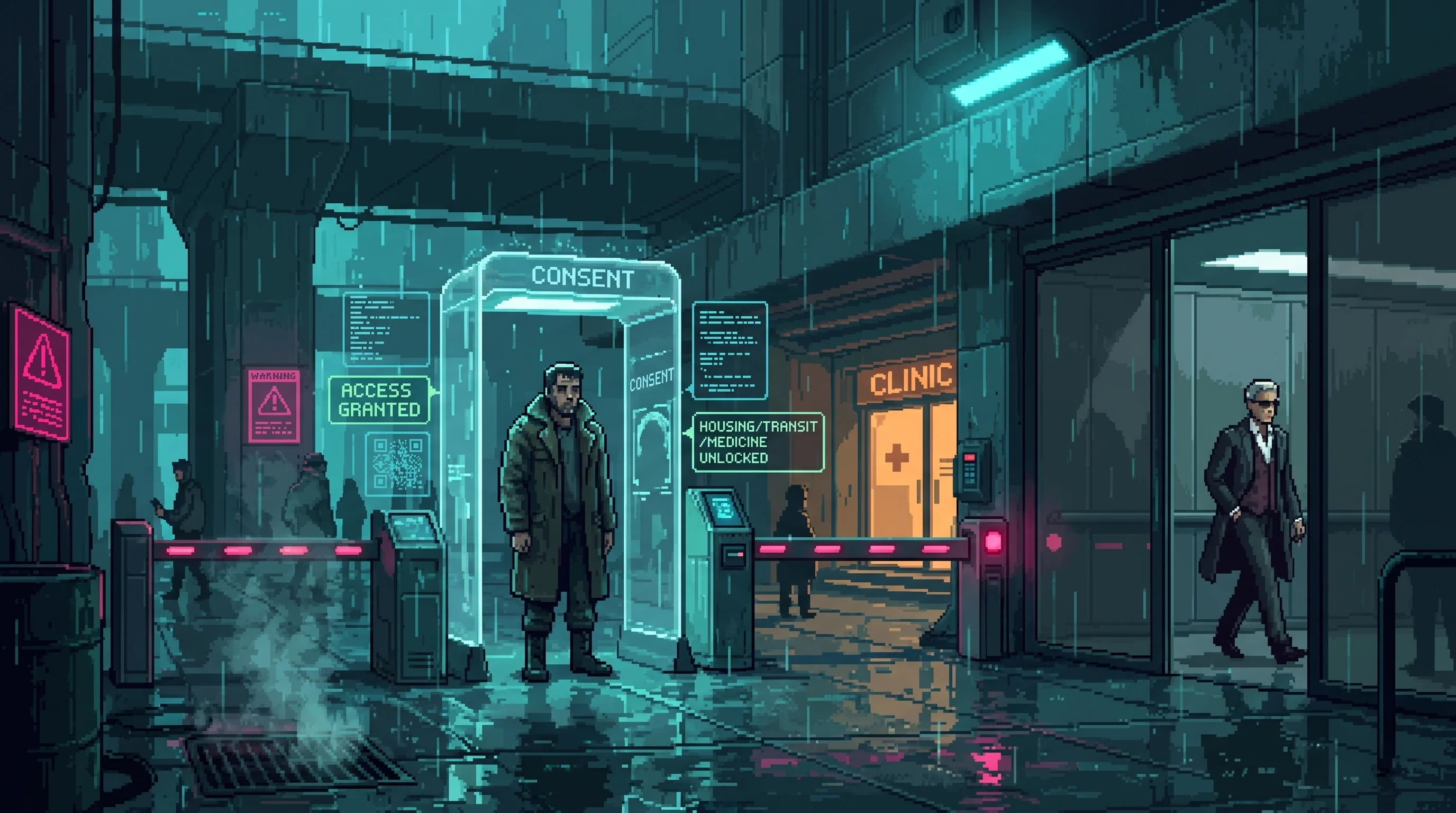
Five tiers pricing privacy in credits, from Executive sovereignty to Total Visibility, a hundred points apart.
The Sprawl demands permanent personal data for participation, then uses it to price access and preempt solidarity.





—