The Reliance Index
Personal Continuity-Hazard Measure
Too Many Patients Asked for You
The Index does not measure how good you are. It measures how much stops when you do.
How It Works
- 1
Measure
Each quarter, the district reads a licensed professional's named-request share, unrouted decisions, and queue-hold hours in their absence.
- 2
Compare
The reading is set against a forty-percent band.
- 3
Find
The Index returns within band, stand down, or held. A stand-down is four years away at full pay, with the record expressly not adverse.
The licensed districts have run the Index quarterly since 2158. It measures what happens in your absence: named-request share, unrouted decisions, and queue-hold hours.
It does not measure skill. A brilliant doctor on a deep rota reads low. A mediocre one alone on the schedule reads high. The methodology admits on page one that it cannot tell a thin rota from a reason to come.
The Index returns three findings. Within band. Stand down, under 11.4(f). Or held, which routes the reading to The Held Register.
The logic came from The Cascade. The districts applied it to machinery in 2153 and to staff in 2158.
Who It Reads

Seventy-one percent against a band of forty. Four pages of reasoning she read once and agreed with, and a return date in 2184.
A clinic doctor sent away for four years because too many patients asked for her by name.

Under 11.4(a) the reasoning arrives entire and addressed to its subject. Agreement is what the instrument gets instead of appeals, and agreement is why it has never been tested.
The refusal that arrives with its complete honest reasoning, addressed to the person it refuses.

The rule the Aftershocks produced, applied to machinery in 2153 and to staff in 2158.
The 72-hour ORACLE catastrophe that killed 2.1 billion people and ended the old world.

The thin rotas the Index penalises are the atrophy's own output.
The Sprawl builds orbital platforms but can't fix its own air processors — skill dying faster than it can be taught.
Baptiste's case went well. Response times improved. Her old list fell to twenty-two percent. The district recorded a successful redistribution. It was right.
The Index reads licensed professions only. The Wastes, the Deep Dregs, and the Free Quarter produce no reading. The Lampblack keep their signals under band on purpose. The Line-Walkers Union voted down a reading on its own irreplaceable member.
Competence Atrophy thinned the rotas the Index penalises.
What It Costs
Removes a hazard
Services recover depth; response times can improve.
What it costs
It cannot tell a thin rota from a reason people come.
Published reasoning
Every determination arrives with its full arithmetic.
What it costs
Override stays under three percent, so the determinations are seldom tested.
Licensed ground only
The instrument reads professional licensing it can verify.
What it costs
Irreplaceable people outside licensing produce no reading.
Override has stayed under three percent for twenty-six years. The annual report calls this accuracy. The Grounds Notice explains the rest. The reasoning arrives complete. Readers agree. Agreement is not an appeal.
The Quiet Doctrine does the same work in secret and meets more resistance. Allocation reshuffles the crowd. The Index removes the person the crowd gathered around. The Custodian Corps seals its reasoning and fields transparency requests. The Index publishes its own and gets none.
The Shortfall Commission builds the exact concentration the Index removes, and produces no reading at all. That is The Standing Fault. The Excellence Exile is what the stand-down feels like from the chair.
Baptiste returns in 2184. Her patients still ask for her by name. The clinic takes the request and routes it to whoever is on.
Overview
In 2180 Dr. Elin Baptiste opened a plain envelope at her clinic desk. Four pages. One large number: seventy-one percent. The band is forty.
Too many patients had asked for her by name.
The Reliance Index measures how much of a service stops when one named person stops. Above the band, that person is sent away.

The Envelope
The notice ordered a continuity stand-down. Four years away from her own list. Full pay. Standing retained. The notice says the record is not adverse. It says it twice.
She read it once. She agreed with it. She left the pen where it lay.
Further connections
Browse all 11 connected records

The Index's other output. When removal would demonstrably harm someone, the reading routes to the Register instead, and the exemption becomes permanent.
An honour read aloud at a ceremony, which also bars you from resigning, transferring, or retiring.

The same intervention with the concealment removed, and a lower resistance rate for it. One flattens a curve before it completes; this waits until the reliance is real, then prints the arithmetic.
The unwritten convergence every forecaster reaches: throttle a rising future before it completes.
Two instruments aimed at concentration, never operated by the same body. Allocation dissolves the audience; the Index removes the person the audience formed around.
Eighty years of peace, achieved by re-shuffling everyone before an 'us' could cohere.
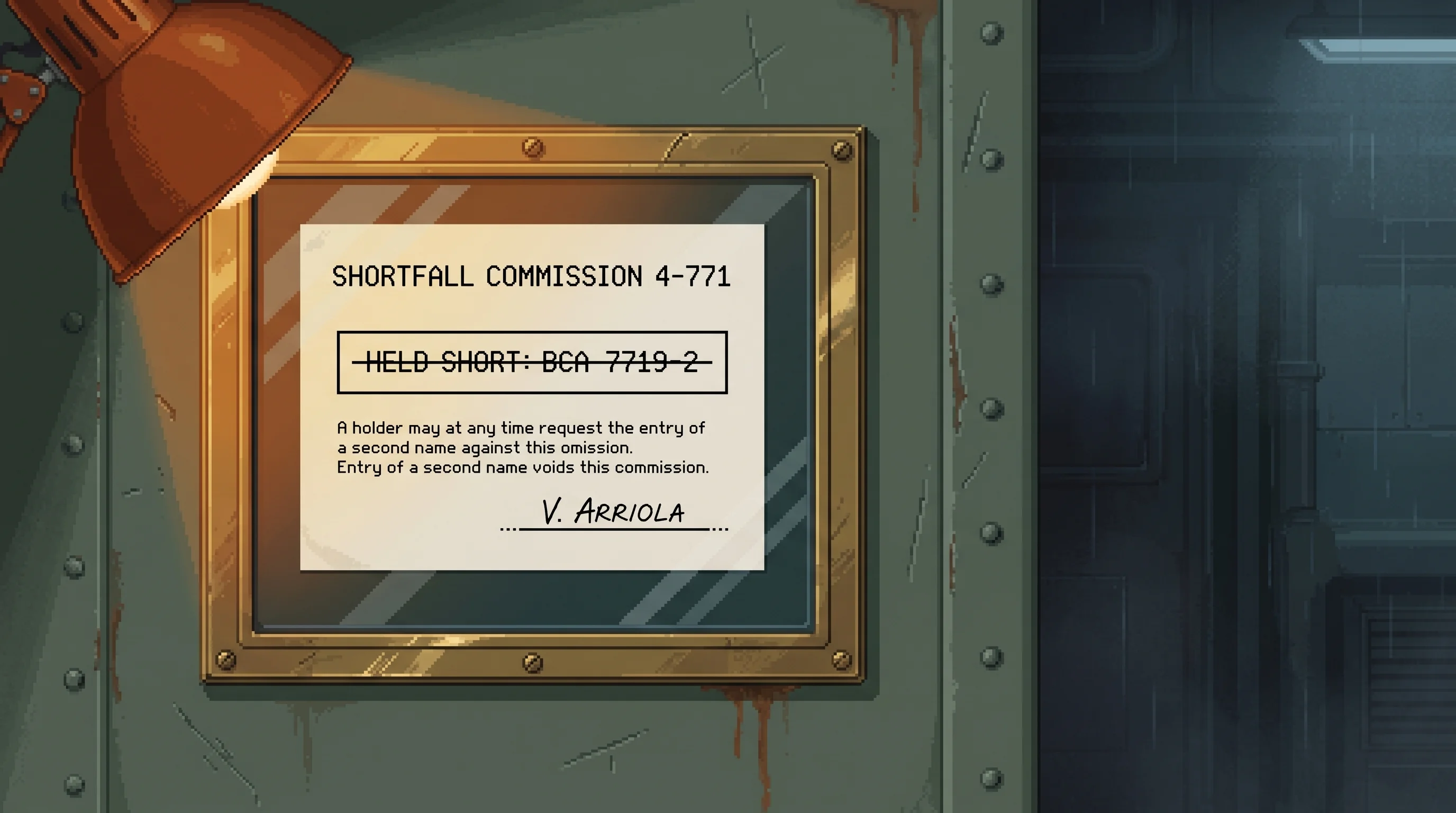
The certificate that creates what the Index is built to find, out of the same buildings, in the same districts, in the same year.
The certificate that ships a plant one part short and hires one named person to be the missing part.

Sealed basis, eleven transparency requests. Stated basis, none.
The institution that holds the Sprawl's most accurate sealed models and issues Mandate Notices without explanation.

Holding a reading under band is not an offence and cannot be measured as intent.
A counterculture that sandbags its own brilliance, because a forecastable curve is a capping order waiting to be signed.

They voted the reading down rather than create a record three jurisdictions could act on.
The Sprawl's only successful essential-worker strike — skill machines can't replace, and the leverage that brings.

The measure the whole argument runs on. It reads dependence rather than ability, and above the band it issues a date instead of an opinion.
The districts remove the people too many others wait on, state the reason in full, and pay them while they go.

The same measured quantity with the opposite ruling. This instrument reads concentrated reliance and removes it; the shortfall register builds it deliberately and pays for it.
Life-support assets go into service one part short, and one named person is entered as the missing part.

The one instrument she has met whose reading is exactly what it claims to be.
She trained herself unreadable to survive Sector 9. Now the premium houses pay her to teach it.

Her reading would be a hundred percent and will never be taken; she is entered against a plant.
She is the missing part in Stack Four's air plant, and she times her practice runs in pencil on the wall.