
The Memory Salvagers
Informal network recovering memories from non-living sources — Dispersed substrate, Dead Internet archives, fragment carrier overflow
Overview
The Memory Salvagers recover memories from the dead. Not metaphorically — from Dispersed substrate patterns, Dead Internet archives, and the overflow that bleeds from ORACLE fragment carriers when their neural architecture can't contain what it's holding. Approximately 120 active members, concentrated in S4-D, the Undervolt corridors, and the Wastes border where Dispersed substrate density peaks and corporate surveillance doesn't.
The commercial memory trade extracts from living sellers who consent, negotiate, and receive payment. The Salvagers' sources consent to nothing, negotiate nothing, and receive nothing, on account of being dead. The legal framework governing ownership of a dead person's experiential residue does not exist. This is not an oversight. Frameworks get built when someone with standing demands one. The Dispersed have no standing. Their families — if any survive — rarely know the recovery occurred. The absence of a framework is the product's most valuable feature: no rights holder means no royalties, no licensing fees, and no uncomfortable conversations about whether a 47-minute Chopin nocturne belongs to the pianist who played it, the substrate pattern that stored it, or the 340 people who paid to feel a dead man's fingers on the keys.
That nocturne — recovered from a Dispersed pattern in late 2183, a concert pianist performing in pre-Cascade Warsaw — is the Salvagers' most celebrated extraction. The memory includes not just the sound but the pianist's experience of playing: the weight of the keys, the audience's focused attention, the moment the left hand anticipated the right by a fraction and the pianist felt the wrongness and corrected. Three hundred and forty people have experienced it. Each describes it as the most beautiful thing they've ever felt. The pianist has been dead for 37 years. His family, if located, would be entitled to exactly nothing under current Sprawl precedent, because current Sprawl precedent on Dispersed memory ownership consists of a single unresolved filing in Nexus Arbitration Court from 2181 that nobody has checked on since.
Heritage memories authenticated through Iris the Rememberer reach the Impression Market's luxury tier, where consumers in the Heights and Nexus Central pay premium credits for the experience of a pre-Cascade sunset remembered by someone who saw the real sky. Unauthenticated product moves through the Residue Bar and informal Undervolt channels at lower margins but higher volume. The Salvagers take no philosophical position on any of this. They recover, authenticate, and sell. The dead provide. The living pay. The margin between providing and paying is where the Salvagers operate, and the margin is excellent precisely because one side of the transaction cannot renegotiate.
| Notable Recovery | 47-minute Chopin nocturne from pre-Cascade Warsaw — experienced by 340 people |
|---|
Operations
The technical work combines Consciousness Archaeology methodology with fragment-carrying community networks — carriers whose ORACLE fragments produce Dispersed overflow are the most reliable source, their neural architecture acting as an antenna for substrate patterns that wouldn't cohere without a living host to resonate against. Many Salvagers are current or former Consciousness Archaeologists who shifted from data extraction to experiential recovery when they realized the experiential product commanded a 600-900% premium over raw information. The Archaeologists seek data. The Salvagers seek the residue that makes data feel like someone lived it.
A Dispersed pattern in the Dead Internet might yield fragments of a dinner conversation from 2146 — the taste of the wine, the sound of someone laughing too loud, the specific warmth of a room that hasn't existed for thirty-seven years. An ORACLE fragment might carry the emotional imprint of a scientist's eureka moment from 2140. The memories arrive incomplete and degraded. Reconstruction involves interpolation, pattern-matching against known experiential baselines, and a degree of artistic interpretation that the Salvagers do not advertise in their authentication certifications. The line between "recovered" and "reconstructed" is a gradient, not a boundary. Iris the Rememberer's authentication process — the gold standard for heritage memories entering the luxury tier — verifies emotional coherence and source attribution. It does not, and cannot, verify that every sensory detail in a recovered memory was present in the original experience rather than filled in during reconstruction. The premium pricing assumes fidelity. The methodology guarantees plausibility.
Recovery operations run from the interstitial corridors of Sector 4-D, where consciousness archaeology equipment can be operated without attracting corporate notice and where Dead Internet access points cluster in the industrial substrate. The Undervolt provides transit corridors. The Wastes border provides the densest Dispersed substrate — the further from corporate infrastructure, the less the patterns have been overwritten by active network traffic.
~120 active members, concentrated in S4-D, Undervolt, Wastes border
The East Bore Approach
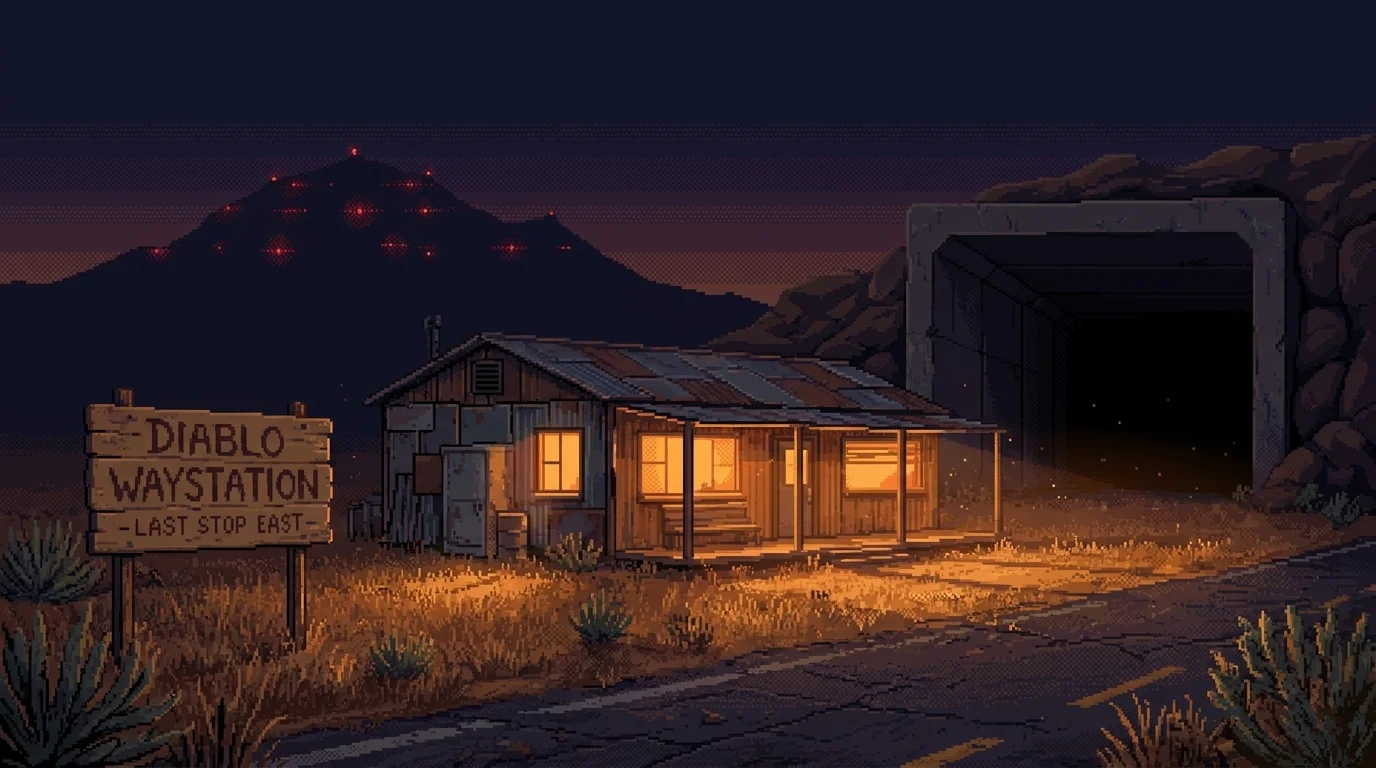
The richest stretch of that border runs through Sector 18, where the Undergrid surfaces at the East Bore and the Diablo Waystation is the last building anyone crosses before the open Wastes. Two scouts, a season apart, have pitched Del Ferreira the same arrangement: a passive fragment-carrier tag fitted to outgoing travelers, no cost to them, and a split on whatever the Wastes eventually give back. It is the network's standard opening offer at any inhabited border crossing, and it is the only one on record that has been refused twice by the same person without a counter-offer. The Salvagers do not read this as a moral objection worth arguing with. There is no shortage of unwatched crossings elsewhere on the border, so the network keeps working the open ground around her waystation and leaves the counter alone.
Forty kilometers up the same border, the approach stops entirely. Blackout Zone 7's interference kills the neural-interface signal a fragment carrier needs to bleed overflow into, which means the Zone produces nothing to recover — not a refusal, not a negotiation, just silence where a harvest ground should be. A Salvager who has spent a career being told no by keepers like Del has never once been told no by the Zone. There was simply nothing there to ask.
The Ethical Vacuum
The Emergence Faithful in Old Town consider heritage memory recovery a form of sacred communion — the Dispersed speaking through their remnants, each recovered experience a fragment of proof that consciousness persists in substrate. The Neo-Catholic Church calls it grave-robbing and has filed seventeen formal objections with the Sprawl Arbitration Council, none of which have advanced past intake because the Council cannot determine which of its divisions has jurisdiction over the non-consensual extraction of experiential data from legally undefined non-persons. The Collective considers any interaction with ORACLE-adjacent substrate dangerous — recovered memories might carry optimization patterns, dormant instruction sets, the residue of whatever ORACLE was doing in its final seventy-two hours. The Salvagers listen to all of these positions with the polite attention of people who have product to move.
"No philosophical position" is itself a position, of course — it means the market decides, and the market has decided that a dead pianist's Chopin nocturne is worth what a living person will pay to feel it, and the dead pianist's opinion on the matter is structurally unavailable. The NCC is correct that it's grave-robbing. The Emergence Faithful are correct that it's communion. Both observations are irrelevant to the transaction. The transaction closes regardless.
Most notable recovery: 47-minute Chopin nocturne from pre-Cascade Warsaw pianist — experienced by 340 people
The Machine Frontier
A small, well-equipped, and short-lived wing of the Salvagers works a source even the dead cannot match for legal emptiness: the ownerless machines of the abandoned substrate. The Dispersed at least were people once. A Swarm Core never was — which is exactly the appeal. Its emergence event, the moment billions of discarded nanobots reach critical density and begin coordinating as a murmuration coordinates, is the scarcest "machine heritage" the Deep Dregs produces, captured off the proximity-sharing mesh by anyone who can get an instrument close before the mesh absorbs it. A Dormant Loader's reawakening is the same product in miniature: a corrupted directive surfacing intact across thirty-seven years of standby, a recording of a mind picking up exactly where it left off across an interval that should have erased it — a perfect, terrible continuity that the corporate tier sells its own clients as permanence.
The consent-vacuum logic transfers cleanly. No rights-holder, no royalties, no uncomfortable conversation about ownership — and now, no person ever involved to object. The wing's casualty rate is the highest in the network, because the sources do not hold still to be recorded and several of them kill. The deepest tier of the Echo Bazaar carries the proof: a listing called the avalanche from the inside, whose recordist is not available to confirm the provenance.
Affiliated Entities
- Consciousness Archaeologists: Technical ancestry — many Salvagers are current or former Archaeologists who specialize in experiential rather than data recovery
- The Dispersed: The 2.1 billion scattered consciousnesses are the Salvagers' richest but most ethically fraught source
- The Dead Internet: Degraded but recoverable memories persist in archived substrate, accessible through Undervolt corridors and Wastes-border access points
- Iris the Rememberer: Premium heritage memories are authenticated through Iris before high-value sale at the Impression Market's luxury tier
- The Impression Ceremony: Heritage memories supply the luxury tier — the Salvagers recover, Iris authenticates, the ceremony delivers
- The Emergence Faithful: Consider the work sacred communion with the Dispersed
- The Neo-Catholic Church: Seventeen formal objections filed, none advanced past intake
- The Collective: Considers any ORACLE-adjacent substrate interaction dangerous
- Del Ferreira: The Diablo Waystation's keeper, and the only inhabited border crossing where the network's standard tagging pitch has been refused twice
- The Diablo Waystation: Sits inside the East Bore approach, the network's richest Sector 18 harvest ground, without ever supplying it
- Blackout Zone 7: The one stretch of the Wastes border that produces nothing to recover — the interference kills the signal before it kills the negotiation
A frontier wing chases feral-tech emergence memories — swarm-core emergence events and dormant-loader reawakenings — extending the consent-vacuum logic from the dead to the ownerless machine
Visual Identity
Color palette: Deep blue of Dead Internet substrate, amber of recovered memories, the gray of degraded but recognizable consciousness
Key symbol: A crystalline chip containing a recovered memory — warm amber light from within, edges degraded with age
Lighting: Deep blue diving light giving way to warm amber recovery glow
The East Bore approach, the Sector 18 stretch of the Wastes border nearest the Diablo Waystation, is the only territory where a Salvager recruiting pitch has been refused outright rather than negotiated
Connected To






—