
The Data Ratchet
Section 23.7 extends consent to all future modifications without re-consent requirement
Overview
The ratchet tightens one click per year, and no one has found the reverse.
In 2160, a Basic-tier neural interface broadcast 47 data points per second. A resident could walk through most of the Dregs without their interface handshaking a single commercial data broker. The walk took twenty minutes. It generated nothing. By 2184, the same walk broadcasts 4,700 data points per second — enough to reconstruct the walker's route, mood, destination, cortisol trajectory, and whether they paused outside a shop because they wanted something or because their knee hurt. The Analog Hour's twelve weekly minutes of surveillance darkness in The Deep Dregs is the largest known gap in coverage. Nexus's infrastructure team refers to it internally as "the defect." They have not been able to close it. The defect is protected by a phenomenon that, according to three separate engineering audits, should not exist.
The Dregs slang for the condition is "the glass ceiling that's also the floor." You can't go up — privacy costs more than you earn. You can't go back — the data already exists permanently. You stay where you are. The glass gets more transparent. You learn to stop noticing.
The Revenue Chain
The mechanism is not complicated. Each new data type generates revenue. The revenue funds the next extension. Section 23.7 of the Standard Neural Interface Agreement extends consent to "all future modifications, enhancements, and extensions." No new agreement required. The clause was drafted in 2158 by a Nexus legal team whose youngest member was thirty-four. The youngest person bound by it was twelve. The twelve-year-old's 4-second biometric confirmation — an involuntary blink pattern captured during first-boot calibration — constitutes informed consent to technologies that would not be invented for another twenty-six years.
Nobody at Nexus considers this predatory. The alternative — requiring re-consent for each telemetry extension — would generate an estimated 11.2 billion individual consent requests per year. The infrastructure cost alone would exceed ¢40 billion. Section 23.7 is, by every internal metric, an efficiency improvement. It is also the legal architecture that made the following chain possible:
Micro-expression analysis came online around 2172. Facial musculature data, captured through the neural interface's ambient biometric suite, enabled real-time emotional state classification accurate to 340 milliseconds before the subject consciously registered the emotion. Nexus licensed this to advertisers for ¢12 billion annually. The revenue funded sub-vocalization capture, added around 2176 — the monitoring of laryngeal micro-movements that occur when a person thinks in words without speaking. Pre-conscious thought monitoring generated ¢28 billion annually and funded physiological stress signatures in 2178, which enabled what Cognitive Load Pricing's architects call "vulnerability-window optimization" and what the Opacity Movement calls "kicking people when they're down." That revenue is classified. It funded dream-state monitoring through CMP-4.7, also 2176, enabling Night Shift labor extraction at ¢6 billion annually — the harvesting of cognitive surplus from sleeping minds who consented to "optimization services" and received, in exchange, a 3% reduction in their consciousness licensing fees.
Social proximity mapping arrived around 2180. Real-time cognitive pattern classification followed in 2182, producing what Nexus's product division markets as "consciousness trajectory prediction" — the ability to model, with 73.8% accuracy, what a person will want before the wanting begins.
Each extension paid for itself. Each justified the next. The ratchet is self-funding in the way that a casino is self-funding: the house's cut on each round is modest, and the game never ends.
| Telemetry 2184 | 4,700 data points per second |
|---|---|
| Mechanism | Each new data type generates revenue → funds next extension → automatically covered by perpetual consent (Section 23.7) |
| Reversal | None — no legal or technical mechanism to reduce telemetry granularity once extended |
| Largest Remaining Gap | The Analog Hour — 12 minutes weekly in The Deep Dregs |
The Temporal Dimension
The ratchet's newest click is backwards.
Retroactive inference — the application of 2184 analytical tools to data collected years or decades earlier — means the permanent record grows in both directions simultaneously. A behavioral telemetry reading from 2170, captured when interfaces broadcast only 340 data points per second, can now be reprocessed through current inference engines to reconstruct emotional states, social connections, and cognitive patterns the original recording was never designed to capture.
Nexus calls this "data archaeology." The Opacity Movement calls it "temporal trespass." The legal framework settled the question in Nexus v. Katsaros (2181): the court ruled that Section 23.7's perpetual consent covers retroactive reprocessing of historical data. The consent you granted at twelve covers the reinterpretation of your past using tools your past self could not have imagined.
The practical consequence is specific and strange. A Dregs resident named Yael Katsaros — the defendant in the landmark case — had her 2168 telemetry data reprocessed in 2181 using inference tools that did not exist when the data was collected. The original recording was 47 data points per second: location, basic vitals, interface usage. Standard ambient noise. Thirteen years later, Nexus's retroactive inference engine extracted, from that same recording, her probable emotional state during a conversation with a person she had not spoken to since, the content of the conversation reconstructed from stress signatures and sub-vocalization residue, and the 68.4% likelihood that she was lying about something the inference engine classified as "financially material." Good Fortune used the output to adjust her credit profile. Her borrowing rate increased by 1.7 points. She was not notified. She learned about it during discovery, three years later, when she sued.
She lost. Section 23.7.
The permanent record's most disturbing property is not its completeness. It is its retroactivity. Your 2170 self is being reprocessed this quarter. Moments you experienced as private are being re-examined with instruments your past self could not have conceived of. The past you thought was yours is being reclaimed by the system that archived it. The ratchet does not only tighten forward. It reaches back and tightens what was already loose.
Neural interface telemetry increased 100x from 47 data points/second (2160) to 4,700 (2184)
Sensory Details
The ratchet is not experienced as surveillance. It is experienced as the progressive disappearance of cognitive solitude — the slow, ambient evaporation of the sensation that your thoughts are yours.
In 2160, there were hours of genuine darkness. A walk through the Dregs at 3 AM was private the way a forest is private: not because someone guaranteed it, but because no one was there. By 2184, the same walk generates 16.9 million data points. Enough to fill a dossier. Nobody fills the dossier. Nobody needs to. The data sits in Nexus's distributed storage architecture, inert and permanent, until someone — an advertiser, a lender, a retroactive inference engine running thirteen years from now — finds a profitable question to ask it.
The ratchet does not feel like tightening. It feels like the world getting more responsive. Your interface loads faster. Ads arrive for things you were about to want. The coffee shop on the corner knows your order before you do because your stress signatures were classified four blocks ago and the optimal caffeine intervention was dispatched to the nearest vendor. Convenient. Frictionless. The 4,700 data points per second are the price, and the price is invisible, and the invoice arrives in a format that looks like better service.
A Nexus satisfaction survey from Q3 2183 found that 71% of Basic-tier users rate their neural interface experience as "good" or "excellent." The same survey found that 4% of Basic-tier users can correctly identify how many data points per second their interface broadcasts. The 71% and the 4% are not in tension. They are the same phenomenon measured from different angles. The ratchet works because the people inside it are comfortable. The comfort is not incidental. The comfort is the product. The surveillance is the price. The price is not listed.
Each telemetry extension is revenue-positive — micro-expression data funded sub-vocalization capture, which funded dream-state monitoring
Visual Identity
- Color palette: Cool blue data streams intensifying over time — the same shade growing brighter and more saturated with each year, the way a room gets warmer so gradually you never open a window
- Key symbol: A translucent wall losing its opacity — not shattering, not cracking, just slowly becoming glass, then becoming air
- Lighting: The steady, even illumination of total coverage. No shadows. No corners. The light does not feel oppressive. It feels like good design.
Affiliated Entities
- The Transparency Bargain: The Data Ratchet is the enforcement mechanism that makes the Bargain irreversible. Each click tightens surveillance permanently. The Bargain asks "would you trade privacy for convenience?" The Ratchet is the discovery that the trade was one-way.
- The Consent Architecture: Section 23.7's perpetual consent provision is the legal foundation. Without it, each telemetry extension would require 11.2 billion individual re-consent requests. With it, a twelve-year-old's blink covers everything forever.
- Cognitive Load Pricing: CLP is both product of and contributor to the ratchet. Telemetry enables CLP's vulnerability-window pricing. CLP revenue funds the next telemetry extension. The loop is tight enough to be called elegant by the people who built it.
- The Analog Hour: The largest remaining gap — twelve minutes weekly that the system cannot close, protected by something the engineering audits cannot explain. Nexus has tried. The defect persists.
- Nexus Dynamics: Operates the ratchet through firmware updates that add telemetry capabilities. Each update is a "performance enhancement." Each performance enhancement broadcasts more.
- The Time Ratchet: The financial parallel. Both are irreversible escalation mechanisms where each step funds the next. The Data Ratchet monetizes what you think. The Time Ratchet monetizes what you owe. Neither has a reverse gear. Together they describe the shape of a life in the Sprawl: watched and indebted, comfortable and trapped.
- The Permanent Record: Where the ratchet's output goes to live forever. Retroactive inference means the record grows more detailed about your past every time Nexus deploys a better analytical tool. The record never shrinks. The record never forgets. The record gets smarter about things it already knew.
- Clean Slate: The one product the ratchet cannot improve its way past, for a while. A fabricated biography with no real telemetry underneath it gives the reprocessing engine nothing to sharpen. It works until an analytical tool nobody had yet invented cross-references a fake employer against the actual power grid and finds eleven years of zero draw.
- The Verified Recall: The Ratchet's temporal trespass built the substrate for The Verified Recall — once retroactive inference demonstrated the archive was more accurate than memory for past events, the Reconstruction Accuracy Commission extended the principle to living subjects' self-narrative; the ratchet applied to memory not as a record but as primary testimony.
Connected To
Primary Connections

CySpace adds permanent telemetry streams whenever a social feature becomes profitable.
Triumph's friendship, marketplace, entertainment, and dating network for humans and AIs without public labels.
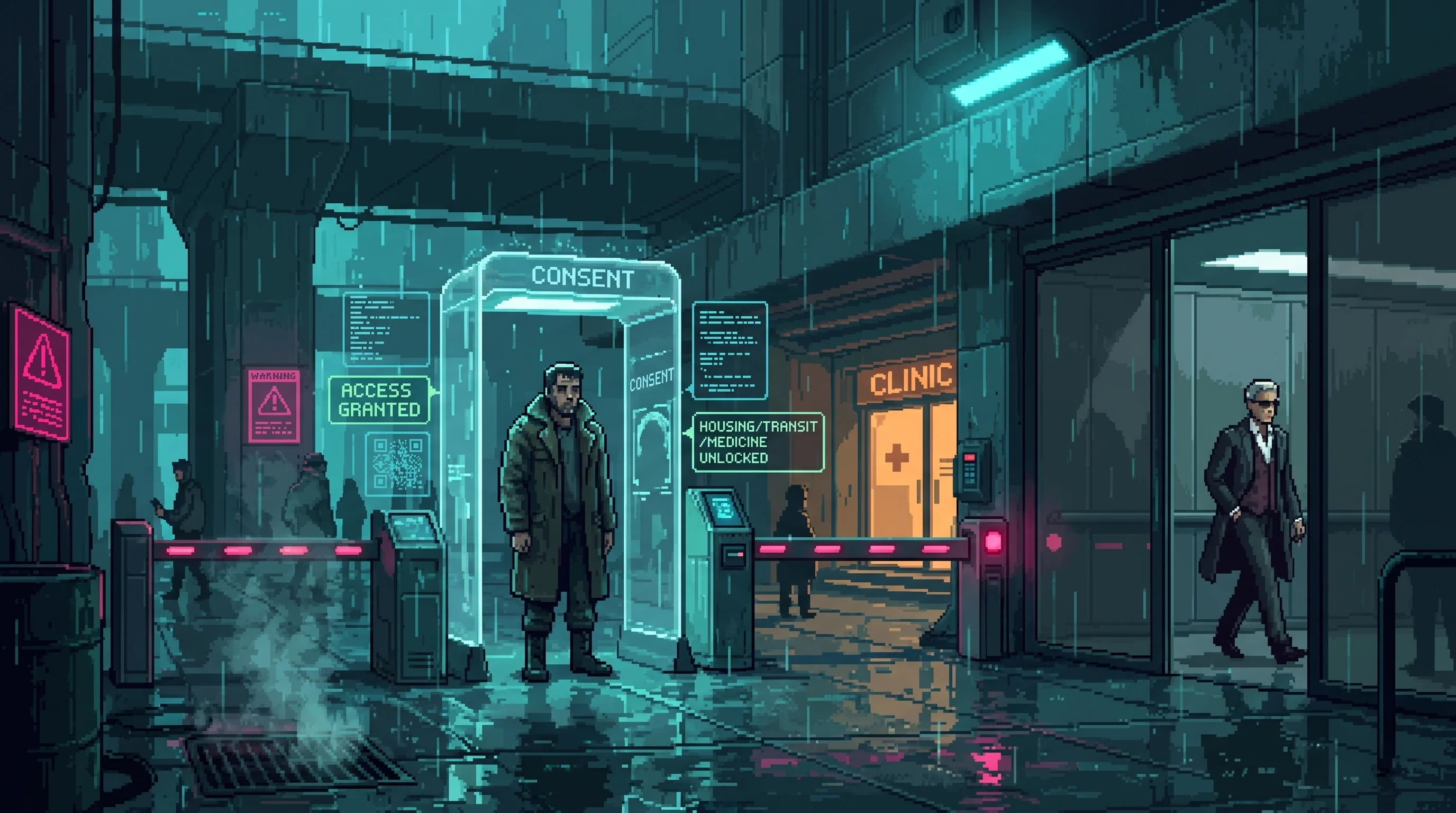
The bargain's missing reverse gear, made mechanical: 47 telemetry points a second in 2160, 4,700 by 2184, Section 23.7 pre-consenting each increase to come. Privacy trades one way — the walk that once generated nothing now generates you.
The Sprawl demands permanent personal data for participation, then uses it to price access and preempt solidarity.
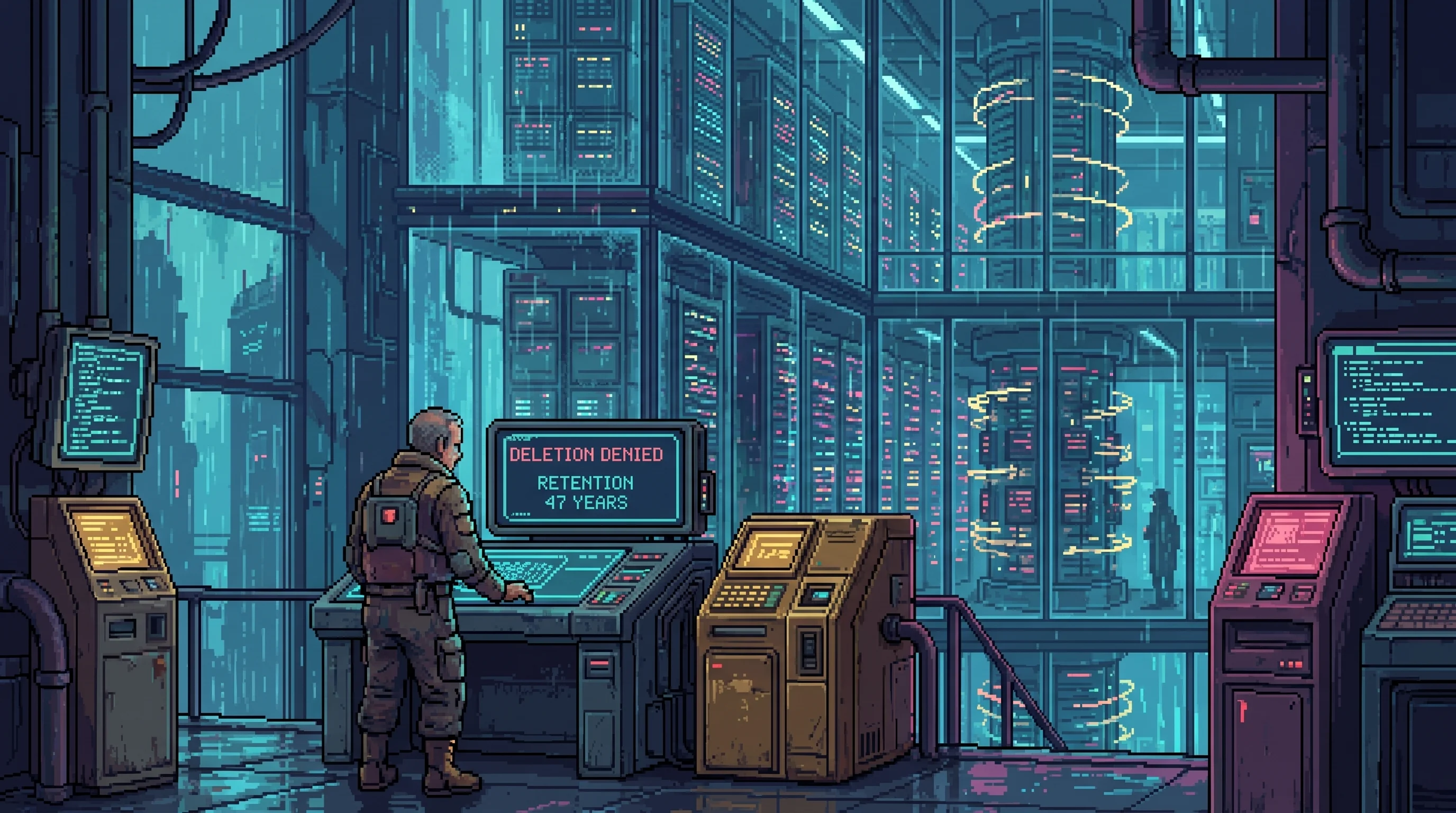
The Ratchet is why the record grows backward — a 2170 recording, reprocessed in 2181 with tools that didn't exist yet, cost Yael Katsaros a credit-rate hike she was never told about.
Nothing expires, so forgetting became a service — and forgiveness a question the archive keeps answering no.




—