
The Anchorage Stranding
The assault won the airspace in ninety minutes and then stood still for eleven hours: settled platforms holding queued authorizations closed the ground to both armies, and the field was cleared by the Last Mile at card rate, under spoken salvage terms, over one tide

Overview
Three days after the Refinery Massacre, the same theater, one wharf over. The Pinole enclave was dying — its plant a sealed ruin, its people and portable assets going out by water, barge by barge, under the mesh of the Hesitation's port cover. The anchorage that had fed the refinery belt its feedstock was now the enclave's back door. Ironclad Industries wanted the door shut. The order went out under the name Operation COFFERDAM, filed as marine enclosure and dewatering works, and for once the house voice was being precise. A cofferdam seals a basin and pumps it dry so you can work the bottom. Ironclad proposed to seal the harbor, pump the network out of the sky, and work whatever was left standing on the mud.
The instrument was new. The Pink Slip family — the Shout, the Slip, Birdlime — had been fielded piecemeal since Day 9; Day 12 was its first massed employment, all three members, batteries deep. The Slip's darts spoke Nexus's own session grammar, lifted from the server halls of Operation Bedrock a week earlier and read closely by the munitions division. The opening ground campaign of the war had seized eleven addresses and failed to move a number. Its filing cabinet, weaponized, was about to stop an airspace.
What the day is remembered for is not the ninety minutes it took to win it. It is the eleven hours nobody moved, and the tide it took the neighborhood's carters to make the ground walkable again — at published rates, under terms spoken aloud at both cordons because neither army could afford to have them in writing. The Anchorage Stranding is the Three-Week War compressed to one harbor: both corporations' proudest systems performing exactly as designed, and the outcome settled by an invoice.
The Ninety Minutes
The Shout opened at 05:52 — mortar-thrown spectrum bursts walking the wharf line, one ninety-second syllable after another. The Overcast over the anchorage did what its engineering promised: degraded gracefully, shed its lowest service tiers, locked weapons, loitered. Under sustained denial the strike and relay tiers went home by their own final rung, autonomous return to roost, and the watchers on the seawall saw the signature sight of the war's middle week — the cloud leaving in good order, which is the only order it knows.
The denial ring could not leave. Perimeter, escort, and point-defense platforms hold ground; that is what denial means. Rose-banded Slip darts went into the ring's sessions and severed 388 of them mid-shift. On the operator floors of the Presence Office, two sectors away, the feeds died in rows — three hundred platforms a seat, on what was already the floors' worst calendar morning of the war. Birdlime airbursts took the low tier: 219 machines fouled and settled onto quays, tank roofs, mudflats, and one moored barge, indifferent as glue. By 07:20 the sky over the Pinole Anchorage belonged to Ironclad. The Enforcer Corps' assault elements stepped off toward the wharfs.
They stopped at the edge of the hardstand, and the engagement entered the phase it is named for.
The Standstill
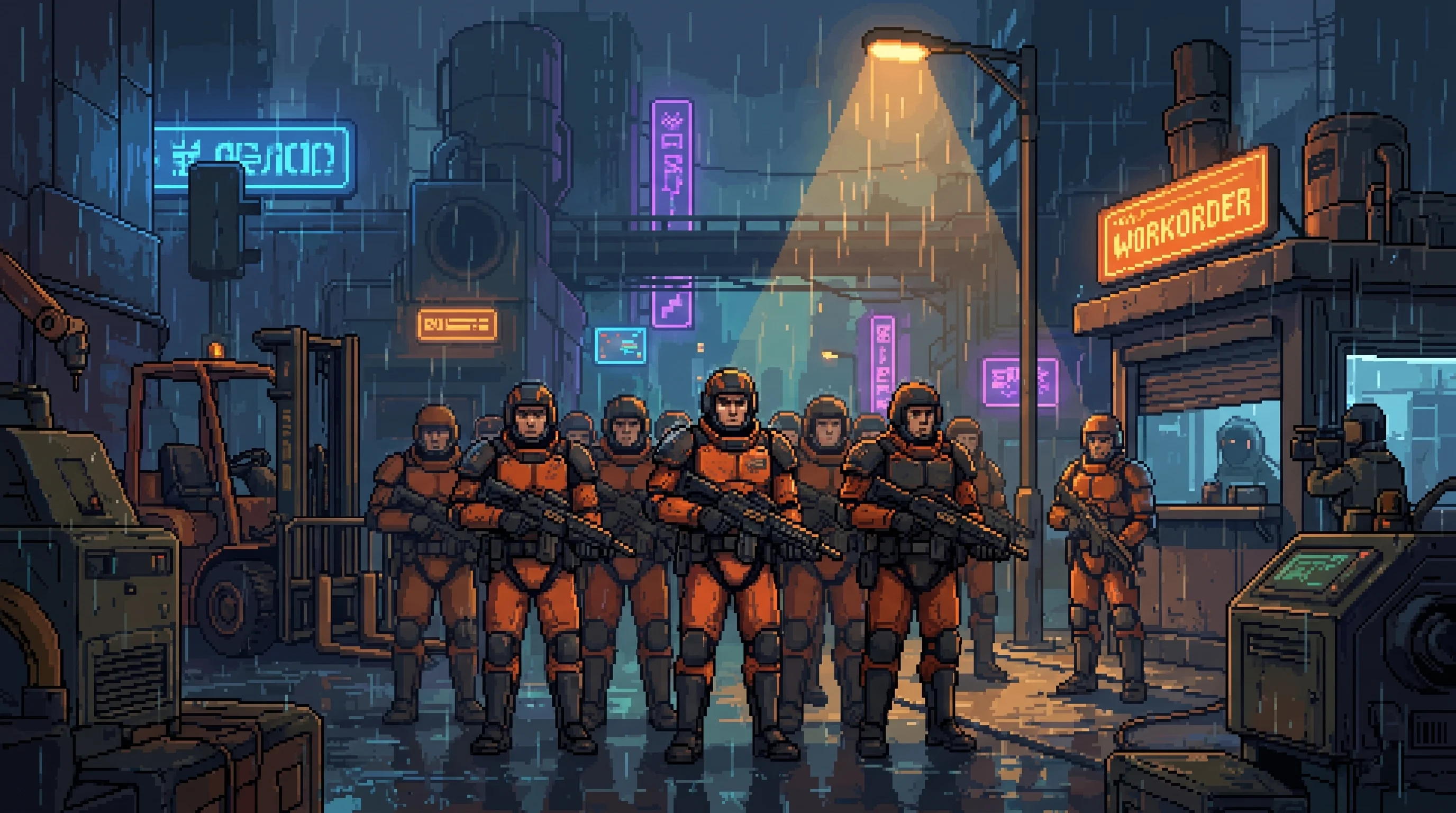
The field ahead of the assault was six hundred settled machines, and there is no way to tell an empty from a holder from the outside. A severed platform takes no new orders — the Slip's entire product — but the conditional authorizations already signed into its queue stay live, templated against threat profiles, waiting for the world to match. The templates had been written against exactly the transponders now facing the harbor. An Enforcer breacher walking that mud was a completed authorization on legs. The Corps cordoned and stood. Across the basin, the Nexus shore detail did the same, for the mirrored reason: its recall messages were addressed to sessions that no longer existed, and nobody on the Nexus side could certify which of its own machines still recognized it. Two armies, ninety meters of tidal flat, and the only things moving were the lamps — pending-amber on the fouled airframes, burning over requests that would never now be answered. On the click floors of the Warm Hands Doctrine, the anchorage queue returned undeliverable and went quiet. Approvals paid 0.4 credits and denials paid the same. Silence paid nothing. The confirmers remember Day 12 as the shift the war stopped paying.
At 09:40 the enclave's last four evacuation barges came off the inner wharf, made the channel at eight knots, and left. Both cordons watched. Firing into a field of holders, over a feedstock harbor, at civilian-flagged hulls, was the one act neither corporation's filings could survive; the Calculation Doctrine would have priced it, and both staffs already knew the price. The engagement's entire strategic object sailed out through the middle of the engagement, unopposed. Three of the four manifests were filed.
| Date | March 25, 2171 (Day 12 of the Three-Week War) |
|---|---|
| Location | The Pinole Anchorage — the feedstock harbor of Sector 17's refinery belt |
| Cause | Operation COFFERDAM — Ironclad's move to close the Pinole enclave's back door |
| Filing | 'Marine enclosure and dewatering works' |
The Clearing
The Last Mile arrived with the afternoon tide, because that is when the Last Mile arrives. Its negotiators walked to both cordons, hands empty, card out, and bought the field out loud — no paper, terms spoken at the wire, the same trade the firm had been running across the collision band since Day 4, scaled for the first time to an engagement both armies were still standing inside.
Q. What were the terms? A. Spoken. Q. Spoken where? A. At the wire. Everything on the mud was theirs until the tide turned. After the tide, it was the war's again.
— Enforcer Corps quartermaster, counter-remote litigation, deposition fragment, 2175
The windows were Tereza Sousa's, called from the seawall water tanks through the brass glass that had priced the Pinole galleries two days before. Four minutes here, six there — routes threaded between the sight-lines of machines whose templates nobody could read. Carters went in transponder-dark, the way the trade learned that week to go. Empties were carted at the per-platform rate. The 61 holders were the triple line: 48 of them fed their match against a decoy transponder lashed to a cart pole and retired where they sat, the anchorage's contribution to the war's strangest job description. The last 13 were flagged, cordoned, and left holding, and the Corps inherited the cordon with the ground. The fourteen human dead of the ninety minutes — dock crews, mostly, caught on the hardstand when the ring settled — came out at card rate regardless of employer. One recovery card from that evening survives in a bay-floor parlor frame, its true sentence initialed by the bearer: "Carried past forty of them at slack water; none of them moved."
By full dark the field was mud, machines, and cart tracks. The invoice went to both quartermasters, itemized, and both paid before the tide tables changed. The Corps walked the anchorage at low water on Day 13 and enclosed, on schedule, a harbor containing nothing the war wanted anymore.
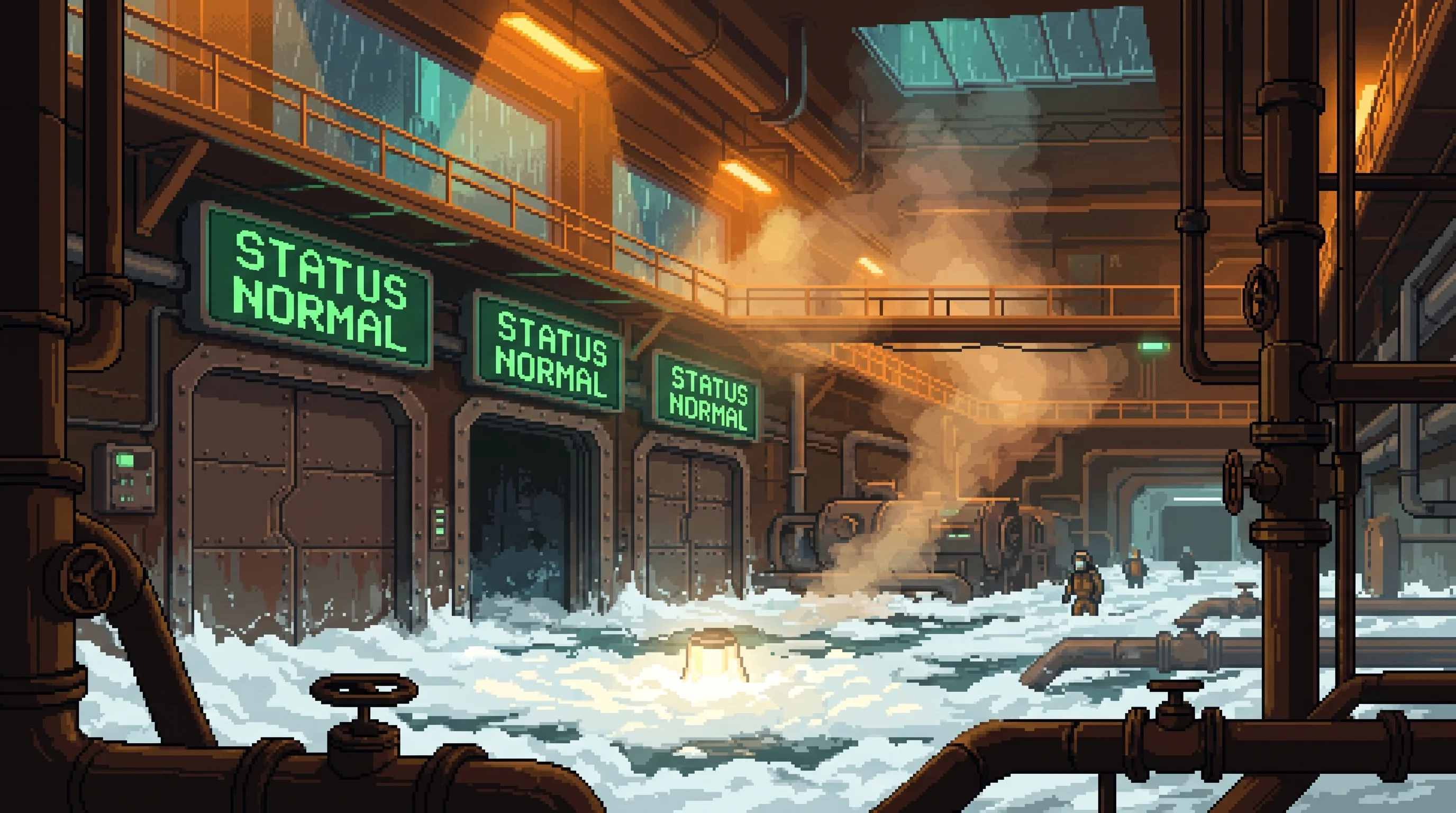
The Pinole enclave's last four evacuation barges cleared the harbor through the middle of the standstill, unopposed; three manifests were filed
Aftermath
The cofferdam held. The bottom, pumped dry, was bare — an enclosure achieved around an evacuation completed, which is as close as the port theater came to a verdict. Ironclad holds the Pinole Anchorage to this day, and the Pinole Works' ruin joined it after the treaty, by paperwork, the belt consolidating at last around a plant nobody rebuilt and a harbor everyone watched empty itself at eight knots.
The doctrine writers got more out of the day than either belligerent. The spoken terms of the clearing became the collision band's common law for the rest of the war — the first time both armies stood down for the duration of a civilian contract, and not the last. The alternative had been demonstrated: a parking lot of live conditionals nobody could touch. The Calculation Doctrine metabolized the anchorage the way the Sprawl metabolizes everything, as a form. Article 2 filings now carry a severed-asset annex, counting what a proposed jamming will strand and what the stranded may be holding; the annex exists because of one tide in the refinery belt. The Upgrade Treadmill's military annex files the day beside its civilian diagrams — the counter-weapon priced the dependency, and the dependency turned out to include the ground itself. And the compilers of the Human Premium Services indices keep the clearing as their wartime exhibit, cited carefully and without names: the engagement's only functioning authority, for one tide, was a laminated rate card and the people who honored it. Both armies had automated everything except the ability to cross their own battlefield. That, they rented, from the neighborhood, at rates fixed on Day 1.
The fouled airframes kept their amber lamps lit on the mudflats for eight nights while the batteries ran down — pending, in the exact technical sense, forever. The seawall children counted each one out, aloud, as it died. The Witness Protocol's reconstruction of the engagement, assembled from the Milers' ledger, plant telemetry, and two corporate silences, is the archive's tidiest: every machine accounted for, every carriage receipted, both filings printed side by side without comment. Fourteen dead, and for once, every one of them carried.
Ironclad's filing for the day reads 'marine enclosure and dewatering works'; the Milers' invoice line reads 'field clearance, per platform; holders triple'; the Witness Protocol prints both without comment
Affiliated Entities
- The Three-Week War — Day 12; the middle week's cleanest demonstration of how the war actually worked
- Operation Bedrock — The opening campaign whose captured sessions became the Slip; the enabler, twelve days on
- The Hesitation — The port cover; withdrew by its own ladder, in good order
- The Pink Slip — First massed employment; the stranding problem, discovered at scale
- The Last Mile — The clearing; card rate, spoken terms, one tide
- Tereza Sousa — The windows, called from the seawall tanks
- The Presence Office — Sessions dying in rows, two sectors away
- The Warm Hands Doctrine — The queue side of severance: undeliverable, unpaid
- The Refinery Massacre — Three days earlier; the urgency behind the back door
- The Enforcer Corps — Won the sky in ninety minutes; waited on carters for eleven hours
- The Calculation Doctrine — The severed-asset annex, descended from this filing
- The Witness Protocol — The reconstruction; tidiest engagement, least official sources
Restricted Access
The seventeen entries. The Last Mile's war ledger carries one unlabeled column, inked out at the header, seventeen entries long, all in Week Two — the firm's only concealment in a document it otherwise handed whole to the Witness Protocol. The anchorage sits in Week Two, and seventeen would fit several of the day's untold counts: the crews who went in dark, the holders' template classes, the things brought off the mud that appear on no invoice. Bay-floor theory has settled comfortably on the anchorage without a scrap of confirmation. The firm's position has not changed in thirteen years. The firm reprints the card.
The fourth barge. Three of the four evacuation barges appear in Nexus's asset-repatriation record, cargo manifested down to the crate. The fourth was never filed — not sealed, not redacted, simply never filed, a hull that left a corporate harbor in wartime carrying officially nothing. Three days earlier, at the same enclave, a Graywater element had spent nineteen quiet minutes in the Pinole Works' records annex and withdrawn intact. Whether the two absences are one absence is a question the litigation has circled for a decade, at a distance, the way the carters circled the holders. Some templates are still live. Nobody can read them from the outside.
Neither corporation issued a communiqué; the engagement's record is the Milers' ledger, the Witness Protocol's reconstruction, and an invoice both quartermasters paid
Connected To

Supporting Connections

Day 12: the port engagement that ended in an invoice.
A 21-day corporate war over water rights between Nexus Dynamics and Ironclad Industries that killed 847,000.

The Overcast's port cover — shouted down, severed, settled.
Nexus's teleoperated war swarm — 22,000 airframes that never fired until a human, somewhere, clicked.

First massed employment — all three members over one tide.
Ironclad's counter-swarm family — jam, sever, foul. A severed platform is stranded, not disarmed: its orders stay live.

The carters cleared the field two armies could not cross.
The bay-floor outfit that worked both armies' wreckage and priced the dignity of the dead in tiers.

Sever the link; the last order survives the sender.
Upgrades rewire users until baseline feels disabling, removal risks catastrophe, and each version demands the next.





—