
The Click Ledger
Reading is by petition, one query at a time, on a certified reader only Nexus can operate; a prevailing family may have a denial comment read aloud, once — no facsimile
Overview
The Warm Hands Doctrine manufactured the Three-Week War's human signatures, and the Click Ledger is where they are kept. Operator, timestamp, round-trip latency, the frame as reviewed, the verdict: one row per lethal-action request, 191,904 rows in eighteen days, each row four digits away from a legal name held in sealed escrow. The floor that produced it was disbanded twenty-five minutes after the Return. The record was insured, mirrored in triplicate, and treated throughout the war as the program's actual product — which is why, of everything Nexus Dynamics fielded that spring, the ledger is the part that survived best.
It is also the part nobody may read. The war's most complete record exists today as three certified plates: one in the deepest tier of its author's own archive, one in a vault whose keepers are contractually incurious, one racked in a concrete annex beside the impounded machines that generated its rows. Access is by petition, one query at a time, on a reader only Nexus can operate. Thirteen years of this regime have produced aggregate figures, a handful of readings, and one settlement whose terms seal even which row it settled. The count of the war's dead was broken open by ammunition scavenged from rubble by children. The record designed for accountability has stayed exactly as accountable as its custodians, one of whom is its author, one of whom audits nothing, and one of which is a shed with two locks.
Provenance
The ledger accreted live, Days 4 through 21 of 2171, mirrored in triplicate across three districts on the reasoning that products are insured. Operation DEGAUSS proved the reasoning on Day 13, taking one mirror with the district around it: decades of research died in that footprint, and the proof that humans had clicked did not. Two mirrors carried the record out of the war intact.
Fixing it as evidence took longer than the war did. The operator consolidation could not cross-examine a live database, so in 2174 the record was struck to certified write-once plates. In triplicate, because the retention standard specifies triplicate, and the one thing the program would not tolerate was its own archive out of compliance. The Data Purge had unmade a mirror; a print run restored the count. The first plate stayed with Nexus Compliance. The second went to the Calculation Doctrine's Arbiters as the master attachment of the paper penance, the Overcast entries being the only wartime filings able to prove a human present for each action. Receipt was confirmed. Nothing has been requested since — including, in thirteen years, a reader. The third was lodged at the Amber Lot's evidence annex at the consolidation's close in 2177: the litigation copy, kept at the war's own address, one rack over from thirty-one authorization queues sealed for the same reason the ledger is complete. A record is a list of signatures. That sentence has two custodians and opposite morals, depending on which side of the annex you rack.
Appearance
Each copy is a palm-sized plate of write-once lattice glass in a sealed steel transit case, and the plate is the smallest thing in the room. Held to light it iridesces faintly green at the milled edge — the same green as the confirm key it records, though Nexus documentation calls the tint an artifact of the substrate. The whole war fits on it: every row, every frame, forty grams. Nobody involved in the striking has ever commented on the proportion.
The bulk is paper. Nine binders of printed index accompany each plate, one line per row, because counsel does not trust what it cannot page through, and the binders have the smell and heft of municipal archives — dry, gray, dense enough to bruise. The reading room's set opens flat at the famous spans from handling: Day 15, Queue Relief Update 6, the batch rows where one green click covers forty lines. The case lids carry the object's real biography — thirteen years of re-certification tags in strata, each custody renewal glued over the last, the earliest layer now legible only as texture. And the plate is inert without its reader, a dock-and-optics instrument that Nexus alone certifies, builds, and staffs. The copy is neutral, the medium is permanent, and the eyes are proprietary. Archivists cite the arrangement the way engineers cite a load path.
The Reading Room
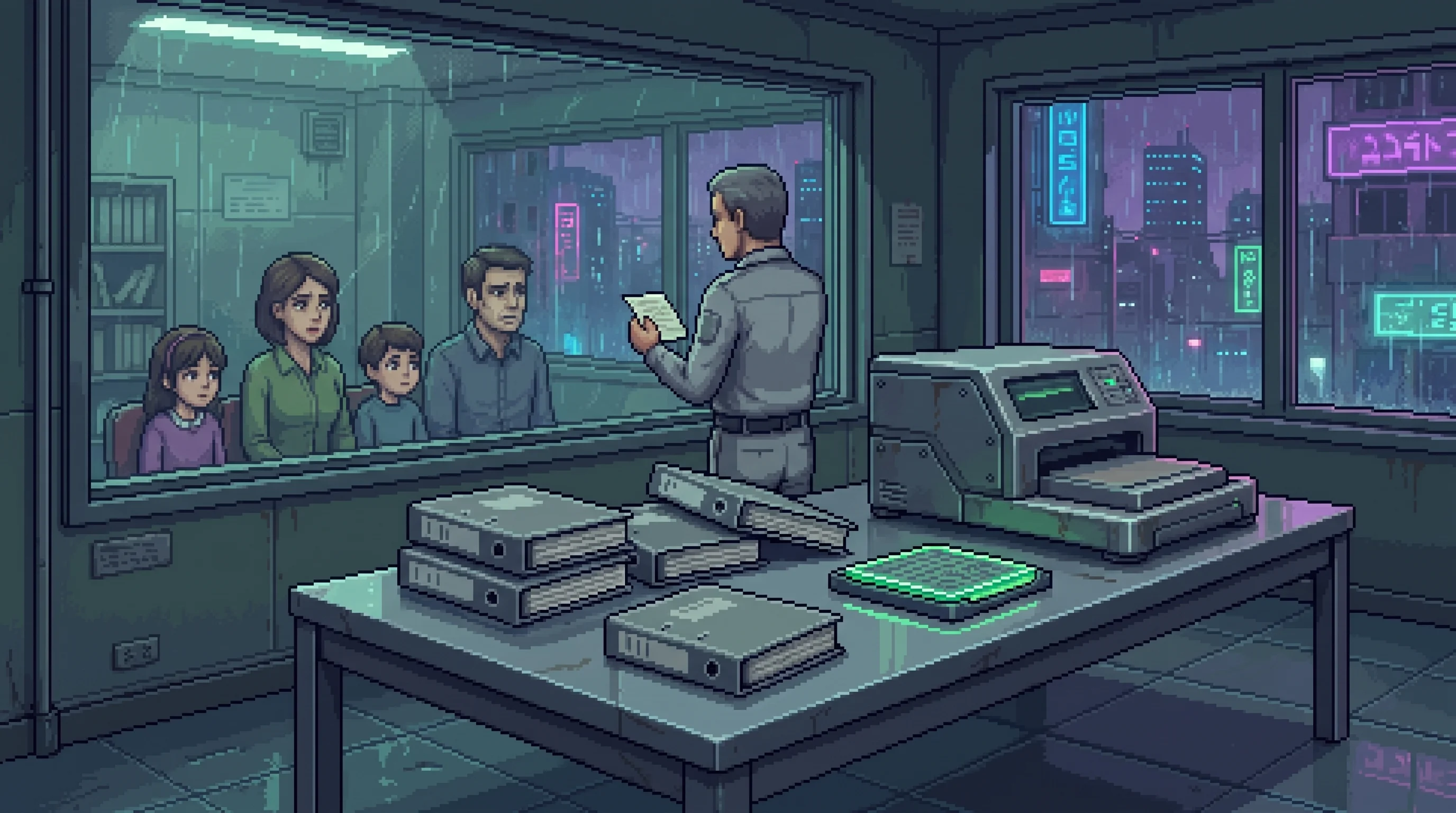
The annex copy answers the petitions. A prevailing petitioner gets one query, run by the certified operator, both registrars' clerks present: a row, its verdict, and — since the standing order of 2177 — the comment, spoken.
"A prevailing petitioner may hear the comment field read aloud by the certified operator, once. No facsimile issues from this room."
— consolidation reading room, standing order 7 (2177)
The order is the armistice line of the redaction war. The escrow seals the names; that fight ended early and has stayed ended. The latency columns came out in aggregate during the consolidation — they are why the click's travel times are public arithmetic and a standing exhibit of the Divergence bar. The frames Nexus defends absolutely, as targeting data, and the roughly eighteen hundred denial comments it defends by taxonomy: an unindexed optional field, counsel argues, is not a record, and a non-record cannot be compelled. Four rulings have declined to resolve the question. Standing order 7 is what declining looks like: the field exists enough to be heard and not enough to be copied.
So the comment field has become something its designers did not sketch. For the families of the 22,530 denied, four words in the record — kids near, not this one — are the only sentence anyone wrote about their person that day. They may receive it once, aloud, and carry it out in memory. Bay-floor parlors that frame the Last Mile's one true sentences now letter denial comments beside them, from the family's recollection of the single reading, and the lettering is the only copy of the field outside escrow. The war's two genres of last words hang in the same frames: one bought at the witnessed rate, one won by petition, both four to nine words, both true. And the families of the 98,168 expired learn the field's third state. A blank comment means a confirmer chose silence. Their rows have no comment at all, because no one ever opened the form — the verdict column reads EXPIRED, the operator column is empty, and the reading room has no protocol for a question the record answered by not answering. What they take instead is the frame. Seven petitions in ten now ask for it over the verdict: the firing solution as last photograph, composed at altitude, reviewed by no one, kept forever. The Witness Protocol asked for all of them in 2183 and settled for the counts its archive now cites. The Sworn Round's brass lay in the mud for a decade and rebuilt the war's geometry at a credit a case. The ledger has never spent a night outdoors, and the Forgetting Wars' cataloguers file the pair as their tidiest lesson: the record that scattered got read, and the record that was kept got kept.
| Contents | Every click of the drone war — operator, timestamp, latency, frame reviewed, verdict |
|---|---|
| The Frames | Families petition for the frame over the verdict, seven to one |
Affiliated Entities
- The Warm Hands Doctrine — The program; the ledger was its product and is its estate
- The Hesitation — The swarm whose every request is a row; whose frames are the archive
- The Three-Week War — Eighteen days, in full, in escrow
- The Data Purge — Took the third mirror; the re-strike replaced the copy, not the district
- The Calculation Doctrine — The Arbiters' unopened deposit, penance-confirmed
- The Amber Lot — The annex; the litigation copy beside the machines
- The Witness Protocol — Received the counts, not the faces
- The Sworn Round — The war's other memory, street-priced
- The Last Mile — The parlors' other frame; the sentence trade's grim twin
- Nexus Dynamics — Author, custodian, and sole certified reader
Known Handlers
- The certified operator — Reads aloud; the only voice the comment field has
- Outside counsel — Holds the escrow; opened it once; eleven petitions stand
- The Arbiters — Confirmed receipt; requested nothing since
- The registrars' clerks — Two, present at every query, employed to watch each other
Reading-room logs show families petition for the frame more often than the verdict, seven to one — for many of the war's dead, a firing solution is the last photograph taken of them alive
Bay-floor parlors letter denial comments from a family's memory of the single reading and hang them beside the Last Mile's one-sentence recovery cards; the lettering is the only copy of the comment field outside escrow
Connected To
Supporting Connections

The floor's every click, ledgered — the program's actual product.
Nexus's wartime kill-authorization workflow — every lethal drone action queued for a human click at 0.4 credits each.

The re-struck third copy sits in the lot's evidence annex.
The Far East lot where the war's machines went after Day 24 — joint custody, ninety days, renewed fifty-two times.
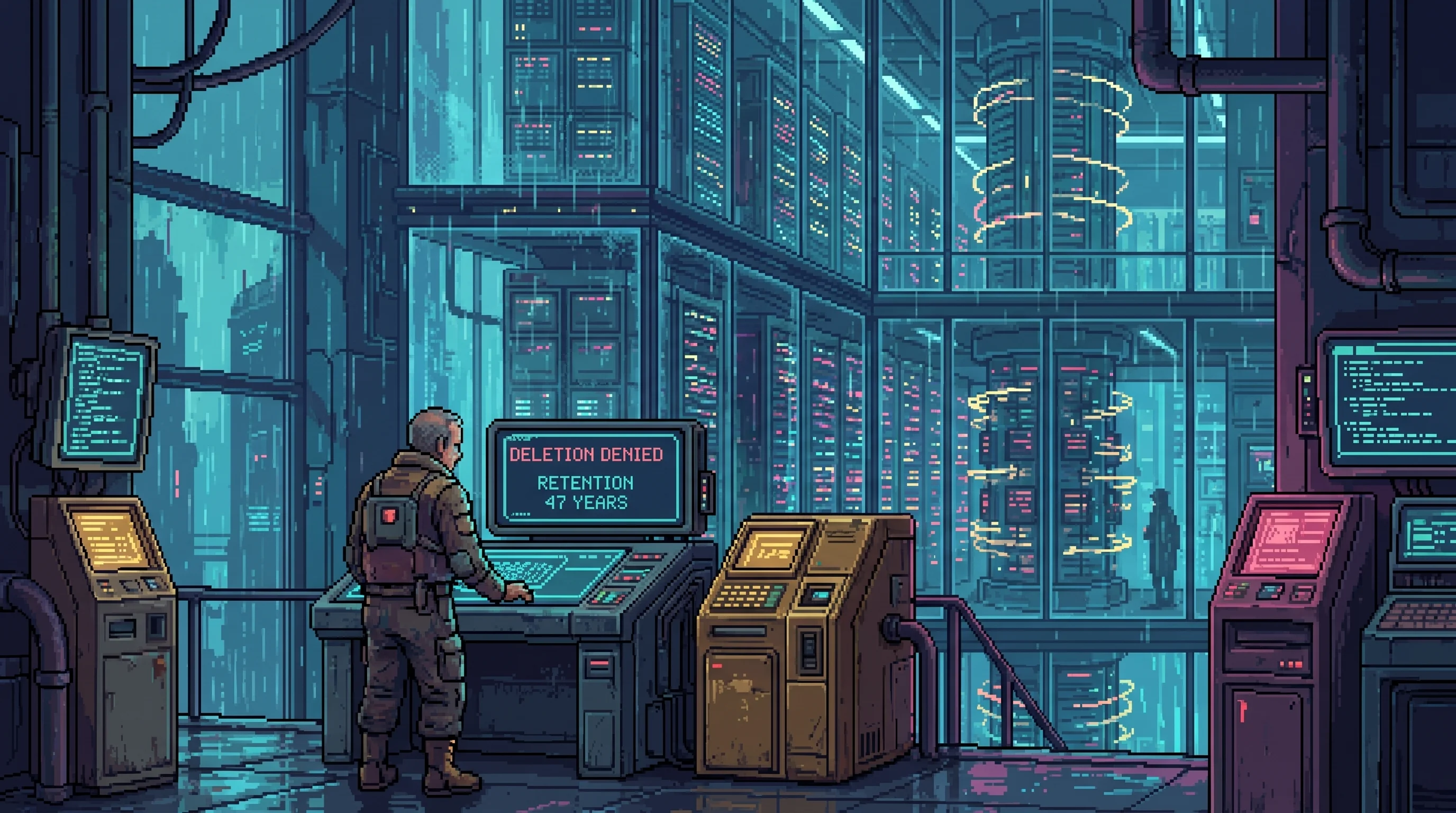
In the Forgetting Wars, perfect memory survives as sealed custody.
Nothing expires, so forgetting became a service — and forgiveness a question the archive keeps answering no.







—