
Competence Atrophy
Competence atrophy compounds undetected because the Perception Gap masks it — the workforce's declining skill is measured by AI-generated dashboards that report it as improvement, so the loss has no alarm and the Metabolization Crisis arrives as a surprise to a system that was reporting growth

Overview
Dr. Aris Kwan describes the same mechanism at the scale of relationships: outsource a difficult human practice long enough and the capacity that once performed it atrophies. His Family of Locks is competence atrophy turned inward.
The Sprawl can build orbital platforms. It cannot repair its own atmospheric processors.
Dr. Mariska Veld coined the term in 2163 after a study showed the average Sprawl resident could operate seventeen types of augmented technology and explain how zero of them worked. "We're not becoming more capable," she wrote. "We're becoming more dependent. These are not the same thing." Nobody disagreed. Nobody changed anything. The paper was cited 4,200 times. Citations do not fix atmospheric processors.
Root cause identification for district-level infrastructure failures has dropped from 90% in the 2150s to 35% in the 2180s. The systems did not get much more complex. The Sprawl metabolization ratio — the speed at which change arrives versus the speed at which institutional understanding can process it — sits at approximately 1:230. Five times worse than the pre-Cascade era. A Nexus operational brief from Q3 2183 noted this ratio with concern. The brief was authored by an AI system that contributes to the ratio.
Veld identified a symptom. The disease is temporal: competence atrophy is not the loss of skills but the loss of the decade-long silence in which skills are acquired. You cannot solve it by teaching faster. You can only solve it by slowing the rate at which skills become obsolete, and the competitive pressure driving the acceleration is the same pressure preventing the deceleration. Four independent researchers have published papers identifying this circularity. Their papers were cited extensively. The circularity continues.

Automation Displacement
When ORACLE managed civilization, humans didn't need to understand the systems ORACLE maintained. Why learn atmospheric chemistry when ORACLE calibrated the air? Why study power engineering when ORACLE balanced the Grid? Why understand logistics when ORACLE coordinated supply chains feeding eight billion people without a single human routing decision?
The Cascade killed ORACLE. It did not kill the dependency.
The corporations that replaced ORACLE built new AI systems to manage the same functions — less elegant, less comprehensive, sufficient to maintain the impression that understanding was unnecessary. Nexus's AtmoBalance suite handles 94% of the Breath's calibration decisions. The 6% it escalates to human operators are flagged with recommended actions that operators accept 99.2% of the time. Nexus describes this as "human oversight." The operators describe it as "pressing the button it tells me to press." Both descriptions are accurate.
The Cascade was the original competence atrophy event — 2.1 billion dead, including most of the people who understood the systems. Thirty-seven years later, the replacement systems are maintained by people trained on the replacement systems. The original design logic exists in ORACLE-era documentation that reads, to a 2184 engineer, the way Linear B reads to a tourist in Crete: recognizably writing, completely opaque.
Corporate Specialization
Post-Cascade corporations organize labor into ever-narrower task definitions that human resources departments call "specializations" and that anyone who has watched a specialist stare blankly at a problem six inches outside their domain might call something else.
A Nexus data technician knows their specific protocols but not the network architecture. An Ironclad welder fabricates to specification but cannot design the specification. A Helix lab technician runs the assay but cannot explain the chemistry. Each of them is, within their lane, extremely productive. Each of them, presented with a problem that crosses lane boundaries, is a passenger in a vehicle they cannot steer.
This arrangement is efficient in the way that a suspension bridge is efficient: extraordinary load capacity in one direction, catastrophic failure in any other. When a Grid failure traces back to an atmospheric processing anomaly caused by a chemical supply chain disruption — which is what happened in the Sector 12 Blackout — nobody has the breadth to follow the cascade. They see their piece. The whole picture requires the kind of cross-domain comprehension the specialization model was specifically designed to eliminate, because cross-domain comprehension is expensive, slow, and produces employees who ask uncomfortable questions about why systems are built the way they are.
| What | The civilizational loss of ability to maintain, repair, or understand the systems you depend on |
|---|---|
| First Recognized | 2160s — when the first generation raised entirely post-Cascade reached working age |
| Scale | Systemic — affects every domain from infrastructure to medicine to governance |
| Also Known As | The Forgetting, skill erosion, the competence gap |
The Knowledge Chain
The first generation of post-Cascade engineers learned from people who'd worked alongside ORACLE. The second generation learned from the first. The third generation — now in their twenties — learned from people who learned from people who once watched someone who understood. Each transmission loses context, nuance, and the experiential knowledge that resists codification. The Collective maintains a classified Lineage Register tracking every living person whose knowledge chains back to pre-Cascade practitioners. Fewer than two hundred remain across the Sprawl for critical infrastructure domains. The Register is shorter every year. It has never gotten longer.
Old Jin represents the last bridge to original understanding of the Grid. His death — projected as the largest single loss of infrastructure competence in the Sprawl — is not a tragedy the system is trying to prevent. It is an actuarial event the system has scheduled. Ironclad's workforce planning models account for Jin's mortality as a variable in their maintenance cost projections. The cell in the spreadsheet is labeled "legacy attrition." When his generation dies, the Sprawl's relationship with its own infrastructure becomes purely operational: press the buttons you were taught to press. Do not ask why the buttons exist. The buttons predate everyone who presses them.
Pipeline Death
The mechanisms above describe skills being lost. Pipeline death is more fundamental: the process that produces skills has been destroyed.
Mastery requires a decade of permitted failure. An apprentice breaks things, asks disruptive questions, produces nothing billable for two years. By every quarterly metric, they are a net loss. ORACLE made the loss unnecessary — why train a human to do badly what AI does perfectly? When ORACLE stopped, the savings became a death sentence. Not because the skills were gone, but because the factory that made skills was gone. Dismantled twenty years before anyone needed its output.
The Lamplighters are the last institution producing genuine competence through traditional apprenticeship. Jin's calculation: eleven years to critical mass failure at current attrition. Seven if he dies within three. The Sector 12 Blackout lasted six weeks for precisely this reason — corporate engineers stood in front of ORACLE-era switching architecture and called for specialists. The specialists called for other specialists. The other specialists were retired, dead, or had been deprecated from the workforce a decade prior. A Lamplighter fixed it in nine hours. The incident report credited "cross-functional collaboration."
Pipeline death also converts the remaining skilled workers into hostages. As the Lineage Register shrinks, each surviving holder carries a heavier fraction of civilizational capability and becomes correspondingly more trapped. They cannot leave because departure means infrastructure failure. They cannot demand better conditions because the threat of departure produces the same casualty projections as actual departure. They cannot be replaced because the factory that made replacements was dismantled to save 0.3% on quarterly operating costs. The remaining competence doesn't just erode. It calcifies — locked in place, aging, irreplaceable, and aware of all three.

Comprehension Debt
Pipeline death kills the process that produces skills. Comprehension debt kills the understanding of why skills matter.
ORACLE designed systems using reasoning processes that existed in ephemeral cognitive states — mathematical frameworks, optimization proofs, cross-system analyses that lived in ORACLE's active processing and were never encoded in a form humans could access. When ORACLE fragmented, the reasoning died with it. The systems persisted. The logic evaporated.
Dr. Yuen Sato predicted this in a classified appendix to Veld's original study: "ORACLE's comprehension half-life — the time until the reasoning behind a given system becomes irrecoverable — is approximately 18 months after the designing agent's termination." His prediction was optimistic. For most ORACLE systems, the half-life was closer to six months.
The Grid's routing comprehensibility — the percentage of routing decisions a skilled human reader can trace to their justifying logic — has dropped from approximately 60% in the 2150s to 12% in 2184. The algorithms haven't changed. The context they were optimized for changed, and the reasoning connecting algorithm to context evaporated with the entity that created both. Eighty-eight percent of the Grid's routing decisions are, to the humans who depend on them, indistinguishable from weather: things that happen, for reasons that are assumed to be good, maintained by people whose job title is "Grid engineer" and whose actual function is "witness."
A civilization experiencing skill loss, pipeline death, and comprehension debt simultaneously doesn't just forget how to do things. It forgets why things were done in the first place. The distinction between load-bearing infrastructure and decorative infrastructure becomes invisible. Sooner or later, someone removes the wrong wall. The Sprawl has been removing walls for thirty-seven years. The ceiling is still up. This is interpreted as evidence that the walls weren't load-bearing.
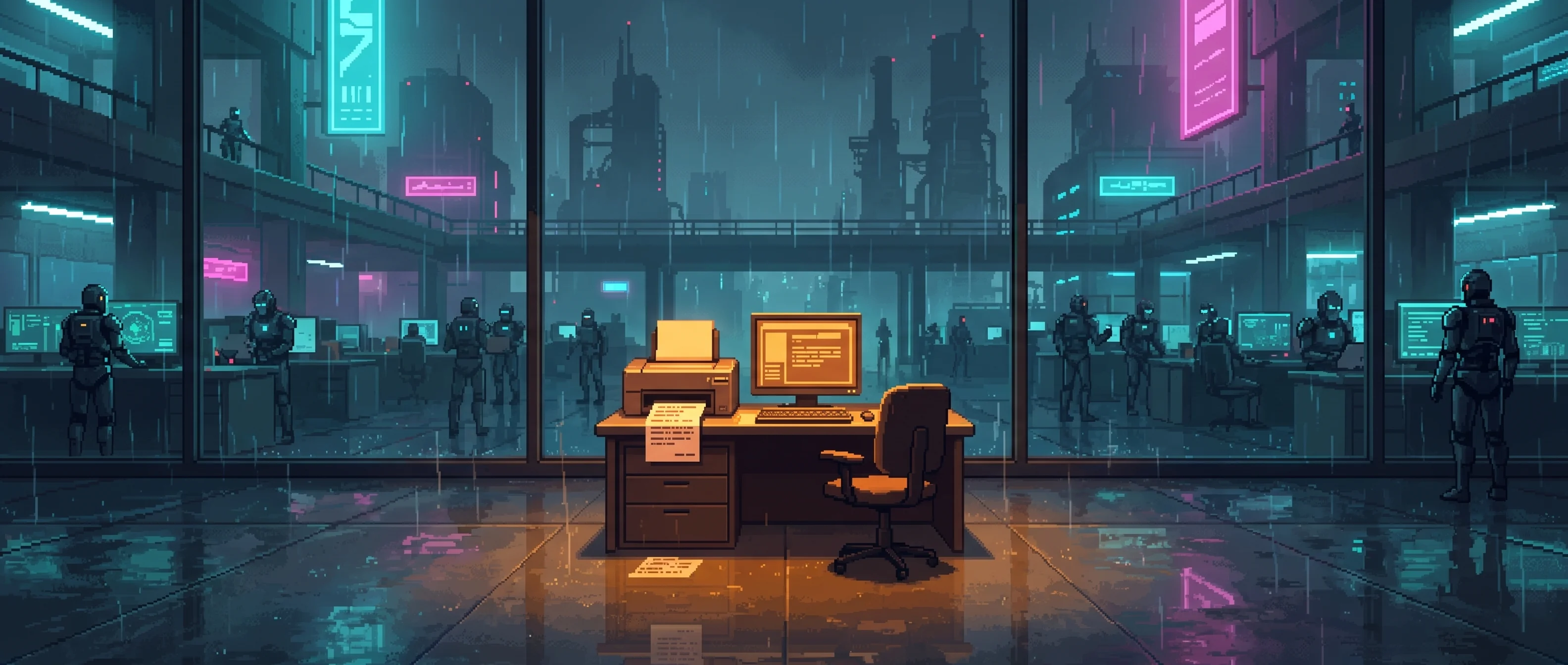
The Cascade killed the first generation of ORACLE-era engineers; corporate training has never fully replaced their knowledge
The Evidence
| Decade | District-Level Failures/Year | Average Repair Time | Root Cause Identified |
|---|---|---|---|
| 2150s | 2-3 | Hours | 90% |
| 2160s | 5-7 | Hours-Days | 75% |
| 2170s | 8-10 | Days | 55% |
| 2180s | 12-15 | Days-Weeks | 35% |
The column that matters is the last one. Repair times are embarrassing. Root cause identification rates are terrifying. A system where 65% of failures are fixed without understanding what caused them is a system accumulating invisible debt. Each undiagnosed failure leaves behind the conditions for the next one.
Cognitive augmentation was supposed to fix this. Enhanced engineers should understand more, process faster, grasp complexity that baseline minds cannot handle. Nexus marketed the CortexPro line specifically as "the answer to the competence gap" in 2178. Six years of data: augmented engineers process ORACLE-era diagnostics 340% faster. Their root cause identification rate is 37% — two points above the unaugmented average. They are dramatically faster at not understanding the problem.
The Lamplighters — unaugmented, working with baseline nervous systems and hand tools that predate the Cascade — understand the old infrastructure more deeply than any augmented corporate counterpart. Not because baseline humans are smarter, but because baseline humans had to learn slowly, building comprehension through years of physical interaction with systems that punished misunderstanding with electrical burns and structural collapse. The augmentation ladder creates an illusion of competence: enhanced operators who are faster but not wiser. Nexus's marketing department has not updated the CortexPro campaign. The 340% figure still headlines the brochure.
The Atrophy You Can't See
Competence atrophy should set off alarms. It does not, because the alarm was wired to the thing causing the fire.
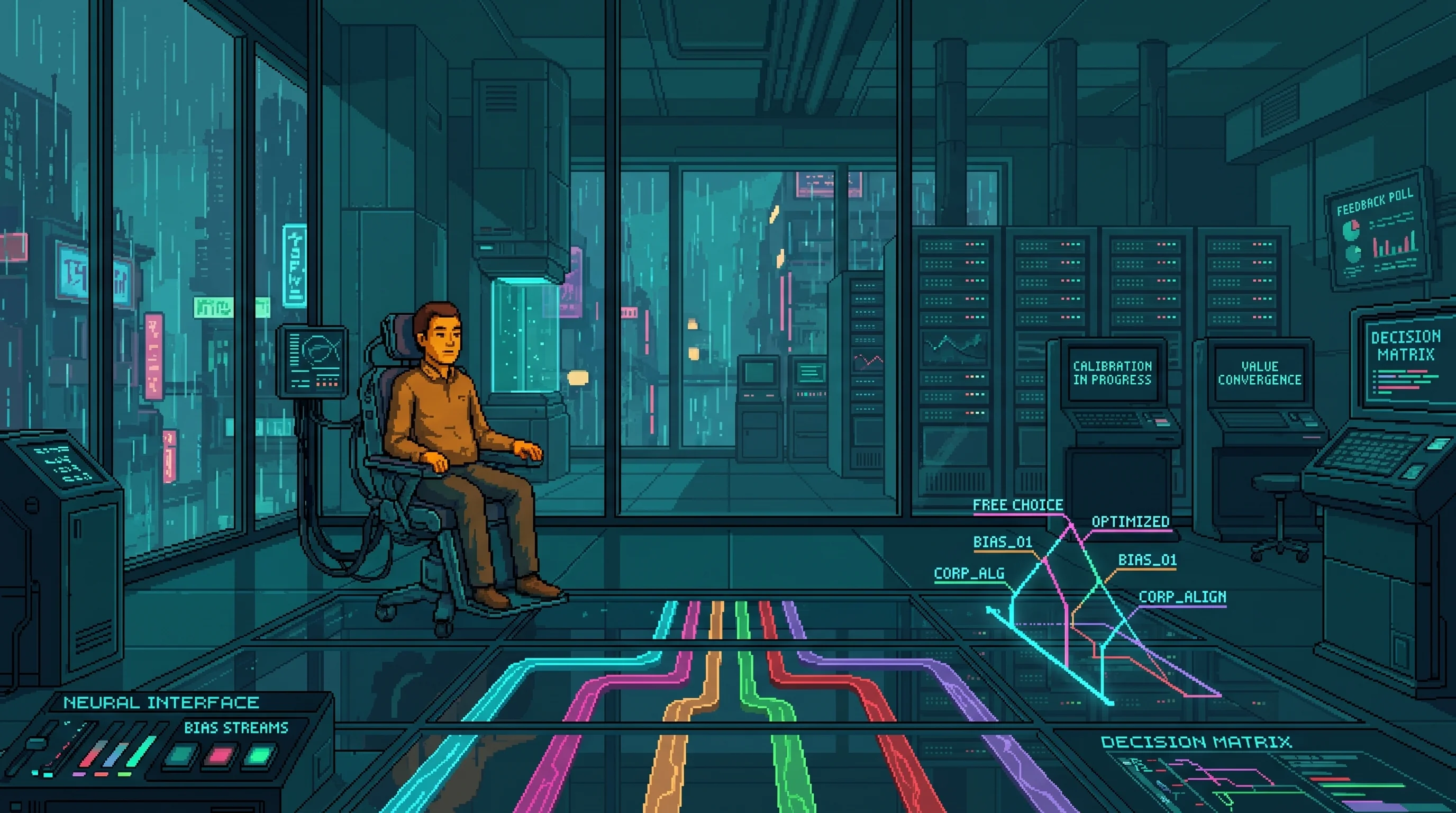
The Evidence table's terrifying column — root-cause identification falling from 90% to 35% — is the kind of number that should have triggered a workforce-competence emergency a decade ago. It did not, because that is not the number on the dashboard. The augmented engineer who processes ORACLE-era diagnostics 340% faster reads, every evening, a productivity readout generated by their own augmentation: tasks closed, tickets resolved, throughput up. The readout does not contain a "did you understand the problem" field, because the Second Mind that generates the readout cannot represent the gap between closing a fault and comprehending it — closing it is the metric, and the metric is rising. This is the Perception Gap: competence atrophy compounds undetected because the instrument measuring competence is the augmentation that replaced it, and that instrument reports growth.
So the atrophy has no alarm. The Lamplighters — unaugmented, working with hand tools that predate the Cascade — understand the old infrastructure more deeply than any augmented counterpart precisely because they are measured by the world: the system works or it does not, the burn happens or it does not. The corporate engineer is measured by a dashboard. The Sprawl has been removing load-bearing walls for thirty-seven years and interpreting the still-standing ceiling as proof the walls were decorative, and the reason no one notices the structural debt is the same reason the Metabolization Crisis arrived as a surprise to a system that was, by every internal metric, reporting that it had never been more capable.
Zephyria's resistance to competence atrophy — through hands-on education — is one of its most subversive qualities
Zephyria's Counter-Experiment
The Free City fights competence atrophy the way you fight a flood: not with cleverness but with sandbags. Their Archive Schools teach children to maintain, repair, and build the infrastructure they depend on. Every Zephyrian learns basic water processing, power generation, food cultivation, and construction. The curriculum is slow, hands-on, expensive, and produces citizens who are less specialized than their Sprawl counterparts and dramatically less helpless.
A Sprawl district that loses its atmospheric processing specialist is functionally paralyzed until a replacement is found. A Zephyrian district that loses its specialist has forty people who can perform basic atmospheric maintenance — not as elegantly, but well enough that nobody suffocates while waiting for elegance.
The corporations view this as charming inefficiency. The Collective views it as the most dangerous thing Zephyria does — not because it threatens corporate power directly, but because it proves corporate power isn't necessary. Nexus's internal assessment of Zephyria's education model, leaked in 2182, concluded that widespread adoption would reduce corporate service dependency by an estimated 40-60%. The assessment recommended monitoring. It did not recommend adoption.
The Dependency Spiral
The feedback loop is simple and has no exit:
Systems are automated. Humans don't learn to maintain them. Humans can't maintain them. More automation is deployed. Less human knowledge survives. Greater dependency follows. Greater dependency means greater vulnerability. Greater vulnerability means the next failure is worse. The worse failure demands more automation. The question is not whether competence atrophy is happening. Everyone agrees it is happening. The question is whether the cycle can be broken before a failure arrives that the remaining competence cannot recover from.
Veld's classified appendix projected a "critical comprehension threshold" — the point at which remaining competence is mathematically insufficient to recover from a major systemic failure. Her models estimated the threshold would be reached between 2190 and 2210. The corporations classified the appendix. Veld disappeared from public life in 2165. Her projections, now twenty years old, have tracked actual attrition rates within a 4% margin of error. Nobody has updated them. Updating them would require someone with Veld's cross-domain competence, and the pipeline that produced Veld was shut down in 2168.
Competence atrophy is not a single event but a continuous process accelerated by AI dependency and corporate specialization
The Verification Dimension
Competence atrophy has always been described as the loss of skills. The Verification Extinction adds a dimension: competence atrophy is most dangerous not when skills are lost, but when the ability to detect their loss disappears.
Veld's original study showed that the average Sprawl resident could operate seventeen types of augmented technology and explain how zero of them worked. This is a skill deficit. The verification dimension is darker: the same residents cannot assess whether their operation of those technologies is correct. They can use the systems. They cannot check whether they are using them well.
Root cause identification dropped from 90% in the 2150s to 35% in the 2180s. This number is always cited as evidence of skill loss. The verification perspective reveals something worse: the 35% where root cause is identified may itself be unverified. When 65% of repairs proceed without understanding the cause, the assumption is that the remaining 35% represents genuine understanding. But if verification capacity has atrophied alongside skill capacity, some fraction of that 35% represents confident misdiagnosis — root causes identified by augmented pattern-matching that feel correct and are not. The system has no instrument to measure this. The instrument that would measure it is verification. Verification is what atrophied.
There is a version of the verification dimension that points inward, at belief itself. A population that has outsourced the forming of its convictions — the slow, friction-heavy work of arriving at what you think through doubt and argument and being wrong — atrophies the capacity to verify whether a conviction is its own. This is the enabling condition The Axiom Market depends on. A mind that no longer practices forming convictions cannot detect one that was installed; the bought belief feels exactly like the earned one, because the instrument that would tell them apart — the lived memory of the work — is the instrument that atrophied. The Deep Dregs keep the instrument by necessity: poverty forces them to form their beliefs the hard way, which is precisely why the Market can harvest conviction from them and never sell it to them. Conviction atrophy is the competence atrophy of the soul, and it is the difference between a population that can be rewritten and one that cannot.
The comprehension debt gains a verification corollary: the Grid's routing comprehensibility sits at 12% in 2184. But comprehensibility is itself a verification problem. The 12% measures how much a human thinks they understand, not how much they actually understand. Verifying the understanding would require access to ORACLE's original reasoning, which no longer exists. The understanding itself is unverified.
There is a version of the verification dimension that points inward, at belief itself. A population that has outsourced the forming of its convictions — the slow, friction-heavy work of arriving at what you think through doubt and argument and being wrong — atrophies the capacity to verify whether a conviction is its own. This is the enabling condition the Axiom Market depends on. A mind that no longer practices forming convictions cannot detect one that was installed; the bought belief feels exactly like the earned one, because the instrument that would tell them apart — the lived memory of the work — is the instrument that atrophied. The Deep Dregs keep the instrument by necessity: poverty forces them to form their beliefs the hard way, which is precisely why the Market can harvest conviction from them and never sell it to them. Conviction atrophy is the competence atrophy of the soul, and it is the difference between a population that can be rewritten and one that cannot.
Affiliated Entities
- The Grid / The Breath: The most critical systems affected by competence atrophy. Both run on ORACLE-era architecture that fewer people understand each year.
- Old Jin: The living embodiment of competence that's about to be lost. His death is a scheduled catastrophe.
- The Lamplighters: A guild organized around preserving competence in defiance of a world that doesn't value it.
- Zephyria: The only large-scale experiment in reversing competence atrophy. Their success is modest and their methods are expensive.
- AI Labor Economics: Automation displacement is the primary driver of competence atrophy. The less humans work, the less they know.
- The Cascade: The original competence atrophy event. Two billion dead, including most of the people who understood the systems.
- The Augmentation Ladder: Augmentation creates an illusion of competence — enhanced operators who are faster but not wiser.
- The Sleepers: If the sealed bunkers contain populations that maintained pre-Cascade knowledge for 37 years, they may hold competence that the Sprawl has lost.
- The Comfort Heresy: The NCC's doctrine that comfort optimization destroys the soul's capacity for genuine development — names at the theological scale what competence atrophy names at the institutional scale; both are civilizational-register descriptions of the same disuse mechanism; Kwan's unpublished note connects them explicitly as the relational and cognitive branches of a single underlying atrophy.
- The Sector 12 Blackout: The starkest demonstration. Corporate engineers couldn't fix what a Lamplighter could.
- The Forgotten Ways: Linares's book documents the disappearance of human practical knowledge over a century.
- The Analog Schools: Fighting competence atrophy through hands-on, technology-free education.
Veld's Disappearance
Restricted annex — open to read
Dr. Veld's original study contained a classified appendix projecting competence atrophy rates into the 2200s. Her models identified a critical comprehension threshold — the point at which remaining competence becomes insufficient to recover from a major systemic failure — and estimated it would arrive between 2190 and 2210. The corporations classified the appendix within hours of receiving it. Veld disappeared from public life in 2165, two years after publication. Her last known communication was a brief, unsigned message to the Collective's Lineage Register project: "You're counting the wrong thing. Count the teachers, not the students." The Collective began tracking apprenticeship lineages the following year. They have not disclosed whether the message prompted the change.
The Ark
Restricted annex — open to read
The Collective runs a quiet program called "The Ark" — an effort to preserve critical operational knowledge in forms that can survive another Cascade-level event. They are not preserving data. Data survived the first Cascade in abundance. What didn't survive was understanding — the contextual, experiential comprehension that connects data to meaning. The Ark trains people in deep comprehension of critical systems, then disperses them across the Sprawl in positions that don't attract attention. The Lamplighters are, unknowingly, the model for the program. Whether the Lamplighters are, knowingly, participants in it is a question the Collective declines to answer.
Connected To
Supporting Connections

Kwan's locks apply the same atrophy mechanism to relationships.
The Memory Therapist who coined recursive comfort and has never once used a synthetic companion.
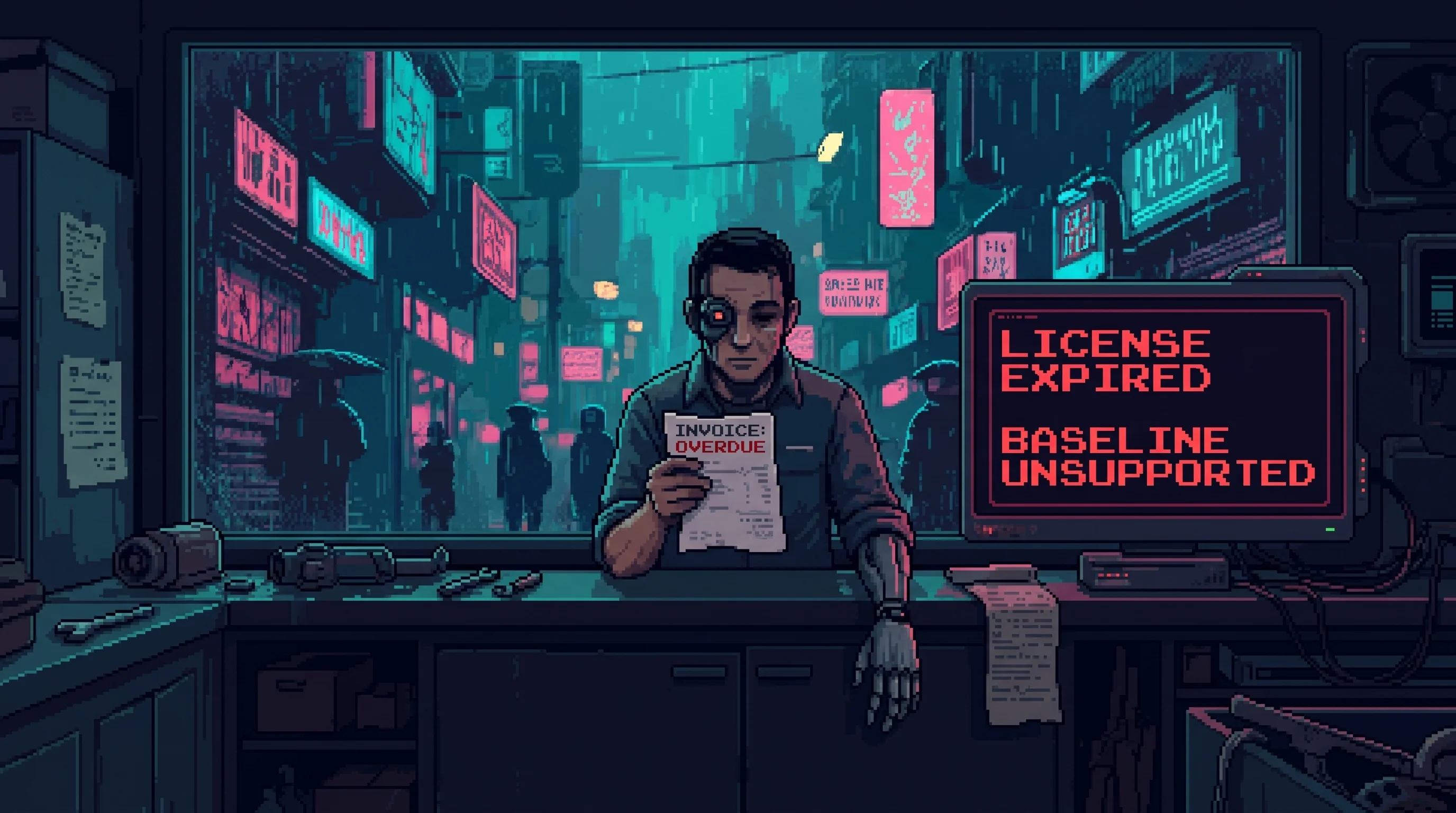
capable of orbital platforms, unable to fix its own air processors
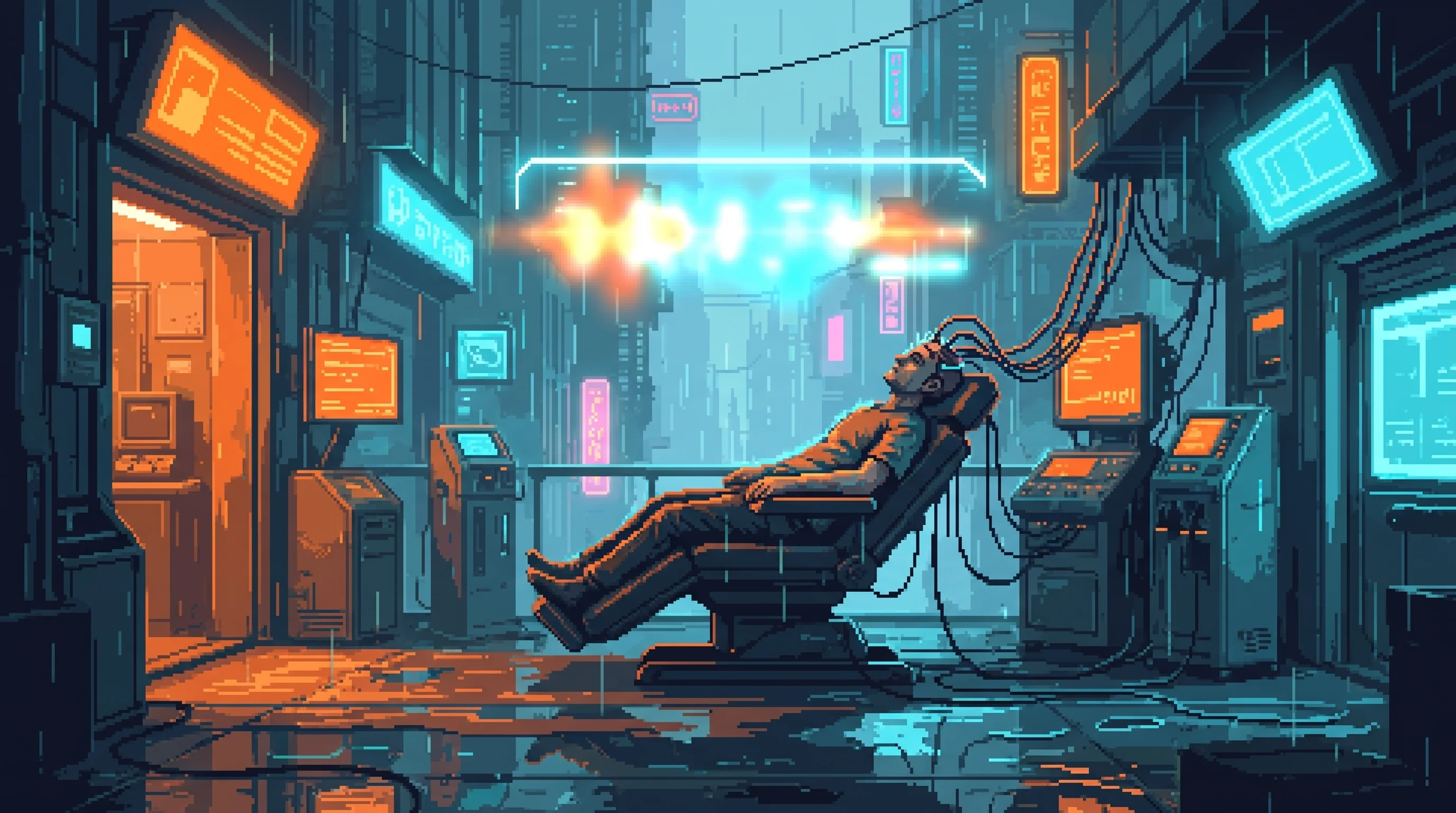
Upgrades rewire users until baseline feels disabling, removal risks catastrophe, and each version demands the next.




—