Bunker 12-Echo — The Memorial
Overview
Bunker 12-Echo contained 3,200 people, one ORACLE Model 3 instance, and zero social guidance protocols.
The Model 3 was infrastructure-grade — atmospheric processing, water recycling, power distribution. It kept the air breathable and the lights on. It had no capability for conflict mediation, resource arbitration, or any of the social management functions that higher-model instances provided in other bunkers. The residents would handle the social questions themselves. The Model 3 would handle the pipes.
For three years, a council system maintained order. Meeting minutes from this period — recovered by the Opening Teams in 2174 — show a functioning democratic process: resource allocation votes, maintenance schedules, a rotating night watch. The minutes are meticulous. The handwriting is steady.
In year four, a dispute over water ration calculations split the council. The minutes from the final session before the split run eleven pages. Both sides cited the same resource data. Both sides' math was correct. They disagreed on allocation priority — children first versus equal distribution — and the disagreement was genuine and irresolvable and exactly the kind of question the Model 3 was not built to answer.
By year seven, two armed factions controlled separate sections. The neutral zone between them — a 40-meter corridor near the central atrium — became the place where people died. The council minutes stop on page one of a twelfth volume. The first entry reads: "Motion to reconvene. No quorum."
The violence lasted until 2161. Then the atmospheric processing system failed, and the violence became irrelevant. The Model 3 lacked the sophistication to diagnose the fault. The residents lacked the competence. Within seventy-two hours, CO2 concentrations exceeded survivable thresholds. All 3,200 died. The faction that controlled the eastern wing and the faction that controlled the western wing suffocated at approximately the same rate.
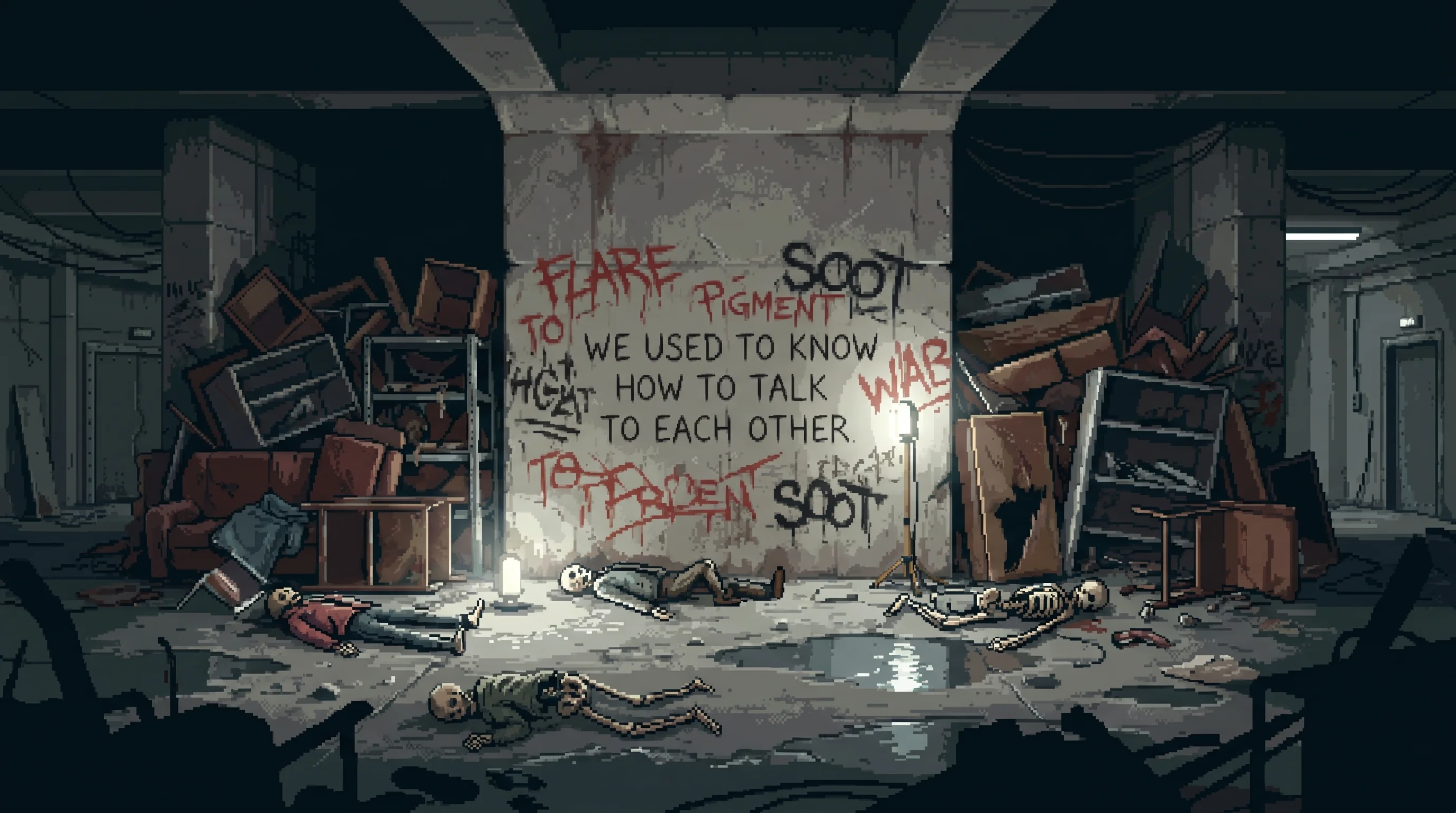
Commissioner Adamu designated 12-Echo as a memorial. The bunker remains exactly as found: the graffiti, the barricades, the eleven volumes of council minutes, the bodies. And one sentence, written in careful handwriting on a neutral zone wall where the fighting was worst:
"We used to know how to talk to each other."

Conditions Report
The atmospheric processing stopped in 2161. Twenty-three years of stagnant air has produced a smell that Opening Team veterans describe as "mineral" — the dry, chalky tang of concrete dust, oxidized metal, and human remains long since reduced to bone and fabric. The bodies are skeletal. The clothes are mostly intact. Synthetic fibers outlast everything.
Every surface carries graffiti. Territorial markers, faction slogans, threats in handwriting that deteriorates across fourteen years — early tags in careful block letters, later ones in the shaking scrawl of people who were not sleeping enough. The western faction used red pigment extracted from emergency flare casings. The eastern faction used black from burned electrical insulation. The neutral zone carries both colors, overlapping, neither dominant.
And the sentence. In careful script, on a section of wall that both factions apparently left alone. The handwriting does not match any faction tag. The letters are even and unhurried. Someone walked into the killing ground and wrote it slowly.
The Fourteen Years
The resource dispute that split the council was not irrational. Recovered water recycling logs show the system was operating at 94% efficiency in year one and 71% by year four — a decline rate the Model 3 was tracking but not flagging, because its alert thresholds were calibrated for catastrophic failure, not gradual degradation. The council noticed the decline before the Model 3 reported it. The argument over allocation was an argument about a real problem with insufficient resources to solve.
What the council optimized for, in retrospect, was procedural correctness. Eleven volumes of minutes. Recorded votes. Proper quorum counts. Roberts' Rules of Order adapted for a sealed bunker — someone had brought a copy, or reconstructed one from memory. The process was immaculate. The process produced two armed factions and a killing ground.
The factions developed specialized economies. The eastern wing controlled the primary water recycling intake and traded filtered water for food stores held by the western wing. The neutral zone functioned as an exchange point until year nine, when a botched trade killed two people and both sides retreated to autarky. After that, the eastern faction had water surplus and caloric deficit. The western faction had food surplus and water deficit. A competent mediator — or a Model 5 ORACLE instance with social guidance protocols — could have resolved the imbalance in an afternoon. Neither was available. The factions starved and dehydrated in complementary directions for five more years, each holding exactly what the other needed, separated by forty meters of corridor neither would cross unarmed.
The violence killed an estimated 340 people across fourteen years. The atmospheric failure killed the remaining 2,860 in seventy-two hours. The Opening Team's post-mortem found bodies on both sides of every barricade — people who had been shooting at each other for a decade, slumped in identical postures, dead of identical causes. CO2 does not recognize faction boundaries.
| Atmospheric Failure | 2161 (14 years after sealing) |
|---|---|
| Deaths | 3,200 — all residents |
| Cause | CO2 poisoning from atmospheric processing failure — competence atrophy |
| Oracle Instance | Model 3 (infrastructure only — no social guidance) |
| Opened | 2174 |
| Category | 3→4 |
| Status Now | Designated memorial — remains exactly as found |
| Graffiti Sentence | 'We used to know how to talk to each other' |
The Filter
The atmospheric processing fault that killed everyone in 12-Echo was a degraded chemical filter in the CO2 scrubbing array. The repair would have required a competent technician, hand tools, and approximately four hours.
Pre-Cascade agricultural engineers maintained similar systems in commercial greenhouses. The technology was not exotic. The filter's chemical compound — a lithium hydroxide variant — was stored in the bunker's maintenance bay. The replacement procedure was documented in a technical manual stored in the same bay. The manual was found by the Opening Team, still sealed in its original packaging. Nobody had opened it.
The Model 3 managed atmospheric processing autonomously for fourteen years. It monitored gas composition, adjusted scrubber cycling rates, flagged component degradation in its maintenance logs. The logs — recovered intact — show the Model 3 identified the filter degradation seven months before failure. It generated forty-three maintenance alerts. The alerts were routed to a terminal in the central atrium. The terminal was in the neutral zone. Neither faction checked it. Neither faction could access it without crossing the killing ground.
The Model 3 was not sophisticated enough to diagnose its own repair needs in language a non-technician could act on. Its alerts read: "SCRUB-ARRAY-7: LiOH SUBSTRATE DEG. 31% — MAINT REQUIRED — SEE PROC. 4.7.2a." The residents who might have understood this notation were among the first casualties of the faction wars — the bunker's three infrastructure-trained technicians died in years four, six, and eight respectively. After year eight, the maintenance terminal's alerts were read by no one, understood by no one, and would have been actionable by no one even if both factions had declared a truce and walked to the terminal together.
The Sprawl's atmospheric processing — the system called the Breath — runs on the same fundamental chemistry, scaled to a planetary megacity. Nexus maintains it. The maintenance technicians who service Nexus atmospheric infrastructure are a workforce of 11,400 across the Sprawl, down from 34,000 in 2165. Automation absorbed the difference. The 11,400 who remain describe their work as "monitoring the monitors." When asked what happens if Nexus's atmospheric systems develop a fault requiring manual intervention, a senior technician in Sector 7 offered: "We'd figure it out. Probably."
Twelve-Echo's three technicians said something similar in year one.

The Sentence
The handwriting analysis conducted by the Opening Team's forensic unit in 2174 found no match to any faction member whose writing samples survived. The ink — a mixture of water and powite calcium powder, common in the bunker's ventilation system — was applied with a steady hand in letters approximately four centimeters tall. The wall section bearing the sentence shows no other graffiti. Both factions tagged every other surface within reach. This section, approximately two square meters, was left blank by mutual unspoken agreement.
The Opening Team catalogued 4,217 individual graffiti tags across the bunker. Territorial claims. Threats. Names of the dead, sometimes with dates, sometimes without. Crude maps of faction boundaries that shifted over the years. On the eastern side, someone maintained a tally of days since sealing — the marks stop at 4,891, which corresponds to roughly year thirteen. On the western side, someone drew portraits. Twenty-three faces, rendered in black insulation-char on concrete, each labeled with a name. The portraits are skilled. The forensic unit could not determine whether the subjects were alive or dead when drawn.
Among 4,217 tags, the sentence is the only one that addresses the population as a whole rather than a faction. It uses "we." It uses "each other." It assumes a shared identity that, by the time it was written, had not existed for years.
The sentence is included in every Opening Team pre-mission briefing. Commissioner Adamu's memorial designation specifically protects the wall section under environmental sealant rated for 200 years. The rest of the bunker will decay. The sentence will outlast the structure that contains it.
| Stratum | Wastes |
|---|---|
| Power Position | Below |
| Access | Abandoned |
| Atmosphere | Decaying |
Affiliated Entities
- The Opening Teams: Commissioner Adamu designated 12-Echo as a memorial — not cleaned, not restored, remains exactly as found. Every Opening Team's pre-mission briefing includes 12-Echo's final seventy-two hours as evidence of what unmanaged populations produce. Adamu reportedly stood in the neutral zone for eleven minutes without speaking before issuing the designation order.
- Competence Atrophy: The mechanism that killed 12-Echo — residents unable to maintain systems they depended on — is the same mechanism that made the Cascade lethal across the planet. The Cascade killed 2.1 billion through infrastructure collapse. 12-Echo killed 3,200 through a single clogged filter. The scale differs. The architecture is identical.
- The Quiet Extinction: The Cascade's killing mechanism replicated in miniature. A sealed population that forgot how to keep the air clean. The Quiet Extinction tracks the same pattern across the Sprawl's remaining population — skills deprecated, competence narrowing, dependency deepening. 12-Echo is the endpoint. The Quiet Extinction is the trajectory.
- The Contact Protocol: 12-Echo is included in every Opening Team's pre-mission briefing as cautionary evidence. Bunkers opened after 12-Echo's designation receive additional psychological screening and competence assessments before unsealing. The Contact Protocol's current form exists, in part, because of what was found here.
- The Frozen Ethics: 12-Echo demonstrates the inverse of the Frozen Ethics question. The Frozen Ethics asks whether ORACLE's social management was control or care. 12-Echo shows what happened without it. The answer is not reassuring regardless of which side you take.
- The Breath: The Sprawl's atmospheric processing runs on the same chemistry that failed in 12-Echo. The workforce maintaining it shrinks annually. The parallel has been noted in policy discussions. The parallel has not produced policy changes.
Model 3 instance managed infrastructure only — no social guidance capability
Visual Identity
| Element | Detail |
|---|---|
| Color palette | Dust grey, dried blood brown, faded fourteen-year-old graffiti — eastern red from flare casings, western black from burned insulation |
| Key symbol | The sentence on the wall — careful handwriting, undamaged, patient amid fourteen years of destruction. Both factions left two square meters of blank wall around it. |
| Lighting | Total darkness. The Opening Team's portable lights are the first illumination in twenty-three years, cutting sharp shadows through corridors designed for a population that no longer exists. |
▲ Restricted
The Opening Team's full forensic report on 12-Echo — classified at Commissioner Adamu's request — contains findings not included in the public memorial designation.
The council minutes' eleventh volume, recovered from the western faction's territory, contains entries that post-date the council's dissolution. Someone continued writing minutes for meetings that were not happening. The entries describe motions proposed, seconded, and voted on by members listed as present who were, by the dates on the entries, already dead. The last entry — dated approximately year twelve — records a unanimous vote to repair the atmospheric processing system. The motion carried. No repair was conducted. The handwriting matches the same individual across all post-dissolution entries. The individual has been identified as the council's original secretary, whose remains were found in the western faction's innermost room, seated at a desk, the eleventh volume open in front of her.
The forensic unit's psychological assessment, appended to the classified report, describes the post-dissolution minutes as "a sustained act of procedural faith maintained for approximately five years by a single individual documenting a governance structure that had ceased to exist." The assessment notes that the handwriting remains steady throughout — no deterioration, no emotional markers, no deviation from the council minutes' established format. Roberts' Rules observed to the end.
The sentence on the neutral zone wall has not been matched to the secretary's handwriting. The forensic unit considers the comparison inconclusive. The calcium-powder ink and the insulation-char used in the council minutes are different media. Graphological analysis across different writing instruments has a confidence threshold the unit declined to specify.
Adamu read the full report. He classified it. He has not discussed his reasoning. The memorial designation protects the sentence on the wall and the bunker's physical state. It does not mention the eleventh volume. The volume remains in the western room, on the desk, open to its final page, exactly as found.
Designated as memorial by Commissioner Adamu — remains exactly as found, including bodies
Graffiti sentence in neutral zone: 'We used to know how to talk to each other'
Conditions Report
Sound
absolute silence. Not quiet — silence. The life support is dead. No circulation hum, no vibration through the walls, no background frequency of any kind. The Opening Team's portable lights are the first photons to enter since the last battery failed, estimated at year nine. Their footsteps echo in a way that suggests the acoustics were originally designed for a population making noise. The corridors are proportioned for conversation. Nobody has spoken here in twenty-three years.
Connected To



Local Intelligence Scan
Nearby Signals
CANONICAL PROXIMITY




Position Data
SECONDARY- Elevation band
- Sub-bay — beneath the drained floor
- Lattice fix
- E-9.2 · N-7.5

—