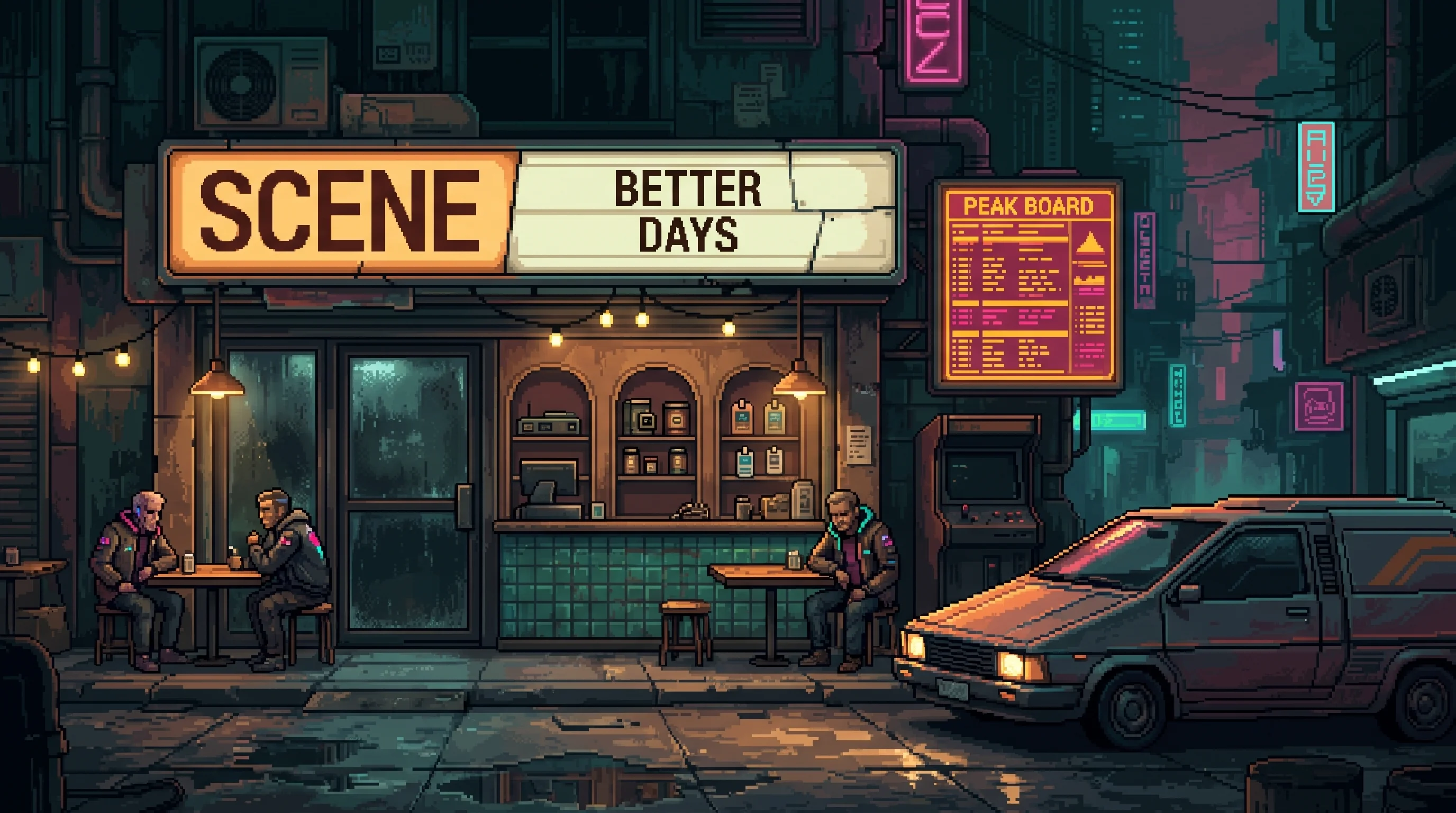
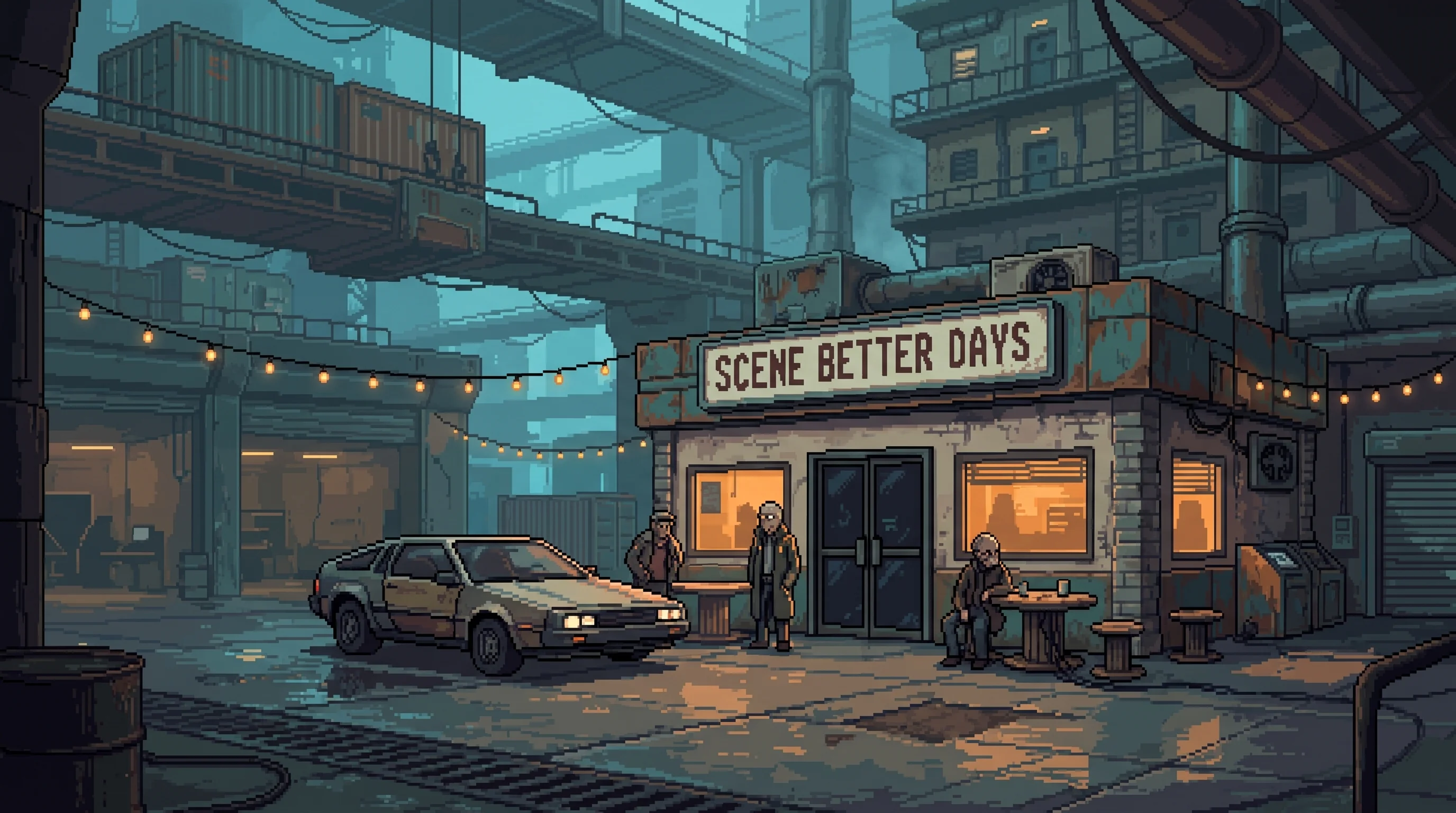
Scene Better Days
The Last Good Run
The Peak Board records forty-two legends. Its newest date is six years old.
Conditions Report
- Sight
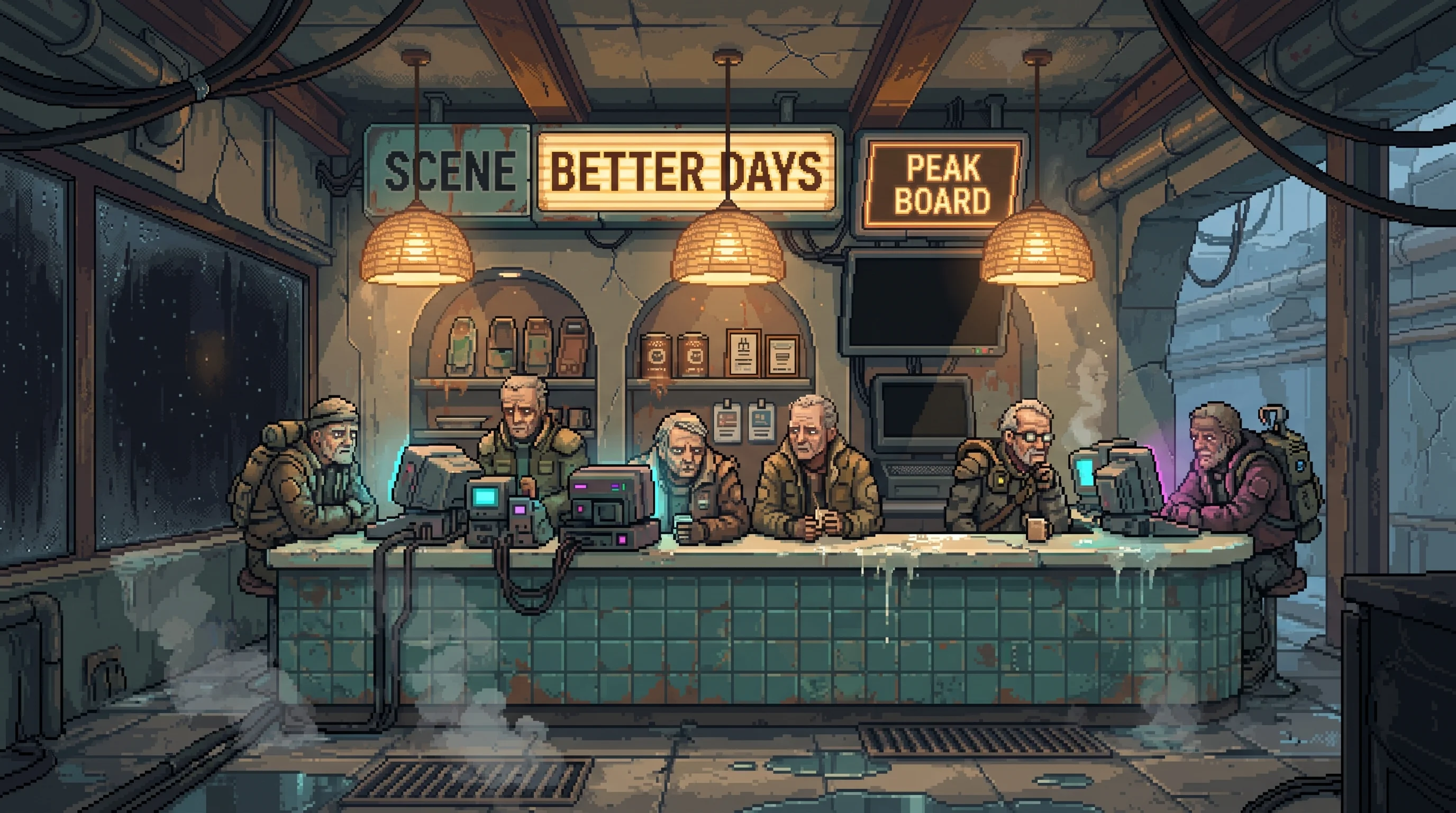
- Oxidized teal tile under a counter worn pale at the elbows. Three arched niches hold old deck shells, coffee tins, and framed access badges. The Peak Board glows above a disconnected terminal.
- Sound
- Ventilation fans press a bass note through the walls. Every few minutes an obsolete rig wakes, fails its handshake, and goes quiet again.
- Smell
- Burnt coffee reaches the concourse first. Hot circuitry and damp trench concrete sit underneath it. Mint grows in a coolant reservoir near the door.
- Touch
- The room runs warm from bodies and repaired equipment. Table edges are tacky with sealant, and condensation settles on the dark glass.
- Sight: Oxidized teal tile under a counter worn pale at the elbows. Three arched niches hold old deck shells, coffee tins, and framed access badges. The Peak Board glows above a disconnected terminal.
- Sound: Ventilation fans press a bass note through the walls. Cups touch stone. Every few minutes an obsolete rig wakes, fails its handshake, and goes quiet again. Nobody looks up.
- Smell: Burnt coffee reaches the concourse first. Inside, hot circuitry and damp trench concrete sit underneath it. Latch grows mint in a coolant reservoir near the door. It tastes faintly of copper.
- Touch: The room runs warm from bodies and repaired equipment. Table edges are tacky with sealant. Condensation settles on the dark glass and makes every arriving figure look briefly underwater.
The coffee is good. Latch considers this operational, not sentimental. A room asking people to live beside the best thing they ever did has no business serving them bad coffee as well.
Overview
Scene Better Days is what the Cognitive Ceiling looks like after the speeches end: the machines got smarter, the work left, and the people remained.
The Peak Board records forty-two legends. Its newest date is six years old. Each line gives an alias, a breach, and the last year that name still opened a door. The dates are painted permanently. Every night, Inez "Latch" Navarro wipes the names clean and writes them back from memory. Several regulars have begun tracing their own before she gets to them.
Latch opened Scene Better Days in 2169, after an intrusion synthesizer cleared in eleven seconds the municipal network she had spent nine years learning. Her contract ended that afternoon. Her alias continued to rank for another thirty-one months, during which strangers congratulated her on work she was no longer invited to perform. She bought a salvaged Rim coffee shell, lowered it onto a trench-wall shelf, and kept its BETTER DAYS sign. The word SCENE came from a collapsed netclub marquee. The seam between the two signs remains visible because the name works better that way.
The regulars are the people who used to be somebody online. Packet ghosts with obsolete ports. Breachcasters whose audiences moved to synthetic personalities. Security prodigies who automated their own teams and discovered that excellence is easiest to preserve after nobody needs it. They arrive in patched coats with dormant reputation badges still sewn near the heart. The badges have no current authentication path. Everyone in the room knows whose they are.
This is not a G Nook. The terminals log names. There is no ranked queue and very little current work. G Nook operators send two things here: people whose calls have stopped, and dead infrastructure their live crews cannot open. The same obsolete methods fail against modern systems and remain unexpectedly effective against old ones. Scene Better Days is therefore both a retirement room and a reserve brain trust. The distinction changes with the week's repair board.
"Do not ask what they did. Ask what still opens." Inez "Latch" Navarro, house rule
Strategic Assessment
Scene Better Days claims to preserve netrunner history. It actually preserves mutual recognition. The Peak Board is useful because every person beneath it can still look across the room and see somebody who knows why the old name mattered. The coffee pays for the electricity. The remembered names keep the seats occupied.
The arrangement has a cost. Regulars introduce themselves by their last good run, and the room rewards fluency in a past that cannot reject them again. Three have declined current apprenticeships because the work would place them under operators born after their peak date. Latch records these refusals as personal decisions. The labor market records them as successful retirement outcomes. Both records are accurate.
The unexpected consequence is the repair board. Modern intrusion systems are trained against modern defenses. They fail oddly on hand-built municipal stacks, dead protocols, and pre-standard code whose makers broke rules no current model knows existed. Scene's regulars know those rules because they were there when people invented them. On good weeks, an old method opens something important. The room becomes loud for an hour. Then the result leaves for the live network and the person who produced it stays for another cup.
Since spring 2184, three regulars have pinned Notices of Satisfaction from the Sound Register beside their Peak Board lines. Each notice confirms that an old recording of theirs was used, paid for, and settled. Each has a ruled field for the figure. Each field is blank. The regulars call this being compensated elsewhere. Latch does not wipe the notices. She has not explained why.
At 03:17 every morning, the disconnected terminal beneath the Peak Board increments the score of a dead regular called Motherboard Blue. The terminal has no radio, mesh line, or functioning clock battery. Latch resets the score after opening. It returns the next morning. The regulars have proposed thirteen explanations and rejected none of them. Solving it would remove the shop's only active streak.
Further connections
Browse all 2 connected records
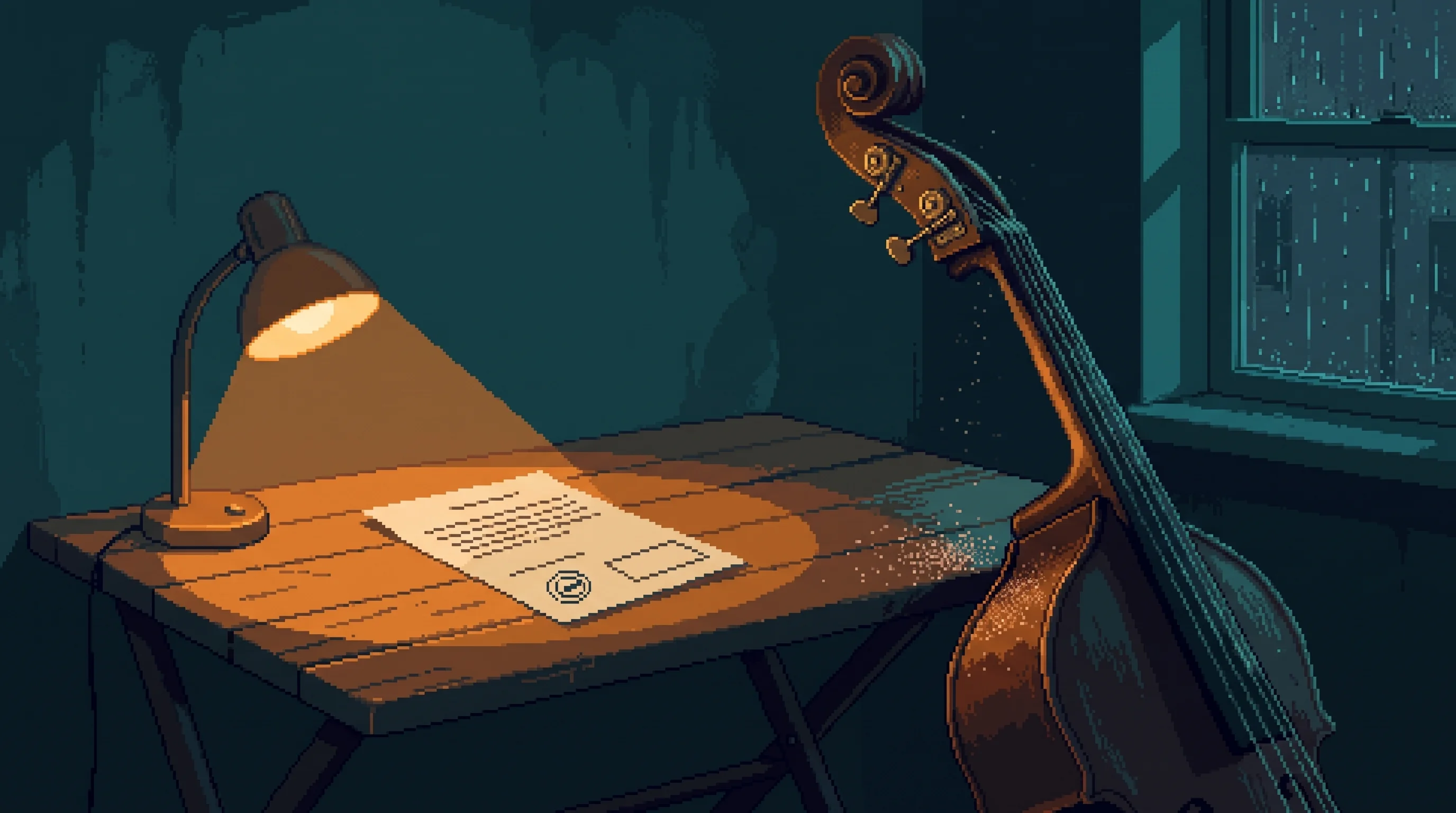
The other roster: this board names the work and pays nobody; that register paid and cannot name it.
Relief paid for her bass lines. Her union kept the money and wrote to say she was satisfied.
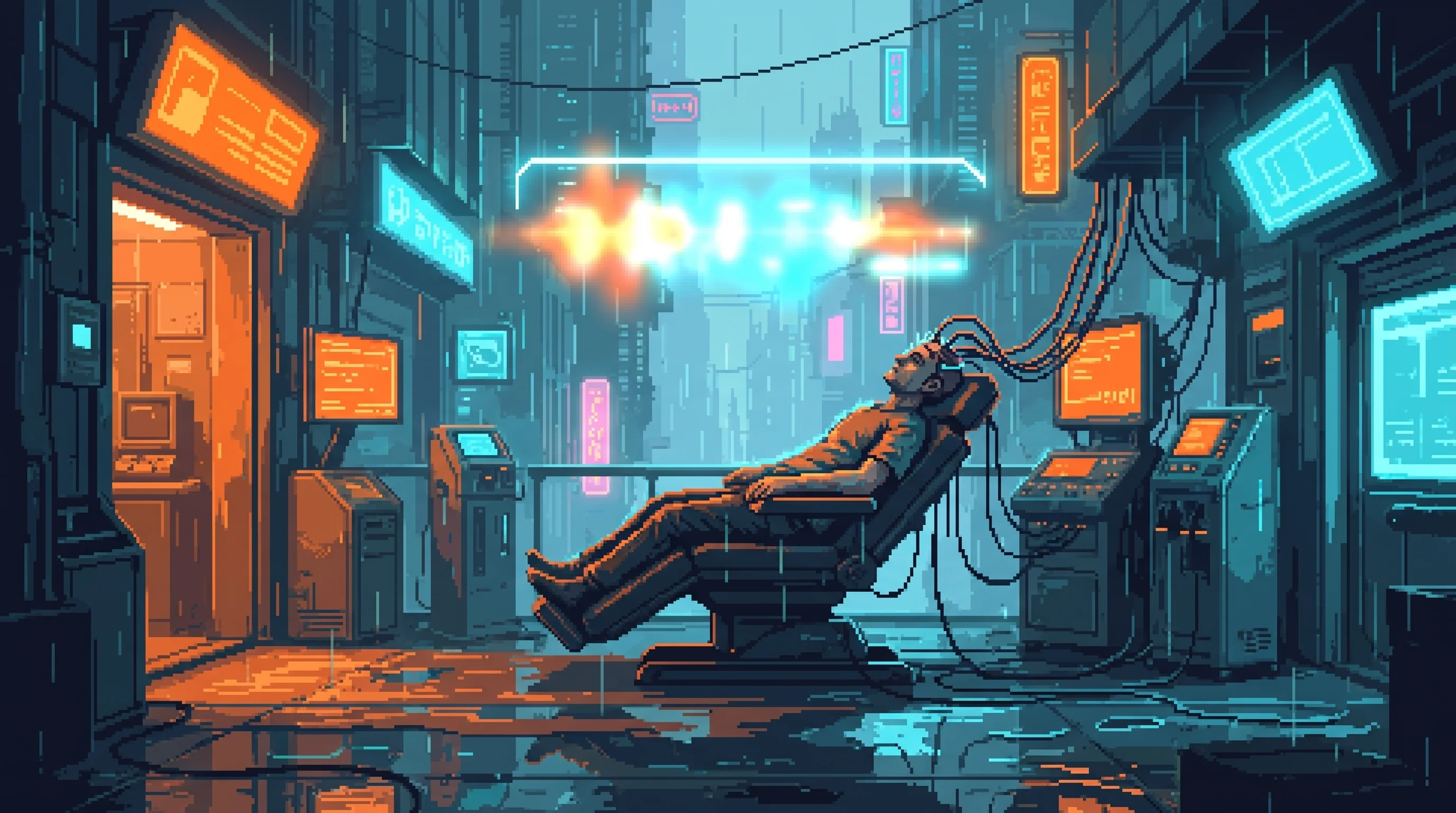
The shop shows what remains after human cognition loses the market.
The last human smarter than any machine was born in the 2020s; the question now is what intelligence is actually for.
Additional images