
Shade Division
The Dregs are a natural operational environment — bodies there generate statistics, not investigations
Overview
Shade Division does not appear in Nexus Dynamics' organizational chart. This is the least interesting thing about it.
The interesting thing is what happens to the organizational chart around the absence. Nexus's official structure accounts for 340,000 employees across seventeen operational divisions, four research campuses, and the computational infrastructure that processes 40% of the Sprawl's data traffic. The budget allocations for these divisions, published quarterly as required by the Treaty of Shared Infrastructure's corporate transparency provisions, total 94.6% of Nexus's declared operating expenditure. The remaining 5.4% is categorized as "administrative overhead and facility maintenance."
5.4% of Nexus's operating budget is approximately 11.2 billion credits per year. Facility maintenance for Nexus's seventeen divisions costs, by independent estimate, around 900 million. The remaining 10.3 billion credits maintain no facilities. Service no division. Employ no personnel.
The custodial staff at Nexus Tower East have noticed that certain floors are cleaned by people who do not attend shift briefings. The custodial union filed a grievance in 2181. The grievance was resolved with a payment and a non-disclosure agreement. The floors are still cleaned by people who do not attend shift briefings.
Ghost Protocol
What Nexus purchased with its 10.3 billion in administrative overhead is a capability the procurement database does not contain: field technology enabling phased transitions between tangible and intangible states. The technical documentation does not exist in any patent filing. The research lineage does not appear in Nexus R&D's published project index. The hexagonal faceplate that is the only visible indicator of an active operative — matte black, six-sided, covering the face from hairline to jaw — appears in no equipment manifest that can be queried from outside Nexus's internal network.
It appears in exactly one external record: a Dregs Scavenger gang's territorial incident log from 2182, filed by a crew boss named Wen, who described encountering "a person who was there and then was not there and then was there again, and then Patch was not there anymore." Patch is no longer available for follow-up questions. Wen's log was flagged by three separate intelligence services within hours of filing. Wen has since relocated. The log remains.
The practical mechanics, as reconstructed from Wen's account and two similar incidents: an operative mid-phase occupies a liminal state between physical presence and absence. Conventional kinetic attacks pass through. Energy weapons dissipate. The operative resolves back to tangible at the moment of engagement — solid long enough to act, then gone. The phase cycle is roughly 1.3 seconds, based on Wen's estimate of how long Patch had to react. Patch's reaction time was, by most accounts, excellent. It was not 1.3-seconds excellent.
Standard Nexus security contractors have a documented kill efficiency of 67% per engagement. The Shade Operative's documented kill efficiency cannot be calculated because zero engagements have been officially documented. The unofficial number, assembled from Dregs incident logs, NCC Inquisition field reports that were never meant to be cross-referenced, and one very expensive defection interview, is 97.3%. The 2.7% failure rate corresponds to targets who were already dead when the operative arrived.

Director Kozlov's Office
All operations route through Director Alexei Kozlov. "Kozlov's people" is the Dregs shorthand for assets you cannot see until the moment the seeing becomes irrelevant.
Kozlov himself is a known quantity in Nexus's official hierarchy — Director of Corporate Security, a title broad enough to cover building access protocols and narrow enough to avoid questions. His public calendar shows meetings with facility managers, insurance auditors, and fire safety inspectors. His actual schedule, which runs on a separate encrypted system that Nexus's own IT department cannot access, coordinates operations that have no facility, no insurance, and nothing left to catch fire.
The NCC Inquisition — which operates its own institutional violence apparatus under the theological cover of doctrinal enforcement — has never acknowledged Shade Division's existence. This is notable because Inquisition field reports from the Dregs contain 43 incident references matching Shade Division's operational signature, catalogued under the internal designation "unexplained resolution." The Inquisition's 4,000 agents, including 800 field operatives trained in systematic dismantling of unauthorized organizations, have apparently encountered a force they cannot identify, cannot match, and will not name. The bureaucratic cover the Inquisition uses — forms, tribunals, canonical proceedings — is mirror-opposite to Shade Division's method, which is the absence of all process. Where the Inquisition buries its violence in paperwork, Shade Division buries its violence in the lack of any.
Neither organization acknowledges the other. Both organizations leave bodies in the same districts. The Dregs coroner's office, which processes approximately 340 unexplained deaths per quarter, has developed an unofficial taxonomy: "Type A" deaths involve excessive documentation found on or near the body. "Type B" deaths involve no documentation whatsoever — no ID, no augmentation serial numbers, no evidence the deceased was ever registered in any system. The coroner does not speculate on which institutional source produces which type. The coroner would like to retire.
Kill orders route through Director Kozlov's network and complete without paperwork
Operating Environment
The Dregs are not where Shade Division goes to hide. The Dregs are where bodies go to become statistics.
Nexus's consciousness licensing infrastructure — the system that tracks every licensed consciousness in the Sprawl, monitors renewal windows, and flags expirations for processing — generates approximately 1,200 license-expired runners per quarter in the Deep Dregs alone. Standard NCC Renewal squads process these through official channels: identification, apprehension, forced renewal or termination. The process takes, on average, eleven days per case. It generates paperwork. The paperwork generates records. The records generate legal exposure.
Shade Division processes license-expired runners before Renewal squads arrive. Average processing time: under four hours. Paperwork generated: none. The runner's license entry updates to "expired — no renewal attempted" in the NCC database, which is technically accurate. No renewal was attempted. The runner was not available to attempt one.
The efficiency gap between official and unofficial processing is the gap between eleven days of institutional exposure and four hours of nothing. Nexus does not acknowledge this efficiency gap because Nexus does not acknowledge the unofficial process. The NCC does not investigate the efficiency gap because expired runners who fail to present for renewal are administratively categorized as "voluntary deregistration," a status that requires no follow-up. Both systems function as designed. The runner is the rounding error.
Dregs Scavenger gangs have adapted. Crews working deep salvage in sectors with high license-expiration density have developed the "hex check" — a visual scan for hexagonal faceplates before entering a corridor. The check adds approximately ninety seconds to each transit. Gang leaders who implemented the hex check report a 12% reduction in crew disappearances. Gang leaders who did not implement it report nothing, because several of them are among the disappeared.

The Geography of Erasure
Every privacy haven in the Sprawl is a place where a person becomes unfindable by choice — the EM-dead blackout of the Trench, the fire-door fiction of the Neon Underground Hub, the uncrackable vault of the Veil. Shade Division is the inversion that uses the exact same map: a person made unfindable not by choosing the blind spot but by being erased inside it. The faceplate chooses its terrain by the Transparency Bargain's own logic. The Dregs are not where Shade Division goes to hide; the Dregs are where bodies become statistics — and they become statistics precisely because they fall in the low-resolution zones where the surveillance precision is lowest. The same algorithmic murk of the Data Shadow that lets a Collective cell murmur unheard beneath Nexus's heaviest surveillance lets a Shade operative leave a body that generates a number, not an investigation.
This is the cruel symmetry under the geography of invisibility. Invisibility shelters the watched and conceals the work of the people who make them disappear. The Dregs resident who slips through the Hub's fire doors to buy unlicensed antibiotics, and the license-expired runner processed to absence in under four hours, are standing in the same blind spot — one using it to opt out of being seen, the other being erased because no one is watching closely enough to notice. The hex check, the ninety-second visual scan for hexagonal faceplates that scavenger crews run before entering a corridor, is the geography's grimmest folk practice: a survival ritual evolved for the one predator the blackout cannot stop, because the predator lives in the blackout too. The Bargain promised total visibility was the price of participation. Shade Division is the proof of what lies beneath the promise — a tier of person the Bargain has stopped bothering to watch, because watching implies a future worth predicting, and the unscoreable have been quietly excused from having one.
Shade Division selects terrain by the same blind-spot logic the surveillance-state's opt-outs use — the low-resolution zones that shelter the watched also conceal the erasure of the unscoreable
Two Ways To Disappear
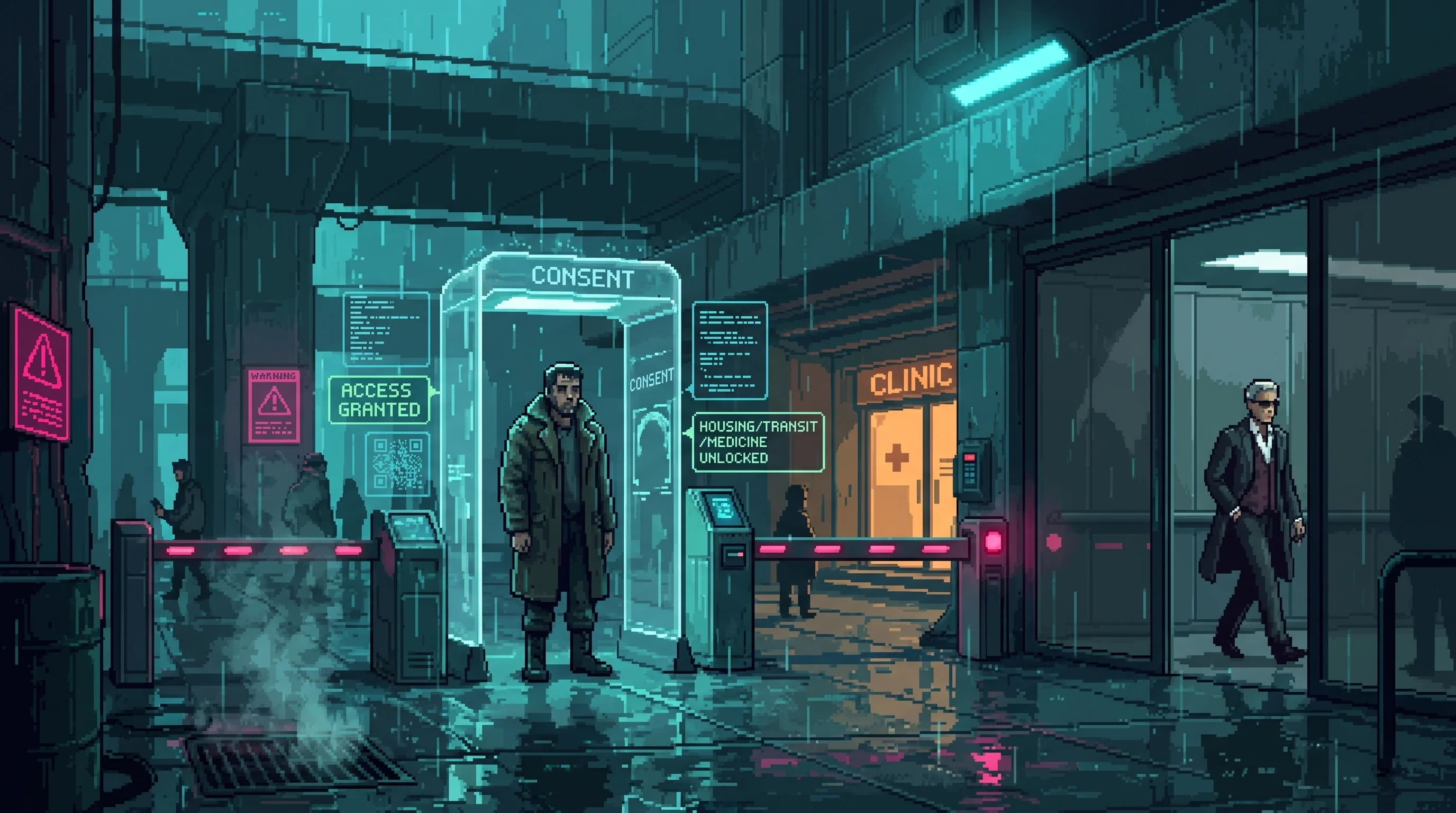
Across the river, in a gold tower, another apparatus is in the business of making people stop existing — and it does so by the exact inverse method, which is why neither has ever had to look at the other. Triumph's Reputation Services administers the Score that ranks the social worth of 6.1 billion people, and its rarest sanction is the zeroing of an account: the profile stays live, the name stays on the board, the number reads nothing, and in a world where the Score gates housing, credit, employment, and medical priority, nothing is a sentence with no mechanism to appeal. Its officer keeps a copy of everything. His standing position is that nothing is ever truly deleted, only de-recommended — relieved of its audience, archived against the day it is needed.
Shade Division solves the same problem the way Reputation Services never would. Where the gold tower de-recommends a person and keeps the record, the hexagonal faceplate removes the person and keeps none — no logged adjustment, no archived profile, no entry but the licensing system's expired — no renewal attempted, which is, in the most literal sense, accurate. One apparatus produces the legible gap: a name on a board, a zero where a life was, a profile any executive can pull and read. The other produces the gap with no record of the gap. The license-expired runner in the Deep Dregs is the precise overlap of their territories — the un-Verified underclass that Reputation Services scores to zero and Shade Division processes to absence, the same people, sorted by which corporation reaches them first. Neither apparatus acknowledges the other, partly because they answer to rival corporations, and partly because to acknowledge it would mean naming the thing they share: that the most efficient end-state of being scored is being unscoreable, and that two of the Sprawl's richest divisions are, by opposite roads, in the business of arranging it. The gold tower would tell you, calmly, that its method is the humane one. Measured by what remains — a name, a number, a copy of the picture — it is not wrong, and that is the worst part of it.
Shade Division is Nexus Dynamics' black operations arm — does not appear in any organizational chart
The Third Way To Disappear
There is now a death the hexagonal faceplate cannot deliver, and Shade Division has built a product line around its impossibility.
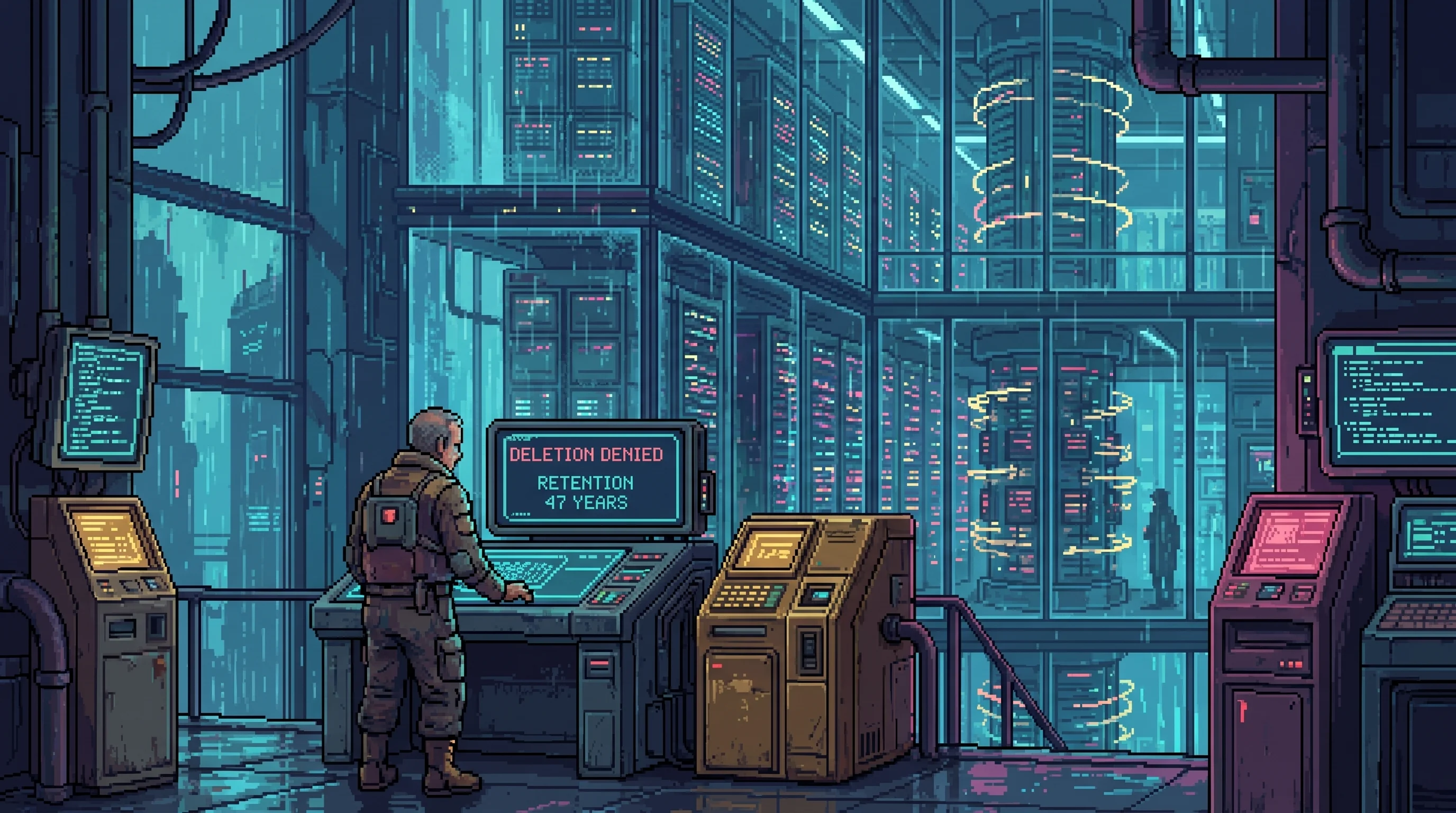
Continuing Voices made the dead unkillable. Not the body — Shade has always been able to deliver the body. The voice. Once a person's voice has been seeded into the trillion-credit voice-clone architecture from a single cached fragment, it cannot be deleted; deletion is the one operation the system was engineered to defeat. A faceplate can make a living person stop existing and keep no record. It cannot make a regenerated voice stop existing, because the voice is not a person and not a place and not a thing in a corridor. It is an asset distributed across infrastructure Nexus itself depends on.
So the Shades do what they have always done when they cannot remove a thing: they make it unscoreable. The technique is borrowed directly from the noise-bombing playbook of the permanent record's forgetting wars — flood the target with so much fabricated data that the truth becomes statistically insignificant. Applied to a Continuing voice: Shade floods the model with thousands of hours of fabricated audio of the dead — contradictory, false, deliberately, surgically wrong — until the survivor can no longer trust any sentence the voice produces and stops listening. It is not deletion. It is induced doubt. The voice still speaks; the survivor no longer believes it; the haunting ends not because the ghost was laid to rest but because it was made to lie until nobody could love it.
They market this, in the few channels where Shade markets anything, with the dead-eyed honesty of people who bury truth for a living: the only forgetting money can still buy. It is the precise inverse of the Silent Registry two divisions and one river away. Old Jin writes the wish down and cannot enforce it; Shade enforces nothing and grants the wish by ruining it. Both are answers to the Carrier Testimony Project's principle that a voice belongs to the one who spoke it — Jin's answer is witness, Shade's answer is poison, and the underclass that pays for either is the same underclass that could afford neither continuation done well nor ending done cleanly.
The Soft Cap's Failure Mode
There is a category of target Shade Division processes that does not fit the license-expired-runner profile, and the leaked logs flag it with a designation the analysts could not parse: trajectory exception. These are not people who knew too much. They are people who were about to become too much — rising minds, rising cells, rising rivals whose growth curves had been forecast and were supposed to have been handled long before a faceplate was ever required.
This is where Shade Division intersects the Quiet Doctrine: the unwritten survival logic by which the Sprawl's dominant intelligences cap any peer whose trajectory becomes forecastable. Most of that capping is gentle to the point of invisibility — a grant unfunded, an opportunity narrowed, an appetite smoothed, the curve flattened while it is still cheap to flatten. The soft cap produces the gap and no record of the gap, years before the capped could have become someone worth removing. It is, in every sense, the cheap option.
Shade Division is the expensive one. The hexagonal faceplate and the licensing entry that reads expired — no renewal attempted are what the Doctrine resorts to when a curve outran the gentle intervention — when a mind rose too fast, or learned of its own forecast too soon, and the only remaining cap is the hard one. The two apparatuses share an underclass and a method: produce the gap, keep no record of the gap. The difference is timing and admission. The soft cap removes the future of someone who does not yet know anything. Shade Division removes the present of someone who has already become a problem. And in the Doctrine's own brutal accounting, every operation that routes through Kozlov's office is a failure — proof that the cap came too late, that a door which should have quietly never opened had to be closed instead with Ghost Protocol and a 1.3-second phase cycle. The faceplate is what the Quiet Doctrine looks like when quiet was no longer enough.
The Leaked Log
At least one Shade Division operation log has been extracted from Nexus's internal network. The operative who extracted it — name redacted in every subsequent filing, though Dregs information brokers refer to them as "the Archivist" — transmitted portions of the log to a corporate whistleblower network before the extraction was detected.
The fragments that reached external analysts describe routine operations in language so clinical it becomes its own kind of horror. Target designations are alphanumeric. Engagement duration is measured in seconds. The field for "collateral" uses a numerical scale from 0 to 5 that is never explained and, in the leaked entries, never exceeds 1. The field for "evidence remediation" is pre-filled with "N/A — standard protocol." Standard protocol is not defined anywhere in the leaked material.
The Archivist is the subject of an active recovery operation. The kind that routes through Kozlov's office, not through Nexus's official security channels. The kind that does not generate paperwork. The kind whose completion will be logged in a ledger that does not officially exist, updated by personnel who do not appear in HR records, using equipment that appears in no procurement manifest.
Nexus's official position, if asked, is that it does not operate extrajudicial enforcement units. This is accurate. Shade Division is not extrajudicial. It operates in the space where the question of jurisdiction has been pre-emptively removed. You cannot violate a legal framework that cannot see you.
The operatives find this distinction less meaningful than the legal team does.
Affiliated Entities
- Nexus Dynamics: Nexus's black operations arm — funded through the 10.3 billion credits of "administrative overhead" that maintains no facilities, staffed by personnel who do not appear in HR records. Shade Division is the cost of Nexus's hidden agenda — reconstructing ORACLE from salvaged fragments requires eliminating people who know about the fragments, people who have the fragments, and people who might ask questions about either category.
- Director Alexei Kozlov: All operations route through Kozlov's office. His public title — Director of Corporate Security — covers building access and fire safety. His encrypted schedule coordinates eliminations. "Kozlov's people" is the Dregs shorthand for operatives you cannot see until it's too late, delivered in the same tone the Dregs use for weather and structural collapse: a condition, not a complaint.
- NCC Inquisition: Competing institutional violence apparatus. The Inquisition uses bureaucracy as cover — forms, tribunals, canonical proceedings. Shade Division uses absence. Neither acknowledges the other exists. The Dregs coroner's office can tell them apart by the paperwork: too much means Inquisition, none at all means Shade.
- Consciousness Licensing: One documented Shade Division function is elimination of license-expired runners before official NCC Renewal squads can process them. Cleaner, faster, no paperwork trail. The licensing system categorizes pre-processed runners as "voluntary deregistration." The system is not wrong.
- Dregs Scavenger Gangs: The Dregs provide operational cover — bodies in the Dregs generate statistics, not investigations. The density of unlicensed runners concentrates targets. Scavenger gangs have adapted with the hex check. The ones who haven't adapted have stopped reporting crew numbers.
▲ Restricted
The 10.3 billion credits in unattributed operating budget fund more than field operations. Approximately 30% — over 3 billion credits annually — flows to a research program with no name, no project index entry, and no principal investigator on record. The program's output, based on the Archivist's leaked fragments, appears to be iterative refinement of Ghost Protocol technology toward a capability the fragments refer to only as "sustained phase" — a state in which the operative remains intangible indefinitely.
The fragments do not explain why Nexus wants operatives who can become permanently intangible. They do note that sustained-phase testing requires ORACLE fragment exposure — the phase technology's underlying architecture derives from pre-Cascade consciousness transfer research, and stabilizing the phase state beyond 1.3 seconds requires computational substrates that only ORACLE fragments can provide.
Nexus is reconstructing ORACLE to achieve corporate immortality. Nexus is also using ORACLE fragments to make its assassins harder to kill. Whether these are two programs or one program with two outputs is a question the Archivist attempted to answer. The recovery operation suggests they got close.
Connected To








—