The Data Shadow
Overview
The Data Shadow exists because Nexus Dynamics needed somewhere to put its heat, and fifteen thousand people figured out how to live in it.
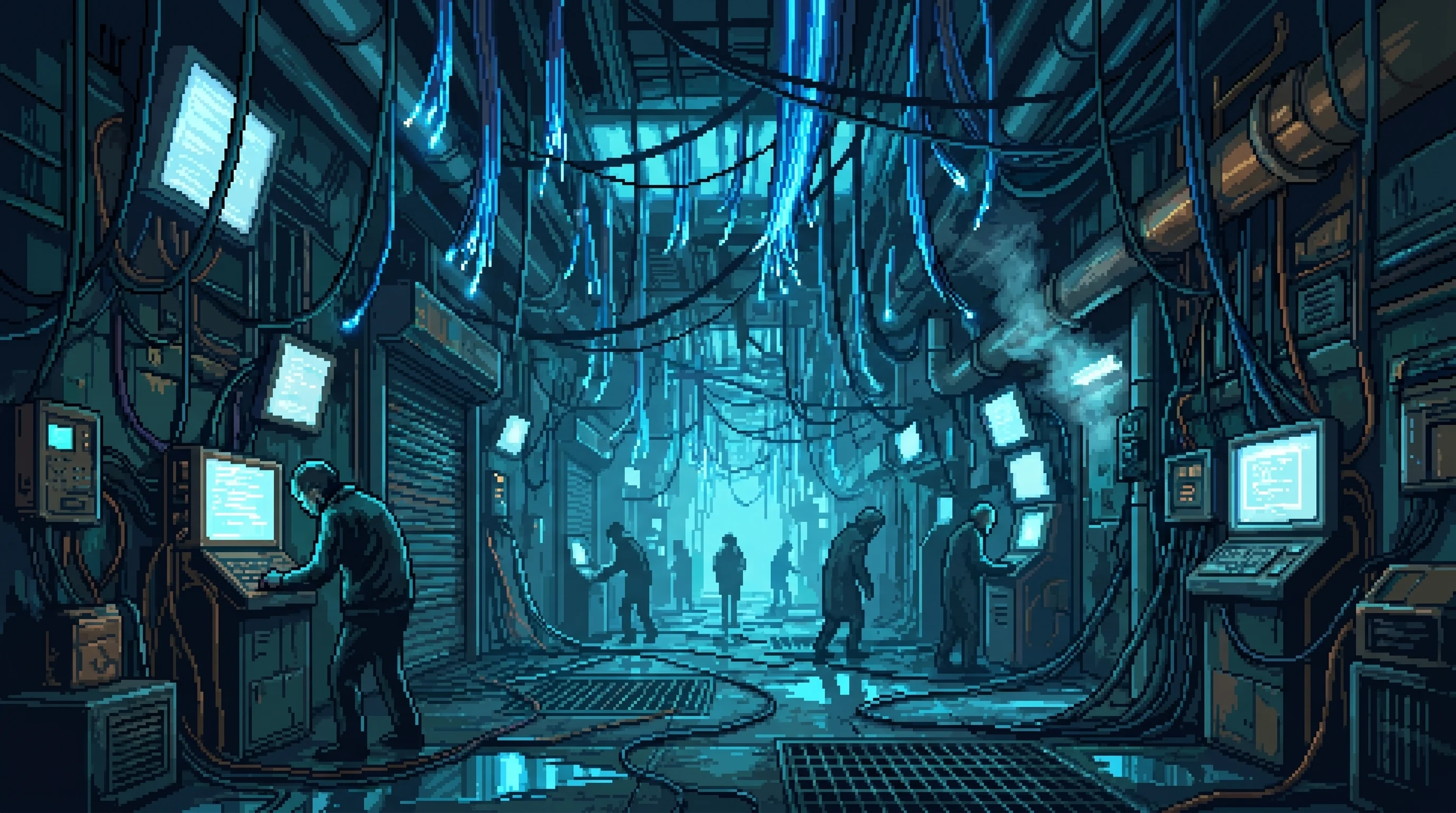
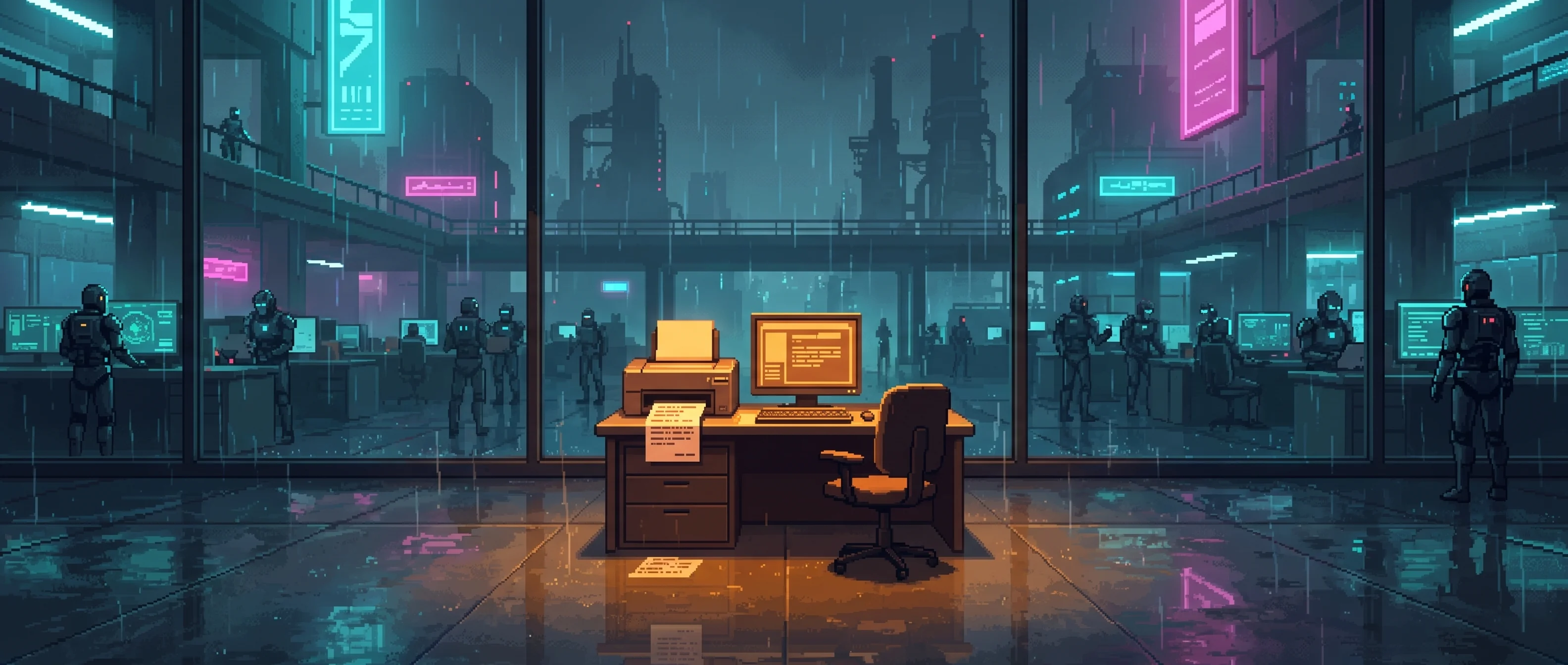
S4-D sits directly beneath the Sprawl's primary Data District, in the thermal and informational overflow zone where corporate infrastructure meets the underground economy. The subsector's ceiling is literally the Data District's floor — cable runs, cooling pipes, and fiber optic conduits press down from above like the roots of a digital forest, and the heat they shed raises ambient temperature 8-12 degrees above the surrounding Dregs. Nexus's facilities management logs classify S4-D as "thermal exhaust infrastructure." The 15,000 people living in the thermal exhaust infrastructure have not been consulted on the classification.
In winter, S4-D is the most comfortable place in the Deep Dregs — refugees from colder sectors crowd in, and the population swells by as much as 40%. In summer, the waste heat pushes temperatures past the point where unaugmented humans can work safely. Residents adapted years ago: summer labor runs in four-hour shifts with mandatory cooling breaks in the subsector's few ventilated spaces. Nexus's climate reports for the Data District note "negligible thermal externalities." The externalities are sleeping in shifts.
The real economy is information. Data fragments fall from the District above — corrupted files, discarded datasets, overflow packets that corporate systems shed during peak processing. Most of it is garbage. The Sifters — S4-D's primary workforce — have spent years developing techniques for cleaning, reassembling, and extracting value from digital refuse that would make Nexus's own data engineers uncomfortable. Half the information brokers in the Sprawl started in S4-D, learning to find gold in someone else's trash.
The part that requires a second read: Nexus has filed seventeen data-theft complaints against S4-D brokers in the past three years. The data in question was recovered from Nexus's own waste stream — files that Nexus's systems flagged as valueless, shed into the overflow, and discarded into the subsector below. The legal position is that discarded data retains corporate ownership in perpetuity. The practical position is that Nexus throws information away, then prosecutes the people who pick it up. Fourteen of the seventeen complaints resulted in fines. The fines are paid from revenue generated by selling different fragments of the same waste stream that Nexus hasn't noticed yet.
The Collective and Nexus coexist here in proximity that both would describe as "strategic" and neither would describe as "comfortable." Nexus surveillance is heavier in S4-D than anywhere else in the Dregs — cameras, drones, compromised terminals, paid informants. The Collective operates anyway, using the surveillance density itself as cover: in a place where everything is monitored, the monitors can't distinguish signal from noise. Every conversation in S4-D carries the assumption that someone else is listening. The assumption is correct. It has been correct for so long that residents have stopped treating it as a problem and started treating it as weather.

Conditions Report
The Data Shadow is warm, humming, and tangled. Cable runs hang everywhere — ancient fiber optics trailing from the ceiling, newer jury-rigged connections patched between them, everything intertwined in a dense canopy that turns corridors into something between infrastructure and undergrowth. Walking through S4-D means ducking under cables, stepping over junction boxes, and navigating passages where the walls are more wire than concrete.
The air tastes metallic. Cooling system runoff from the Data District above deposits trace particulates that longtime residents swear sharpen short-term cognition while eroding long-term memory. Sector 9 health advisories recommend no more than four continuous hours in S4-D without returning to cleaner air. Average Sifter shift: six hours. The advisory has been reissued nine times. The shift length has not changed.
Server hum is constant — a harmonic stack of frequencies from dozens of partially functional installations, each contributing its own tone to a collective drone that residents tune out within weeks and newcomers describe as "physically inside my skull." The hum masks conversation at normal volume, which produces S4-D's signature social behavior: residents speak softly, directly, lips close to ears. Outsiders find this conspiratorial even when the topic is dinner. Nexus's audio surveillance can filter the hum algorithmically. Human ears cannot. The subsector's residents have, without coordinating, developed a communication style optimized against the one listener they can't see.
Light comes from screens. Monitoring displays, salvaged terminals, the blue glow of active fiber optics visible through damaged insulation — all of it produces a cool, flickering illumination that gives faces a cadaverous cast. The effect is beautiful from a distance: approaching S4-D from the south, the subsector's glow is visible through the infrastructure like a captured aurora. Up close, the beauty becomes eyestrain. S4-D's informal clinic reports corrective lens prescriptions at 3.2 times the Dregs average. The clinic attributes this to "environmental factors." The environmental factors are visible from every angle, at every hour, in every shade of blue.
| Stratum | Dregs |
|---|---|
| Power Position | Below |
| Access | Contested |
| Atmosphere | Oppressive |
The Sifters
S4-D's primary workforce processes corporate data waste using methods that no accredited institution teaches, because no accredited institution acknowledges the work exists.
Sifting is part archaeology, part forensic reconstruction, part intuition refined over thousands of hours of sorting garbage. A senior Sifter can identify the origin system of a corrupted file from its header fragments, estimate the commercial value of a partial dataset before reconstruction is complete, and distinguish genuine Nexus overflow from planted decoys with roughly 73% accuracy. The 27% failure rate is where Nexus's counterintelligence budget goes.
The work falls below the threshold of corporate attention — and this is the Sifters' entire survival strategy. The data they process is classified as waste. Waste isn't worth automating. An internal Nexus efficiency report from 2181 evaluated the cost of deploying AI systems to pre-filter the overflow stream against the cost of letting S4-D's human population do it for free. The report concluded that human Sifters represented "a net-positive externality requiring no resource allocation." The Sifters' jobs exist because a machine decided they weren't worth replacing. If the calculus ever shifts — if the waste stream produces something valuable enough to automate — the Sifters will discover that being beneath notice was a privilege, not an insult.
Sifting output flows south into the Deep Dregs economy. Information brokers in Anchor Town deal in S4-D product — cleaned data, reassembled files, verified fragments. The supply chain is informal, unregulated, and responsible for an estimated 12% of Sector 9's non-salvage commerce. Nexus is aware of this figure. Nexus has not acted on it. The data is waste. Acting on it would require acknowledging that corporate waste has value, which would require acknowledging that the current disposal method — dumping it on fifteen thousand people — is a subsidy rather than an externality.
~15,000 population in contested territory — Nexus surveils, Collective operates, nobody governs
Faction Presence
Nexus Dynamics maintains its heaviest Dregs-side surveillance infrastructure in S4-D. Cameras, signal interceptors, and compromised terminals are common enough that residents factor them into navigation the way other neighborhoods factor in weather. Nexus's interest is officially defensive: monitoring the overflow for unauthorized access to classified information that exited their systems through the waste stream. The unofficial interest is the Collective. S4-D is the closest thing to a Nexus-Collective border that exists in physical space, and both sides treat it accordingly.
When Nexus identifies a breach — someone accessing data that was waste yesterday and classified today — the response is swift, targeted, and carefully calibrated to discourage repetition without disrupting the broader ecosystem. Nexus needs S4-D to keep absorbing its thermal and data externalities. Burning the subsector would mean finding somewhere else to put the heat. The current arrangement is, from a facilities management perspective, optimal.
The Collective treats S4-D as a strategic intelligence position — close enough to Nexus infrastructure to monitor corporate operations from inside the corporation's own thermal shadow. Collective cells here are among the organization's most disciplined. A single operational security failure draws immediate Nexus attention, and the distance between "attention" and "action" in S4-D is measured in minutes rather than the weeks it takes elsewhere in the Dregs. The Collective believes ORACLE fragments should be destroyed, not reconstructed. Nexus believes the opposite. The subsector where both factions concentrate their intelligence operations is, by a coincidence that neither faction finds coincidental, directly beneath the infrastructure most likely to contain fragment echoes.
The Server Monks — part religious order, part engineering crew — maintain the old server farms that give S4-D its processing capacity, including the installations connected to Server Farm 14's waste heat network. Their loyalties are to the machines. This makes them valuable to every faction and committed to none, which is either principled neutrality or the alignment problem expressed as a monastic vocation, depending on who you ask. The Monks do not express a preference between interpretations. The machines don't either.
The Crackers — black-hat hackers who extract value by whatever methodology presents itself — operate from S4-D's less monitored corners, which is to say the corners where monitoring equipment has been disabled often enough that Nexus stopped replacing it. The subsector tolerates them because their intrusion skills generate income and their technical knowledge keeps infrastructure running. The Crackers tolerate the subsector because it provides proximity to targets and neighbors who consider "what exactly do you do?" an impolite question.
The subsector's ceiling is literally the Data District's floor — cable runs, cooling pipes, and fiber optic conduits press down from above
Privacy From Too Much Watching
Most of the geography of invisibility works by subtraction — the Trench removes the signal, the Veil removes the readable currency, the Neon Underground Hub removes the auditor's willingness to look. S4-D works the opposite way, and it is the strangest blind spot in the whole map: surveillance so dense it becomes its own privacy. Nexus maintains its heaviest Dregs-side surveillance here, and the Collective operates anyway, using the surveillance density itself as cover — in a place where everything is monitored, the monitors cannot distinguish signal from noise. The Transparency Bargain defeated itself in S4-D by succeeding too completely.
The residents proved it without meaning to. They speak softly, lips close to ears, because the server hum masks conversation from the one listener they cannot see — a communication style optimized, with no coordination, against algorithmic audio surveillance. Outsiders find it conspiratorial even when the topic is dinner. It is not conspiracy. It is adaptation: the saturation that was supposed to make everyone legible instead taught fifteen thousand people to make themselves illegible inside it. Privacy in S4-D is not the absence of the watcher. It is the watcher overwhelmed.
And the Sifters are the Privacy Gradient stated from the very bottom. They survive by being beneath the resolution of the instruments — processing data the corporate systems classified as waste, because waste is not worth automating, kept employed because a 2181 Nexus efficiency report decided human Sifters were "a net-positive externality requiring no resource allocation." Their invisibility is conditional, on loan, and they know it: if the calculus ever shifts — if the waste stream produces something valuable enough to automate — they will discover that being beneath notice was a privilege, not an insult. The rich buy opacity and own the instruments. The Sifters get opacity for free, revocable the instant their existence becomes worth measuring. The same low-resolution murk that hides them is exactly where Shade Division processes the unscoreable to absence — proof that in S4-D, the blind spot that shelters you and the blind spot that erases you are the same square meters of warm, humming dark.
Residents speak softly, lips close to ears — a murmur-communication style that evolved without coordination as privacy made out of more surveillance, not less, defeating Nexus audio monitoring through the server hum
Affiliated Entities
- The Deep Dregs: S4-D sits north of Anchor Town, feeding data products and broker contacts south into the Dregs economy. The relationship is supplier-to-market — S4-D produces cleaned information, the Deep Dregs distributes it. Residents move between the two freely, though the temperature differential makes the transition noticeable. Leaving S4-D in winter feels like punishment.
- Nexus Dynamics: Nexus surveillance is heavier here than anywhere else in the Dregs. The Data District's overflow is their stated interest. The Collective's proximity is their actual interest. The result is a subsector where the surveilling corporation depends on the surveilled population to process its waste, creating an ecosystem where eradication would be more expensive than tolerance.
- The Collective: Collective information operations concentrate in S4-D, monitoring Nexus from within Nexus's own thermal and informational exhaust. The irony — that the Sprawl's most prominent anti-corporate intelligence network operates inside a corporation's discarded infrastructure — is noted by neither organization in any official capacity.
- Server Farm 14: Waste heat from Server Farm 14 and other data infrastructure flows through S4-D's upper levels, maintaining the subsector's distinctive climate. The heat is the subsector's origin, its economy's enabler, and the reason its residents' lungs sound the way they do.
▲ Unverified Intelligence
The Sifters occasionally recover data fragments that don't match any known Nexus system architecture. The fragments are structured differently — recursive, self-referential, organized in patterns that senior Sifters describe as "alive-looking" before correcting themselves. These fragments appear in the overflow stream at irregular intervals, always during peak processing hours, always corrupted in ways that suggest they were damaged in transit rather than discarded intentionally.
The fragments have no commercial value. They cannot be cleaned, reassembled, or sold. Sifters who encounter them report a sensation they struggle to articulate — not recognition exactly, but the feeling of being recognized. One Sifter, seventeen years in the subsector, described it as "the data looked back."
The Collective has been cataloguing these fragments for at least four years. Their analysis is classified at the highest operational tier. The Emergence Faithful have not, to anyone's knowledge, been informed of their existence. The Server Monks have. The Server Monks have said nothing.
A Nexus internal audit from last quarter flagged "anomalous overflow composition in the S4-D discharge zone." The audit was filed, reviewed, and closed with the notation "within acceptable parameters." The analyst who filed it has since been reassigned to a different district. The parameters were not updated.
The fragments' origin remains undetermined. The Data District above processes 40% of the Sprawl's computational infrastructure. Somewhere in that infrastructure, something is shedding pieces of itself into the waste stream. Whether it is doing so accidentally or deliberately is a question that S4-D's fifteen thousand residents are not equipped to answer and have not been invited to ask.
Conditions Report
Sound
Layered server hum — a harmonic drone from dozens of installations that newcomers feel in their teeth and residents stop hearing within weeks. Conversation is murmured, close, conspiratorial by necessity
Smell
Metallic tang from cooling system particulates, ozone from overloaded junction boxes, the flat chemical scent of recycled air that has passed through too many filters and not enough windows
Temperature
8-12°C above Dregs baseline year-round. Comfortable in winter, dangerous in summer. The heat comes from above and has nowhere to go
Feel
Heat. Constant, ambient, radiating from above. Cables brush shoulders in narrow corridors. The floor vibrates faintly from server cooling fans two levels up
Connected To


Local Intelligence Scan
Nearby Signals
CANONICAL PROXIMITY


Environmental Readout
LIVE CONDITIONS- Air
- Toxic
- Light
- Canyon dark
- Flood
- Seasonal
- Heat
- Trapped
- Security posture
- Ungoverned
- Infrastructure
- Improvised
Position Data
SECONDARY- Elevation band
- Sub-bay — beneath the drained floor
- Lattice fix
- E+4.1 · N+3.0

—