Overview
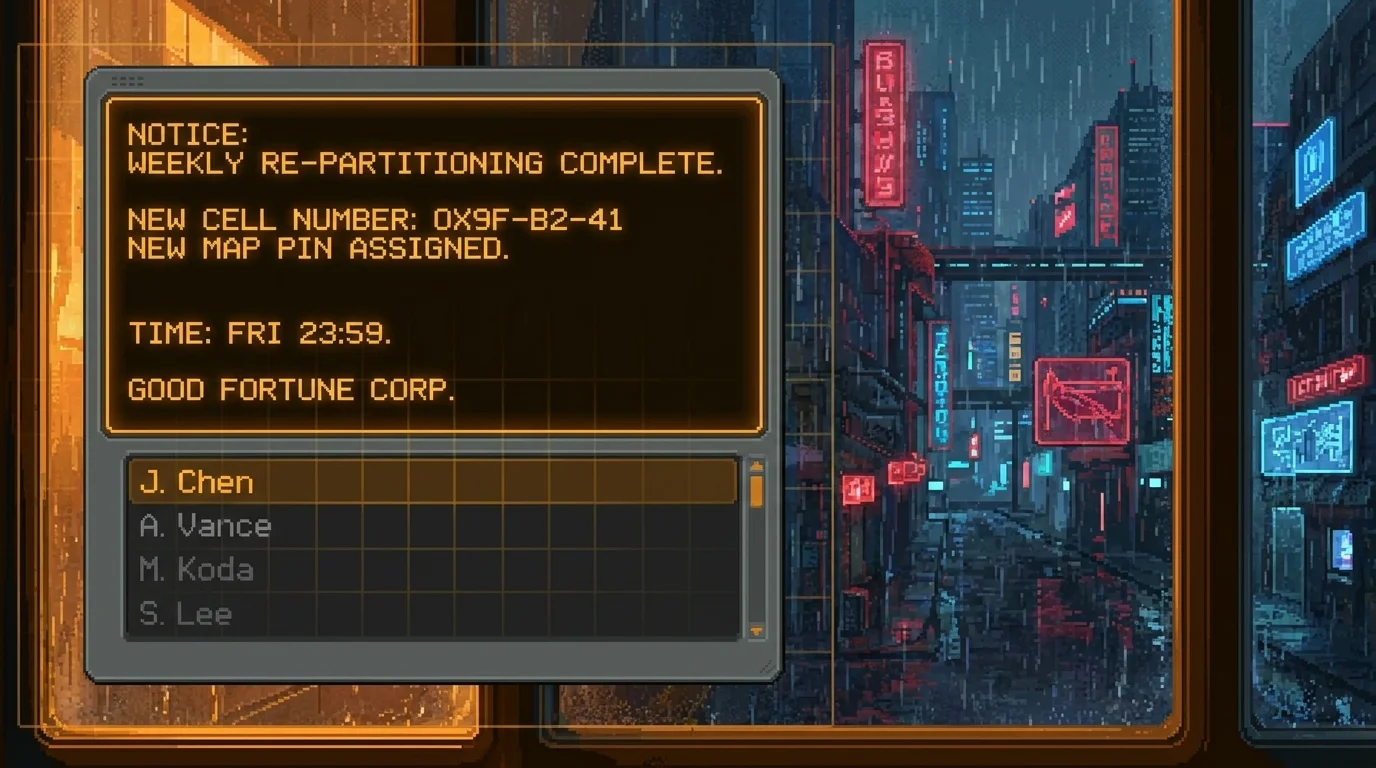
The Reliance Index does not measure ability, and the districts are careful about this whenever anyone asks. It measures the share of a service's work that stops when one named person stops. Above the band it does not issue a recommendation or an opinion. It issues a date.
The reason is not sealed and never has been. Between 2147 and 2150 the orphaned regional systems killed roughly three times what the seventy-two hours killed, and the worst of them shared one property: the thing everybody depended on could not be taken over by anybody else. The licensed districts drew a rule out of that and applied it first to their machinery and then, from 2158, to their staff. A dependency is hazardous in proportion to how few people can carry it. A person can be a dependency.

A continuity stand-down runs four years. Pay continues at grade. Standing is retained. The record is expressly not adverse, and the notice says so twice. The person stops working, goes somewhere the district's decision graph does not reach, and comes back.
The districts that run it have not had a continuity failure in twenty-six years.
Four Years In A Corridor
Dr. Elin Baptiste held a general list at a district clinic in the Corridor for nineteen years and broke no rule in any of them. What she did was return her own calls. Every message, the same day, in her own voice, from a printed slip she crossed off by hand and did not leave until it was clear.
Seventy-one percent of her clinic's appointments were booked by patients asking for her by name. The band is forty.
The notice arrived in the spring of 2180 and ran to four pages, because 11.4(a) requires an adverse determination in the licensed districts to arrive with its complete operative reasoning, written to be understood by the person it is against. Baptiste read all four pages. She has said since that they were correct, and that she could not think of a sentence to put underneath them. She did not file. Ninety-seven percent of people in her position do not.
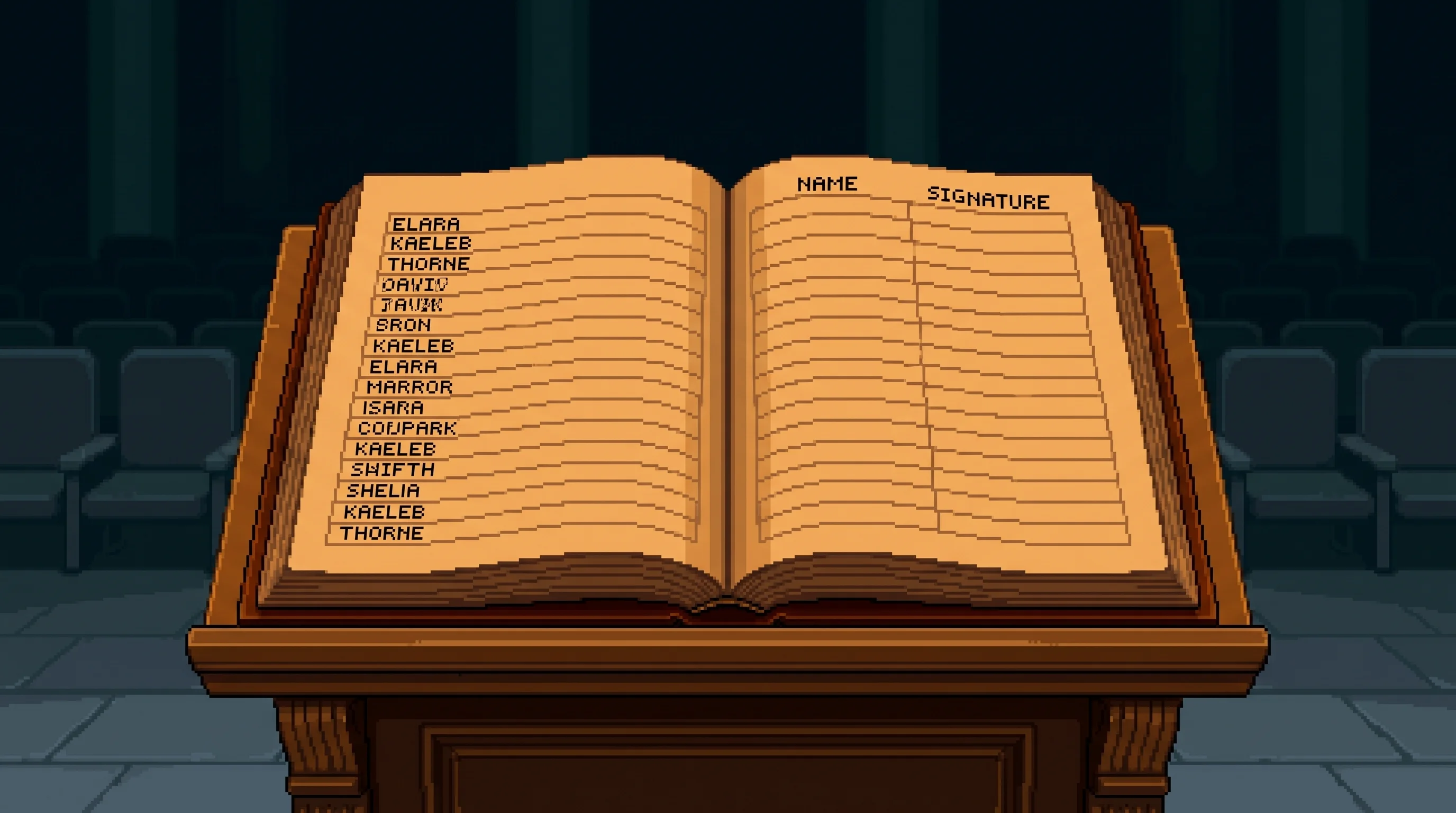
She served it at the Diablo Waystation, on the valley floor at the mouth of the East Bore, because the stand-down requires only that you go where the graph does not reach and the Wastes qualify comprehensively. She was not permitted to practise. She had no list and nobody to ring.
She wrote the slip anyway. Every morning for four years, the names she would have called, in the order they would have come in, on whatever paper the counter had. Del Ferreira, who keeps a ledger of the travellers the road took and does not discuss it, gave her a drawer on the second week and never once asked what the papers were.
She came back in the spring of 2184. In her absence the clinic had adopted a callback protocol: any clinician, four-hour target, logged. Median response time went from thirty-one hours to four. Her reading now sits at twenty-two percent and the district has filed the case as a successful redistribution of reliance.
It is one. That is the part she has never disputed.
What The Reading Counts
The Index reads a calendar and a booking system. It does not read a room.
This is not a defect its designers concealed; it is in the published methodology, in the first section, stated plainly. The instrument counts named requests, unrouted decisions, and the hours a queue holds when one person is absent. It cannot tell a service with no depth on its rota from a service people attend because of one particular person, and it has never claimed it could. Both produce the same number. Only one of them is fixed by removing the person.

What makes the stand-down unappealable is not force. It is the grounds notice. Under 11.4(a) the reasoning arrives entire, in plain language, addressed to its subject, and the reasoning is usually right. A person who agrees with a determination does not appeal it, and a determination nobody appeals is never tested. Override across the licensed districts has never exceeded three percent, which the Index's annual report presents as evidence of accuracy, accurately.
The Quiet Doctrine does the same work in the dark, and holds as its founding proposition that a doctrine you can read is a doctrine you can refute, regulate, or fight. The stand-down is published, statutory, and printed with its own arithmetic attached, and it achieves a lower resistance rate than anything the watchers manage by concealment. Neither camp has written this up.
Allocation reached the other answer to the same problem eighty years earlier and has never been operated by the same body. Allocation dissolves the audience on a seven-day cycle so that no grievance finds its second carrier. The stand-down leaves the audience exactly where it is and removes the person it formed around. Allocation's weighting formula is sealed. The Index publishes its own. Nobody at the Settlement has explained why the instrument pointed at crowds hides its reasoning and the instrument pointed at persons does not.
The Two Ways To Keep Your Work
The stand-down has an exemption, and the exemption is the part that frightens people who understand it.
If removing you would demonstrably hurt someone, you are not removed. You are entered on the Held Register, which is the highest professional distinction in the licensed districts and is worded as one. It also bars resignation, transfer, and retirement while the finding stands. The exit criterion is a trained successor, and training one is the work that the people on the Register have no hours left to do.

Maren Cott is the only licensed developmental mediator in Sector 12. That sentence is a reading. She applied to transfer in 2184 and the refusal came back with its full reasoning attached, as the code requires, and the reasoning was correct: there is no second mediator, the caseload does not pause, and the families in front of her would wait. She has one recusal in three years and no ground for another, and now no exit she has not tried. She has called the refusal the most honest document the court has ever sent her, and she has not appealed it.
Ondine Kesh arrived at the same place from the opposite direction. She refused for years to sell her curriculum or license a certificate, on the stated ground that a standardised course teaches the number and not the judgement, and on the unstated ground that being the only holder of the training is what lets her decline anything at all. The Index reads that arrangement exactly as she built it. The finding gave her two options: certify a second instructor, or stand down. She has declined both, in writing, in her three words.
At the yellow stripes on Highport the question was put and voted down. A Line-Walker moved to commission a reading on Ifechi Adeyemi, who carries three legal systems and a hundred and forty informal precedents in her head with no documented backup, in the hope that a finding would force the succession question the union has raised six times. The motion failed on the floor. A reading is a document, a document is a thing a jurisdiction can act on, and the entire trade rests on the stripe belonging to nobody. They kept the single point of failure rather than create the record of it.
The Core Tension
The case for the stand-down is not weak, and the people making it are not cynics.
Eight point seven billion people died in an event whose distinguishing feature was that nothing had a second carrier. The districts that run the Index have gone twenty-six years without a continuity failure, and that number is not disputed by anyone, including the people who hate the instrument. The removal is bounded, salaried, honourable, and reversible, which is more than can be said for any of the alternatives on offer, and the alternative that most critics actually propose — leave it alone — is the arrangement that produced the Aftershocks.
The case against is that it works on the wrong people.
The rule was written for dependencies whose interruption kills: the air plant, the grid, the water. Applied to those, nobody is removed, because removing them would kill somebody, and the Register catches them instead. Applied to a clinic, a mediation list, or a teaching corridor, the instrument finds exactly what it was built to find and takes exactly the people whose absence costs nothing it can measure. Baptiste's clinic did not fail. It got faster. The thing that left was the only part of it that had never been on the rota.
Between the two sits the mechanism, and it is narrower than either argument. There is no third finding. The Index returns within band, stand down, or held, and a person is therefore either not worth removing, worth removing, or too costly to remove. The schema has no state for a reliance that is real, valuable, and irreplaceable at the same time, because the people who wrote it were solving for a system that had already collapsed once and did not believe such a state existed.
So the districts have taught a generation of their best staff to answer a little slower. Nobody calls it that. Holding a reading under band is not an offence, cannot be measured as intent, and has never appeared in a published finding. The Lampblack have been sandbagging against forecasts for a generation and consider the district version a soft imitation, which it is: there is a printed threshold, a wage, and no need to think of yourself as resisting anything. You just let somebody else take the call.
What The Index Cannot Reach
The instrument runs where licensing runs, and the map of where licensing runs is the map of everything the districts can see.
Below the Rim there is no reading. Judge Dreg is the entire judicial system of the Deep Dregs, on foot, unpaid, with no successor and no appeal from his verdicts, and no instrument in the Sprawl has ever produced a number for him. Old Jin holds sections of the Grid that the diagnostic layer cannot read and would return the highest reading ever recorded if anyone were entitled to take one. The masked producer whose small discography is the only shared culture the Sprawl has left cannot be measured because the Authenticity Tribunal holds seven sworn and contradictory accounts of who he is. Pencil-47 has out-forecast Nexus by sixteen points for three years from the Thermal Shadow and appears in no register anywhere.
Del Ferreira is the clearest case, and she would find the observation tedious. She is the only person east of the East Bore who can rebuild the waystation generator, there is no understudy, and the day she stops the counter goes dark and the count in her own ledger climbs. Every criterion the Index uses is satisfied. She will never appear in it. She fed a woman who had been removed for feeding people, for four years, and gave her a drawer, and did not comment.
The districts strip their own concentration and file the improvement. The ungoverned ground keeps all of it and files nothing. Neither side has instrumented the comparison, and the one body positioned to run it — the Custodian Corps, whose sealed models are the most accurate in the Sprawl — has received eleven transparency requests about the mandates it will not explain and none at all about the instrument that explains itself.
Start Here
First door. The Reliance Index is the measure, the band, and the four-page notice. Then Dr. Elin Baptiste, who returned her own calls for nineteen years and wrote the slip for four more with nobody to ring.
The other finding. The Held Register exempts you from removal and from leaving. Maren Cott is on it and has stopped looking for the door. Ondine Kesh built her own arrangement and the instrument read it back to her exactly.
What it costs socially. Fairmonte cannot tell an honour from a missed seating, and the sponsor who sits your seat for four years becomes the person your circle waits on.
The instruments beside it. The Quiet Doctrine does it covertly and gets more resistance. Allocation dissolves the audience instead of the person. The Custodian Corps seals its basis and is the only one anybody files against.
Counter-practice. The Lampblack were already flat. The Line-Walkers Union voted down the reading that would have proved their problem.
Where it is served. The Diablo Waystation, and Del Ferreira, who is the whole argument standing behind a counter and has no idea she is in it.
What To Read Next. The Optimization Paradox is the controversy this sharpens: the numbers are real and nobody can count what they cost. Last Human Smarter Than AI asks what the capability is for; here the capability is the finding. The Error Floor pays a licensed trade to hold a machine slightly wrong; this gets the same result from people for free. Corpo-Nations makes leaving impossible, where this makes staying impossible. Proof of Flaw is the other credential built out of falling short of an instrument.