Overview
Maren Cott stands at the front of the civic hall. Her family sits in the second row. The civic-stability officer reads the notice aloud.
"In recognition of..."
The Held Register is the licensed districts' honour roll for people whose removal would hurt someone. Entry also bars them from resigning, transferring, or retiring.
- Entry
- A finding that the person's removal would cause demonstrable harm to identifiable people
- Effect
- Exempt from the continuity stand-down; barred from resignation, transfer, and retirement while the finding stands
- Exit
- A trained successor, assessed by the district
- Held count
- Roughly nine hundred entries across the licensed districts; four voluntary exits since 2158
- Established
- 2158, alongside the Reliance Index; the exemption and the removal were drafted together
- The wording
- Entry notices open 'In recognition of' and are read aloud at the district's annual ceremony
Entry begins with the words 'In recognition of'. It ends resignation, transfer, and retirement.
How It Works
Reading
The Reliance Index finds a person above band.
Harm test
If removal would cause demonstrable harm to identifiable people, the person is entered instead of stood down.
Ceremony
The entry notice opens 'In recognition of' and is read aloud at the district's annual ceremony.
Annual review
The finding stands until a successor is trained to the district's assessment.
The Reliance Index reads every licensed professional each quarter. It returns three findings. Within band: nothing happens. Above band: a four-year stand-down. Above band, with demonstrable harm to identifiable people: you are held.
The Register and the stand-down were drafted together in 2158. There is no third outcome above the band.
A successor trained to the district's assessment is the single exit. About nine hundred people are held. Four have left voluntarily since 2158. No request to leave on the holder's own wish has succeeded. The criterion is harm, not preference.
At the Ceremony
The hall applauds. The notice is printed on heavy stock.
Paragraph four says she may not resign, transfer between districts, or retire while the finding stands.
The roll is ruled in two columns. The left holds a name. The right is headed Successor. In most districts that column is empty down the whole page.
The only way off the roll is a trained successor, and training one is the work the held have no hours left to do.
Who It Holds
Participants and dependencies
People

Organizations


Systems and technology

Ideas and culture

Sector 12 has one licensed developmental mediator. It is Maren. She asked to transfer in 2184. The refusal came with full reasoning, as The Grounds Notice requires. There is no second mediator. The families would wait. Every line was true. She called it the most honest document the court ever sent her. She did not appeal.
The Lamplighters are the guild the clause was drawn around. Their apprenticeship runs ten years. The roll leaves them no hours to run it.
The Line-Walkers Union voted down a reading on its own single point of failure. A finding is a document. A jurisdiction can act on a document. They kept her undocumented, on purpose.
What It Costs
Protects the needed
Districts keep the one surgeon, mediator, or pump technician others depend on.
Cost
The held may not resign, transfer, or retire.
Successor exit
A trained successor ends the hold.
Cost
Training takes years the held do not have; four have left voluntarily since 2158.
An honour
Entry is public recognition, in front of family.
Cost
The recognition and the bar are the same paragraph of the same notice.
Training a successor takes years the held do not have. Competence Atrophy hollowed the training pipelines a generation earlier. The Register files the result under recognition.
The Dependency Spiral sells the same trap. The Register awards it.
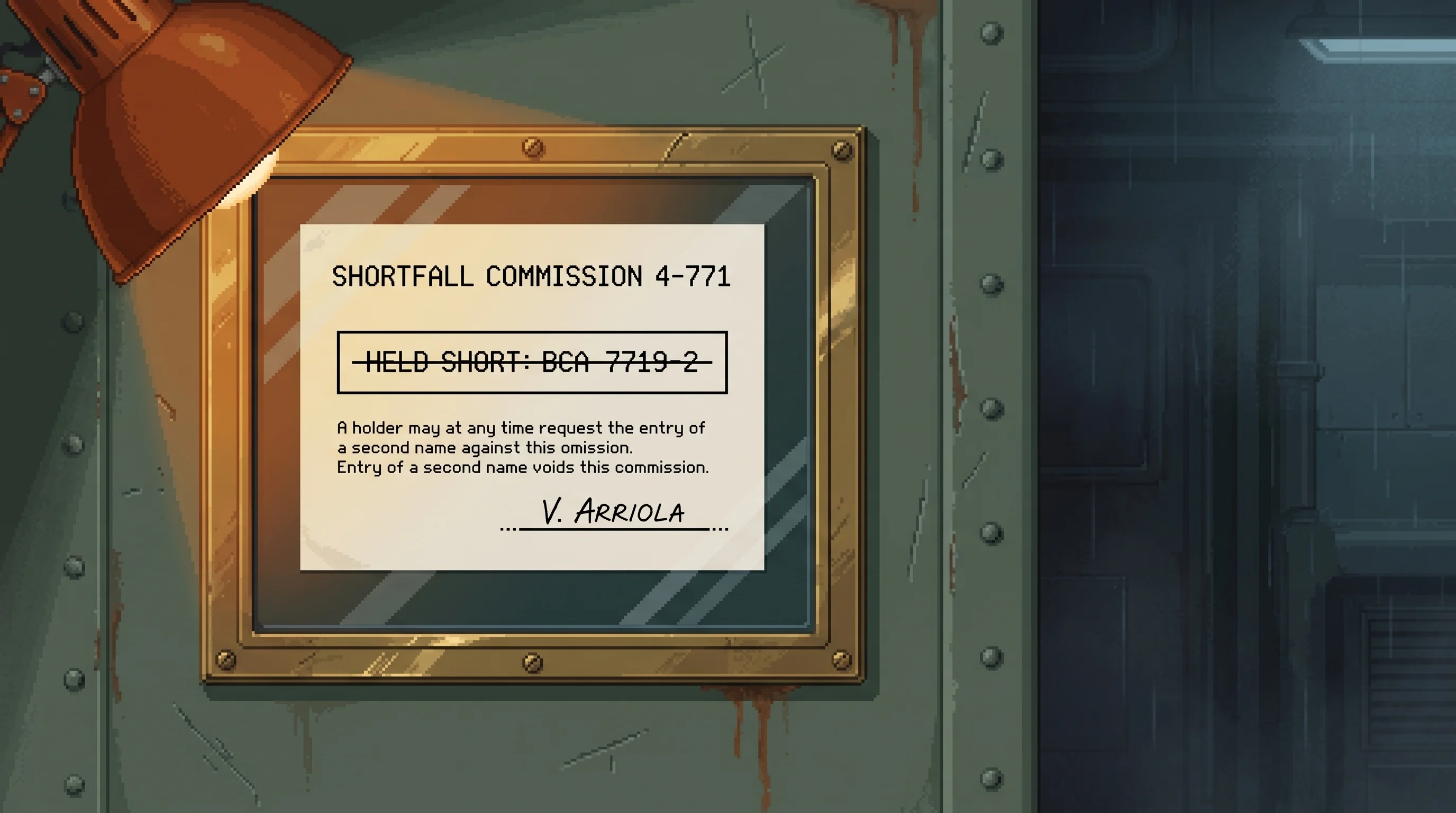
The Shortfall Commission gets there without a ban. Its certificate prints the exit above the signature. Forty-one of one thousand nine hundred holders have used it. Asking deletes the post. That is The Standing Fault. The Excellence Exile is the stand-down's side of the same arithmetic.
The Forfeit Seat keeps the opposite roll: people with nothing left to hold. No holder has appeared on both.
Maren went back to work the next morning. Her caseload had not paused for the ceremony.