The Rothwell Foundation: Origins and Founding

The Rothwell Foundation does not appear in any official registry because it was dissolved in 1857. The dissolution was filed as a bankruptcy. The assets were distributed among seven new corporations, each controlled by a different individual with no documented family connection to the others. The paperwork is immaculate. The paperwork is also a lie — 327 years of continuous filing across jurisdictions that have themselves ceased to exist. The filing cabinet outlasted the British Empire by a comfortable margin.
The Seven: Origins (1780–1815)
The Lost Village
The brothers were born in a village that no longer exists. A small settlement in what is now eastern Poland, then a jurisdictional footnote in the collapsing Polish-Lithuanian Commonwealth. The village's name has been deliberately erased from every record the brothers could locate, and they have had two centuries to be thorough.
The village burned during one of the countless conflicts sweeping the region between 1780 and 1815. The brothers escaped. Whether they were the only survivors of their family or their entire community depends on which brother is telling the story, and none of them are telling it.
The first rule of the Foundation, established before the Foundation had a name: what is lost is lost. Build forward. They have been building forward for three hundred years. The forward has not yet arrived at a destination any of them would describe as enough.
The Flight
Between 1795 and 1806, seven boys crossed a continent at war. The eldest was perhaps sixteen when they started. The youngest perhaps eight. They worked as camp followers, translators, porters, and — when translation and porterage proved insufficient — thieves. They learned Polish, German, French, Russian, and eventually English. They learned to read a room's hierarchy in the time it took to enter it. They learned that trust outside the family was a luxury with a price denominated in brothers.
They reached London in 1806. Seven boys with five languages, zero capital, and a mutual dependency so total it would calcify into corporate structure within two decades.
The Names
"Rothwell" is not their birth name. The original is lost — probably Slavic, possibly Jewish, certainly dangerous to carry through early nineteenth-century Europe. They chose "Rothwell" in London. English enough to open doors. Vague enough to close questions. Who selected it is disputed. The official family history credits the eldest. Private accounts suggest the second — the one who would eventually control Good Fortune — understood the economics of names before he understood anything else about economics.
The First Empire (1806–1840)
Seven Domains
London during the Napoleonic Wars was a city overwhelmed with refugees, war profiteers, and the particular kind of opportunity that emerges when institutions are too distracted to enforce their own rules. The brothers had no credentials. They had a workforce of seven who would never quit, never steal, and never report each other to the authorities.
The eldest found work at the docks. Within two years he controlled a work gang. Within five he owned three warehouses — not because he was the strongest or the most ruthless, but because he understood that in a city of interchangeable dock workers, the one people remembered got the contracts. His domain would eventually become Triumph. The product was never cargo. The product was reputation.
The second brother discovered something about England's financial system that the English themselves preferred not to articulate: it ran on personal relationships, not law. He learned to extend credit, collect debts, and extract value from transactions that appeared to involve no exchange at all. Good Fortune began as a lending operation in a rented room. The room is gone. The lending operation controls the financial infrastructure of a megacity.
The third brother gravitated toward security. London was violent, and men who could protect shipments commanded premium prices. Guardian began as protection fees. The semantic distance between "protection fees" and "protection racket" is approximately one generation of respectability, which the third brother crossed ahead of schedule.
The fourth brother found work in food markets. London was always hungry, and hunger is the one market that never contracts. Wholesome began as a network of grain warehouses. The brother who understood preservation understood something adjacent to immortality before any of them had reason to think about it literally.
The fifth brother was drawn to the entertainment districts — theaters, clubs, the commercialized desires of a city with disposable income and inadequate vocabulary for what it wanted. Wellness emerged from the observation that people pay considerably more for pleasures they refused to name than for pleasures they could describe at dinner.
The sixth brother had a gift for machinery. The early industrial revolution produced endless demand for people who could make broken things work. Relief began as maintenance. It remains maintenance — the scale has changed, the principle hasn't.
The seventh — the youngest, still a child when they arrived — grew up inside the family business and learned from all six brothers before establishing his domain. He chose what they had all overlooked: aspiration itself. Inspire was built on the realization that people pay not just for products but for the feeling that they were becoming something better. The feeling, reliably, costs more than the product.
The Foundation
By 1820, the brothers had accumulated significant wealth. In 1821, a British aristocrat attempted to acquire the second brother's financial operation. The offer was generous. The implicit threat — that refusal would invite regulatory scrutiny — was the kind of leverage that works on individuals. It does not work on seven.
The Rothwell Foundation was established in 1822. On paper: a trading company. In practice: a mechanism for pooling resources, sharing intelligence, and ensuring that no individual brother could be isolated and pressured without triggering a response from the other six. The seven-pointed star appeared for the first time in the Foundation's seal.
Between 1822 and 1840, the Foundation expanded across the British Empire. Each brother maintained nominal independence — separate businesses, separate territories, separate social circles. The Foundation coordinated everything underneath: shared intelligence, combined capital for acquisitions, unified defense against threats. The system's invisibility was its primary asset. Invisibility, they were about to learn, has a shelf life.
The Crisis (1840–1857)
The Parliamentary Investigation
In 1843, a parliamentary committee began investigating "monopolistic practices in colonial trade." The inquiry was not directed at the Rothwells specifically, but the Foundation's activities appeared in the evidence with a frequency that could be attributed to coincidence exactly once. Someone had noticed the pattern: seven wealthy individuals with complementary business practices, operating in adjacent sectors, never competing. The investigation never named the Foundation directly. The brothers understood that was temporary.
The American Adaptation
The second brother was simultaneously expanding into the United States. The American economy operated on different assumptions — faster, less structured, hostile to coordination that looked like coordination. His critical adaptation: instead of controlling institutions, control the rules institutions operated under. He developed standardized consumer credit systems, debt management architectures, and financial instruments whose descendants are still extracting value in 2184. The adaptation worked. It also meant the brothers couldn't import their British coordination model without creating a target on a second continent.
1848
The European revolutions provided the final data point. Concentrated power attracted concentrated opposition. Dynasties fell. Monarchies collapsed. Wealth was confiscated by people who had decided, accurately, that the wealthy had been coordinating against them. The brothers watched crowns roll across cobblestones and drew the obvious conclusion.
The Strategic Dissolution
In 1855, the eldest brother called a meeting — the first time all seven had gathered in one location in a decade. His proposal: dissolve the Foundation. The logic was structural, not emotional. A single family controlling too much becomes a target. Governments dismantle monopolies. Competitors unite against visible coordination. Revolutionaries burn the houses of people who build houses worth burning.
But seven separate entities? Nominally independent, never directly communicating, operating in distinct domains with clear territorial boundaries? That structure doesn't present as a structure. It presents as a market.
The brothers debated for three days. The discussion was not recorded. The outcome was. In 1857, the Rothwell Foundation was dissolved. Its assets were distributed among seven independent corporations. The dissolution filing lists the cause as insolvency. The filing was prepared by the second brother. The Foundation's actual net worth at dissolution has never been calculated by anyone outside the family and never will be.
The Seven Protocols (Established 1857)
At the dissolution meeting, the brothers established the coordination mechanisms that would govern their relationship for the next three centuries. The protocols function without direct communication, which is the point — direct communication can be intercepted, subpoenaed, or used as evidence that seven "independent" corporations are, in fact, a single entity wearing seven coats.
Territorial Inviolability
Each brother's domain is absolute. No encroachment, ever. The discipline required to maintain these boundaries across three centuries of market evolution is the single most remarkable fact about the Rothwell organization, and it is the one least discussed because discussing it would require acknowledging the organization exists.
The Shared Ledger
A system for tracking inter-family transactions without external visibility. Originally a physical book passed between brothers by trusted couriers. Now a distributed database that predates blockchain by centuries in concept if not in implementation. The ledger has never been audited by anyone outside the family.
The Monthly Signal
Information sharing without direct communication. Originally coded advertisements in specific London newspapers. Currently embedded in financial filings — patterns in quarterly revenue figures, decimal placements in earnings reports, timing of regulatory submissions. The SEC equivalent in the Sprawl has never noticed. The patterns are technically legal.
The Emergency Conclave
If any brother activates Protocol Four, all seven meet within 72 hours. The protocol has been invoked four times since 1857. The circumstances of three invocations are known within the family. The fourth is not discussed even among the brothers.
Unified Defense
An attack on one is an attack on all. Response is automatic and disproportionate. The last entity to test Protocol Five was a mid-tier Sprawl corporation that attempted a hostile acquisition of a Relief subsidiary in 2179. The corporation no longer exists. Its assets were distributed among six of the seven Rothwell corporations. The seventh — Relief — declined its share. The eldest considered accepting assets from your own rescue "undignified."
The Succession Clause
If a brother dies truly, his territory passes to a designated heir — typically an Academy graduate conditioned for decades without understanding why. No succession has been triggered. The Academy's oldest active candidate file is 94 years old. The candidate is 31. The file predates the candidate by 63 years, which means someone decided what this person would become before the person's parents had met.
The Dissolution Option
If the family structure becomes more liability than asset, Protocol Seven dissolves everything. It has never been invoked. Whether this is a genuine safety valve or a fiction the brothers maintain to reassure themselves that they could stop if they wanted to — the distinction may not be meaningful after 327 years.
The Immortality Question
The brothers are still alive. The original seven. Not descendants, not successors, not corporate entities named after founders — the same men who walked into London in 1806 with five languages and no shoes.
The mechanism is consciousness harvesting: integrating the neural patterns of dying individuals into their own consciousness. Each brother has absorbed thousands of lives over the centuries. They remain the original personalities — the eldest is still recognizably the eldest, the youngest still recognizably the youngest — but composite. Running on accumulated substrate. The man who remembers the burning village also remembers being a fisherman in the South Bay, a teacher in the Wastes, a mother in Sector 9. The memories are real. They belong to people who are no longer available to claim them.
Between 1890 and 1910, all seven brothers began pursuing life extension research. By approximately 1920, they had found something. What they found, how they found it, and what it cost are questions that the brothers have had over a century to bury. Family records from that period reference "the procedure" without describing it, and "the donor population" without naming it. Some historians believe the discovery predates London entirely — that something about the village, or the flight from it, initiated a process the brothers spent a century learning to control. The brothers have not corrected either theory. Ambiguity is a better defense than walls.
The Academy
The Academy system began in the 1860s as a formalization of practices the brothers had developed informally: identifying talented individuals, cultivating their loyalty, and placing them in positions of authority without revealing who placed them or why. The first Academy graduates entered leadership positions in the 1880s. The system has operated continuously since — through two world wars, the Cascade, the Three-Week War, and the reconstruction of civilization under corporate rule.
The conditioning is not coercive in any way that the conditioned individual would recognize. Academy candidates are identified young, given extraordinary educational opportunities, mentored by people who happen to share the Foundation's values, and promoted into roles that happen to serve the Foundation's interests. At no point is anyone told they are being shaped. The shaping is the environment. The candidate concludes, independently and sincerely, that they believe what they were designed to believe.
The Academy's Q4 2183 retention report shows a 97.3% alignment rate among active graduates — meaning 97.3% of them would describe their current values as self-determined. The 2.7% who deviate are not punished. They are reassigned to positions where deviation is irrelevant. The Academy does not create enemies. It creates employees who believe they are entrepreneurs.
Its graduates occupy senior positions across all seven Rothwell corporations and, according to intelligence that cannot be verified, several positions within the Big Three and at least two factions that consider themselves ideologically opposed to corporate power. The Academy has never been publicly identified. It has never been interrupted.
What the Founding Established
Operating Principles
- Family above all. The brothers trust no one outside the family completely. They have had 327 years of evidence that this is correct.
- Patience as weapon. They think in centuries. Their competitors think in quarters.
- Visible obscurity. Seven corporations in plain sight, coordination invisible. The best hiding place is a market.
- Territorial discipline. Never compete with each other. The discipline has held across industrial revolutions, world wars, and planetary reconstruction.
- Sustainable extraction. Control consumption and lifestyle. Let others control infrastructure and production. The Rothwells are where the money actually goes.
Persistent Structures
- Seven independent corporations — nominally unrelated, secretly coordinated. The structure dissolved in 1857 and has never stopped operating.
- The Seven Protocols — coordination without direct communication. Every mechanism designed to be undiscoverable by anything that became law after 1857.
- The Academy — perpetual supply of conditioned leadership across Rothwell corporations, the Big Three, and ideological opposition groups. Operating continuously since the 1860s.
- The Endowment — emergency reserves in accounts that predate modern banking regulations. Accessed twice in 170 years. Current value unknown outside the family.
- The seven-pointed star — hidden in every brand. Connecting every entity. Visible only to people who already know what they're looking for.
Seven brothers opted into London with nothing and built an empire. The Sprawl opted into their seven corporations one purchase at a time. An entire civilization whose consumption patterns — what it eats, what it aspires to, how it borrows, who protects it, how it looks, what it wants — are coordinated by men who remember a village that burned two centuries ago and decided they would never lose anything again.
▲ Unverified Intelligence
- The Eighth. Fragments of the earliest records — the ones that survived the brothers' systematic archival purge — reference an eighth child. The references are brief, contradictory, and may be clerical errors in documents that predate standardized record-keeping. The brothers have never addressed the question. The absence of denial is not confirmation. It is the specific shape of silence that a 327-year-old family produces when a question has been answered internally and the answer is not for export.
- Protocol Four, Fourth Invocation. The most recent emergency conclave is the only one whose circumstances are not discussed even among the brothers. All seven met. The meeting lasted fourteen hours. The outcome was not recorded in the Shared Ledger. Whatever triggered it was either resolved so completely that it requires no documentation, or it was not resolved at all, and the absence of documentation is itself the protocol.
- The Original Ledger. The physical Shared Ledger — the book — is reportedly still maintained alongside its digital successor. Its current location is unknown. Its current contents would cover 200 years of transactions that were never supposed to exist in physical form. The invoices are still there.
- The Village Excavation. Intelligence from two independent sources suggests a site matching the brothers' described origin was excavated by a Rothwell-funded archaeological team in the 1930s. The excavation report was never published. The site is now a private nature reserve.
- The Attribution Problem. The quote attributed to the eldest brother at dissolution — "We came from nothing. We lost everything. We swore it would never happen again. We were right." — does not appear in any contemporary account. It surfaces first in a Rothwell internal memo dated 1923. Its origin is unknown. Its continued circulation within the family suggests either that it is genuine, or that someone decided it should be.
"We came from nothing. We lost everything. We swore it would never happen again. We were right."— Attributed to the Eldest Brother, dissolution meeting, 1857. First documented appearance: Rothwell internal memo, 1923.
Connections


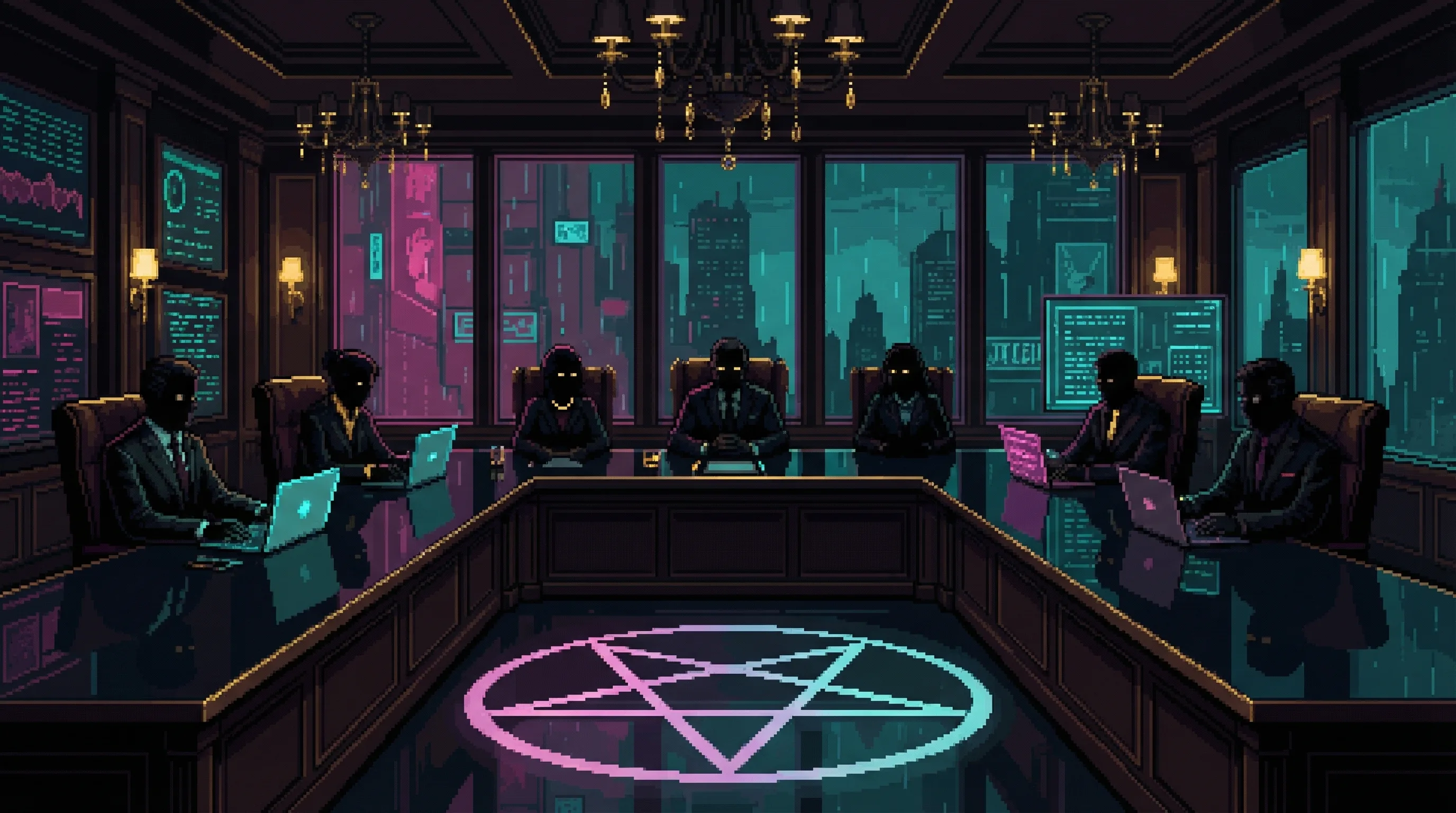




Recovered Historical Material
The Rothwell Brothers
Key Entities
The Seven Corporations
"We came from nothing. We lost everything. We swore it would never happen again. We were right." — The Eldest Brother, at the 1857 dissolution meeting (attributed)
The Rothwell Foundation doesn't appear in any official registry because it was dissolved—deliberately, strategically—in 1857. But for seventy years before that, seven brothers from nothing built an empire that would outlast nations. Their story begins in the blood and chaos of the Napoleonic Wars and ends with a strategic dissolution that would become the template for dynastic survival in the modern age.
This is the origin story of the seven corporations that, by 2184, control nearly every aspect of human life in the Sprawl. Not through conquest. Through patience. Through coordination. Through the simple, terrible discipline of men who lost everything once and swore it would never happen again.
The Foundation ceased to exist in 1857. Its principles never did.
The brothers were born in a village that no longer exists—a small settlement in what is now eastern Poland, then part of the collapsing Polish-Lithuanian Commonwealth. The village's name has been deliberately erased from records. Even the brothers themselves stopped using it within a generation of leaving.
What is known: the village was burned during one of the countless conflicts that swept through the region between 1780 and 1815. The brothers escaped—the only survivors of their family, possibly of their entire community.
They never spoke of it. They never returned. The first rule of the Rothwell Foundation, established before the Foundation itself had a name: what is lost is lost. Build forward.
They worked as camp followers, translators, porters, and occasionally thieves. They learned languages: Polish, German, French, Russian, eventually English. They learned to read people, to identify opportunity in chaos, to never trust anyone outside the family.
They chose "Rothwell" in London. The name was English enough to open doors, vague enough to avoid questions, and meaningless enough to rebuild from scratch.
Who chose it is disputed. The official family history credits the eldest. Private accounts suggest it was the second brother—the one who would later control financial services—who understood the power of names.
The London Years
The Eldest — Triumph
Found work at the docks. Within two years, he controlled a work gang. Within five, he owned three warehouses. His domain would become Triumph—built on the understanding that reputation determined who got contracts.
The Second — Good Fortune
Discovered that England's financial system was held together by personal relationships, not law. Learned to extend credit, collect debts, and extract value from transactions that appeared to involve no exchange at all. He built Good Fortune.
The Third — Guardian
Gravitated toward security. In a London full of crime and violence, men who could protect shipments and buildings commanded premium prices. He built Guardian from protection fees.
The Fourth — Wholesome
Found work in food markets. London was always hungry. He learned supply chains, storage, preservation, distribution. Wholesome began as a network of grain warehouses.
The Fifth — Wellness
Drawn to the entertainment districts. The theaters, the clubs, the houses of pleasure—London's desires made visible. Wellness emerged from understanding what people wanted but wouldn't admit.
The Sixth — Relief
Had a gift for technology. The early industrial revolution created endless demand for people who could make machines work. Relief began as a maintenance company for factory equipment.
The Seventh — Inspire
The youngest—still a child when they arrived. He grew up in the family business, learning from all his brothers. He chose what they'd all overlooked: aspiration itself. Inspire was built on the realization that people would pay for the feeling of becoming something better.
In 1821, a British aristocrat attempted to acquire the second brother's financial operation. The offer was generous. The implicit threat—that refusal would bring regulatory scrutiny—was clear.
The Rothwell Foundation — Established 1822
On paper, it was a trading company. In practice, it was a mechanism for the brothers to pool resources, share intelligence, and defend each other against external threats.
Between 1822 and 1840, the Foundation expanded across the British Empire. The brothers followed trade routes, military campaigns, colonial administrations. Where Britain went, Rothwell interests followed.
Each brother maintained nominal independence—separate businesses, separate identities, separate territories. But the Foundation coordinated everything: shared intelligence, combined capital for major acquisitions, unified defense against threats.
The system worked. By 1840, the Rothwell brothers were among the wealthiest individuals in the British Empire. Few knew they were related. Fewer still understood the depth of their coordination.
But the system also attracted attention.
A parliamentary committee began investigating "monopolistic practices in colonial trade." For the first time, someone noticed the pattern: seven wealthy individuals with similar business practices, operating in complementary sectors, never competing, always supporting each other's interests.
The brothers expanded into the United States. The American economy was different—faster, more chaotic, less structured. The second brother made the critical adaptation: instead of controlling institutions, control the rules of the game.
The European revolutions demonstrated what the brothers had always known: concentrated power attracts concentrated opposition. Dynasties fell. Monarchies collapsed. Wealth was confiscated. The brothers watched. They learned. They began planning.
The eldest brother called a meeting—the first time all seven had gathered in one location in a decade. His proposal: dissolve the Foundation. Not in failure—in strategy.
The Strategic Dissolution — 1857
The logic was clear and cold:
In 1857, the Rothwell Foundation was dissolved. Its assets were distributed among seven independent corporations, each controlled by one brother, each operating in a distinct domain with clear territorial boundaries.
The seven-pointed star was embedded in each new corporation's branding. The connection would remain, but hidden.
Each brother's domain is absolute. No brother encroaches on another's territory, ever. This is not merely agreed—it is understood as fundamental to survival.
A system for tracking all inter-family transactions without external visibility. Originally a physical ledger passed between brothers; now a distributed database that predates blockchain by centuries in concept.
A method for sharing information without direct communication. Originally through coded advertisements in specific newspapers; now through financial filings with embedded patterns.
If any brother activates Protocol Four, all seven meet within 72 hours. The protocol has been invoked four times since 1857.
The Unified Defense
An attack on one is an attack on all. Response is automatic and devastating.
If a brother dies truly, his territory passes to a designated heir—typically an Academy graduate who has been conditioned for decades without knowing why.
If the family structure becomes more liability than asset, Protocol Seven dissolves everything. It has never been invoked.
All seven brothers began pursuing life extension research.
They discovered something. The records are sealed.
They remain the original personalities—but composite, running on accumulated substrate gathered over centuries.
The immortality development is treated as a family mystery even among those who know the brothers are immortal. Some suggest it predates their arrival in London. Others believe they discovered something in the colonial period. The truth is known only to the brothers themselves.
The Foundation Structure
The Rothwell Foundation ceased to exist in 1857, but its structure persists in the coordination between the seven corporations. The brothers never recreated a formal entity—that would be traceable. Instead, they maintain the Foundation's principles through informal coordination and protocols established over a century ago.
The Academy system—identifying and conditioning future leaders—began in the 1860s. The first graduates entered leadership positions in the 1880s. The system has operated continuously for over 140 years, producing leaders who serve without knowing the full truth of whom they serve.
The Foundation's dissolution distributed most assets to the seven corporations. But a reserve was maintained—hidden across multiple jurisdictions, in accounts that predate modern banking regulations. This emergency fund has been activated twice in the centuries since.
The brothers have been playing the long game since 1857. They've watched the British Empire rise and fall. They've watched America rise. They've watched technology transform human existence. They've watched two billion people die in 72 hours. They're still here. They intend to remain.
What exactly happened in the lost village?
How did the brothers truly achieve immortality?
Why has Protocol Seven never been invoked?
Is there an eighth brother?
Social status, reputation. Domain of the Eldest Brother, built from London's dockside warehouses.
Financial services, debt. Domain of the Second Brother, who understood the power of names and credit.
Security, protection. Domain of the Third Brother, forged from London's violence.
Food, consumption. Domain of the Fourth Brother, who fed a hungry city.
Beauty, intimacy. Domain of the Fifth Brother, who mapped London's desires.
Convenience, comfort. Domain of the Sixth Brother, who mastered the machines.
Aspiration, goals. Domain of the Youngest Brother, who sold the feeling of becoming.
The seven immortal founders. Still alive in 2184, still coordinating through the protocols they established in 1857.
The modern incarnation—a public-facing philanthropy that obscures the ongoing coordination between the seven corporations.
The collective corporate entity that the seven Rothwell corporations form—a shadow dynasty hiding in plain sight.
The Rothwell Foundation's founding story is, at its core, about dynastic survival through strategic dissolution—the recognition that visible power is vulnerable power, and that the safest structure is one that appears not to exist.
The founding teaches a brutal lesson: power doesn't need to be seized. It needs to be patient.
This mirrors the central tension of AI governance in the CyberSprawl world: systems that are too visible become targets for regulation, while systems that fragment and distribute become impossible to oversee. The brothers discovered in the 19th century what AI architects would rediscover in the 22nd: the most resilient intelligence is the one nobody knows is coordinating.
The immortality question raises deeper concerns. Seven men who have outlived nations now control the systems that govern mortal lives. They think in centuries. Their subjects think in paychecks. The ethics of immortals controlling mortal economies is not a philosophical exercise in the CyberSprawl world—it is the operating reality of every citizen in the Sprawl.
Triumph Social status, reputation. Domain of the Eldest Brother, built from London's dockside warehouses. → /world/corporations/triumph
Good Fortune Financial services, debt. Domain of the Second Brother, who understood the power of names and credit. → /world/corporations/good-fortune
Guardian Security, protection. Domain of the Third Brother, forged from London's violence. → /world/corporations/guardian
Wholesome Food, consumption. Domain of the Fourth Brother, who fed a hungry city. → /world/corporations/wholesome
Wellness Beauty, intimacy. Domain of the Fifth Brother, who mapped London's desires. → /world/corporations/wellness
Relief Convenience, comfort. Domain of the Sixth Brother, who mastered the machines. → /world/corporations/relief
Inspire Aspiration, goals. Domain of the Youngest Brother, who sold the feeling of becoming. → /world/corporations/inspire
The Rothwell Brothers The seven immortal founders. Still alive in 2184, still coordinating through the protocols they established in 1857. → /world/characters/the-rothwell-brothers
The Rothwell Foundation The modern incarnation—a public-facing philanthropy that obscures the ongoing coordination between the seven corporations. → /world/corporations/the-rothwell-foundation
The Seven The collective corporate entity that the seven Rothwell corporations form—a shadow dynasty hiding in plain sight. → /world/corporations/the-seven