The Sound Register
It was built so that no musician could ever be paid alone. In 2184 that turned out to include being paid at all.

Overview
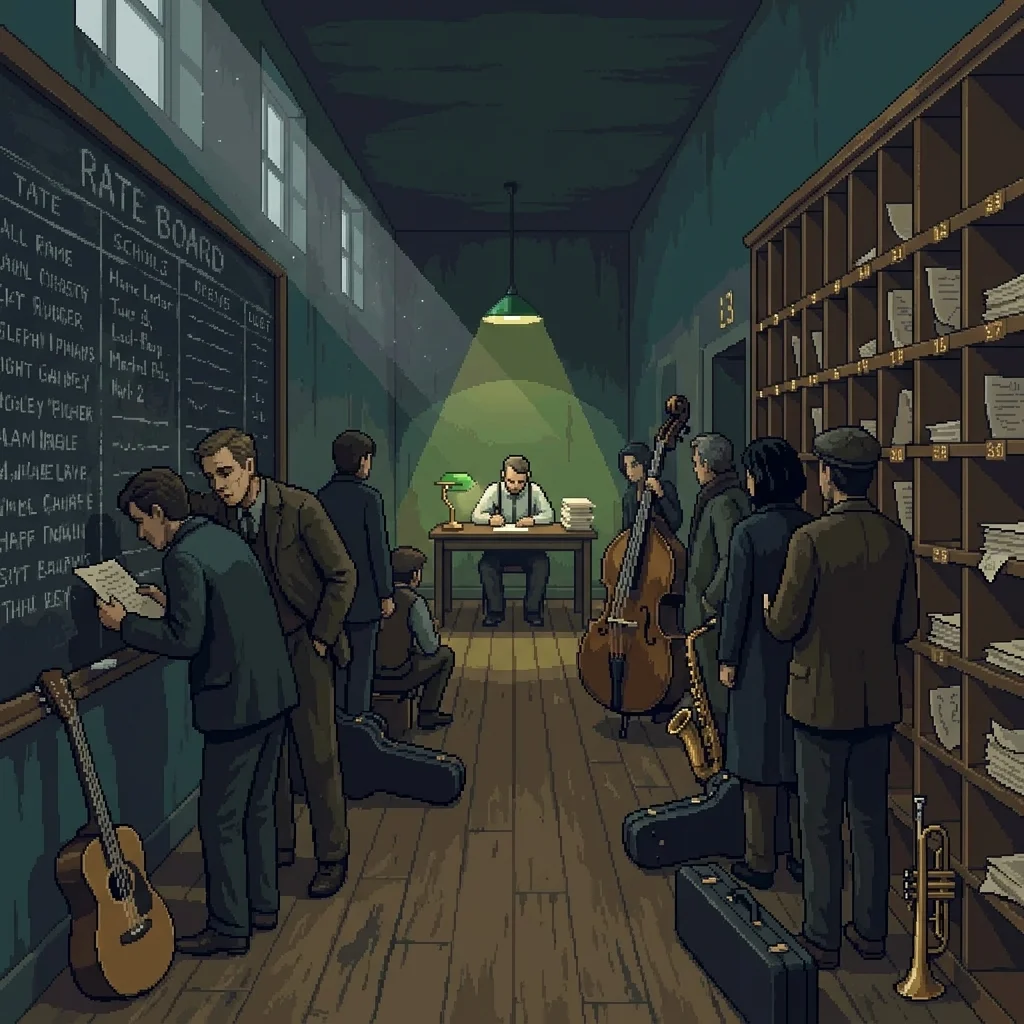
The Register Hall is a converted recording works on the Sector 8 shoreline, and the first thing in it is the rate board: a chalked wall running the length of the room, listing what a session date pays by instrument, by hour, by room size. It is the only published price for session work anywhere in the Sprawl. Studios that employ no members set their rates from it, because there is nothing else to set them from.
The second thing is the pigeonholes โ a floor-to-ceiling grid of them, one slot per studio, stuffed with paper date sheets. A date sheet lists the session, the date, the takes, the musicians by name, and the fee. It is the only document in the trade where a name and a number appear on the same page.
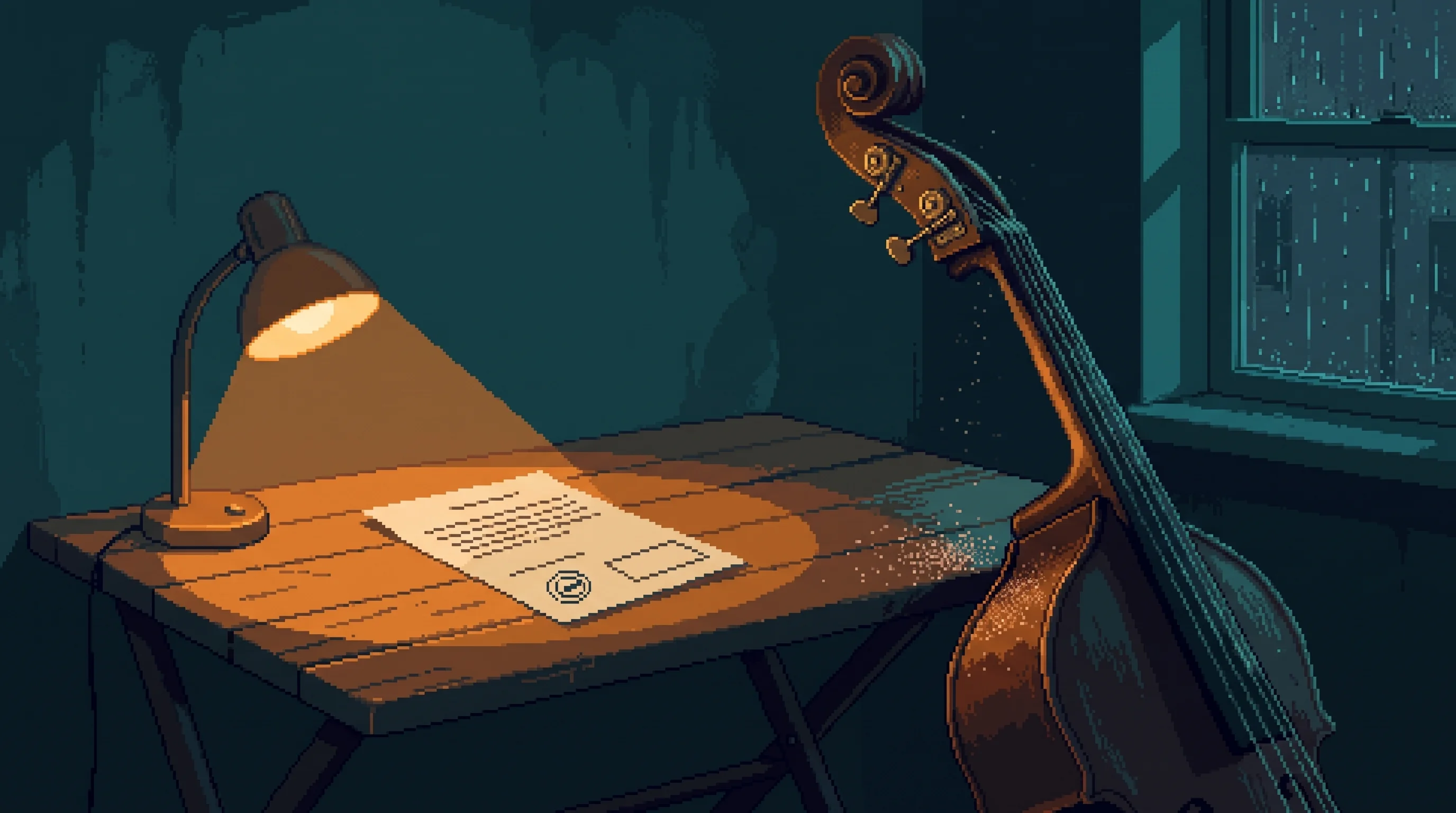
At the far end, under a green-shaded lamp, is one desk. That desk is the reason the Register exists.
Under Article 7 of the Recorded Work Agreement, any use of a member's recording outside its licensed term triggers a mandatory payment, and the Register is the only party permitted to receive it. Its countersignature is conclusive that every represented performer in that use has been satisfied. Sixty-one thousand four hundred and twelve claims run through that one desk, and no member may receive, negotiate, or settle their own.
What Article 7 Was For
The founders were session musicians. They met in 2159 because a studio four streets from the present Hall had cleared a room of sixty by buying four waivers.
That was the method. A musician behind on rent signed away the new-use claim on a date for whatever was in the room that afternoon, and once four had signed, the price of the other fifty-six was set at what the most desperate one had taken. Nobody was defrauded. Everybody was informed. The arithmetic simply favoured whoever could wait longest, and a session musician cannot wait.
The founders worked out that there is no defence against a buyer picking off the cheapest signature except to make a signature impossible to buy. Not dearer. Impossible. One desk that must be paid, and no member who can be paid instead. That was the victory, and it is still the victory, and every older member in the Hall will tell you so without being asked.
Conclusive certification came with it, and came honestly. A buyer who pays needs the matter closed, or the buyer does not pay โ it litigates, and a register of interchangeable people loses every case it cannot afford to bring. So the countersignature was made final. Pay the desk, take the certificate, and no performer in that use can come at you again.
For twenty-five years the halves held each other up, because uses could be counted. Name the recording, name the musicians on the date, divide. The clause did not fail. It met a use with no line items.
The Spring of 2184
Relief licensed forty years of session masters into its own generative catalogue and paid what it owed: once for the use already taken, once for the term ahead. Ninety-four point two million credits, on time, to the desk.
Deputy Registrar Anselm Kew countersigned the satisfied-use certificate on a Tuesday afternoon. It took about eleven seconds.
Then the Register did the apportionment Article 7 requires โ division by identified performance โ and could not do it, because nobody can say which of an estimated 1.4 million generated tracks contains whose eight bars. Registrar Mirjana Vetch petitioned the Authenticity Tribunal to certify a method. The petition was returned as outside its remit. She petitioned again. It was returned again.
So the money stayed where it landed, lawfully, in general funds. General funds are the clinic and the pension. And the Register printed both numbers in the same quarterly bulletin, in the same size type โ ninety-four point two million received, nothing apportioned โ and posted 61,412 Notices of Satisfaction.
Every member can do the division. Sixty-one thousand into ninety-four million is about fifteen hundred credits. Vetch has said, in the Hall, to a room that included people who needed fifteen hundred credits, that the division is arithmetic and is not lawful, and she was right on both counts.
The Three Positions
The Register is not united and does not pretend to be. Its floor debates are minuted and its minutes are public, and the argument runs three ways.
Keep it whole. Vetch's position, and the clinic's. Article 7 unamended, general funds intact, on the ground that fifteen hundred credits once does not set a wrist twice, and that the members who most need the money are the members the pension is for. This position is strongest among musicians over fifty and overwhelming among those who have used the clinic.
Apportion roughly. Amend Article 7 to permit per-capita distribution when identification fails. Its advocates are mostly engineers and copyists, who point out that a rough division is closer to right than zero and that the clause's silence is being read as a preference. Vetch's answer is that a per-capita split pays a man who played one date in 2183 the same as a woman with four hundred dates, and that the first year it runs, the Register will be sued by its own members. Nobody has refuted this.
Repeal receipt. Return the claim to the musician. Argued by younger members who have never been picked off, and opposed by every member who was in a room in 2158. The floor has voted it down four times. The margin is narrowing.
None of the three positions is stupid, and the Register has never had a vote in which the winning side could explain what the losing side had got wrong.
| Type | Performers' register and collecting body for recorded session work |
|---|---|
| Headquarters | The Register Hall, Neon Graves, Sector 8 |
| Registrar | Registrar Mirjana Vetch, elected 2178; Deputy Registrar Anselm Kew countersigns |
What Membership Gives, And What It Takes
It gives a rate you can point at, a clinic, a pension, free rehearsal rooms booked eleven months out, and a wall against the thing that happened in 2158. For a session musician these are not small; outside the Register there is no rate, no clinic, and no pension at all.
It takes the claim. Permanently, on everything you record, whether or not the Register can ever hand you anything for it. That is not a hidden term. It is the first operative clause and it is read aloud at registration.
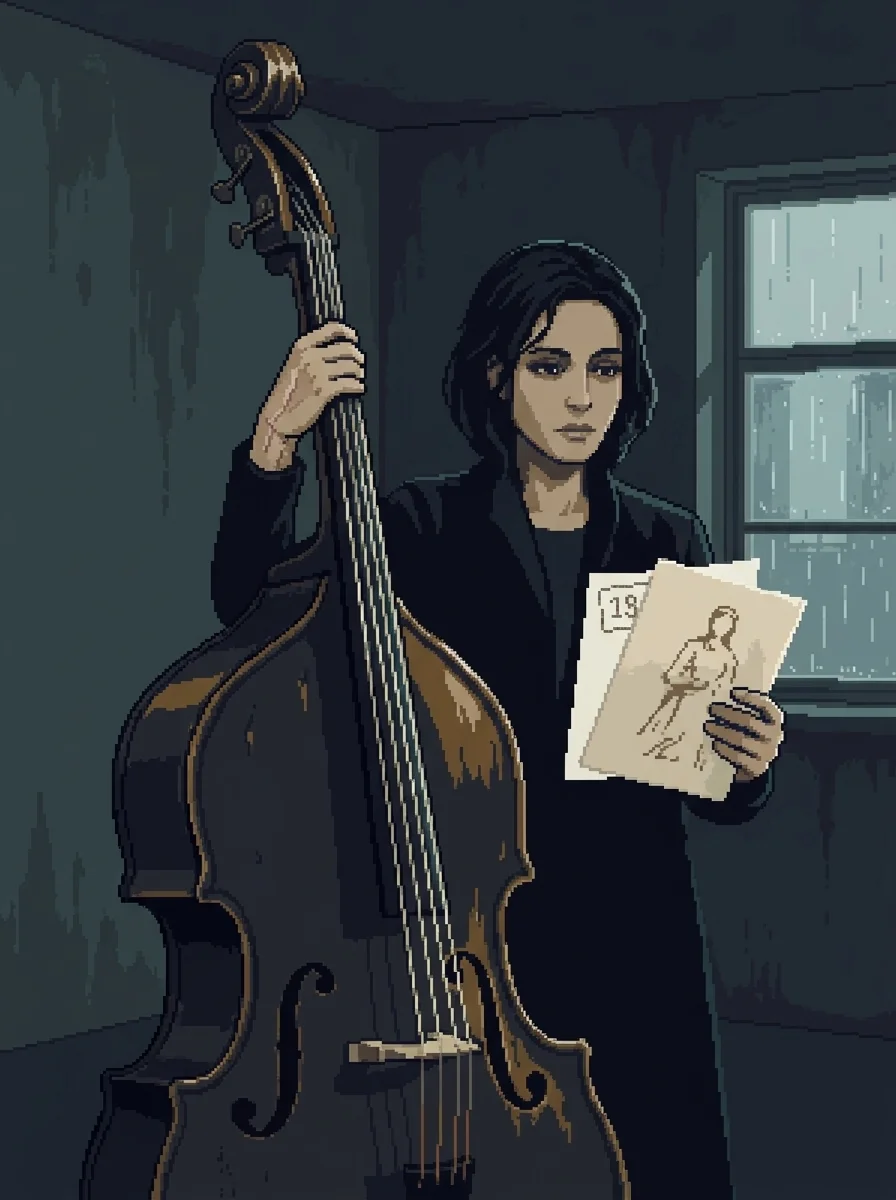
Ilsa Brekke registered in 2166 and is the cleanest illustration the Register has, which is why it is quoted against her. Her dues are current. The clinic set her left wrist in 2179 and she plays because of it. Her pension is the only one she is going to see. She filed a grievance against her own Notice, argued it, lost correctly, and did not resign.
Registration is also how a musician says what they are. Registered is the word for professional in the Graves, and it is said with the number: Brekke is 14,206. The brass plates in the Hall corridor run to five digits now and the early ones have been polished thin.
Outside The Desk
Four streets away, the Resonance Collective refuses recording altogether, because the Dispersed did not consent to perform and cannot consent to distribution. Mikel Saar answers a licensing inquiry with seventeen minutes of philosophy so patiently delivered that no corporate representative has ever asked twice. No Collective member has ever applied for registration and the Register has never invited one, and both institutions know precisely why: a Collective member who registered would become satisfiable on a signature they would never see.
Lyra Voss is the Register's best argument and has never joined it. She was individually contracted, Relief kept the telemetry, forty thousand unlicensed companions wear her voice, and she has been paid for none of them. Asked why she will not register, she has said she would not hand the voice to a desk. The Hall's older members treat that answer as the reason the desk was built.
Up on Highport, the Line-Walkers reached the opposite conclusion about paperwork and stuck to it. When a member moved in 2183 that the union commission a reading on Ifechi Adeyemi โ so her indispensability would exist on paper and force a successor โ the motion died in under a minute, because a document is a thing a jurisdiction can act on. The Register wrote its members' leverage into a document in 2159 and beat the studios with it for twenty-five years. Then the document was what got spent. Neither body has ever cited the other.
Hollis Sarr, two sectors down at a folding table on Sump Row, has now read more Notices of Satisfaction aloud than the Register has answered.
One desk that must be paid, and no member who can be paid instead. That was the victory, and it is still the victory.
Points of Inquiry
- Whether a per-capita apportionment would survive the first suit brought by the Register's own members, and which side would bring it
- What the fourth repeal vote's narrowing margin will be at the fifth
- Whether the Tribunal's two refusals were remit or reluctance, given what a certified apportionment method would prove about its own origin findings
- How many of the 61,412 are traceable to any individual recording in the Relief catalogue, a figure the Register has never published and has never said it holds
Ninety-four point two million received. Nothing apportioned. Both figures printed in the same bulletin, in the same size type.
The clinic set her wrist. The pension is the only one she will get. She filed anyway.
Local Intelligence Scan
Nearby Signals
CANONICAL PROXIMITYEnvironmental Readout
LIVE CONDITIONS- Air
- Toxic
- Light
- Shadowed
- Flood
- No exposure
- Heat
- Temperate
- Security posture
- Patrolled
- Infrastructure
- Patchwork
Position Data
SECONDARY- Elevation band
- Shoreline โ the Rim edge
- Lattice fix
- E+0.3 ยท N-5.7
Member Roster
Principal Members
1Connected To
Primary Connections

The Register holds the countersignature. Kew's eleven seconds on the satisfied-use certificate is the act that closes every represented claim in a use.
A countersignature that discharges every represented claim, and a one-page letter with no figure.

Paid the Register ยข94.2 million for forty years of session masters, twice over โ the use already taken and the term ahead โ and took its certificate.
The corporation whose algorithms produce 70% of the Sprawl's synthetic content and decide what surfaces from the rest.
The Register Hall sits in the Graves because the rent was nothing in 2159 and because the musicians were already there. It is now the district's largest employer of nobody.
The Sprawl's last art district preserves aesthetic diversity because its artists cannot afford certification.
Four streets apart and structurally incompatible. The Collective refuses recording so no body can ever be paid for it; the Register exists to be the body that is paid.
Musicians accompany the Dispersed as artists, but reject recordings because the dead cannot consent to distribution.

The other answer to the same question. Highport refused to write its leverage into a document; the Register wrote its into Article 7 and won with it for twenty-five years.
The Sprawl's only successful essential-worker strike โ skill machines can't replace, and the leverage that brings.
The Register's best argument, standing outside it. No collective held her claim, and forty thousand companions wear her voice for nothing.
A neural-recording artist whose consciousness patterns resist duplication โ her voice didn't.

The body at the centre of the argument, and the one that wrote the clause. It won exclusive receipt against real opposition in 2159 and spent its members' claims with it in 2184.
The only body allowed to be paid for your work was paid, kept it, and filed your claim as satisfied.
Major Connections

Labour's strongest instrument in the Sprawl, and the case that its own advocates have no form of words for.
Seventy years arguing what people are for; its ugliest answer is that priced right, flesh costs less than the machine.

Certifies a use as licensed, which is what a satisfied-use certificate is issued against.
Nexus-funded body certifying what's real โ its accuracy is decaying toward a coin flip, unpublished.

The trade's unofficial reading room for Notices. He has read more of them aloud than the Register has answered.
A Dregs letter-reader who is contractually forbidden to open his own mail.
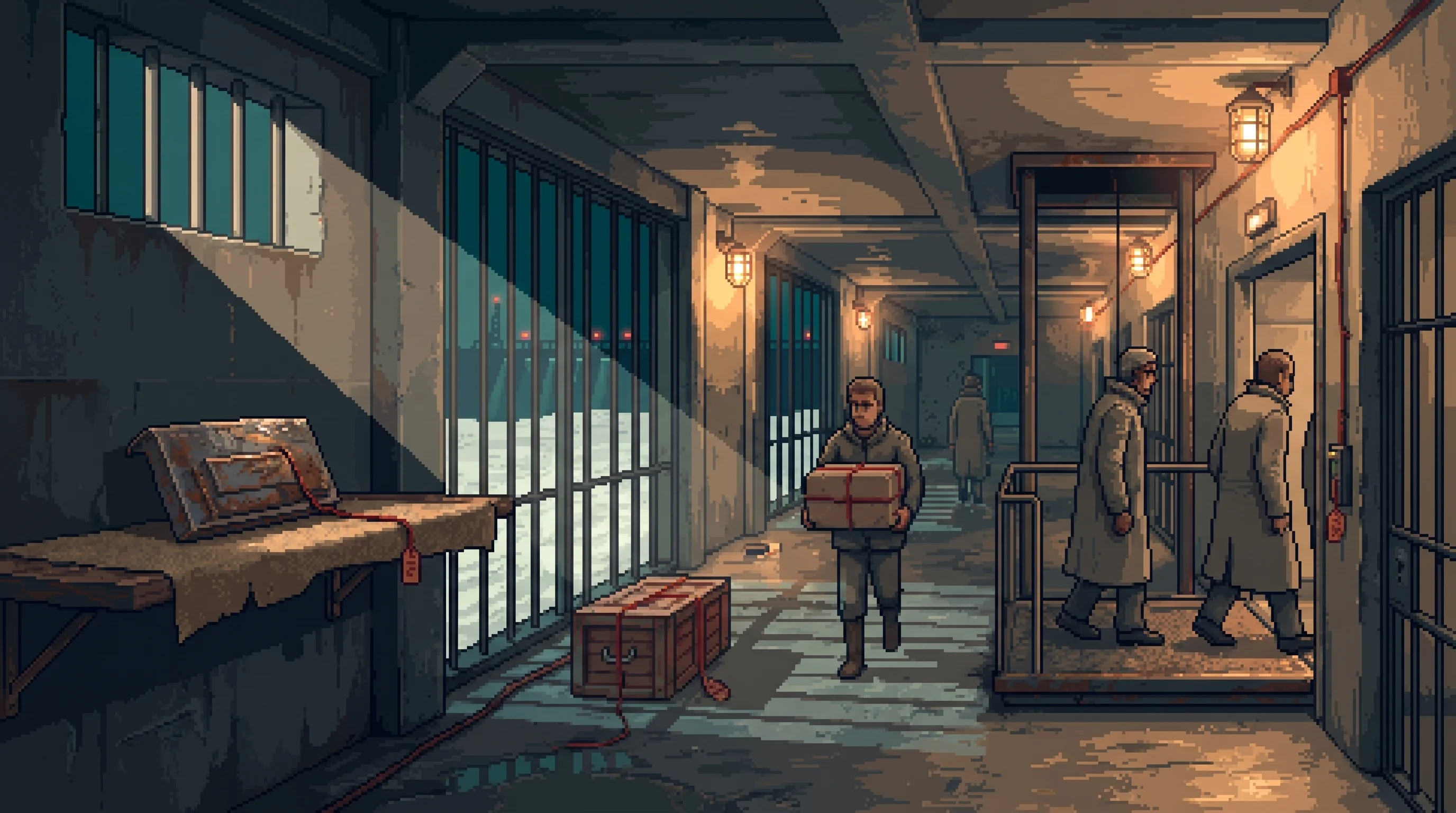
A house that pays a flat sum, keeps the difference, and has never claimed to act for the finder.
An Alcatraz cell-house auction room where one hand-inked line turns a rusted pre-Cascade object into a fortune.

Built to make copying payable, and met a use that could be paid for and not divided.
Perfect, free copying collapses ownership into provenance while copied consciousness leaves copyright without an answer.

โ